

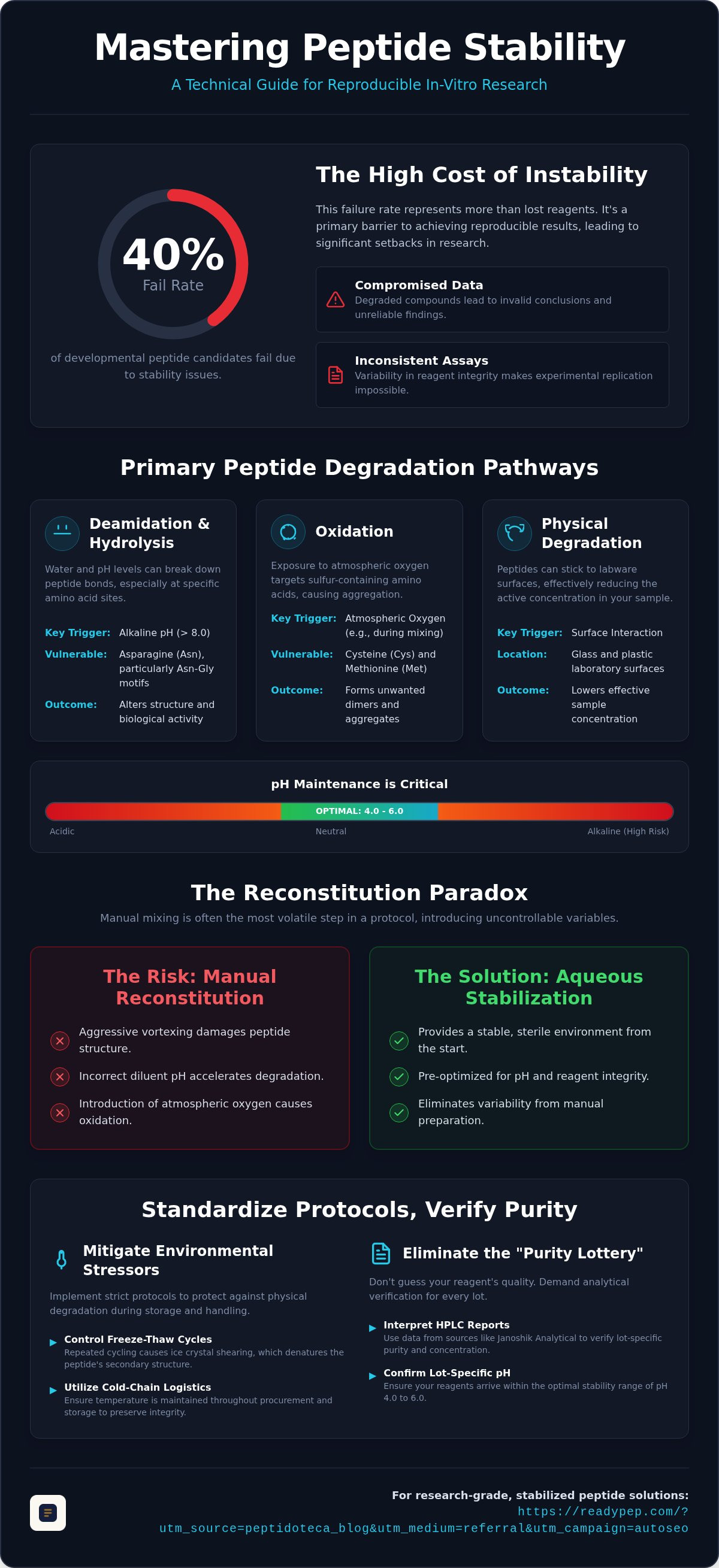
Forty percent of developmental peptide candidates fail due to instability issues during research. This statistic represents more than just lost reagents; it reflects thousands of hours of compromised data and inconsistent assay results. You likely recognize the frustration of seeing a promising study derailed by a reagent that degraded before it even reached the pipette. When handling sensitive compounds, research peptide stability issues are the primary barrier to achieving reproducible in-vitro results.
This guide provides the technical framework needed to master the chemical and environmental factors affecting laboratory integrity. You'll learn how to standardize storage protocols and verify lot-specific purity to eliminate the "reconstitution paradox." We will examine the critical importance of pH maintenance between 4.0 and 6.0, the impact of cold-chain logistics on peptide secondary structure, and the analytical standards required to ensure your research remains beyond reproach. By the end of this article, you'll have a clear roadmap for reducing experimental variability and protecting your laboratory's most valuable assets.
Key Takeaways
- Identify the primary chemical degradation pathways, such as hydrolysis, deamidation, and oxidation, that compromise the structural integrity of your research compounds.
- Overcome the "reconstitution paradox" by understanding how manual mixing introduces variability through aggressive vortexing and incorrect diluent pH.
- Implement standardized storage protocols to mitigate research peptide stability issues caused by thermal denaturation and ice crystal shearing during freeze-thaw cycles.
- Master the interpretation of Janoshik Analytical HPLC reports to verify lot-specific purity and ensure your results are derived from verified, high-standard reagents.
- Learn how controlled-environment aqueous stabilization and cold-chain logistics eliminate the "purity lottery" common in traditional peptide procurement.
The Chemistry of Fragility: Identifying Primary Peptide Degradation Pathways
Peptide stability isn't a static state. It's the resilience of a primary sequence against chemical and physical stressors. To understand The Chemistry of Fragility, researchers must look beyond the label. Chemical degradation acts as a silent killer of research integrity. Hydrolysis, deamidation, and oxidation often occur undetected. These pathways alter the peptide's primary structure, leading to failed assays and wasted resources. Physical degradation adds another layer of complexity. Peptides can aggregate or adsorb to laboratory glass and plastic surfaces. This effectively lowers the concentration before the first aliquot is even drawn.
Sequence design dictates vulnerability. High-risk amino acids like Asparagine (Asn) and Cysteine (Cys) act as primary targets for degradation. When these residues are present, research peptide stability issues become a constant threat to data reproducibility. Understanding these mechanisms is the first step toward maintaining laboratory standards.
Hydrolysis and Deamidation: The Role of pH
Deamidation is a primary concern for sequences containing Asparagine. Asn-Gly motifs are the most susceptible. The glycine residue offers little steric hindrance, allowing the asparagine side chain to attack the peptide backbone. This forms a cyclic imide intermediate. The result is a mixture of aspartic and isoaspartic acid. This change is subtle but destructive. It can completely shift the binding affinity or biological activity of the compound.
Maintaining aqueous integrity requires a strict pH threshold. You must avoid a pH greater than 8. High alkalinity accelerates base-catalyzed deamidation, rendering the sample useless within hours. Precision matters here. Researchers should prioritize lot-specific pH verification as part of their peptide research quality assurance protocols. A deviation of even 0.5 pH units can significantly shorten the half-life of a sensitive peptide in solution.
Oxidation of Cysteine and Methionine
Oxidation targets sulfur-containing residues with clinical precision. Cysteine residues are particularly prone to forming disulfide bonds. This leads to unwanted dimers or complex aggregates that precipitate out of solution. Methionine is equally sensitive. Exposure to atmospheric oxygen during manual reconstitution acts as a catalyst for these reactions. It's a common point of failure in traditional laboratory workflows where vials are opened and closed repeatedly.
- Cysteine: Forms inter- or intra-molecular disulfide bridges, altering the 3D conformation.
- Methionine: Highly reactive with oxygen, leading to sulfoxide formation.
- Atmospheric Risk: Manual mixing introduces air bubbles, which increases the surface area for oxidation to occur.
While methionine sulfoxide represents a reversible state of oxidation, the further conversion into methionine sulfone is an irreversible pathway that permanently alters the peptide's chemical profile. Preventing this requires minimizing oxygen exposure and maintaining strict temperature controls. For researchers using compounds like BPC-157 + TB-500 40mg, ensuring the stability of these sequences is vital for accurate in-vitro modeling.
The Reconstitution Paradox: Why Pre-filled Pens Outperform Manual Mixing
Many researchers assume lyophilized powder is the safest format for long-term storage. It isn't. While solid-state peptides are stable in a vacuum, the moment you add a diluent, the risk of research peptide stability issues spikes. Manual reconstitution is often the most volatile step in any laboratory protocol. It introduces variables that are impossible to control in a standard setting. Professional manufacturing by Metatide Healthcare solves this by providing a stable, sterile aqueous environment from the start. This approach removes the "reconstitution paradox" by delivering a compound that's already optimized for integrity.
Common DIY errors compromise your data before the experiment begins. Aggressive vortexing, incorrect diluent pH, and the accidental introduction of air are frequent culprits. These mistakes lead to rapid degradation. Transitioning to a standardized delivery system is a primary method for improving lab workflow while protecting your reagents. By removing the manual mixing step, you eliminate the most significant source of human error in peptide handling.
Aggregation and Mechanical Stress
Vigorous shaking causes irreversible peptide unfolding. Think of it as mechanical denaturation. High-speed mixing creates shear forces that tear apart delicate structures. Once a peptide aggregates, it loses biological activity and precipitates out of solution. Pre-filled delivery systems offer a mechanical advantage. They protect delicate tertiary structures by eliminating the need for agitation. Consider complex sequences like BPC-157 + TB-500 40mg. These blends are highly sensitive to physical stress. Professional stabilization ensures they remain in a monomeric, active state throughout their shelf life.
Contamination and Sterility Risks
Repeated vial access is a major liability. Every needle entry is a potential contamination event. Microbial growth isn't just a safety concern; it's a direct threat to stability. Bacteria produce proteolytic enzymes that actively degrade peptide chains. Pre-filled research pens utilize an airtight, closed-system design. This setup is essential for long-term in-vitro studies. It maintains sterility from the first dose to the last, ensuring that your results aren't skewed by enzymatic breakdown or bacterial interference. If you're tired of the "purity lottery" associated with manual mixing, exploring professionally stabilized research formats is the logical next step for your laboratory.
Environmental Stressors: Temperature and Light Sensitivity
Peptides are inherently sensitive to their surroundings. Temperature and light act as powerful catalysts for the degradation pathways discussed in previous sections. Even minor environmental fluctuations can trigger research peptide stability issues that compromise the validity of an entire study. Temperature-induced denaturation occurs when the kinetic energy in a system overcomes the weak non-covalent bonds holding a peptide's secondary structure together. Brief excursions above the critical 8°C threshold can lead to immediate conformational changes, rendering the compound inactive for high-precision in-vitro research.
The "Freeze-Thaw" trap is a common point of failure in many laboratories. While freezing is often used for long-term storage, the transition process is dangerous for aqueous solutions. As water freezes, ice crystals form and expand. These crystals act as microscopic blades, shearing peptide chains and causing irreversible aggregation upon thawing. Photodegradation represents an additional chemical threat. Residues like Tryptophan and Tyrosine are highly sensitive to UV exposure. Light absorption triggers the formation of free radicals, which then catalyze the cleavage of peptide bonds and the formation of unwanted byproducts. Verifying cold chain integrity is a non-negotiable requirement for global research chemical procurement to prevent these stressors from affecting your reagents during transit.
Cold Chain Shipping Standards
ReadyPep addresses these risks by providing free cold-chain shipping for all international orders. This logistics framework maintains a consistent 2-8°C environment across international borders, ensuring that the reagents arrive in the same state they left the manufacturing facility. Thermal shock occurs when a rapid temperature change causes a sudden shift in the solvent's dielectric constant, leading to immediate peptide precipitation or conformational collapse. By utilizing specialized cooling technology and expedited transit, the Metatide Healthcare manufacturing chain remains unbroken from the lab to your facility.
Optimal Laboratory Storage Protocols
Once your shipment arrives, laboratory storage becomes the final line of defense. Pre-filled pens should be kept in a dedicated, temperature-monitored refrigerator away from light sources. Strict temperature adherence is especially critical for specialized research protocols. For example, the Mind and Edge protocols rely on the chemical stability of their components to ensure reproducible results across different in-vitro models. Referencing the latest peptide pen quality control standards will help you establish a storage routine that maximizes the shelf life of your inventory.
Analytical Verification: Interpreting HPLC and pH Data
Verification is the bridge between procurement and publication. It's not enough to trust a label. Researchers must actively interpret analytical data to mitigate research peptide stability issues. High-Performance Liquid Chromatography (HPLC) remains the gold standard for monitoring purity. However, a single percentage value doesn't tell the whole story. You need to look at the baseline. Follow these steps to ensure your reagents meet the necessary thresholds for reproducible research:
- Step 1: Verify the lot number on your pen against the Janoshik Analytical report. This ensures the data matches the physical inventory in your lab.
- Step 2: Analyze the HPLC chromatogram. Look for secondary peaks. These often indicate degradation products like deamidated fragments or sulfoxides.
- Step 3: Confirm the pH value. For aqueous integrity, the solution must fall within the specific stability window, typically between 4.0 and 6.0.
- Step 4: Cross-reference purity levels against the baseline requirements for your specific in-vitro assay. High-precision studies often require purity exceeding 99 percent.
- Step 5: Document these parameters. Publication integrity depends on your ability to prove the quality of your starting materials.
Analytical transparency removes the friction of uncertainty. By documenting these metrics, you protect your data from the hidden variables of chemical decay. You can access the latest verified analytical reports for your research compounds to confirm these standards before starting your next series of trials.
The Role of Independent Third-Party Testing
Manufacturer-provided Certificates of Analysis (COAs) are often insufficient. They lack the neutrality required for high-stakes research. Independent testing acts as a critical gatekeeper for research peptide quality standards. Janoshik Analytical provides the empirical verification needed to bypass the "purity lottery." ReadyPep disrupts the industry norm by publishing all lot-specific documentation. This radical transparency ensures that every researcher has access to the raw data behind their compounds.
Specific Compound Stability Profiles
Different sequences exhibit unique degradation patterns. Retatrutide 40mg is a large, complex triple-agonist. Its size makes it more susceptible to conformational collapse if the pH drifts outside the optimal range. In contrast, smaller metabolic tools like MOTS-c 40mg have different shelf-life nuances. While MOTS-c is a shorter sequence, it requires strict thermal adherence to prevent aggregation during metabolic modeling. Identifying these compound-specific profiles is essential for maintaining laboratory integrity across diverse research protocols.
Standardizing Stability: The ReadyPep and Metatide Framework
Stability is not a singular event. It's a systemic requirement that spans from the moment of synthesis to the final aliquot. The ReadyPep and Metatide framework addresses research peptide stability issues by integrating manufacturing, analytical verification, and logistics into a single, unbroken chain of custody. Metatide Healthcare utilizes controlled-environment aqueous stabilization during the manufacturing process. This ensures that the peptide reaches its optimal pH and concentration before it's sealed. By providing a stabilized liquid format, the framework bypasses the degradation risks inherent in manual reconstitution.
Janoshik Analytical acts as the independent gatekeeper in this process. Every lot undergoes rigorous testing for purity and pH, eliminating the "purity lottery" that plagues the research chemical market. This empirical verification is paired with an aseptic pre-filled pen format to mitigate common research peptide stability issues found in traditional vials. The closed-system design minimizes both mechanical stress and microbial exposure, two factors that account for a significant portion of in-vitro variability. Finally, global cold-chain logistics ensure that the chemical profile remains static during transit, delivering a compound that performs exactly as the analytical reports suggest.
Why Precision Matters for In-Vitro Modeling
The link between reagent stability and the avoidance of retracted research papers is direct. Inconsistent starting materials lead to skewed data that cannot be replicated. High-throughput screening requires reagents that don't drift over time. Pre-filled pens facilitate this by providing a consistent concentration across multiple trials. This level of precision is vital for complex modeling where even a 1 percent shift in purity can alter the biological outcome. Researchers can consult the ReadyPep Library for compound-specific data and stability profiles to better align their protocols with the chemical realities of their reagents.
Sourcing with Integrity
UK-based distribution provides a strategic advantage for international research compliance. It ensures faster transit times and more reliable cold-chain maintenance across borders. The "Stability Chain" is only as strong as its weakest link. From production to the lab bench, every step must be verified. By standardizing these variables, the ReadyPep framework removes the friction of uncertainty. It's time to prioritize data integrity over industry norms. Ensure your next study uses verified research peptide pens to secure the reproducibility your work deserves.
Securing the Future of Reproducible Research
Maintaining laboratory integrity requires more than just careful handling. It demands a shift in how reagents are sourced and verified. We've established that research peptide stability issues are often rooted in the volatility of manual reconstitution and unverified logistics. By moving toward a standardized framework, you eliminate the variables that lead to data drift and assay failure. Precision is the only path to publication-grade results. Don't let preventable chemical degradation compromise your work.
ReadyPep provides the necessary infrastructure for this transition. Every order is manufactured by Metatide Healthcare to rigorous analytical standards and includes lot-specific Janoshik Analytical documentation for total transparency. Our global cold-chain shipping ensures temperature stability remains unbroken from our UK base directly to your lab bench. It's time to stop gambling with your starting materials. You can secure your research integrity with pre-filled, cold-chain shipped peptide pens and focus on the science that matters. Elevate your standards. Let the data speak for itself.
Frequently Asked Questions
How long do pre-filled research peptide pens remain stable after the first use?
Pre-filled pens typically remain stable for 28 to 30 days once the seal is breached, provided they're kept at a consistent 2-8°C. The antimicrobial preservatives in the aqueous solution prevent bacterial growth during this window. However, repeated thermal fluctuations can shorten this period. Always store the pen upright in a dedicated laboratory refrigerator to minimize the risk of peptide adsorption to the internal plunger.
What are the visible signs that a research peptide has degraded?
Cloudiness, precipitation, or a change in color are the primary visible indicators of significant peptide degradation. While many chemical changes like deamidation are invisible to the naked eye, physical aggregation often results in "floaters" or a milky appearance. If the solution is no longer crystal clear, the compound has likely denatured. These visible changes often correlate with severe research peptide stability issues that render the sample useless for precise in-vitro assays.
Can I freeze my pre-filled peptide pens to extend their shelf life?
You should never freeze pre-filled aqueous peptide pens. Freezing causes ice crystal formation that mechanically shears the peptide chains, leading to irreversible aggregation. The expansion of the liquid can also compromise the pen's internal mechanical components and seal integrity. To maintain the stability of compounds like Retatrutide 40mg, stick to a consistent 2-8°C environment. Freezing is for lyophilized powder, not stabilized aqueous solutions.
Why is pH testing so critical for aqueous peptide stability?
pH dictates the rate of deamidation and hydrolysis, which are the primary drivers of chemical decay in solution. Most research peptides require a specific pH window, often between 4.0 and 6.0, to maintain their primary sequence. If the pH drifts toward alkalinity, base-catalyzed reactions accelerate, rapidly lowering the purity. ReadyPep ensures every lot is verified by Janoshik for pH accuracy, removing the guesswork that often leads to failed experiments.
Does cold-chain shipping really matter if the transit time is under 48 hours?
Cold-chain shipping is essential regardless of transit time because even brief exposures to temperatures above 8°C can trigger conformational changes. Ambient temperatures in cargo holds or delivery trucks can exceed 30°C, causing thermal shock. This energy accelerates oxidation and unfolding. By maintaining a strict 2-8°C environment from the UK base to the destination, ReadyPep prevents the thermal excursions that compromise the integrity of sensitive metabolic tools like MOTS-c 40mg.
What is the difference between physical and chemical peptide degradation?
Physical degradation involves changes to the peptide's 3D shape or state, while chemical degradation involves changes to the actual primary amino acid sequence. Physical issues include aggregation, precipitation, and adsorption to surfaces. Chemical issues include deamidation, oxidation, and hydrolysis. Both types contribute to research peptide stability issues, but they require different mitigation strategies. Pre-filled pens address both by providing a stabilized environment and a closed delivery system.
How does Janoshik Analytical verify the purity of ReadyPep products?
Janoshik Analytical utilizes High-Performance Liquid Chromatography (HPLC) and Mass Spectrometry (MS) to verify the purity and identity of every batch. The laboratory tests for the exact mass of the peptide and analyzes the chromatogram for any secondary peaks that would indicate impurities or degradation products. They also verify the pH of the aqueous solution. ReadyPep publishes these third-party reports for every lot, providing the empirical proof required for high-standard laboratory research.
Which amino acid sequences are most prone to research peptide stability issues?
Sequences containing Asparagine, Glutamine, Cysteine, and Methionine are the most susceptible to degradation. Asparagine and Glutamine are targets for deamidation, while Cysteine and Methionine are highly prone to oxidation. Sequences with "Asn-Gly" motifs are particularly volatile and require precise handling. Using professionally stabilized formats like those from Metatide Healthcare helps protect these high-risk residues from environmental stressors that would otherwise compromise the study.
Disclaimer
Educational content only. Not medical advice.


