

Manual syringe draws from vials carry a dosing variance of up to 9.2 percent. In a high-stakes research environment, that margin of error is a liability you can't afford. You spend hours at the bench pipetting and diluting, only to worry that inter-operator inconsistency or a single contamination event will invalidate weeks of data. It's a bottleneck that slows discovery and drains resources. Precision requires a better protocol.
Improving lab workflow with pre-filled pens represents a shift from manual variability to clinical precision. We understand the frustration of losing expensive lots to reconstitution errors or handling risks. This guide explores how transitioning to pre-filled research peptide pens eliminates prep-work hurdles and significantly enhances data reproducibility. We'll examine the transition from labor-intensive manual handling to a streamlined, hardware-based approach. You'll see how this shift reduces material waste and protects your experimental integrity. Accuracy is the only acceptable standard.
Key Takeaways
- Eliminate the reconstitution bottleneck. Transition from manual powder handling to factory-standardized, pH-balanced solutions to save critical labor hours.
- Quantify your efficiency gains. Use a Total Prep Time (TPT) audit to measure the impact of improving lab workflow with pre-filled pens compared to traditional vial protocols.
- Standardize dosing precision. Implement click-dial mechanisms to reduce inter-operator variance and minimize contamination risks during the pre-analytical phase.
- Execute a seamless protocol transition. Use our five-step framework to audit consumption and validate pen performance through controlled pilot studies.
The Hidden Costs of Traditional Peptide Preparation in In-Vitro Research
Traditional peptide preparation is an invisible drain on laboratory resources. It isn't just the cost of the reagents that impacts your budget. It's the reconstitution bottleneck. This occurs when highly trained researchers spend hours calculating molarity, measuring solvents, and manually handling lyophilized powders. From a Lean management perspective, this represents significant waste in "Motion" and "Waiting." Researchers move between balances and hoods. They wait for powders to reach full dissolution. These minutes accumulate into lost days of productivity. Improving lab workflow with pre-filled pens eliminates these non-value-added activities, allowing personnel to focus on data analysis rather than reagent prep.
The "invisible" cost of this manual process often manifests as experiment retractions. When prep-work is inconsistent, the data is unreliable. Improving lab workflow with pre-filled pens removes these human variables, ensuring that the pre-analytical phase doesn't compromise the final analysis. Accuracy is the only acceptable standard.
Quantifying Manual Handling Errors
Pipetting fatigue is a documented reality in high-throughput environments. Research indicates that manual syringe draws from vials carry a dosing variance of up to 9.2 percent. After fifty repetitive draws, mechanical precision inevitably slips. Even micro-variations in solvent volume alter final molar concentrations, creating lot-to-lot inconsistencies that are difficult to trace. These precision gaps often lead to the consequences of impure peptides in experiments. When inter-operator reproducibility fails, the entire study is at risk. Standardizing the delivery mechanism is the only way to lock in concentration accuracy across multiple users.
Contamination Risks in Open-Vial Systems
Every time a needle pierces a rubber vial stopper, you introduce a vulnerability. Traditional open-vial systems require multiple entries, increasing the cumulative risk of microbial or atmospheric contamination. This is where the evolution of autoinjector technology provides a blueprint for laboratory efficiency. By utilizing a factory-sealed, closed-system delivery, you eliminate the exposure points found in manual syringe transfers. Open vials invite atmospheric contaminants. Pre-filled pens seal integrity. Transitioning to a closed system protects your reagents and your results from the moment of arrival.
By modernizing your reagent handling, you aren't just buying convenience. You're investing in data insurance. For labs focusing on high-throughput screening, having access to standardized peptide formats is no longer optional; it's a requirement for competitive research.
How Pre-filled Pens Streamline the Pre-analytical Phase
Pre-filled research pens function as a sophisticated ready-to-use (RTU) reagent format. Unlike traditional lyophilized powders that require manual intervention, these pens arrive factory-reconstituted in pH-balanced, stabilized solutions. This design is a critical component in optimizing the pre-analytical phase of your experiments. By shifting the complex chemistry of reconstitution from the laboratory bench to a controlled manufacturing environment, you effectively eliminate the "calculation step." Researchers no longer need to spend valuable time computing dilution ratios or precise solvent volumes for every new lot. Improving lab workflow with pre-filled pens replaces these manual calculations with a streamlined, verified process.
Standardization is built directly into the hardware. The "click-dial" mechanism provides rapid, repeatable dosing with tactile and audible feedback. Each click corresponds to a specific microliter volume, ensuring that every operator delivers the exact same concentration every time. This removes the variability inherent in manual syringe draws where parallax error or hand tremors can skew results. Improving lab workflow with pre-filled pens replaces cognitive load with mechanical certainty, allowing for high-throughput execution without sacrificing precision.
Precision via Factory Calibration
Professional lot-standardization is handled by expert manufacturers like Metatide Healthcare. They ensure each batch meets rigorous analytical standards before it ever reaches your facility. This professional calibration is vital for maintaining peptide stability in aqueous solution over the product's entire shelf life. In a manual environment, the researcher is responsible for this verification. With a pre-filled system, the verification is part of the product's inherent specification. Pre-filled pens eliminate the need for analytical scales in daily protocols.
Reducing Lab Footprint and Equipment Needs
Efficiency is also measured by the physical footprint of your reagents. A traditional setup requires refrigerated storage for vials, dedicated space for bacteriostatic water, and bulk inventory for alcohol swabs and syringes. A single pen replaces this entire collection of supplies. This reduction simplifies stock management and clears bench space for more critical analytical equipment. There is also a significant reduction in biohazardous sharps waste. Integrated systems generate far less waste than a protocol requiring multiple syringes per experiment.
When you evaluate the peptide pen vs syringe for lab work, the total resource savings become undeniable. You reduce handling time, storage needs, and disposal costs in one transition. Adopting pre-filled research formats ensures your team focuses on high-value data generation rather than inventory maintenance.
Vials vs. Pre-filled Pens: A Workflow Efficiency Audit
A rigorous workflow audit reveals the true cost of manual protocols. Total Prep Time (TPT) includes every action from opening the refrigerator to the final reagent application. In a standard 10-sample cell culture assay, a researcher using traditional vials must perform at least thirty distinct manual steps. These include vial swabbing, air venting, drawing, and volume verification for every single sample. Improving lab workflow with pre-filled pens reduces these manual touchpoints to a simple "dial and click" sequence. While digital tracking systems provide data oversight, they cannot fix a physically slow preparation process. Hardware-based efficiency is the only solution for manual bottlenecks.
Scientific literature on total laboratory automation confirms that reducing specimen handling steps directly correlates with lower error rates and higher throughput. For a 10-sample run, manual preparation often exceeds 15 minutes when including reconstitution and syringe loading. Pre-filled pens complete the same task in under three minutes. This speed is critical for point-of-use applications where reagents must move quickly from cold storage to the bench. The learning curve for new personnel is also significantly shorter. Training a junior technician on complex dilution mathematics and sterile drawing techniques takes hours of supervision. Training them to operate a pre-filled pen takes seconds. Improving lab workflow with pre-filled pens ensures that your team remains productive from day one.
The 'Click' Advantage in High-Throughput Assays
Multi-dose pens allow for rapid sequential application without the need to reload or swap syringes between samples. This is particularly effective in MOTS-c 40mg metabolic pathway research where the timing between doses must be precise to maintain assay integrity. By removing the mental load of counting units on a small syringe scale, researchers can maintain focus on the experimental variables that matter. Standardized hardware creates a standardized rhythm. This mechanical consistency is the foundation of reproducible science.
Material Waste and Cost-Benefit Analysis
Traditional syringes suffer from "dead space" volume loss, where a small amount of reagent remains trapped in the needle hub and syringe tip. Over a month of high-frequency testing, this waste represents a significant percentage of your total inventory. Pre-filled systems eliminate this loss through integrated delivery mechanisms. When justifying premium research chemical costs, the return on investment is found in the recovery of senior researcher hours. A Principal Investigator's time is better spent on high-level hypothesis testing than on repetitive pipetting tasks. Efficiency pays for itself through accelerated discovery timelines.
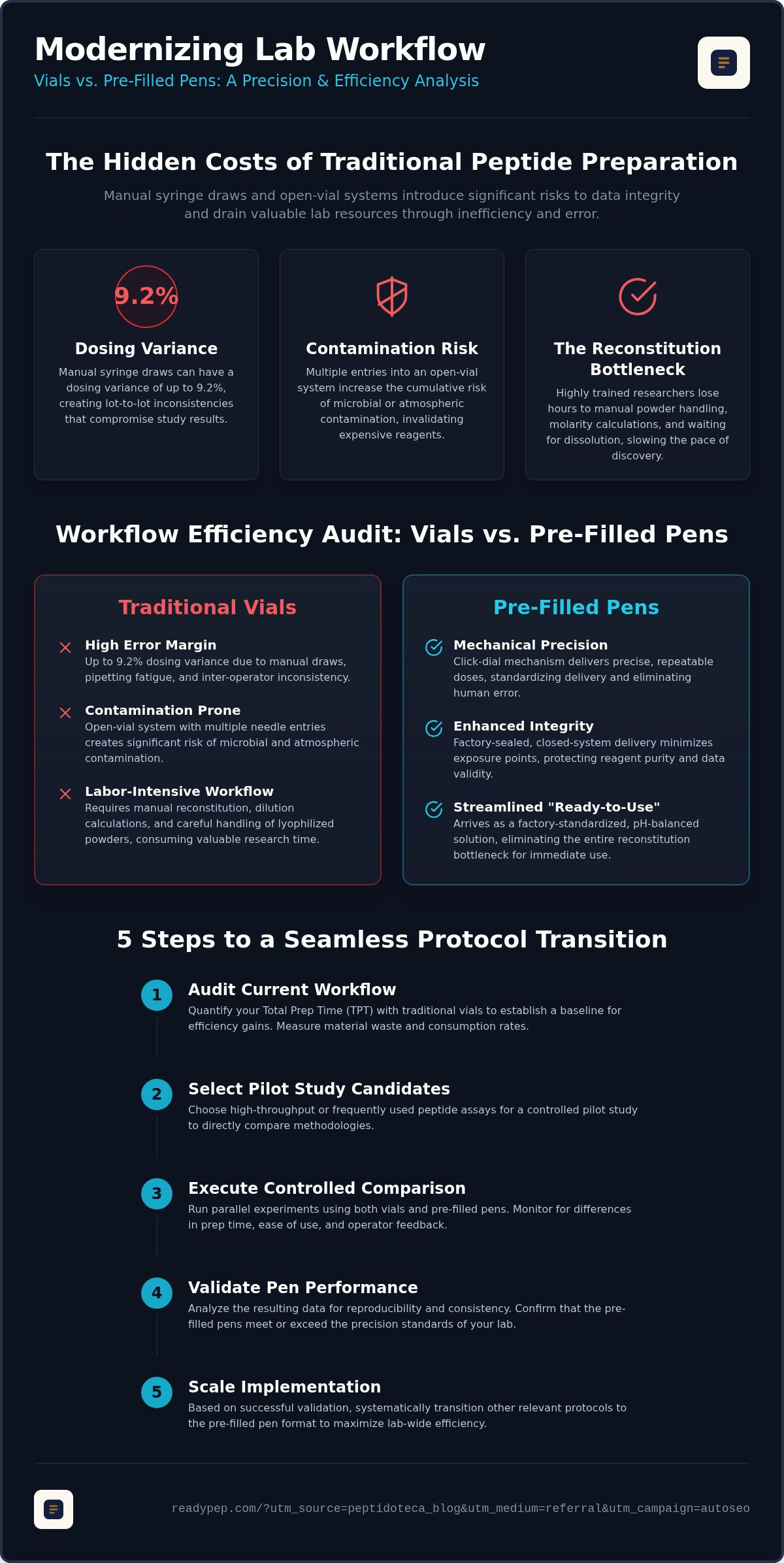
5 Steps to Implementing Pre-filled Pens into Your Lab Protocol
Transitioning from manual reconstitution to a standardized delivery system requires a methodical approach to ensure data continuity. Improving lab workflow with pre-filled pens is most effective when the change is integrated into the lab's core quality management system. You aren't just changing a tool; you're refining the pre-analytical phase of your research. Success depends on clear documentation and rigorous validation of the new hardware against your existing manual benchmarks.
- Step 1: Audit Consumption. Identify high-frequency protocols where repetitive pipetting creates the most significant time-loss or error risk.
- Step 2: Validate Precision. Conduct a pilot study comparing the pen's dosing accuracy against your current manual syringe standards to confirm inter-operator reproducibility.
- Step 3: Update SOPs. Rewrite Standard Operating Procedures to replace volume-based instructions with "click" increments for faster execution.
- Step 4: Integrate Documentation. Link lot-specific batch numbers and Certificates of Analysis (COAs) directly to your laboratory record-keeping for full traceability.
- Step 5: Manage Storage. Establish cold-chain protocols specifically for ready-to-use pens to maintain peptide stability from arrival to application.
Following these steps is essential for improving lab workflow with pre-filled pens while maintaining the high standards required for peer-reviewed discovery. Precision is a process, not just a product.
Calibrating Your Protocol to Pen Increments
Translating your existing molarity requirements into hardware-based dosing is the most critical technical step. You must understand how to calculate peptide dosage from a pen to eliminate potential concentration errors. For instance, when utilizing a compound like Retatrutide 40mg, you must map the total mg/mL concentration to the specific microliter volume delivered per click. This conversion removes the ambiguity of manual syringe markings. It replaces visual estimation with mechanical certainty.
Maintaining Research Integrity with Third-Party Verification
Data reproducibility relies on the chemical purity of your reagents. Every pen used in your protocol should be backed by lot-specific HPLC and Mass Spectrometry documentation. When citing your sources in publications, referencing the specific manufacturing standards ensures your work can be replicated by other institutions. You can access comprehensive compliance data through the ReadyPep lab testing portal to support your integrity audits. If you're ready to upgrade your facility's efficiency, you can browse our full inventory of pre-filled research peptide pens today to find the right fit for your next study.
ReadyPep: Precision Reagents for High-Throughput In-Vitro Research
ReadyPep positions itself as the essential bridge between pharmaceutical-grade delivery systems and the rigorous demands of research-grade peptides. By partnering with Metatide Healthcare, we provide specialized pen manufacturing that adheres to high-level analytical standards. This collaboration ensures that every device is optimized for performance in a laboratory setting. Improving lab workflow with pre-filled pens isn't just about the hardware; it's about the reliability of the chemistry inside. We operate on a model of radical transparency. Every lot undergoes independent testing through Janoshik Analytical, with results accessible to researchers. This empirical verification removes the uncertainty often associated with reagent sourcing.
When you integrate these tools, you're also leveraging a global cold-chain logistics network. Our UK-based operations ensure that temperature-sensitive compounds arrive at your facility with their molecular integrity intact. This logistical safeguard is a critical component of improving lab workflow with pre-filled pens, as it prevents the experimental delays caused by compromised reagents. Discover the difference that verified purity makes in your data sets.
Specialized Protocols for Targeted Research
Efficiency is not a luxury; it is a prerequisite for reproducible data. To further streamline complex metabolic or cellular studies, we developed the "Protocol" series. These include specialized options like the Edge Protocol and the Repair Protocol. These pre-mixed stacks are factory-calibrated to eliminate the need for multi-vial handling. By providing standardized ratios in a single delivery system, we remove the friction of manual stacking. This approach allows researchers to focus on observing cellular responses rather than managing complex dilution schedules. Standardized stacks ensure that your protocol remains consistent across every replicate.
Global Sourcing and Compliance
Our commitment to high standards extends to our worldwide distribution. We utilize specialized cold-chain shipping from our UK hub to maintain the stability of every product. Maintaining strict compliance requires acknowledging that all items in our inventory are strictly for in-vitro laboratory research. They aren't intended for human or veterinary use. This clear distinction ensures that our clients remain compliant with institutional safety and ethical guidelines. For those seeking to modernize their benchtop procedures, the ReadyPep product catalog offers a comprehensive range of pre-filled formats designed for precision science. Reliability is our baseline. Transparency is our protocol.
Modernizing Your Laboratory Protocol
Discovery demands precision. Traditional manual reconstitution introduces variables that jeopardize data integrity and waste valuable labor hours. By shifting to factory-calibrated reagents, you eliminate the reconstitution bottleneck and lock in inter-operator reproducibility. Improving lab workflow with pre-filled pens represents a transition from labor-intensive prep to streamlined, hardware-based execution. It's the most direct path to reducing contamination risks while maximizing your daily throughput. Precision is no longer a variable; it's a constant.
ReadyPep provides the accountability modern research requires. Our pens, manufactured by Metatide Healthcare, are backed by independent Janoshik Analytical testing for every lot to ensure chemical purity. We safeguard your workflow with free worldwide cold-chain shipping; this protects your reagents from arrival to application. Don't let manual prep-work hold back your next breakthrough. It's time to prioritize analytical integrity over repetitive pipetting tasks. High standards lead to high-impact data.
Streamline your research workflow with Ready-to-Use Peptide Pens and secure the precision your study deserves. Reproducible results are within reach.
Frequently Asked Questions
How do pre-filled pens improve inter-operator reproducibility in lab settings?
Pre-filled pens improve inter-operator reproducibility by standardizing delivery volume through a mechanical click-dial system. This hardware-based approach removes the visual estimation and manual pipetting variability found in traditional syringe draws. Every researcher delivers the exact same microliter volume regardless of their technique or experience level. Improving lab workflow with pre-filled pens ensures that your data remains consistent across different shifts and personnel. Precision is built into the device.
Are pre-filled research pens compatible with standard sterile lab techniques?
Yes, these devices are designed for integration into sterile laboratory environments. The closed-system reservoir protects the reagent from atmospheric exposure during storage and use. Researchers utilize standard aseptic techniques, such as swabbing the delivery port and using sterile, disposable tips for each application. This protocol maintains the integrity of the peptide solution while reducing the contamination risks associated with repeated vial piercing. Sterile handling remains a priority for all in-vitro assays.
What is the shelf-life of a factory-reconstituted peptide pen compared to a vial?
Factory-reconstituted pens often exhibit superior stability compared to manually prepared vials due to professional buffer optimization and stabilization. While lyophilized powder in a sealed vial is stable for long periods, manual reconstitution begins a rapid degradation clock once the seal is broken. Pre-filled pens are formulated to maintain potency throughout their specified shelf life when stored under correct cold-chain conditions. Always refer to the lot-specific documentation for exact stability timelines and expiration data.
How do I verify the purity of a pre-filled pen from ReadyPep?
Verification is handled through our radical transparency model. Every lot is independently tested by Janoshik Analytical to confirm chemical purity and concentration. You can access these results directly through the ReadyPep lab testing portal using your batch number. This third-party validation provides empirical proof of the reagent's quality before you begin your experiment. We don't ask for trust; we provide the data to verify every pen in your inventory.
Can pre-filled pens be used for high-throughput cell culture assays?
Pre-filled pens are ideal for high-throughput cell culture assays because they allow for rapid, sequential dosing without the need for constant syringe reloading. The multi-dose reservoir enables researchers to move quickly between plates, maintaining a consistent rhythm that is difficult to achieve with manual vials. Improving lab workflow with pre-filled pens accelerates the pre-analytical phase, significantly reducing the time required to treat large sample sets. Efficiency is essential for large-scale discovery.
What happens to dosing accuracy if the pen is not stored at the correct temperature?
Improper storage affects chemical stability rather than the mechanical accuracy of the pen itself. Peptides are temperature-sensitive; exposure to heat can lead to molecular degradation or aggregation, which alters the effective concentration of the solution. While the pen will still deliver the calibrated volume, the potency of the peptide may be compromised. Maintaining a strict cold-chain protocol is vital for ensuring that your experimental results reflect the intended dosage and purity.
How do I calculate the cost-savings of switching from vials to pre-filled pens?
Calculate savings by auditing your Total Prep Time (TPT) and material waste. Factor in the hourly rate of the senior researchers performing manual reconstitutions and the cost of lost reagents due to syringe dead space. You should also account for the reduction in accessory costs, such as bacteriostatic water, alcohol swabs, and bulk syringes. Often, the recovery of labor hours and the reduction in experiment failures provide a clear return on investment for the facility.
Are ReadyPep pens independently tested for pH and purity?
Yes, every batch undergoes rigorous independent testing for both pH balance and chemical purity. These standards are verified during the manufacturing process by Metatide Healthcare and confirmed through third-party analysis. Maintaining a precise pH is critical for peptide stability in aqueous solutions and ensures that the reagent does not disrupt the delicate environment of your cell culture assays. Full documentation for these parameters is available for every lot we distribute.
Disclaimer
Educational content only. Not medical advice.


