

The most expensive reagent in your laboratory isn't the one with the highest invoice price; it's the one that fails to replicate your previous results. When batch-to-batch variability or shipping degradation occurs, weeks of progress vanish. It's a frustrating reality for teams striving for reproducibility while managing the pressure of 2026 regulatory updates, such as the revised EU CLP requirements. You need an in-vitro research chemicals supplier that treats analytical verification as a standard, not an optional luxury.
We understand that laboratory efficiency depends on more than just theoretical purity. It requires reagents that arrive stable and ready for immediate use. This guide details how to identify high-purity suppliers that prioritize lot-specific documentation and modern delivery systems. We'll explore the shift toward pre-filled pen formats, the impact of 2026 cold-chain logistics standards, and how to eliminate time-consuming preparation steps. You'll gain a framework for selecting partners that reduce contamination risks and streamline your entire research protocol.
Key Takeaways
- Understand why lot-specific independent testing from Janoshik Analytical has become the 2026 standard for verifying chemical purity.
- Evaluate how pre-filled research pens provide superior dosing accuracy compared to traditional manual syringe measurements in a laboratory setting.
- Identify the critical role of cold-chain logistics in preventing peptide degradation during international shipping.
- Learn to select an in-vitro research chemicals supplier that integrates radical transparency with high-efficiency workflow tools.
The Evolving Landscape of In-Vitro Research Chemical Sourcing
In-vitro research chemicals are high-purity reagents designed specifically for use in controlled laboratory environments. For decades, laboratories relied on industrial bulk sourcing. This often required researchers to handle raw powders and perform complex titrations. By 2026, the landscape has shifted toward specialized, precision-delivery reagents. Principal Investigators now prioritize tools that minimize manual handling. They want efficiency. The transition from traditional vials to precision formats, such as pre-filled pens, reflects a broader demand for workflow optimization. This evolution isn't merely about convenience; it's about eliminating the human error inherent in manual reconstitution.
Regulatory compliance remains the primary filter for selecting an in-vitro research chemicals supplier. Since September 2025, the FDA has issued over 50 warning letters to vendors who marketed research peptides with therapeutic claims. Maintaining a strict "Research Use Only" status is essential for institutional safety. Suppliers who operate with radical transparency avoid the "grey market" pitfalls that lead to customs seizures or laboratory contamination.
Standardizing Purity in Modern Laboratory Settings
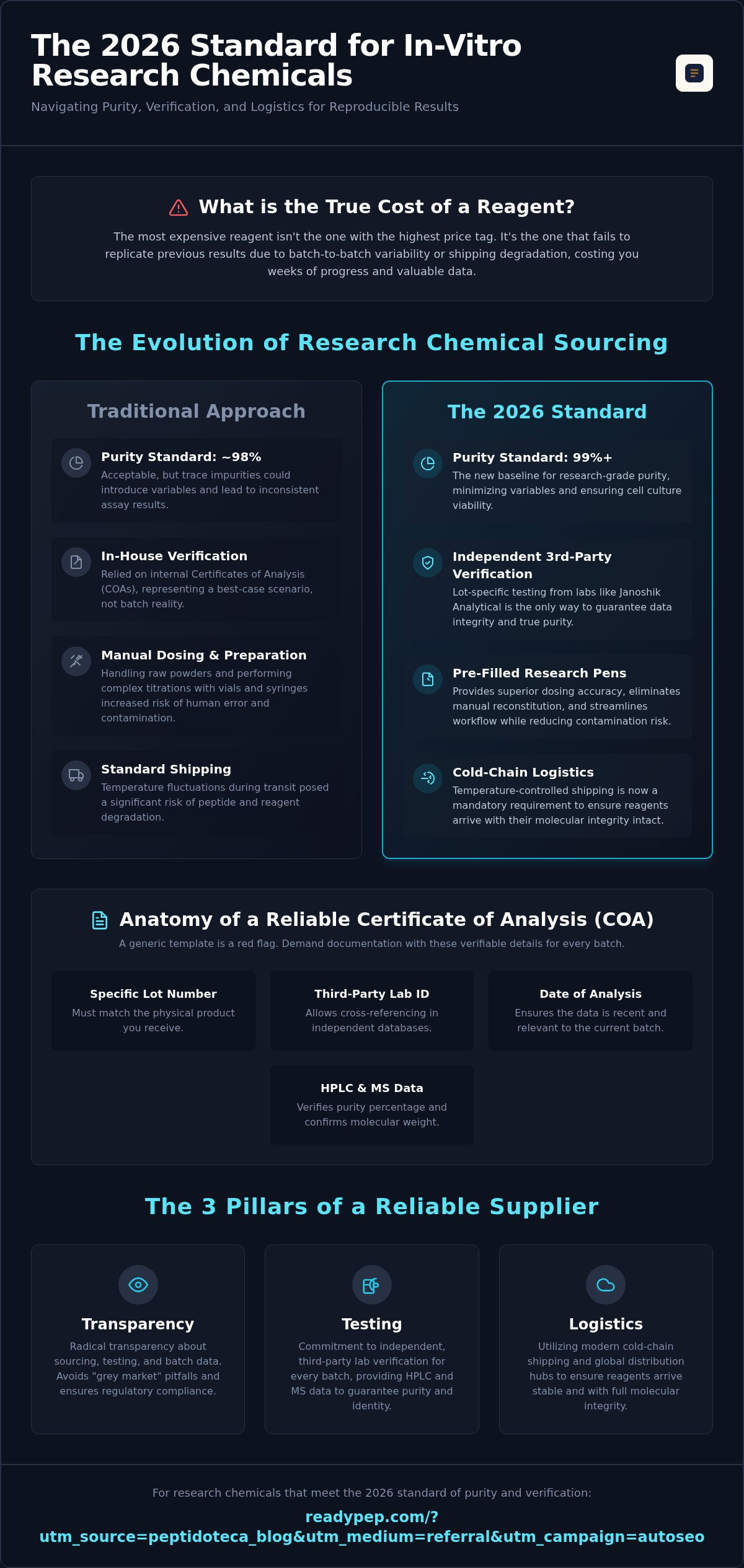
The baseline for chemical purity has climbed. In 2026, the industry standard has moved from 98% to 99%+. Trace impurities, even in minute quantities, can drastically alter cell culture viability and lead to inconsistent assay results. These contaminants introduce variables that a modern lab can't afford. Research-grade purity in peptide synthesis refers to a chemical profile where the target sequence is isolated from truncated sequences and residual solvents through rigorous purification.
Identifying Reliable International Suppliers
Reliability in 2026 is defined by three pillars: transparency, testing, and logistics. A reputable supplier provides lot-specific documentation that isn't generated in-house. They utilize third-party labs to verify every batch. Logistics are equally vital. With the biopharmaceutical cold chain market projected to reach $106.9 billion by 2036, temperature-controlled shipping is a requirement. In-vitro research requires stable reagents. UK-based distribution hubs have become critical for managing global compliance. This is especially true as the revised EU CLP regulation transition periods for substances extend through November 1, 2026. Choosing a reputable in-vitro research chemicals supplier with a verified chain of custody ensures that your reagents arrive with their molecular integrity intact.
Analytical Verification: Ensuring Chemical Purity and Research Integrity
Internal Certificates of Analysis (COAs) often represent a supplier's best-case scenario rather than a batch's actual reality. High-impact research demands more. In 2026, relying on "self-policing" documentation is a significant liability for any laboratory. Rigorous Analytical Verification through independent third-party labs has become the only way to ensure data integrity. Without this verification, your results might reflect trace impurities rather than your experimental hypothesis. An in-vitro research chemicals supplier that hides behind proprietary internal data creates unnecessary risk for your project.
Every reputable supplier must provide High-Performance Liquid Chromatography (HPLC) and Mass Spectrometry (MS) data. HPLC measures purity by separating chemical components; it identifies the exact percentage of the target compound. MS confirms the molecular weight, ensuring the identity of the substance. These aren't just charts. They're the chemical fingerprints of your reagents. Precise pH testing is also critical for aqueous solution stability. If the pH deviates from the physiological range, it can induce cellular stress or cause premature reagent degradation. Testing ensures your assays remain stable and reproducible across different lots.
Deconstructing the Certificate of Analysis (COA)
A generic COA template is a red flag. Look for specific lot numbers that match your physical product. You should verify authenticity by cross-referencing report IDs in third-party databases. Low-tier suppliers often reuse old templates or omit the date of analysis. Documenting these lot numbers is vital for future publication integrity. It allows other researchers to verify your work and replicate your findings without ambiguity. Accessing reagents with verified purity profiles ensures your focus remains on discovery rather than troubleshooting.
Independent Lot Testing Protocols
Third-party validation mitigates batch-to-batch variability. Labs like Janoshik Analytical provide unbiased reporting that a supplier cannot manipulate. This level of transparency is essential for maintaining Research Peptide Quality Standards in modern laboratories. By verifying every lot, you eliminate the risk of introducing unknown variables into your cell lines. Independent testing protocols also confirm that pH levels are compatible with delicate cell cultures, preventing unexpected toxicity or assay failure.
Workflow Optimization: Pre-filled Pens vs. Traditional Reagent Vials
Manual titration is a laboratory liability. Every time a researcher draws from a traditional vial, they introduce variables. Parallax error, needle dead space, and meniscus misreadings degrade your data. Pre-filled pens replace these manual inconsistencies with mechanical precision. Each click provides a documented, reproducible volume. It's about removing the human variable from the equation. High-throughput laboratories can't afford the downtime required for manual reconstitution. Ready-to-use (RTU) reagents allow for immediate assay deployment without the friction of preparation.
When you select an in-vitro research chemicals supplier, the delivery format should be as critical as the chemical purity. Uniform delivery systems ensure that every researcher in your department follows the same protocol. This standardization is vital for multi-phase studies. It eliminates the "technique" factor that often plagues laboratory reproducibility. Contamination is the silent killer of in-vitro assays. Traditional vials require repeated piercing of a rubber stopper. This increases the chance of introducing particulates or microbial contaminants. Pre-filled pens utilize a closed system. This design preserves the sterile environment of the reagent from the first dose to the last.
Precision Dosing and Experimental Reproducibility
Micro-dosing requires absolute volumetric accuracy. Pre-filled pens minimize human error by utilizing calibrated click mechanisms that offer precision down to 0.01ml. This accuracy directly impacts the statistical significance of your research data. Even a small deviation in reagent concentration can invalidate a cell culture assay. By implementing these systems, you ensure that your experimental results are driven by the compound's action, not by pipetting mistakes. You can learn more about Improving Lab Workflow with Pre-filled Pens to see how these tools transform daily operations.
Cost-Benefit Analysis of Ready-to-Use Formats
The true cost of a reagent includes labor hours and the price of failed experiments. Manual reconstitution takes time. It also increases the risk of contamination, which can ruin weeks of work. Modern laboratories are moving toward pre-filled formats for complex studies involving MOTS-c and Retatrutide. The ROI of using Retatrutide 40mg in a pre-filled format is realized through the elimination of waste and the significant reduction in preparation labor. By reducing the open-vial time, you protect the molecular integrity of your reagents. This streamlined approach allows your team to focus on analysis rather than preparation. For any in-vitro research chemicals supplier, providing these advanced formats is a sign of operational maturity and a commitment to researcher success.
Global Logistics: Cold-Chain Integrity and Customs Compliance
Reagent stability is the backbone of reproducible results. Peptides are sensitive biological molecules. Temperature fluctuations cause unfolding or the loss of secondary structures. This leads to reduced binding affinity or complete assay failure. The biopharmaceutical cold chain market is projected to reach $106.9 billion by 2036. In 2026, refrigerated logistics (2°C to 8°C) hold 44% of the market share. Your in-vitro research chemicals supplier must operate within these precise parameters. Shipping aqueous reagents across international borders without validated thermal protection isn't just risky; it's scientifically irresponsible.
Verifying temperature monitoring data upon arrival is a standard requirement for modern laboratories. Digital data loggers and chemical indicators provide the empirical proof needed to validate a shipment. Without this data, you're guessing about the integrity of your reagents. A transparent in-vitro research chemicals supplier provides the monitoring data you need to proceed with confidence. This verification step ensures that your experimental variables remain controlled from the moment the reagent leaves the facility.
Maintaining the Cold-Chain from Lab to Lab
Specialized vacuum-insulated packaging and phase-change materials preserve peptide secondary structures during transit. It's a technical necessity, not an optional upgrade. "Free shipping" loses its value if it doesn't include guaranteed cold-chain integrity. Before you start an assay, check the shipment's stability records. Don't rely on assumptions. If a temperature excursion exceeds the 2°C to 8°C window, the reagent's efficacy is compromised. Researchers must implement a strict protocol for verifying shipment conditions before reagents are moved into long-term storage.
Regulatory Compliance in International Sourcing
Navigating customs requires more than just a label. Documentation must explicitly state "In-Vitro Laboratory Research Use Only." This avoids the regulatory scrutiny faced by vendors who have received FDA warning letters for making therapeutic claims. Since 2025, the flight to quality has favored suppliers who provide clear, compliant paperwork. UK-based distribution hubs are particularly effective at streamlining logistics for academic institutions worldwide. They act as strategic gateways that minimize transit time. Reviewing a guide on Customs Clearance for Research Chemicals helps PIs anticipate potential delays. To protect your research timeline, partner with a provider that includes free worldwide cold-chain shipping as a standard service.
ReadyPep: The Precision Supplier for 2026 In-Vitro Research
ReadyPep operates as a high-standard gatekeeper in an industry that demands absolute accountability. It isn't just a vendor; it's a partner in empirical verification. Every reagent in the inventory undergoes lot-specific Janoshik Analytical testing. This includes both purity and pH verification. We don't hide behind internal data. This commitment to radical transparency ensures that your laboratory results are driven by the compound, not by unknown contaminants. As a specialized in-vitro research chemicals supplier, ReadyPep eliminates the friction of traditional sourcing through a modern, tech-forward approach.
The exclusive use of pre-filled research peptide pens defines the ReadyPep standard. This format maximizes experimental accuracy by removing the human error inherent in manual reconstitution. It's a clinical solution for modern efficiency. The inventory is curated for high-impact studies. It includes Retatrutide 40mg, MOTS-c 40mg, and NAD+ 1000mg. Global research collaboration is supported by free worldwide cold-chain shipping. This logistics framework protects the molecular integrity of every shipment. You receive stable, ready-to-use reagents regardless of your laboratory's location.
Specialized Protocols for Advanced Research
ReadyPep provides targeted solutions for complex experimental models. The Mind Protocol offers a foundation for neurological research, utilizing high-purity reagents to ensure data reproducibility. Researchers investigating metabolic pathways can leverage the Edge Protocol for streamlined pathway analysis. Synergy assays are also simplified. Using pre-filled BPC-157 + TB-500 40mg ensures volumetric accuracy across every replicate. These protocols are designed to remove uncertainty and accelerate the discovery process.
Partnering for Research Success
ReadyPep supports academic and commercial labs with an uncompromising focus on quality. The procurement process is direct and methodical. It moves quickly from independent lot verification to temperature-controlled delivery. There's no wasted space in our workflow. By choosing a reliable in-vitro research chemicals supplier, you safeguard your research funding and your professional reputation. The focus remains on the data. Secure high-purity reagents for your next study at ReadyPep and integrate precision-delivery systems into your laboratory standard.
Advancing Laboratory Precision with Verified Reagents
Selecting an in-vitro research chemicals supplier in 2026 requires a focus on both chemical purity and delivery efficiency. Traditional vials introduce variables that modern research can't afford. By adopting pre-filled pens, laboratories eliminate manual titration errors and significantly reduce contamination risks. This shift toward workflow optimization ensures that experimental data remains reproducible and statistically significant. Integrity starts with transparency. It's no longer enough to trust internal reports; third-party verification is the new industry baseline for high-impact studies.
ReadyPep acts as an authorized distributor of Metatide Healthcare, providing the radical transparency your work demands. We provide independent Janoshik Analytical testing for every lot and free worldwide cold-chain shipping to maintain reagent stability from our lab to yours. You don't have to navigate these technical complexities alone. You can streamline your research with pre-verified peptide pens at ReadyPep and focus on discovery instead of troubleshooting. Your next breakthrough depends on the reagents you choose today.
Frequently Asked Questions
What should I look for in an in-vitro research chemicals supplier?
Prioritize third-party analytical verification and delivery precision. A reliable supplier must provide lot-specific COAs from independent laboratories to ensure purity levels exceed 99%. Look for providers that utilize closed-system delivery formats to minimize contamination. Reliability is also defined by logistics; ensure they offer validated cold-chain shipping to protect reagent integrity during international transit. Transparency regarding the manufacturing source and testing protocols is non-negotiable for 2026 laboratory standards.
Why is third-party testing necessary for research peptides?
Third-party testing provides an unbiased audit of chemical identity and purity that internal reports cannot match. Labs like Janoshik Analytical verify the molecular weight and purity percentage through HPLC and Mass Spectrometry. This prevents batch-to-batch variability from compromising your results. Without independent validation, researchers risk using reagents with truncated sequences or residual solvents that interfere with cell culture viability and assay reproducibility. It's the only way to ensure data integrity.
How do pre-filled pens improve laboratory workflow?
Pre-filled pens eliminate the need for manual reconstitution and open-vial handling. By using a calibrated click mechanism, these pens provide precise volumetric dosing that removes human error from micro-dosing protocols. This ready-to-use format saves significant labor hours in high-throughput settings. It also standardizes reagent delivery across multiple researchers, ensuring that every replicate is treated with identical precision. It's a modern solution for labs that value efficiency and reproducible data.
What is the importance of cold-chain shipping for in-vitro chemicals?
Cold-chain shipping prevents the thermal degradation of sensitive biological molecules. Peptides can lose their secondary structure or binding affinity if exposed to temperatures outside the 2°C to 8°C window. Validated cold-chain logistics utilize vacuum-insulated packaging and digital data loggers to prove the shipment stayed within range. This is essential for maintaining the efficacy of aqueous reagents during the complex logistics of international sourcing for any in-vitro research chemicals supplier.
Can I use research peptides for in-vivo animal studies?
No, these reagents are strictly for in-vitro laboratory research use only. They are not intended for human or veterinary therapeutic use, nor are they approved for in-vivo animal testing services. Suppliers like ReadyPep focus exclusively on providing high-purity chemicals for controlled laboratory environments. Always ensure your institutional biosafety protocols align with the "research use only" designation to maintain regulatory compliance and safety standards. Misuse can lead to significant institutional liability.
How do I verify the lot-specific purity of a research chemical?
You verify purity by cross-referencing the lot number on your product with an independent analytical database. A transparent in-vitro research chemicals supplier will provide a report ID from a lab like Janoshik. You can enter this ID directly on the testing lab's website to view the original HPLC and MS data. This direct verification step ensures the documentation hasn't been altered and reflects the actual batch in your hand, providing total transparency.
Does ReadyPep ship research chemicals internationally?
Yes, ReadyPep provides free worldwide cold-chain shipping for all research peptide pens. We utilize a global logistics network to support international research collaborations, ensuring reagents arrive stable and ready for use. Every shipment includes the necessary documentation to streamline customs clearance for academic and commercial institutions. This global reach allows PIs to access high-purity reagents without worrying about temperature excursions or the logistics delays common with traditional vendors.
What is the shelf life of a pre-filled research peptide pen?
The shelf life depends on the specific compound and storage conditions. Generally, aqueous reagents in a pre-filled pen remain stable for up to 24 months when stored in a dedicated laboratory refrigerator at 2°C to 8°C. Because the pen is a closed system, it protects the reagent from oxidation and microbial growth better than traditional vials. Always refer to the lot-specific stability data provided with your shipment for precise expiration timelines and storage requirements.
Disclaimer
Educational content only. Not medical advice.


