

When sourcing a Selank research pen, how should you weigh its pre-filled format against the evidence attached to its lot? The format may suit some laboratory procurement workflows, but it does not establish product quality or prove a research outcome. A useful review starts by checking both the product information and its supporting documentation.
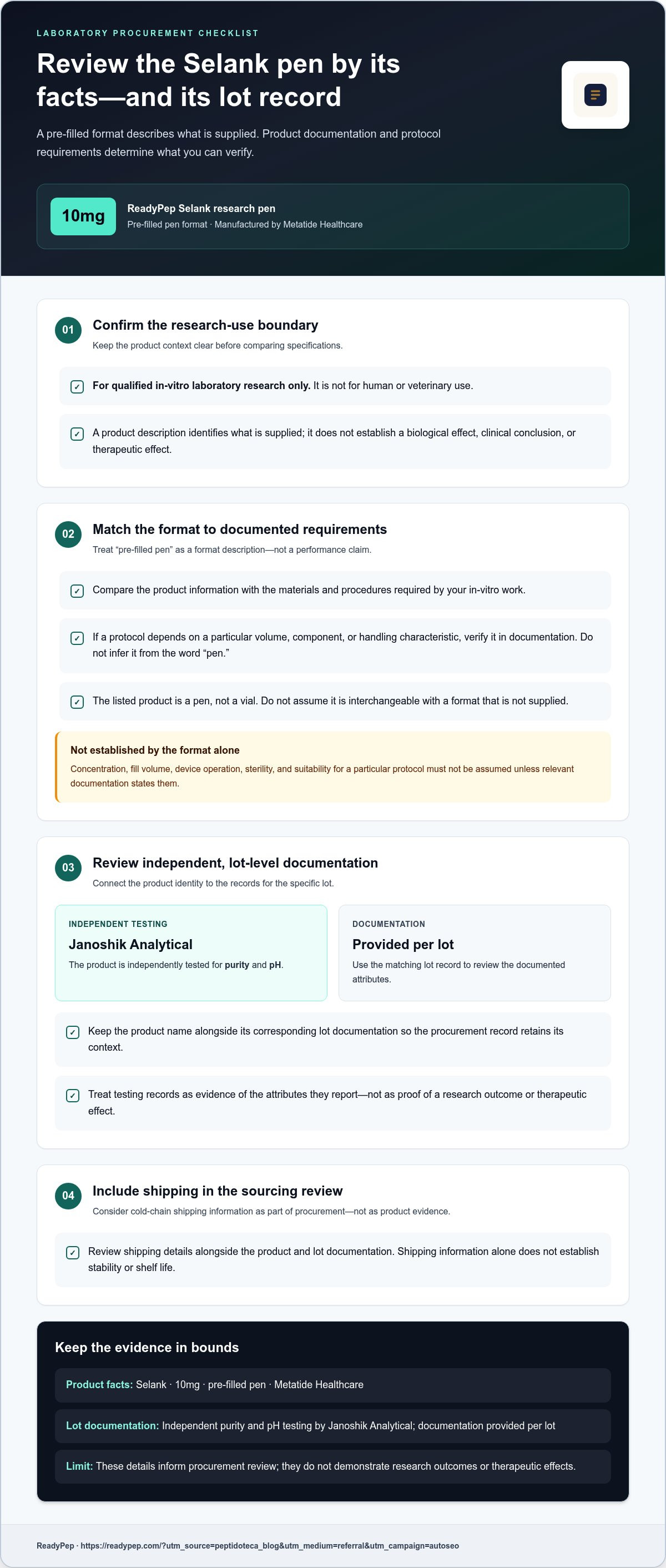
This guide explains what a pre-filled pen is, what independent lot-level testing can show, and what qualified laboratories should consider when sourcing Selank for in-vitro research. ReadyPep’s Selank 10mg pen is manufactured by Metatide Healthcare and independently tested by Janoshik Analytical for purity and pH, with documentation provided per lot. These records can inform procurement decisions, but they do not demonstrate a research outcome or therapeutic effect.
You’ll also learn how to compare the pre-filled format with your lab’s documented requirements and why shipping information belongs in a sourcing review. The scope is clear: this product is for in-vitro laboratory research by qualified scientific personnel only, not for human or veterinary use.
Key Takeaways
- Check whether a pre-filled format fits your laboratory’s procurement requirements without assuming unverified workflow advantages.
- A Selank research pen is intended for qualified in-vitro laboratory research only, not human or veterinary use.
- Lot-specific documentation and independent testing can help you review the product’s documented attributes.
- Include cold-chain shipping in your sourcing review, but do not treat shipping details as evidence of stability or shelf life.
What Is a Selank Research Pen? Define the Research Context First
A Selank research pen is a pre-filled product format containing Selank for in-vitro laboratory research. It is research material, not a therapeutic product. ReadyPep’s pens are intended only for in-vitro research by qualified scientific personnel, and they are not for human or veterinary use.
That distinction is the starting point for evaluating the product. A listing describes what is supplied; it does not establish what a compound does, prove a biological effect, or support a clinical conclusion. Keep procurement facts separate from scientific interpretation. The pen format alone cannot tell you whether a particular research question has been answered.
How to describe Selank research without overclaiming
Start with the question a study investigates, rather than a conclusion that readers might mistake for established fact. When discussing scientific background, use peer-reviewed literature and check that each claim is supported by the cited source. The Selank Wikipedia page can offer general orientation, but it is not a substitute for evaluating primary research.
Distinguish a proposed mechanism from a result observed in a specific study and from a conclusion supported across evidence. Avoid turning a research hypothesis into a promise or presenting findings from one context as universally established. For broader context on peptide topics, the peptide research library can complement careful review of the scientific literature.
Keep practical boundaries clear, too. This guide provides no dosing, administration, or human-use guidance. Those details would move the discussion away from in-vitro research and could lead readers to treat a research product as a self-use guide.
Research use is not human or veterinary use
ReadyPep’s Selank pens are for in-vitro laboratory research by qualified scientific personnel only. Availability does not imply suitability for clinical or veterinary work. A laboratory product description and its supporting documentation identify research-procurement attributes; they do not establish authorization, safety, or effectiveness for treatment.
For a lab, the first step is to define the intended in-vitro research context and keep procurement decisions within that scope. Do not interpret a pre-filled format as instructions for use outside a laboratory setting. The boundary is straightforward: the product is not for human or veterinary use, regardless of who encounters it or how it is presented.
Use a concise definition consistently in product notes, internal procurement records, and educational material: A Selank research pen is a pre-filled research product for qualified in-vitro laboratory work, not a treatment or product for human or veterinary use. Clear wording helps prevent product-format details from being mistaken for clinical evidence or therapeutic claims.
What the Selank Pre-Filled Pen Format Means for Laboratory Procurement
ReadyPep’s listed option is a Selank 10mg pre-filled research pen manufactured by Metatide Healthcare. “Pre-filled pen” describes the supplied format. It does not, by itself, tell a researcher the concentration, fill volume, device operation, sterility, or suitability for a particular protocol. Do not infer those details from the word “pen” or from specifications associated with other products.
Format selection is a procurement decision, not a shortcut around study design. Compare the documented product information with the materials and procedures your in-vitro work requires. If a protocol depends on a particular volume, component, or handling characteristic, treat it as a study requirement to compare with the documentation, not an assumed feature of the format.
Which product details can a researcher verify?
The confirmed product facts are specific: Selank, 10mg, pre-filled pen format, and manufacturer Metatide Healthcare. The linked Selank 10mg research pen identifies the offering. Do not extend those facts into claims about concentration, fill volume, device components, or operation unless the relevant documentation states them.
Keep product identity connected to lot-level records in your procurement files. Record the product name alongside its corresponding lot documentation so your team can trace which materials informed a procurement decision. A product name without its lot reference can make that connection less clear, while a document without matching product and lot context can be harder to interpret later. Retain the source information together instead of relying on memory or a shortened label.
Format suitability depends on the research workflow
Assess fit against documented study requirements, not assumptions that a pre-filled format is inherently more convenient, precise, or efficient. A protocol may call for specific inputs or materials. The relevant question is whether the stated product information matches those needs. If a detail is not provided, do not treat it as established.
The Selank offering is a pen, not a vial. ReadyPep does not sell peptide vials, and the pen should not be treated as interchangeable with a format that is not being supplied. Limit comparisons to the documented attributes of the actual product. This helps prevent format labels from being mistaken for evidence about performance or compatibility.
Confirmed specifications describe the product; they do not establish performance in a laboratory workflow. That distinction keeps procurement discussions and records precise. For a closer look at the listed product and its stated attributes, review the Selank 10mg pre-filled pen details. ReadyPep’s broader research peptide pen selection offers a starting point for comparing listed formats against your laboratory’s documented requirements.
How Independent Selank Lot Testing Supports Research Review
Testing information is most useful when it is tied to the specific lot being sourced. ReadyPep products are independently tested for purity and pH by Janoshik Analytical, and documentation is provided per lot. For a qualified researcher reviewing a Selank research pen, the practical first step is to match the product under consideration to its lot documentation, then interpret the reported checks within their limits.
What purity and pH testing can and can’t tell you
Purity and pH describe different attributes. Purity testing concerns the material’s purity; pH testing concerns acidity or alkalinity. One measure does not stand in for the other, and neither alone establishes how a material will perform in a particular assay. ReadyPep’s independent lot testing supports review of these documented attributes, not a guaranteed experimental result.
Read the documentation as evidence about what was tested, not as a promise about what a study will show. Avoid assumptions about methods, thresholds, or other document fields unless the lot record states them. If a protocol depends on an attribute that is not documented, do not treat the available results as proof of it.
Keep lot information connected to study records
Traceability starts with a clear link between the research material and its supporting record. Record the supplier, product name, and lot identifier together, then retain the matching lot documentation with your procurement information. This makes it easier for a qualified research team to revisit which material was sourced and what information was available at the time.
Use a consistent review sequence:
- Match the documentation to the product name.
- Identify the lot associated with the material being reviewed.
- Read the available purity and pH information without inferring unreported specifications.
- Record the source and keep the documentation connected to the lot in your research records.
This sequence does not replace a study’s own design or evaluation. It makes the sourcing trail easier to understand later, especially when colleagues reviewing the records were not involved in the original procurement. Keep the distinction clear: lot documentation helps describe tested product attributes; it does not establish clinical suitability or predict assay outcomes.
For ReadyPep’s Selank 10mg pre-filled pen, lot-level documentation and independent purity and pH testing provide specific information to consider during procurement review. Use those records as evidence about the documented lot, and keep conclusions proportionate to what they actually state.
How to Assess Selank Pen Sourcing and Cold-Chain Information
Shipping details are part of procurement review, but they answer a different question from product testing. ReadyPep offers free worldwide cold-chain shipping for its research pens. This is a sourcing detail, not evidence of a particular storage temperature, product stability period, or condition after arrival. Keep those claims separate when documenting a Selank research pen for qualified in-vitro laboratory work.
A useful review connects three items: the product identified for procurement, its lot-specific documentation, and the shipment information available to your laboratory. Together, these provide a clearer record of what was sourced and the context in which it arrived. They also help prevent a shipping description from being mistaken for a stability claim.
What to record when a research pen arrives
Match the product name and lot information on the supplied documentation, then retain that material with your procurement records. Record the shipment details available to your team, such as the date received and any accompanying shipping information. Keep observations about the shipment separate from conclusions about the product. An arrival record supports traceability; it does not prove a specific stability duration.
- Product name as shown in the supplied documentation
- Lot information that connects the product to its documentation
- Shipment information available at receipt, retained with procurement records
- Any receipt observations, recorded separately from stability conclusions
This approach keeps the paper trail useful without adding unsupported assumptions. For broader cold-chain context, use a dedicated guide, while relying on product-specific documentation for product claims. Shipping information can inform sourcing review, but it cannot replace data that directly addresses stability.
Separate sourcing facts from stability conclusions
Cold-chain shipping describes a shipping approach. Validated stability data addresses how a product behaves under specified conditions. One does not automatically establish the other. ReadyPep’s confirmed shipping information is free cold-chain shipping worldwide; it does not, by itself, specify storage temperatures, shelf life, or freeze-thaw tolerance. Do not infer those details from the shipping offer.
For a laboratory review, assess each statement according to what it documents. Shipment details can be retained as logistics context. Product documentation can support review of its stated attributes. Stability conclusions require relevant product-specific evidence, not assumptions based on transport language or a package’s appearance.
Cold-chain shipping describes how a product is shipped; validated stability data describes supported stability under specified conditions. Keeping that distinction in procurement notes makes the evidence easier to interpret and reduces the risk of overstating what shipping information proves.
For a sourcing overview grounded in the listed research products and their documented details, review ReadyPep’s research peptide offerings alongside your laboratory’s procurement records.
ReadyPep Selank 10mg Research Pen: A Clear Next Step for Qualified Labs
For qualified research teams, procurement review begins with clear product identity and lot-specific evidence. ReadyPep supplies a Selank 10mg pre-filled research pen manufactured by Metatide Healthcare. Products are independently tested by Janoshik Analytical for purity and pH, with documentation provided per lot. The pen is solely for in-vitro laboratory research by qualified scientific personnel, not for human or veterinary use.
These details define what is being sourced. They do not establish a biological effect, predict an assay result, or provide specifications beyond those stated. Keep the product facts distinct from questions your team needs to resolve using the relevant lot documents and study requirements.
A concise procurement summary for research teams
Use this compact review to separate confirmed information from document-level checks:
- Compound and amount: Confirmed fact: Selank, 10mg. Review prompt: match the product identity to the lot documentation.
- Format: Confirmed fact: pre-filled research pen. Review prompt: compare documented product attributes with your laboratory’s requirements, without assuming device details.
- Manufacturer: Confirmed fact: Metatide Healthcare. Review prompt: retain this information with the product record.
- Testing: Confirmed fact: independent purity and pH testing by Janoshik Analytical. Review prompt: interpret only the information actually provided for the applicable lot.
- Documentation: Confirmed fact: records are provided per lot. Review prompt: connect the documentation to the product and lot being considered.
- Shipping: Confirmed fact: free worldwide cold-chain shipping. Review prompt: keep shipment details separate from claims about storage or stability.
For the product-specific listing, consult the Selank 10mg product details. Keep the product name, lot identifier, and corresponding documentation together in procurement records. That connection helps clarify which product information informed the sourcing decision, without treating test documentation as a guarantee of research performance.
Explore the Selank research product
The practical next step is to compare the stated product attributes with your qualified laboratory’s in-vitro research requirements. Review the relevant lot documentation and retain it alongside your sourcing records. This product is not for human or veterinary use, and its availability does not imply clinical or therapeutic suitability.
If the documented format and scope align with your research procurement needs, explore ReadyPep’s research peptide selection as you complete your review.
Take the Next Step with a Clear Research Scope
Before selecting a Selank research pen, define the in-vitro question your team intends to investigate and the product attributes relevant to that work. Then compare the available information with those requirements, keeping documented facts separate from assumptions about performance. A disciplined review gives your procurement decision a clear rationale and helps your team carry that context into its research records.
ReadyPep’s Selank offering is intended solely for in-vitro laboratory research by qualified scientific personnel. It is not for human or veterinary use. With that boundary in view, qualified labs can assess the product information against their research needs and decide whether the stated format fits their procurement criteria.
Review the Selank 10mg research pen and its product information as a practical next step for your sourcing review. Keep your evaluation evidence-led, your intended scope explicit, and your research planning focused on documented requirements.
Frequently Asked Questions
Is Selank a peptide?
Yes. Selank is described as a peptide in scientific and supplier sources. For laboratory notes, cite peer-reviewed literature for compound-specific statements and distinguish reported findings from what your own in-vitro model examines. The classification alone does not establish assay suitability or clinical outcomes. Connect each citation to the claim it supports, rather than using a general description as evidence for a separate research question.
Is a Selank research pen intended for human use?
No. ReadyPep’s pre-filled research peptide pens are solely for in-vitro laboratory research by qualified scientific personnel, not for human or veterinary use. A product listing, analytical document, or scientific paper is not personal-use guidance or authorization. Treat a paper as scientific context, not as instructions for using a research product outside an in-vitro laboratory setting.
Can a Selank research pen be used in an in-vitro study?
ReadyPep states that its pens are intended for in-vitro laboratory research by qualified scientific personnel. Whether a particular Selank research pen and its documented attributes suit a given study depends on the research design and applicable laboratory procedures. Compare the product information with the requirements specified for your assay. The listing itself does not provide a protocol, dose, or assurance of compatibility with a particular assay.
Does independent purity testing guarantee a successful experiment?
No. A purity result does not guarantee an assay outcome or remove every source of experimental variability. ReadyPep products are independently tested for purity and pH by Janoshik Analytical, with documentation provided per lot. Review the documentation for the lot under consideration and interpret its reported information alongside your study design, rather than treating a test result as a prediction of experimental success.
What does pH testing tell a researcher about a peptide product?
A pH measurement describes an aspect of the tested sample; purity addresses a different analytical question. Neither measurement alone establishes how a product will perform in an assay or whether it will produce a particular biological effect. If your study has pH-related criteria, consider those separately from purity information and use the relevant lot documentation without assuming either result answers the other question.
Does a cold-chain shipment establish a Selank pen’s shelf life?
No. Cold-chain shipping describes a shipping condition, not the product’s storage requirements or validated shelf life after delivery. ReadyPep offers free cold-chain shipping worldwide, but that offer alone does not establish a stability period or temperature range. Retain available shipment context in procurement records and use applicable product documentation for handling information. Do not infer shelf life from shipping language or arrival condition alone.
Disclaimer
Educational content only. Not medical advice.


