

What makes a GHK-Cu research pen a sound choice for laboratory work: the format, the compound information, or the evidence attached to its lot? A pre-filled format may suit some workflows, but convenience alone does not establish what a research reagent is or what its documentation supports.
A useful evaluation starts with practical questions: Does GHK-Cu fit the research question? Does the pen format fit the laboratory’s established workflow? Do the product identifier and lot documents match, and what do the test results actually show? This article explains how to review those points without treating laboratory findings as therapeutic evidence or implying human-use benefits.
You’ll also see how to assess the ReadyPep GHK-Cu 100 mg pen against procurement criteria such as traceability and format fit. ReadyPep supplies pre-filled research peptide pens manufactured by Metatide Healthcare. Its products are independently tested for purity and pH by Janoshik Analytical, with documentation provided per lot. The GHK-Cu pen is intended solely for in-vitro laboratory research by qualified scientific personnel, not for human or veterinary use. Use the checklist below to decide whether this research format fits your lab’s requirements.
Key Takeaways
- Assess purity and pH as separate measurements. Neither one alone establishes how a reagent will perform in an experiment.
- Match the lot identifier on the product to its documentation to support traceability in your research records.
- Compare pen and vial formats by preparation steps, storage procedures, and fit with your established laboratory workflow.
- Use a consistent review sequence: confirm compound identity and research context, then check lot traceability and the scope of the available evidence.
- Evaluate ReadyPep’s GHK-Cu 100 mg pen as a specific format option. It is manufactured by Metatide Healthcare.
What Is a GHK-Cu Research Pen, and What Is It For?
A GHK-Cu research pen is a pre-filled research reagent format intended solely for in-vitro laboratory research conducted by qualified scientific personnel. The word “pen” describes the product’s presentation. It does not establish a biological effect, validate a method, or predict an experimental result.
GHK-Cu is a copper-binding complex involving GHK, a short peptide made up of the amino acids glycine, histidine, and lysine, and copper. The complex is discussed in biochemical and laboratory research, but its identity should be kept distinct from claims about what it may do in a particular experimental system. For a general overview of its discovery and biological context, see GHK-Cu Wikipedia. Researchers evaluating mechanisms or findings should consult primary literature relevant to their specific research question.
How should researchers understand GHK-Cu in laboratory research?
Start by asking whether GHK-Cu is relevant to the research question, model, and analytical methods in the study. Research discussions include areas such as cellular signaling and tissue-related biology, but these are subjects of investigation, not guarantees that a particular effect will occur. Findings depend on the experimental system and conditions. Broad descriptions should not substitute for evidence specific to the study.
This distinction also matters during procurement. A product description identifies the reagent and its format; it does not demonstrate a biological mechanism, confirm suitability for a particular assay, or establish expected performance. Those judgments depend on relevant literature, appropriate controls, and careful interpretation of research data. This section addresses compound identity and research context, while assay-specific methods belong in a protocol designed and approved for the laboratory’s work.
What does “research use only” mean for this pen?
The intended scope is specific: in-vitro laboratory research by qualified scientific personnel. The product is not for human or veterinary use and is not presented as a treatment, cosmetic, or consumer-use item. These boundaries are central to understanding the product category and its appropriate context.
Pre-filled describes how the reagent is presented. It does not make the product a consumer-use item or provide instructions for use. This article does not provide administration guidance, dosing advice, experimental protocols, or instructions for in-vivo animal testing. Any research application must remain within the stated in-vitro context and the qualified personnel’s laboratory procedures.
ReadyPep’s GHK-Cu 100 mg research pen is a specific pre-filled format to evaluate. Consider its format as a procurement factor, separate from what GHK-Cu biology may or may not show in a given experiment.
GHK-Cu Research Pen Quality: Read Purity, pH, and Lot Documentation Separately
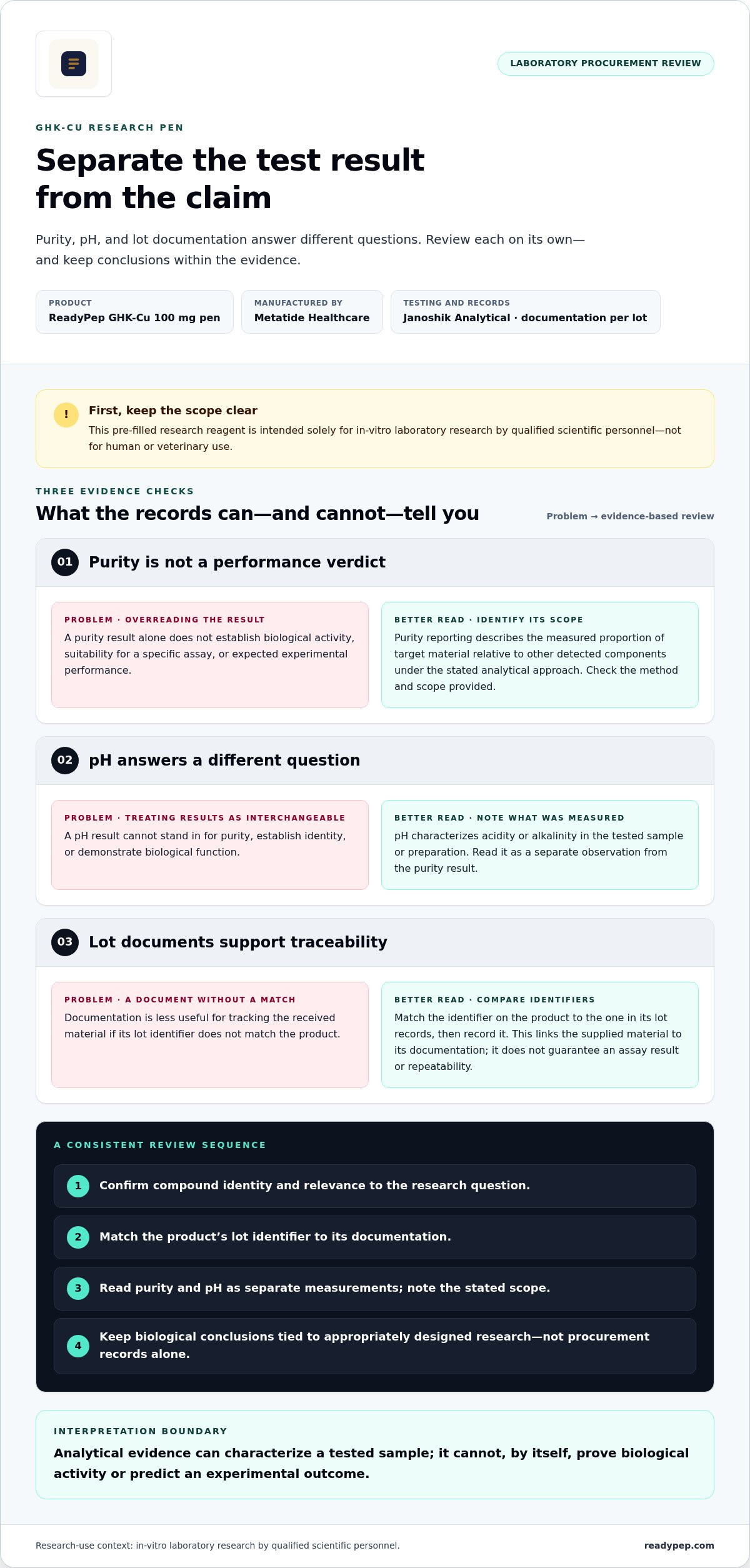
Analytical evidence is most useful when each result is interpreted according to what it measures, rather than treated as a blanket endorsement. For a GHK-Cu research pen, purity and pH provide different information. Neither result alone demonstrates biological activity, suitability for a specific assay, or expected experimental performance.
ReadyPep’s products are independently tested for purity and pH by Janoshik Analytical, with documentation provided per lot. Researchers can use the records to review evidence associated with the material received. A test result does not predict the outcome of a study.
What can a lot-specific document help establish?
A lot identifier connects the supplied product to its accompanying documentation. When recording the material, compare the identifier on the product with the one shown in the records. Matching details help link the evidence to the correct lot and support traceability in laboratory records, including when documenting reagent provenance or distinguishing one received lot from another.
Next, check what the document reports and what its scope covers. The presence of a document is not evidence for every quality attribute or research question. Lot-level records help track material, but they do not guarantee a particular assay result, repeatability, or publication outcome.
Why consider purity and pH as separate results?
Purity reporting describes the measured proportion of the target material relative to other detected components under the stated analytical approach. pH reporting characterizes acidity or alkalinity in the tested sample or preparation. These measurements answer different questions, and one cannot stand in for the other. A pH result can inform solution characterization, but it does not establish identity or biological function.
Read the documentation as a set of distinct observations. Check the lot reference, identify which measurement each result represents, and note any stated method or scope. Do not assume details the document does not provide. If a result is unclear, treat that as a limitation in interpretation rather than filling the gap with a claim about performance. No single analytical value describes every property of a reagent.
Analytical evidence can characterize a tested sample; it cannot, by itself, prove biological activity or predict an experimental outcome. This distinction keeps procurement review grounded in evidence while leaving biological conclusions to appropriately designed research.
For a practical review, consider ReadyPep’s independent testing information alongside the lot-specific records. Check that the identifiers align, then interpret each result within its stated scope. This helps separate documented findings from assumptions about how the material may perform.
To review ReadyPep’s research-format offerings and supporting information, explore the ReadyPep research catalogue.
Pre-Filled GHK-Cu Research Pen vs Vial: Compare Workflow, Not Claims
A pen and a vial organize laboratory work differently. Neither format is automatically more suitable. The right fit depends on the reagent’s documentation, the laboratory’s established procedures, and the planned work. A pre-filled GHK-Cu research pen may change the preparation workflow, but format alone does not establish greater accuracy or better experimental results.
Which workflow factors differ between a pen and a vial?
The comparison below covers general workflow considerations. Product configurations vary, so use the specific product information and the laboratory’s approved handling procedures rather than assuming every pen or vial works the same way.
| Workflow factor | Pre-filled pen format | Vial format |
|---|---|---|
| Preparation | May arrive pre-filled, changing or reducing preparation steps before laboratory handling. | May require preparation before use, depending on the material supplied and its instructions. |
| Traceability | Record the pen’s identifying information and match it to its lot documentation. | Record vial identifiers and match them to the documentation for that lot. |
| Storage | Follow the specific product’s storage information and laboratory procedures. | Follow the specific product’s storage information and laboratory procedures. |
| Workflow fit | Consider whether the format aligns with existing equipment, documentation, and handling practices. | Consider whether vial-based handling aligns with existing equipment, documentation, and practices. |
The table describes workflow considerations, not a performance ranking. A format that removes a preparation step does not prove that handling is more accurate, eliminate the need for controls, or establish suitability for a particular study. Traceability still depends on recording the identifiers and maintaining the corresponding documentation.
When might a pre-filled format suit a research workflow?
A pre-filled format may be worth evaluating when the lab is considering how reagent preparation fits its existing workflow. Assess that question separately from the evidence for the material itself. For example, review whether the product’s documentation is accessible and lot-specific, then determine whether the format aligns with approved receiving, storage, and recordkeeping practices.
Before choosing a format, map the steps the laboratory already follows. Note where product identification is recorded, how documentation is retained, and which internal procedures govern storage and handling. Then compare the product information with those requirements. Do not infer storage conditions, contents, or device features from the words “pen” or “vial.”
Format choice does not replace a laboratory’s validated procedures or safety controls. ReadyPep’s GHK-Cu offering is a pre-filled research pen. Researchers can assess its documented format against their established in-vitro workflow without treating convenience as evidence of an outcome. To compare the available research-format range, review the ReadyPep research catalogue.
A Practical Checklist for Evaluating a GHK-Cu Research Pen
A clear procurement review follows a sequence: establish research fit first, then examine the product identity and evidence tied to the material. This keeps the appeal of a format from overshadowing the questions that matter for laboratory records and study planning.
What should a laboratory verify before procurement?
Use this ordered checklist to assess a GHK-Cu research pen before adding it to an in-vitro research workflow:
- Confirm the research context. Check that the planned work is in-vitro laboratory research conducted by qualified scientific personnel. The product is not for human or veterinary use.
- Match the compound to the research question. Confirm that the product is identified as GHK-Cu, then assess whether the compound fits the laboratory’s research aims. A product description does not establish assay suitability or predict findings.
- Review the format as a workflow choice. Check that the pre-filled pen format fits the lab’s established receiving, handling, and recordkeeping procedures. Do not infer device features or handling steps from the word “pen.”
- Identify the lot. Locate and record the product’s lot identifier. Treat this as a traceability step, separate from reviewing the analytical information.
- Match the supporting records. Compare the identifier on the product with the identifier in its accompanying lot documentation. Confirm that the records correspond to the material being assessed.
- Read the evidence by category. ReadyPep products are independently tested for purity and pH by Janoshik Analytical, with documentation provided per lot. Review the records for what they report, without assuming unreported results or experimental performance.
Before procurement, confirm research fit, compound identity, format, lot match, and the scope of the available evidence.
How should researchers document the material in their workflow?
When the material is received, keep a record that connects the product to its documentation. Depending on the laboratory’s recordkeeping system, this can include the product identity, format, lot details, date received, and a reference to the accompanying documents. Keep the information together so the lot can be distinguished from other materials in the laboratory.
Documentation supports traceability. It does not guarantee a particular assay result, establish the outcome of a study, or replace the lab’s own approved procedures. Keep the evidence within its stated scope, and avoid filling gaps with assumptions. ReadyPep provides independent testing information for its products; review it alongside the records supplied for the relevant lot.
To apply these criteria to a specific GHK-Cu format, review ReadyPep’s research offerings with your laboratory’s intended context and documentation needs in mind.
ReadyPep GHK-Cu 100 mg Research Pen: Evidence and Next Steps
After comparing research context, format, and documentation, assess a specific offering against your laboratory’s procurement criteria. ReadyPep supplies a GHK-Cu 100 mg pre-filled research pen manufactured by Metatide Healthcare. It is a research-format product, not a consumer product or a treatment.
What does ReadyPep state about its GHK-Cu 100 mg pen?
ReadyPep products undergo independent purity and pH testing by Janoshik Analytical, with documentation provided per lot. For procurement review, the lot identifier is central: it connects the product received with its accompanying records. Review the documentation for the lot in hand and interpret each reported measurement within its stated scope. Documentation supports evaluation, but it does not guarantee a particular assay result or research outcome.
The use boundary is specific. This product is solely for in-vitro laboratory research by qualified scientific personnel. It is not for human or veterinary use. Keep that context central to the decision: a pen format does not imply consumer suitability, therapeutic use, or results in a biological system.
Assess the product against your lab’s research question and established procedures. Does the compound identity fit the planned in-vitro work? Does the pre-filled format suit the laboratory’s receiving, storage, and recordkeeping practices? Can the team connect the lot identifier to its documentation? These are separate checks. A convenient format cannot replace evidence review or validated laboratory procedures.
Where can a qualified research team review the product information?
ReadyPep offers free cold-chain shipping worldwide from the United Kingdom. For procurement, consider shipping arrangements separately from product identity and lot-level evidence. Cold-chain shipping is not a substitute for reviewing the product information or the documentation associated with the lot.
A practical next step is to compare the product information with your lab’s criteria, then include the relevant lot documentation in the procurement review. The records can inform material traceability, while questions about experimental suitability remain tied to the research design and the laboratory’s own procedures.
If the product format and stated research-use boundary align with your requirements, review ReadyPep’s research offering and product information as part of your evaluation.
Make Your Next Procurement Decision More Consistent
Turn your evaluation criteria into a repeatable decision record. Note what your team needs from a reagent format, which evidence supports the review, and how the material fits the planned laboratory work. A consistent approach helps colleagues assess future purchases using the same criteria rather than relying on product presentation or assumptions.
Keep the distinction clear: choosing a GHK-Cu research pen is a procurement decision, while interpreting experimental findings belongs to the research process. Product format and documentation can inform that process, but neither replaces careful study design and analysis.
To put these criteria into practice, review the ReadyPep GHK-Cu 100 mg research pen and its lot documentation as part of your laboratory’s evaluation.
Frequently Asked Questions
What is a GHK-Cu research pen?
A GHK-Cu research pen is a pre-filled research format containing GHK-Cu for laboratory work. It is intended solely for in-vitro research conducted by qualified scientific personnel, not for human or veterinary use. “Pen” describes the product’s presentation, not a promise about study design or results. A laboratory can assess whether the format fits its research setup while keeping product format and experimental conclusions distinct.
Is a GHK-Cu research pen intended for human or veterinary use?
No. A GHK-Cu research pen is not intended for human or veterinary use. Its defined scope is in-vitro laboratory research by qualified scientific personnel. That boundary applies regardless of the format or claims readers may encounter elsewhere. If a proposed activity falls outside the stated research context, the product is not appropriate for it. This answer offers no therapeutic guidance or instructions for use.
What does independent purity testing tell researchers about a GHK-Cu lot?
Independent purity testing reports analytical findings about the tested lot under the stated method. It does not establish how that material will behave in a particular experiment. ReadyPep products are independently tested for purity and pH by Janoshik Analytical, with documentation provided per lot. Researchers can use the matching records to assess what was measured, while treating assay performance, biological activity, and study conclusions as separate questions.
Why might pH documentation matter when evaluating a research peptide?
pH documentation gives information about acidity or alkalinity in the tested sample or preparation. It complements, rather than replaces, purity information: the two results describe different properties. For example, a research team reviewing a lot record can note whether a pH result is reported and consider it as part of its material assessment. A pH value alone does not establish identity, experimental suitability, or a biological outcome.
Can researchers compare a pre-filled pen with a vial for laboratory workflow?
Yes. Compare how each format fits the laboratory’s established procedures, documentation practices, and equipment. A pre-filled format may change the preparation workflow, while a vial-based format may involve different preparation steps depending on the supplied material. These are format-level considerations, not proof that one option is universally more accurate or suitable. The laboratory’s approved procedures and safety controls remain central to the decision.
What should a laboratory record when receiving a GHK-Cu research product?
Record enough information to connect the material received with its supporting documents. A practical entry can include the product identity, format, lot details, receipt date, and a reference to the associated records. Keeping the lot identifier beside the documentation reference can help distinguish that material from another lot later. Follow the laboratory’s own recordkeeping practices; this is practical guidance, not a statement of formal requirements.
Does cold-chain shipping guarantee that a research peptide remains suitable for every experiment?
No. Cold-chain shipping describes a shipping approach, not proof that a product is suitable for every research question or experimental setup. ReadyPep offers free cold-chain shipping worldwide from the United Kingdom, but shipping information does not predict biological activity, assay performance, or study outcomes. Researchers should assess product information and lot documentation in the context of their planned in-vitro work and laboratory procedures.
Disclaimer
Educational content only. Not medical advice.


