

What makes a pre-filled peptide pen supplier dependable: a headline purity claim, or evidence tied to the product lot? For qualified scientific personnel sourcing materials for in-vitro laboratory research, the distinction matters. Supplier information can leave research-use limits, testing records, and shipping details unclear, making procurement harder than it needs to be.
A useful evaluation starts with scope: products should be intended solely for in-vitro laboratory research, not human or veterinary use. Then look for product-specific testing and documentation, a format suited to your lab’s workflow, and clear cold-chain fulfilment details. ReadyPep’s pre-filled pens are manufactured by Metatide Healthcare, independently tested for purity and pH by Janoshik Analytical, and supplied with documentation per lot. Orders ship worldwide from the United Kingdom with free cold-chain shipping.
This guide explains how to assess each factor using practical, verifiable criteria. You’ll learn what lot documentation can establish, how to evaluate the pre-filled format during procurement, and which shipping details matter when planning laboratory supply. The goal is a sourcing decision grounded in scope, evidence, and practical fit.
Key Takeaways
- Keep research scope clear: these pens are intended for in-vitro laboratory research by qualified scientific personnel, not human or veterinary use.
- Assess a pre-filled peptide pen supplier by whether product documentation connects clearly to the specific lot.
- Use a simple review sequence: identify the lot, read its documentation, note the stated analyses, and retain the records.
- Compare suppliers on evidence, pre-filled format, and fulfilment details, including whether cold-chain shipping is offered.
- ReadyPep’s pens are manufactured by Metatide Healthcare and independently tested for purity and pH by Janoshik Analytical, with documentation provided per lot.
What a pre-filled peptide pen supplier should provide for in-vitro research
A pre-filled research peptide pen is a product format intended for qualified scientific personnel conducting in-vitro laboratory research. That definition sets the boundary: it describes a research material and its intended context, not a treatment or a product for human or veterinary use. The word “pen” identifies the format; it doesn’t change the research-use scope.
Peptides are a broad class of molecules, so a product name or format alone doesn’t establish whether it fits a project. For foundational context, see What are Peptides?. Procurement assessment should focus on practical evidence: stated research scope, lot-specific documentation, the analyses reported, product format, and fulfilment details. Reviewing these criteria helps distinguish a clear sourcing record from a general claim.
How research-use scope differs from therapeutic claims
ReadyPep products are intended solely for in-vitro laboratory research by qualified scientific personnel. They are not intended for human or veterinary use. Keep that distinction explicit in procurement records and internal product descriptions. Research-use language should describe the laboratory context accurately, without implying a therapeutic purpose, human outcomes, or use beyond the stated scope.
What the pre-filled format means for procurement
A pre-filled pen is supplied as a pen rather than as a vial. For procurement, consider whether that format fits the laboratory’s handling, inventory, and documentation processes. Don’t infer operating details from the format name alone. Review product information and lot records separately, and consider how fulfilment fits the lab’s receiving procedures.
Format is one part of the decision, not a substitute for quality documentation. A sound procurement review considers product identity and lot, stated testing, available records, and shipping arrangements together. This makes it easier to trace what was sourced and received without confusing convenience with verification.
ReadyPep’s pre-filled research peptide pens are manufactured by Metatide Healthcare. Janoshik Analytical independently tests products for purity and pH, and documentation is provided per lot. Free cold-chain shipping is offered worldwide from the United Kingdom. These details provide a concrete starting point for evaluating scope, evidence, and fulfilment together. Explore the pre-filled peptide pen catalogue to review the available research product format.
How to assess peptide pen testing and lot-specific documentation
A purity claim is useful only when you can connect it to the product being assessed. Lot-specific documentation creates that link and gives laboratory teams a clearer record of what was tested. ReadyPep products receive independent purity and pH testing by Janoshik Analytical, with documentation provided per lot.
Use a straightforward review sequence:
- Identify the lot: Record the product and lot identifiers associated with the item received.
- Review its documentation: Match the supplied records to that specific product lot.
- Note the stated analyses: For ReadyPep products, these are purity and pH.
- Retain the records: Store the documentation with the relevant laboratory procurement records.
What lot-specific evidence can help establish
Matching records to a lot supports traceability: a researcher can distinguish documentation for one product lot from general supplier statements or records for another. Read the reported analyses as evidence of the properties they address. For broader background on peptide applications, the American Chemical Society discusses Cell-Penetrating Peptides in Drug Delivery, a separate topic from product-lot testing.
A test result reports on the analysis performed; it does not, by itself, establish product performance, efficacy, sterility, or suitability for clinical use. Keep conclusions within the scope of the supplied documentation.
How to read analytical documentation responsibly
Check that the product and lot identifiers in your records correspond to the documentation provided. Note which analyses are stated, and interpret any results in the context of that report rather than generalizing them across lots. This recordkeeping step supports traceable procurement without assuming information the report doesn’t provide.
For additional context on laboratory quality considerations, see Peptide Pen Quality Control: Ensuring High Purity Research Peptides in Laboratory Settings. ReadyPep’s independent peptide pen testing information explains its testing and lot-documentation approach. A pre-filled peptide pen supplier should clearly connect its stated analyses to product-specific records, so teams can assess evidence without reading beyond what the documentation supports.
If documented sourcing is central to your procurement review, explore ReadyPep’s pre-filled research peptide pens and their lot-specific documentation.
Compare peptide pen suppliers by evidence, format, and fulfilment
A useful comparison puts evidence and procurement logistics side by side. Don’t treat a pre-filled format or a general purity statement as a substitute for clear research-use scope and lot-specific records. The table outlines what to assess and how ReadyPep’s stated offering fits each criterion.
| Criterion | What to assess | ReadyPep |
|---|---|---|
| Research-use scope | Look for an explicit statement of intended research context and user. | Products are intended solely for in-vitro laboratory research by qualified scientific personnel, not human or veterinary use. |
| Lot documentation | Check whether documentation is provided per product lot, supporting traceability in procurement records. | Documentation is provided per lot. |
| Testing | Note which analyses are stated and who performs them. Avoid reading beyond the scope of the evidence. | Janoshik Analytical independently tests products for purity and pH. |
| Format | Consider whether the supplied format fits laboratory inventory and workflow needs. | Pre-filled research peptide pens manufactured by Metatide Healthcare. |
| Shipping | Review the stated fulfilment method and origin as part of receiving plans. | Free cold-chain shipping worldwide from the United Kingdom. |
Which supplier details matter most to laboratory procurement
Start with scope and traceability. Clear in-vitro research-use language defines the product context; lot documentation connects the supplied item to its records. Independent purity and pH testing provides information about those specific analyses, without extending beyond them. Shipping details help teams plan procurement and receipt, but they aren’t evidence of research outcomes or a guarantee of experimental performance.
ReadyPep’s supply chain details are clear: Metatide Healthcare manufactures the pens, and Janoshik Analytical independently tests purity and pH. Documentation is provided per lot. Together, these facts give teams a concrete basis for assessing product evidence and fulfilment without relying on broad claims or supplier rankings.
How the pre-filled format fits a research workflow
Format selection is a practical laboratory consideration. A pre-filled pen may suit an inventory and handling workflow differently from other research formats, but the format alone doesn’t establish analytical quality or suitability for a particular project. Consider it alongside lot records and shipping arrangements, not as a dosing recommendation or a claim about accuracy or sterility. For broader context, the article “Benefits of Pre-filled Research Peptide Pens” can help frame format considerations.
For qualified scientific personnel sourcing materials for in-vitro work, ReadyPep brings the pre-filled format, independent testing, per-lot documentation, and worldwide cold-chain shipping together. Review the pre-filled research peptide pen offering to see how these procurement details are presented.
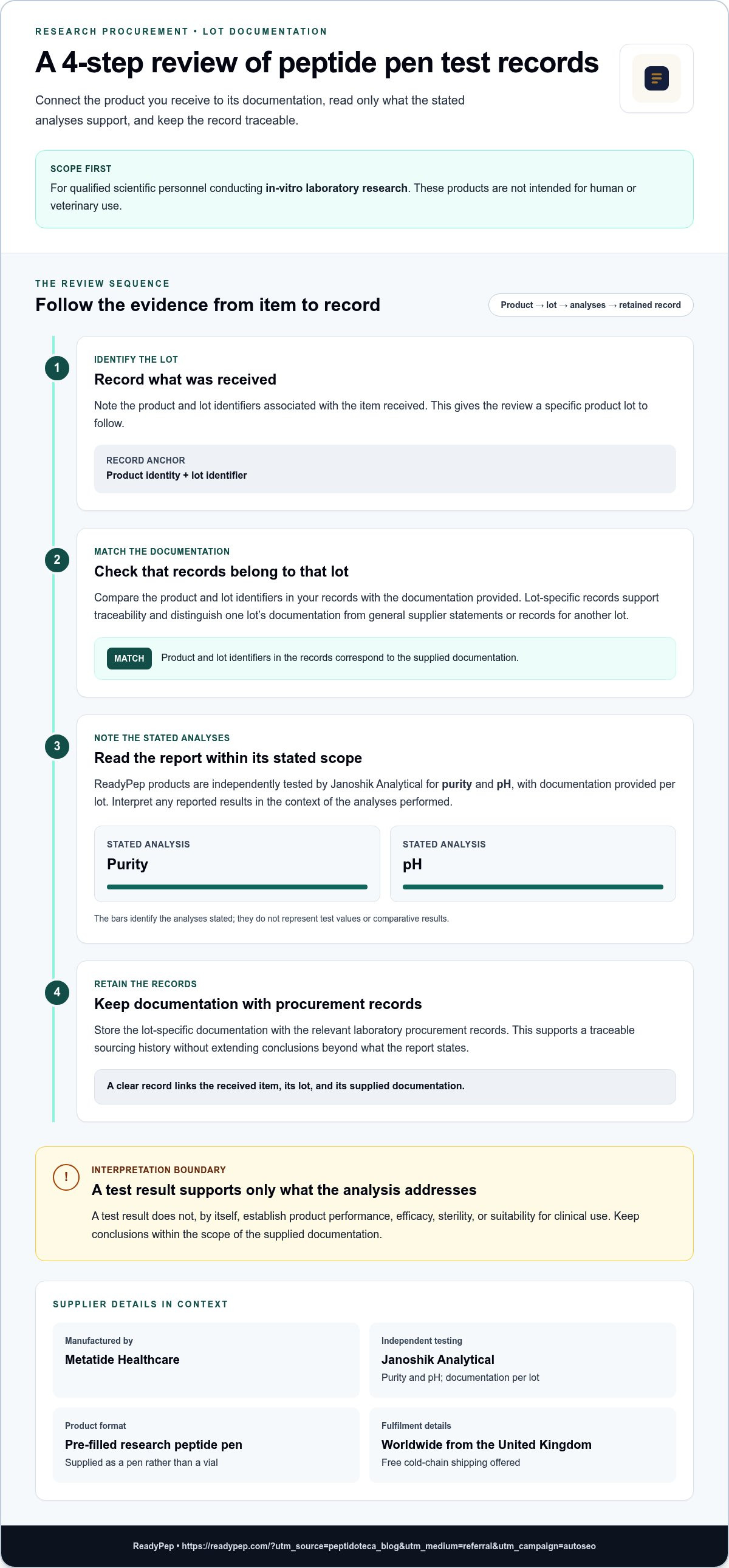
A practical procurement checklist for research peptide pens
A clear procurement record starts before an order is placed and continues through receipt. For qualified scientific personnel, the process should stay focused on the stated in-vitro research scope, product identity, lot documentation, and receipt records. Use this checklist to keep those steps consistent.
- Confirm research scope. Match the project to the product’s stated intended use. ReadyPep serves qualified scientific personnel conducting in-vitro laboratory research; its products aren’t for human or veterinary use.
- Identify the product. Use the research peptide pen catalogue to identify a listed product relevant to the laboratory’s procurement needs. Keep product selection separate from assumptions about research outcomes.
- Review lot documentation. Check the documentation associated with the product lot and note the analyses it states. ReadyPep products receive independent purity and pH testing by Janoshik Analytical, and documentation is supplied per lot.
- Record receipt. Log receipt in the laboratory’s procurement records, retaining the supplied lot documentation alongside the product and order details.
Before placing a research procurement order
Start with scope, then product identity. Confirm that the planned work is in-vitro research and that the product is presented for that purpose. Next, use the catalogue to identify the relevant pre-filled research peptide pen and review its product information. This gives procurement staff a traceable basis for the order without confusing research materials with therapeutic products or experimental services.
A reliable pre-filled peptide pen supplier should make its research-use scope understandable and connect the product to its documentation. ReadyPep’s pens are manufactured by Metatide Healthcare, and its products are intended solely for in-vitro laboratory research by qualified scientific personnel.
When the shipment and lot arrive
At receipt, compare the product and lot identifiers with the accompanying records, then retain those documents in the laboratory’s procurement file. Record receipt and handle the shipment according to your lab’s established procedures. Don’t infer storage temperatures or stability periods from general shipping information; use only verified product-specific guidance available to your team.
Shipping is part of procurement planning, not a promise about research results. ReadyPep offers free cold-chain shipping worldwide from the United Kingdom. For broader shipping context, “Global Logistics and Research Chemical Compliance” can be considered alongside your institution’s procedures, without assuming customs rules or requirements.
Ready to review product options against your lab’s procurement criteria? Explore ReadyPep’s pre-filled research peptide pens.
ReadyPep’s pre-filled peptide pens: documented sourcing for in-vitro laboratories
Supplier evaluation comes down to whether the product’s intended scope, testing, documentation, and fulfilment are clear. ReadyPep supplies pre-filled peptide pens solely for qualified scientific personnel conducting in-vitro laboratory research. The products are not for human or veterinary use. That boundary matters: the format and analytical records support a research procurement decision, not therapeutic claims.
What ReadyPep provides to research customers
The pens are manufactured by Metatide Healthcare. Janoshik Analytical independently tests ReadyPep products for purity and pH, and documentation is supplied per lot. This gives research teams product-specific records to retain and review. It also keeps quality statements tied to the stated analyses rather than implying broader performance or clinical suitability.
ReadyPep offers individual pre-filled research peptide pens and peptide pen bundles and stacks. Examples from the listed inventory include Retatrutide 40mg, MOTS-c 40mg, and NAD+ 1000mg. These are research products, not recommendations for a particular experimental design. Free cold-chain shipping is offered worldwide from the United Kingdom. The shipping description does not specify a delivery time or temperature.
For laboratories comparing product scope and documentation, the pre-filled research peptide pen catalogue provides a practical place to review the range. Broader quality context can also be explored through resources on research peptide quality standards.
Where to continue from supplier evaluation
A pre-filled peptide pen supplier should make it possible to assess research-use scope and connect a product to lot-specific records. For ReadyPep, Metatide Healthcare manufactures the pens, Janoshik Analytical independently tests purity and pH, and documentation is provided per lot. Shipping information adds another practical detail for laboratory planning.
Use those details alongside your institution’s purchasing and receipt procedures. The article “Research Peptide Quality Standards: A Guide for In-Vitro Laboratories in 2026” offers a broader quality perspective; keep any assessment grounded in documented evidence for the specific product lot. When you’re ready to review products within the stated research scope, explore ReadyPep’s documented research peptide pens.
Make your next sourcing decision with clear evidence
A sound procurement decision starts with scope: choose materials intended for qualified scientific personnel conducting in-vitro laboratory research, not human or veterinary use. Then connect the product to its lot documentation and consider whether the pre-filled format and fulfilment details fit your laboratory’s workflow. These steps make supplier claims easier to assess and records easier to retain.
ReadyPep pens are manufactured by Metatide Healthcare and independently tested for purity and pH by Janoshik Analytical. Documentation is provided per lot, and free cold-chain shipping is offered worldwide from the United Kingdom. For laboratories comparing a pre-filled peptide pen supplier, these are concrete sourcing details to weigh alongside the stated research-use scope.
Review the product range and its research context at your own pace. Review ReadyPep’s documented pre-filled research peptide pens and take the next step with a clearer basis for procurement.
Frequently Asked Questions
What should I look for in a pre-filled peptide pen supplier?
Look for a clear in-vitro research-use scope, identifiable products, lot-specific documentation, stated testing, and practical fulfilment details. These points help connect the product received to evidence relevant to procurement. ReadyPep products are intended for qualified scientific personnel conducting in-vitro laboratory research. They receive independent purity and pH testing by Janoshik Analytical, with documentation provided per lot. Keep conclusions within the scope of those stated analyses.
Are pre-filled research peptide pens intended for human use?
No. ReadyPep’s pre-filled research peptide pens are intended solely for in-vitro laboratory research by qualified scientific personnel, not human or veterinary use. They aren’t therapeutic products, and their research designation shouldn’t be interpreted as guidance for personal use. Keep product handling within the laboratory’s established procedures and the stated research scope. This distinction helps ensure product descriptions and procurement records don’t imply human-use directions or therapeutic outcomes.
How can I verify a peptide pen supplier’s purity claims?
Review product- and lot-specific documentation rather than relying on a general quality statement. Match the product and lot identifiers, then note which analyses are stated in the supplied records. ReadyPep products receive independent purity and pH testing by Janoshik Analytical, with documentation provided per lot. Interpret the results for that lot and those analyses only. Testing information isn’t proof of efficacy or clinical suitability.
Does independent peptide testing prove a product is suitable for every experiment?
No. Analytical testing provides information about the measured attributes of the documented product lot, not a guarantee that it fits every research design or model. ReadyPep’s stated testing covers purity and pH. Qualified scientific personnel should interpret those records in context and follow their laboratory’s material qualification procedures. The products are intended solely for in-vitro laboratory research, so testing shouldn’t be read as evidence of therapeutic or clinical suitability.
What does lot-specific documentation mean for a research laboratory?
Lot-specific documentation is associated with a particular product lot, helping a laboratory maintain traceable procurement records. Record the product and lot identifiers, and retain the documentation with the relevant laboratory files. ReadyPep provides documentation per lot. Review the analyses stated for that lot, rather than assuming its results describe another lot or predict study outcomes. This creates a clearer sourcing record without extending the evidence beyond its scope.
Do pre-filled peptide pens ship with cold-chain handling?
ReadyPep offers free cold-chain shipping worldwide from the United Kingdom. This is a fulfilment detail laboratories can include in procurement and receiving plans. Don’t infer a shipping temperature or delivery time from the term “cold-chain.” On receipt, record the shipment and follow your laboratory’s established procedures and applicable product-specific documentation. Avoid applying storage conditions or stability periods that aren’t supported by verified product information.
Can ReadyPep peptide pens be used for veterinary or in-vivo research?
No. ReadyPep products are intended solely for in-vitro laboratory research by qualified scientific personnel and aren’t for human or veterinary use. Their stated scope doesn’t include in-vivo animal research, and ReadyPep doesn’t provide in-vivo animal testing services. Keep procurement decisions, product descriptions, and laboratory records aligned with the in-vitro research context. Don’t interpret independent purity and pH testing as evidence of suitability for animal administration or therapeutic use.
Disclaimer
Educational content only. Not medical advice.


