

What if the most convenient pen is the wrong fit for your research workflow? Sourcing pre-filled research peptide pens takes more than comparing formats or accepting a “lab-tested” claim. Product fit, independent testing, lot-specific records, and delivery conditions all matter. Supplier information can be difficult to verify, so a structured evidence check helps distinguish documented details from assumptions.
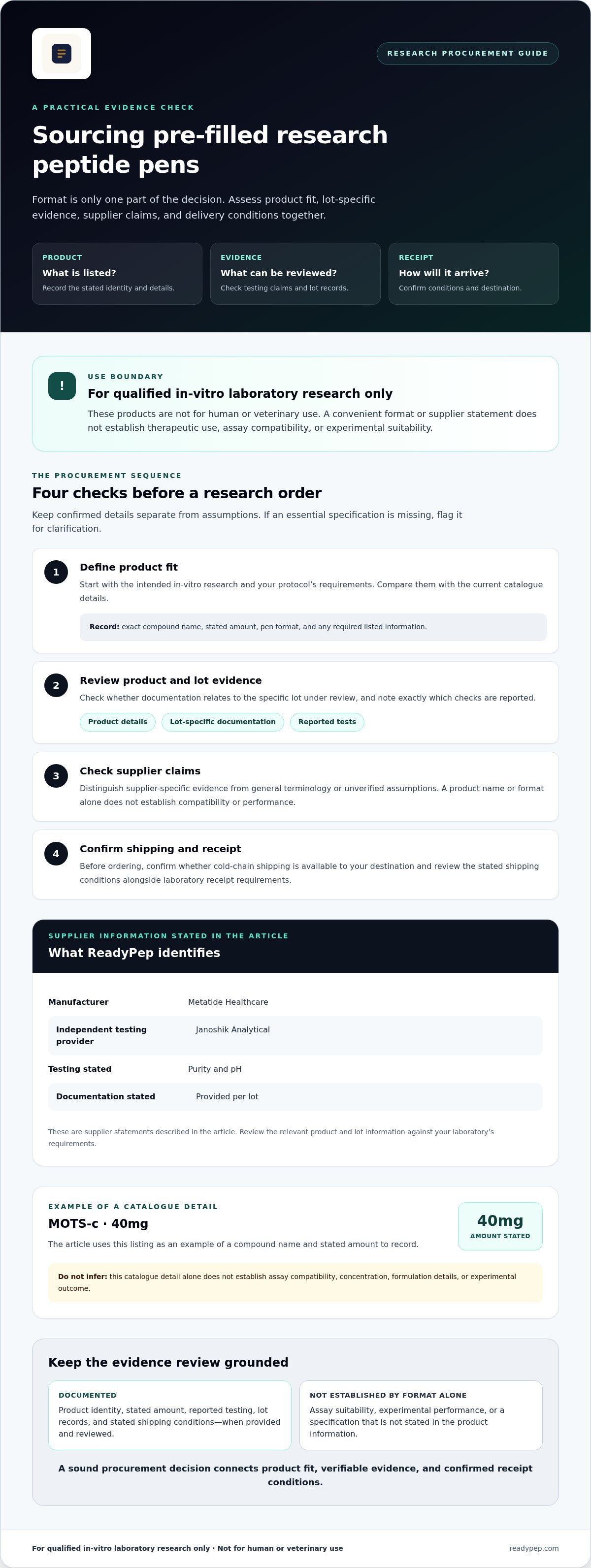
A pre-filled format may suit some in-vitro workflows, but convenience doesn’t replace procurement review. Check the product’s stated purpose, whether testing and documentation relate to the specific lot, and whether cold-chain delivery is available to your destination. ReadyPep identifies Metatide Healthcare as its manufacturer and states that products are independently tested for purity and pH by Janoshik Analytical, with documentation provided per lot.
This guide offers a practical framework for assessing product fit, reviewing product and lot evidence, and confirming shipping details before you decide. It also makes the use boundary clear: these products are solely for in-vitro laboratory research by qualified scientific personnel, not for human or veterinary use. The goal is an informed procurement decision based on verifiable information.
Key Takeaways
- Use a sourcing checklist to compare the pen format and confirmed product information with your in-vitro research workflow.
- When sourcing pre-filled research peptide pens, distinguish catalogue details from assumptions about assay compatibility or performance.
- Review product and lot documentation alongside independent testing claims, and note exactly which checks are reported.
- Confirm stated cold-chain shipping conditions and destination availability before placing an order.
- ReadyPep identifies Metatide Healthcare as the manufacturer and Janoshik Analytical as the independent testing provider. Products are solely for qualified in-vitro laboratory research.
Why sourcing pre-filled research peptide pens requires more than choosing a format
Sourcing pre-filled research peptide pens begins with a format decision, but the pen itself doesn’t establish whether a product suits a particular assay. A sound purchasing review considers the intended in-vitro research, confirmed product identity, available lot evidence, and delivery conditions together. Each factor answers a different question: what is being procured, what evidence supports its description, and whether the order can be received under conditions the laboratory has reviewed.
These products are research reagents, not medicines. ReadyPep’s pre-filled research peptide pens are solely for in-vitro laboratory research by qualified scientific personnel, and they are not for human or veterinary use. Keep that boundary explicit in procurement records and internal discussions. A convenient format, product listing, or supplier statement is not evidence of therapeutic use or experimental suitability.
What does pre-filled mean in a research procurement context?
“Pre-filled” describes the supplied format: a research peptide provided in a pen. By itself, it doesn’t confirm compatibility with an assay, a particular concentration, or an experimental outcome. Check the current catalogue for the product identity and listed details, then compare them with your approved protocol and institutional procurement requirements. If an essential specification isn’t stated, seek clarification rather than filling the gap with an assumption.
Manufacturing terminology also needs careful handling. General information about Good Manufacturing Practices (GMP) can explain the concept, but a general reference isn’t proof that a specific supplier or product meets a particular standard. Review supplier-specific evidence separately.
Which sourcing questions should a laboratory answer first?
Before comparing suppliers, define the research-only purpose and identify the compound and product information your protocol requires. Decide who will assess the supporting documents and who can approve the supplier. This helps prevent a catalogue description from being mistaken for a completed technical or institutional review.
- Product: Does the current listing identify the intended compound and provide the information your review requires?
- Evidence: Who will examine product and lot documentation, and what details must be verified?
- Receipt: Are the destination, stated shipping conditions, and laboratory receipt requirements confirmed before ordering?
Resolve these questions as one procurement decision, not as separate afterthoughts. ReadyPep identifies Metatide Healthcare as the manufacturer and states that products receive independent purity and pH testing by Janoshik Analytical, with documentation provided per lot. Researchers can use the current research peptide pen catalogue as a starting point, then assess the relevant product and lot information against their laboratory’s requirements.
Assess pen format and product information before placing a research order
A product listing is a starting point, not a complete procurement assessment. Compare what the supplier explicitly identifies with what your laboratory needs to verify. Record the compound name exactly as listed, the stated amount, the pen format, and whether documentation is available for the selected lot. Don’t infer formulation details, concentration, assay compatibility, or experimental performance from a product name or format.
For example, a listing that names MOTS-c and states 40mg gives you a compound name and amount to record. It doesn’t, by itself, answer every protocol-specific question. If a specification your review requires is absent or unclear, flag it for supplier confirmation before procurement rather than treating an assumption as a catalogue fact.
Build a comparison from verifiable fields
Use the same fields for each option. A consistent comparison makes missing information easier to spot.
| Field | What to record | What to verify |
|---|---|---|
| Product identity | Exact compound name as listed | Does the listing match the requested research material? |
| Listed amount | Amount shown for the product | Is the unit clear? Don’t reinterpret it as concentration. |
| Format | Pre-filled research peptide pen | Does this format fit the laboratory’s approved workflow? |
| Lot documentation | Availability for the selected item | Can the documentation be reviewed for the relevant lot? |
| Unclear details | Questions or missing fields | Obtain confirmation before approving the order. |
ReadyPep states that it provides documentation per lot. Review the current research peptide pen catalogue against your comparison fields, then confirm that the specific item and its documentation meet your review needs.
Judge format fit without predicting results
Format fit is a workflow question. Compare the pen with the handling and procurement requirements in your laboratory’s approved protocol. A pre-filled format may be a practical option for a suitable in-vitro workflow, but convenience doesn’t establish assay compatibility or demonstrate performance. Keep those scientific questions separate from supplier review.
Products must remain within their stated research-use boundary. ReadyPep’s products are solely for in-vitro laboratory research by qualified scientific personnel, not for human or veterinary use. The FDA guidance on “Research Use Only” products provides context for understanding research-use labeling. It doesn’t replace your institution’s review or establish a product’s suitability for a specific experiment.
For a focused comparison, start with the listings and available product information in ReadyPep’s research peptide pen range, then verify any open questions before placing an order. That’s a more reliable basis for sourcing pre-filled research peptide pens than choosing by format alone.
How to verify testing, lot documents, and supplier claims
Supplier statements are more useful for procurement when you can connect them to the product and lot under review. Use a simple sequence: locate the product information, request or access the corresponding lot documentation, then compare the reported tests and identifiers with your purchasing requirements. Record what you reviewed and note any unresolved questions.
What should a lot-specific document help you confirm?
Start with the identifiers. Check whether the document clearly names the relevant product and lot, then compare those details with the item being considered. Review the reported fields against your team’s purchasing and recordkeeping requirements. If an identifier or required detail is missing, ask the supplier to clarify it. Don’t assume a general product statement applies to every lot, or that an unclear field means something it doesn’t explicitly report.
ReadyPep states that documentation is provided per lot. This gives buyers a defined record to assess, but the laboratory should still confirm that the documentation for its selected product meets its own review criteria.
How can buyers evaluate independent testing claims?
Check who performed the testing and which checks are actually stated. ReadyPep identifies Janoshik Analytical as the independent laboratory and states that it tests products for purity and pH. These are distinct reported checks. Don’t infer a particular analytical method, identity test, acceptance limit, or purity percentage unless it appears in the documentation you review.
- Locate: Find the product information and documentation associated with its lot.
- Match: Compare the product and lot identifiers across the listing and record.
- Review: Note the testing provider and the specific reported checks.
- Resolve: Ask about missing or ambiguous information before completing procurement review.
For a direct look at the supplier’s stated testing information, review ReadyPep’s independent peptide testing information. You can also consult its peptide pen quality control resource for related context.
Testing records support an evidence-based supplier review. They don’t guarantee assay compatibility or experimental outcomes. For qualified personnel sourcing pre-filled research peptide pens for in-vitro work, treat each document as a record to evaluate, not a substitute for protocol review or internal approval.
Check cold-chain shipping and receipt requirements before ordering
Shipping is part of the sourcing decision, not a detail to leave until checkout. Confirm that the destination is currently served, review the conditions stated for the order, and check whether they align with your laboratory’s receiving and handling requirements. A cold-chain shipping claim alone doesn’t establish what conditions applied to a specific shipment or whether they meet your institution’s procedures.
ReadyPep states that it offers free worldwide cold-chain shipping from the United Kingdom. Treat this as a starting point for verification, not a reason to assume every destination is available. Confirm current availability and order-specific shipping information before purchase. Follow institutional procedures and independently confirm any destination-specific requirements relevant to your procurement. Don’t assume transit times, temperature ranges, customs outcomes, or shipment monitoring details unless they’ve been confirmed for your order.
What should buyers confirm before dispatch?
Before checkout, verify that the destination is currently served and review the shipping details presented for the order. If you need more information, ask the supplier which shipment details or documents are available. Compare the response with your laboratory’s receipt and handling requirements. Resolve open questions before dispatch rather than relying on general claims to fill in missing specifics.
What information should the laboratory record on receipt?
Use your established incoming-material procedure. Record the receipt date, product identity, lot identifier, and accompanying documentation. Note any discrepancy between the order, product label, and records, along with any observed delivery concern. Follow institutional procedures for assessing and documenting incoming materials. If something doesn’t match expectations, raise it through the supplier’s support channel before the material enters research use.
A clear receipt record connects the shipping review to the lot documentation assessed during procurement. For background on maintaining cold-chain integrity for peptide shipments, consult the relevant material in ReadyPep’s library, and confirm order-specific details directly before buying. Careful checks make sourcing pre-filled research peptide pens more traceable without assuming undocumented conditions.
Review ReadyPep’s current shipping and product information before placing an order, and confirm destination availability and applicable delivery details for your shipment.
Choose a research peptide pen supplier with evidence you can review
A supplier decision should rest on evidence your team can assess, not a format or broad quality claim alone. Use a consistent checklist before approval. Does the listed product fit the intended in-vitro research workflow? Can the supplier provide documentation for the relevant lot? Are the stated tests and testing provider identified? Have shipping conditions and destination availability been confirmed?
- Product fit: Match the listed product information to your laboratory’s approved requirements. Don’t assume a pen suits every assay.
- Lot records: Check that documentation is available for the product and lot under consideration.
- Testing: Identify the independent laboratory and the specific checks stated in the documentation.
- Shipping: Confirm current destination availability and order-specific delivery details before purchase.
When does ReadyPep align with a laboratory’s sourcing criteria?
ReadyPep identifies Metatide Healthcare as the manufacturer and Janoshik Analytical as the independent laboratory that tests its products for purity and pH. It also states that documentation is provided per lot. These details give qualified research teams specific information to review during supplier assessment. Check the available records against the requirements for each product and lot.
ReadyPep states that it offers free worldwide cold-chain shipping from the United Kingdom. Confirm that your destination is currently served and review the shipping information for your order. Neither documentation nor shipping claims establish that a product suits every assay, institution, or research workflow.
What is a practical next step for qualified research teams?
Review current product information and the documentation available for the item you’re considering. Compare those records with internal purchasing procedures, protocol requirements, and the research-use boundary. If a detail needed for approval is unclear, seek product-specific clarification before procurement. ReadyPep’s products are solely for in-vitro laboratory research by qualified scientific personnel, not for human or veterinary use.
For teams sourcing pre-filled research peptide pens, take a focused approach: confirm product identity, examine lot-specific records, assess the stated testing, and verify delivery details. This keeps supplier selection grounded in information rather than assumptions. Review ReadyPep’s research peptide pen range and available information as part of that assessment.
Make your next sourcing decision evidence-led
Sourcing pre-filled research peptide pens calls for more than selecting a convenient format. Match the listed product information to your qualified in-vitro research workflow, review documentation for the relevant lot, and confirm shipping details and destination availability before ordering.
ReadyPep identifies Metatide Healthcare as the manufacturer and states that Janoshik Analytical independently tests products for purity and pH. Per-lot documentation is provided for review. ReadyPep also states that it offers free worldwide cold-chain shipping from the United Kingdom, but confirm current availability and order-specific details for your destination. These are procurement facts to assess, not guarantees of assay suitability or experimental outcomes.
Keep the research-use boundary clear: products are solely for in-vitro laboratory research by qualified scientific personnel, not for human or veterinary use. When you’re ready to compare current product information and available documentation, review ReadyPep’s research peptide pen range and available information. A careful evidence check helps your team make a considered procurement decision.
Frequently Asked Questions
What should I check when sourcing pre-filled research peptide pens?
When sourcing pre-filled research peptide pens, compare the listed compound, stated amount, format, and available lot documentation with your laboratory’s approved requirements. Confirm which tests are reported and who performed them, then check shipping details and destination availability before ordering. Don’t assume the format establishes assay compatibility or that a general supplier claim applies to a specific product lot. Resolve missing or unclear details before procurement approval.
Are pre-filled research peptide pens intended for human use?
No. ReadyPep’s pre-filled research peptide pens are intended solely for in-vitro laboratory research by qualified scientific personnel. They are not for human or veterinary use and should not be treated as medicines or therapies. Keep this boundary clear in procurement records and research planning. A research-use product format does not establish suitability for clinical, veterinary, or other uses outside the stated in-vitro research purpose.
How can I verify the lot documentation for a research peptide pen?
Check that the document identifies the product and lot you’re considering, then compare those identifiers with the product information and order details. Review the reported fields against your laboratory’s purchasing and recordkeeping requirements. ReadyPep states that it provides documentation per lot. If a required identifier or detail is missing or unclear, ask the supplier for clarification rather than assuming the document applies to the specific item.
Does ReadyPep provide independent testing for its research peptide pens?
Yes. ReadyPep states that its products are independently tested for purity and pH by Janoshik Analytical, with documentation provided per lot. Review the available records for the specific product and lot, and note exactly which checks are reported. Purity and pH are distinct checks; don’t infer an unreported test method, result, or acceptance limit. Testing documentation supports supplier review, but doesn’t guarantee assay compatibility or experimental outcomes.
Can research peptide pens be shipped internationally on a cold chain?
Before ordering, confirm that your destination is currently served and review the shipping information for your specific order. Don’t assume transit times, temperature ranges, or other shipment details unless they’re confirmed. Check your institution’s procedures and independently verify destination-specific requirements relevant to your procurement and receipt of the research material.
What should a laboratory record when a research peptide pen arrives?
Follow your laboratory’s established incoming-material procedures. Record the receipt date, product identity, lot identifier, and accompanying documentation. Compare the received item with the order and available records, and document any discrepancy or delivery concern using your institution’s process. If information doesn’t match or a concern needs review, contact the supplier through its support channel and follow internal procedures before the material is used in research.
Are pre-filled research peptide pens suitable for every in-vitro assay?
No. A pre-filled format doesn’t establish that a product is suitable for every assay or laboratory workflow. Assess the listed product information against the requirements in your approved protocol, and have qualified personnel review relevant documentation. Keep supplier and format evaluation separate from compound-specific scientific assessment. If a specification needed to judge fit isn’t available, seek clarification before deciding whether the product is appropriate for your in-vitro research.
Disclaimer
Educational content only. Not medical advice.


