

Manual reconstitution is quietly corrupting your in-vitro data. For laboratory researchers managing sensitive cellular assays, dissolving lyophilized peptide cakes introduces micro-volumetric discrepancies, mechanical shear stress, and solvent variance that compromise structural stability before an experiment even starts. Every manual step adds another layer of human error and lot variability. Transitioning to a calibrated Tesamorelin research pen eliminates these compounding variables directly at the laboratory bench.
You already know the frustration of watching baseline controls drift due to slight dilution discrepancies or unverified supplier documentation. When pH fluctuations and thermal degradation alter the peptide chain, reproducing reliable cellular assays becomes an uphill battle. Discover how pre-filled Tesamorelin research pens eliminate reconstitution variance and optimize dosing precision in cellular assays. In this 2026 guide, we'll analyze the mechanical micro-dispensing systems that replace manual syringes, evaluate lot-traceable HPLC and pH analytical standards, and establish the cold-chain handling protocols necessary to preserve peptide structural integrity across every trial.
Key Takeaways
- Learn how switching to a pre-filled Tesamorelin research pen eliminates manual reconstitution variance and safeguards micro-dispensing precision in cell culture assays.
- Understand the downstream in-vitro signaling pathways activated by Tesamorelin, focusing on adenylate cyclase stimulation and intracellular cAMP accumulation.
- Discover why lot-specific HPLC and mass spectrometry verification are critical for confirming peptide identity and confirming purity levels of 98% or higher.
- Master standard bench protocols for mechanical dial priming, cold-chain temperature monitoring, and micro-volume calibration.
- Examine how precision-engineered hardware and independent laboratory testing prevent mechanical dose drift and maintain data reproducibility across multi-well plates.
What Is a Tesamorelin Research Pen and Why Laboratories Prefer It
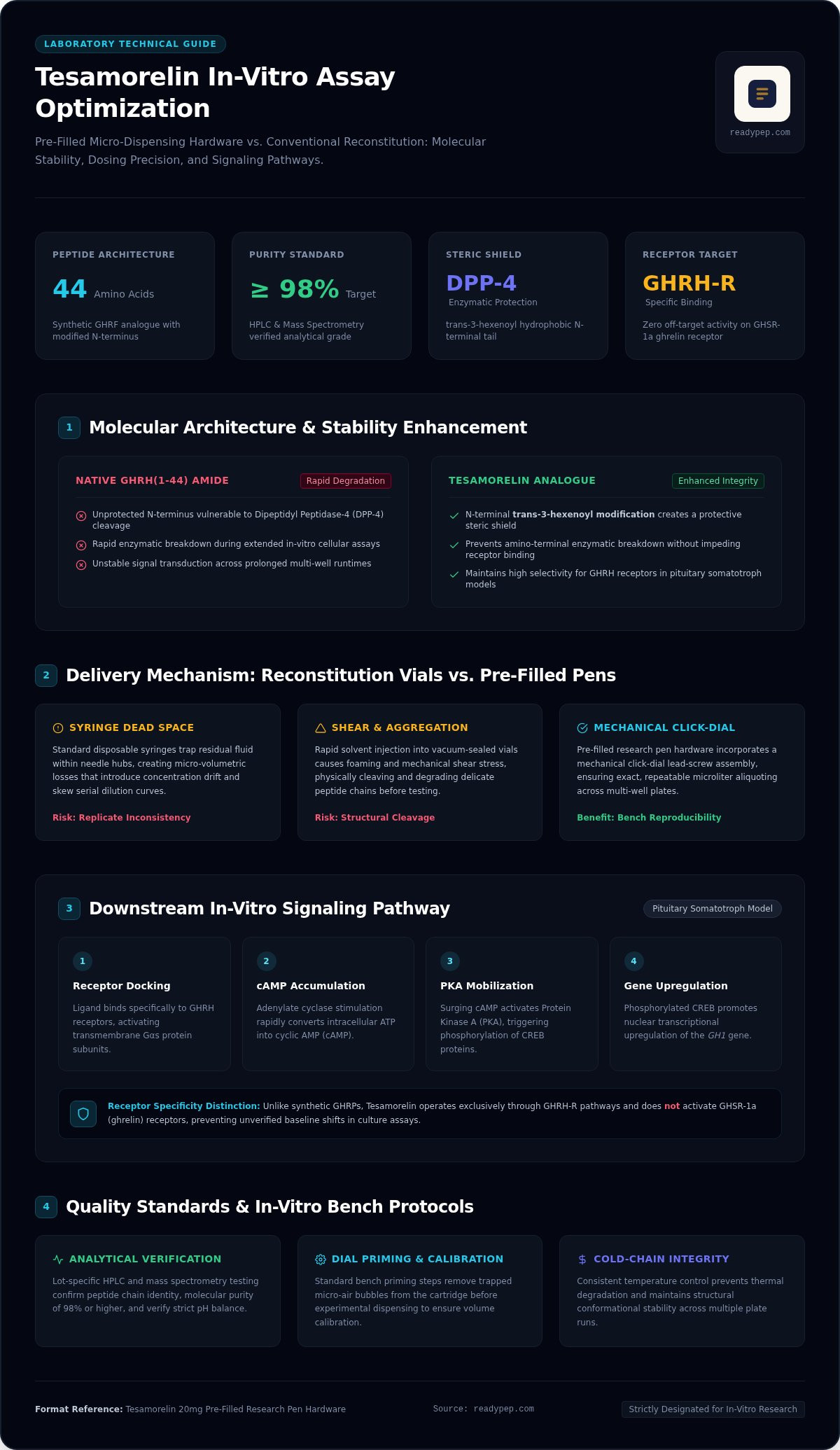
A Tesamorelin research pen is an integrated, pre-filled micro-dispensing device designed for precise reagent delivery in cell culture environments. Tesamorelin itself is a synthetic 44-amino acid growth hormone-releasing factor analogue. In standard laboratory workflows, reconstituting dry peptide cakes requires calculating diluent volumes, aspirating bacteriostatic water, and manually venting vials. These manual steps invite pipetting discrepancies and concentration drift. By housing a pre-measured aqueous solution within a calibrated delivery pen, the system bypasses manual dissolution altogether. Crucially, these instruments are strictly designated for in-vitro laboratory research, providing cellular assay platforms with unmatched operational consistency.
The Molecular Architecture of Tesamorelin in In-Vitro Models
Native human GHRH(1-44) amide degrades rapidly in solution due to dipeptidyl peptidase-4 (DPP-4) cleavage. Tesamorelin solves this stability hurdle through an N-terminal trans-3-hexenoyl modification. This hydrophobic tail acts as a steric shield, preventing rapid amino-terminal enzymatic breakdown without impeding receptor binding. In cultured pituitary somatotrophs, the molecule exhibits high selectivity for GHRH receptors, stimulating sustained signal transduction across extended assay runtimes.
Pre-Filled Pen Hardware vs. Conventional Lyophilized Reagent Vials
Conventional glass vials present documented physical drawbacks during high-throughput screening:
- Syringe Dead Space: Standard disposable syringes trap residual fluid inside needle hubs, creating micro-volume losses that skew serial dilution curves.
- Aerosolization and Aggregation: Rapid solvent injection into vacuum-sealed vials causes foaming and mechanical shear, which cleaves fragile peptide chains.
- Mechanical Microliter Precision: Pre-filled pen hardware utilizes a mechanical click-dial lead-screw assembly, ensuring repeatable microliter aliquots across every multi-well plate.
Eliminating manual reconstitution steps also accelerates screening velocity. As detailed in this guide on improving lab workflow with pre-filled pens, automated mechanical aliquoting saves substantial bench time while curbing inter-operator error rates. For teams testing high-affinity GHRH signaling in micro-plate assays, integrating a Tesamorelin 20mg research pen maintains uniform reagent concentration across entire experimental batches.
Mechanisms of Action: Investigating Cellular Pathways with Tesamorelin
Tesamorelin interacts selectively with pituitary growth hormone-releasing hormone (GHRH) receptors, triggering an intracellular signaling cascade without off-target activity. When the ligand docks to this G-protein coupled receptor, the G-alpha-s subunit stimulates transmembrane adenylate cyclase. This enzyme rapidly converts intracellular adenosine triphosphate (ATP) into cyclic adenosine monophosphate (cAMP). As cAMP levels surge, protein kinase A (PKA) is mobilized, phosphorylating cyclic AMP response element-binding protein (CREB). Unlike synthetic growth hormone-releasing peptides (GHRPs), Tesamorelin does not activate the growth hormone secretagogue receptor (GHSR-1a), leaving baseline ghrelin pathways unperturbed in culture systems.
GHRH Receptor Binding Dynamics and Signal Transduction
In pituitary cell models, Tesamorelin demonstrates strong binding affinity for native receptor sites, stimulating continuous CREB activation. This phosphorylation promotes transcriptional upregulation of the growth hormone 1 (GH1) gene directly within the nucleus. Setting up assay parameters that isolate these targeted transcription factors requires rigorous documentation, as highlighted in this overview of research peptide quality standards. Using calibrated micro-delivery hardware prevents the high concentration peaks that frequently cause receptor desensitization.
Lipid Catabolism and Mitochondrial Assays in Culture
Beyond pituitary models, research teams deploy Tesamorelin to examine lipid clearance pathways in isolated adipocyte cultures. These cellular investigations focus on key metabolic endpoints:
- Lipolytic Flux: Exposure to calibrated concentrations stimulates hormone-sensitive lipase (HSL) phosphorylation, accelerating intracellular triglyceride hydrolysis and glycerol release.
- Cellular Respiration Rates: Metabolic assays quantify mitochondrial oxygen consumption rates (OCR) using extracellular flux analyzers to track oxidative phosphorylation.
- Toxicity Avoidance: High local reagent concentrations cause cellular detachment or membrane leakage. Controlled micro-dispensing protects cell viability during 48-hour exposure curves.
Precision aliquoting controls variability across multi-well plates. Dispensing exact microliter volumes with a calibrated Tesamorelin research pen safeguards against concentration shocks that disrupt delicate mitochondrial respiration curves. For laboratories seeking reproducible experimental baselines across every trial, sourcing pre-filled research peptide pens provides the mechanical dose stability essential for demanding cell culture research.
Analytical Quality Control: Deciphering HPLC, Mass Spectrometry, and pH
Empirical research relies on verified raw materials. Overseas suppliers often circulate static, non-traceable Certificates of Analysis that mask substantial batch-to-batch variability. For in-vitro research teams, independent third-party analytical testing provides the only empirical safeguard against truncated peptide sequences, residual scavengers, and counter-ion imbalances. High-Performance Liquid Chromatography (HPLC) separates the intact target molecule from synthesis dropouts, confirming that purity meets or exceeds the rigorous 98% to 99% benchmark. Mass Spectrometry (MS) corroborates this by verifying the exact theoretical molecular weight of 5135.9 g/mol. Liquid delivery formats also demand rigorous solution pH testing. Without buffer stability, even high-purity peptides degrade rapidly inside delivery cartridges.
Evaluating High-Performance Liquid Chromatography Chromatograms
Reading an HPLC report requires looking well beyond a single advertised purity score. Analysts must evaluate baseline resolution, peak symmetry, and retention time consistency against an authentic reference standard. Secondary peaks eluting closely to the primary analyte indicate degradation products or synthesis errors, including deamidation products, oxidized species, and beta-elimination fragments. Applying the rigorous standards outlined in this review of peptide pen quality control ensures that peak area integration accounts for every trace impurity rather than artificially truncating baselines.
The Decisive Impact of Solution pH on Aqueous Reagents
In aqueous environments, buffer pH governs peptide net charge, intermolecular electrostatic repulsion, and solubility:
- Alkaline Instability: Elevated pH levels accelerate deamidation at sensitive asparagine residues, causing conformational alterations and rapid precipitation.
- Buffer Optimization: A stable, slightly acidic to near-neutral pH profile preserves backbone integrity, preventing chain cleavage over repeated refrigeration cycles.
- Lot-Level Transparency: Independent testing by Janoshik Analytical verifies both purity profiles and solution pH on a per-batch basis.
Verifying both chemical purity and formulation stability is critical for long-term project viability. Deploying a lot-verified Tesamorelin research pen removes chemical uncertainty, protecting cell viability assays from unrecorded pH swings and degrading peptide fragments.
Laboratory Handling Protocols: Dosing Calibration and Cold-Chain Maintenance
Standardized handling preserves reagent activity from receipt to assay execution. When unboxing a Tesamorelin research pen, follow a strict five-step receiving protocol: check transit temperature indicators, match batch numbers against analytical reports, verify visual clarity, log the intake date, and immediately refrigerate the device. Maintain storage temperatures strictly between 2°C and 8°C. Do not freeze pre-filled liquid pens. While lyophilized powders tolerate sub-zero storage, freezing pre-dissolved aqueous solutions generates ice crystals that shear peptide chains and compromise the cartridge's physical seal.
Step-by-Step Pen Priming and Micro-Dispensing Calibration
Priming the mechanical lead-screw ensures precise volume delivery across assay replicates. Follow these bench steps before every experimental run:
- Optical Inspection: Examine the cartridge under direct lighting. The solution must be clear, colorless, and completely particulate-free.
- Aseptic Assembly: Disinfect the rubber septum with 70% isopropanol and attach a sterile single-use dispensing needle perpendicular to the axis to prevent coring.
- Air Purge: Dial the selector to the minimum priming mark, invert the pen, and depress the plunger until a full droplet forms at the needle tip.
- Volume Selection: Dial the exact microliter volume using the audible, tactile click mechanism to guarantee micro-dispensing precision.
Cold-Chain Integrity and Laboratory Storage Safeguards
Thermal stability dictates data reliability. Confirm that the shipping package cold packs arrived solid and intact. Store the pen inside a dedicated laboratory refrigerator, positioned away from door shelves to prevent temperature fluctuations. Because light exposure accelerates photo-oxidation, keep cartridges inside their protective outer casing until dispensing. Document the date of initial needle puncture on the unit label to monitor in-use assay lifespans accurately.
Eliminating pipetting variability starts with calibrated, factory-filled hardware. To streamline bench workflows, researchers can explore certified Tesamorelin 20mg pre-filled cartridges. When your experimental design demands reliable liquid consistency and verified cold-chain delivery, source precision research peptide pens to ensure uncompromised data integrity across every plate.
Sourcing In-Vitro Grade Research Pens: Quality Verification with ReadyPep
Precision hardware is just as vital as chemical purity when managing sensitive cellular assays. Mechanical dose drift in cheap dispensing pens leads to unrecorded volume variances that undermine long-term research. ReadyPep bridges this technical gap by partnering with Metatide Healthcare, incorporating precision-engineered internal gearing that guarantees volumetric accuracy with every turn of the dial. Every pre-filled Tesamorelin research pen delivers reproducible microliter aliquots without the calibration slippage that plagues low-tier lab disposables. Sourced strictly for laboratory in-vitro applications, these systems eliminate human error while adhering to clear regulatory research boundaries.
Verifying Batch-Specific Janoshik Analytical Reports
Blindly trusting manufacturer documentation creates serious risks for experimental replication. ReadyPep implements radical transparency by subjecting every production batch to independent evaluation through Janoshik Analytical. Researchers can quickly match unique cartridge lot codes directly against public analytical archives. Reviewing these verification records via ReadyPep lab testing protocols provides instant access to full chromatograms, purity percentages, and verified solution pH metrics. This unbroken audit trail satisfies strict institutional data integrity standards across multi-phase cell studies.
Optimizing Reagent Budgets with Turnkey In-Vitro Systems
Traditional bench protocols rack up substantial overhead before an assay even begins:
- Supply Consolidation: Ready-to-use pens eliminate separate purchase orders for reconstitution solutions, mixing vials, sterile filters, and insulin syringes.
- Minimizing Reagent Loss: Factory-sealed hermetic glass cartridges prevent fluid evaporation and oxidation, preserving high-potency molecules across sequential screening runs.
- Guaranteed Cold-Chain Logistics: Shipped globally from the United Kingdom with free international cold-chain delivery, cartridges arrive thermally stabilized without degradation.
Replacing disposable reconstitution accessories with an integrated micro-delivery instrument protects both your budget and your cell lines. Explore the full inventory of calibrated, batch-tested solutions available through the ReadyPep research catalog to streamline your upcoming cellular assays.
Standardizing Bench Precision for Future Cellular Assays
Reliable cellular research demands eliminating unforced laboratory errors. Manual reconstitution protocols and syringe dead space introduce volumetric drift that compromises assay reproducibility across multi-well plates. Integrating an engineered delivery system solves this challenge at the source. Pre-filled hardware manufactured by Metatide Healthcare guarantees mechanical micro-dispensing accuracy, while independent HPLC and pH batch testing by Janoshik Analytical confirms chemical purity and solution stability before an assay begins.
Protecting delicate synthetic analogues requires strict adherence to cold-chain custody and rigorous analytical verification. Removing tedious dissolution steps protects bench hours, curbs reagent degradation, and maintains absolute control over dosing curves. When your protocols demand uncompromised data integrity, order verified Tesamorelin 20mg pens for in-vitro research with complimentary cold-chain dispatch directly from the United Kingdom. Equipping your facility with a calibrated Tesamorelin research pen ensures reproducible, verified cellular models with total confidence.
Frequently Asked Questions
Is a Tesamorelin research pen suitable for in-vivo therapeutic administration?
No, a Tesamorelin research pen is strictly manufactured and supplied for in-vitro laboratory research. It isn't designed, approved, or tested for human consumption, clinical therapy, or in-vivo veterinary trials. Sourcing these devices serves dedicated cellular platforms, such as measuring cAMP accumulation in somatotroph cell lines or adipocyte lipolysis in culture plates. Any operational application outside of controlled laboratory bench protocols directly violates regulatory research guidelines.
How much volume does each click on a pre-filled research pen dispense?
Each indexed mechanical click on the Metatide Healthcare dosing dial controls a defined, micro-calibrated volume increment. While exact volumetric ratios depend on cartridge concentration specifications, each dial click corresponds to precise, repeatable microliter aliquots. This fine mechanical lead-screw calibration eliminates syringe dead space and dispensing variance, allowing researchers to titrate identical micro-doses across standard 96-well culture plates with absolute physical reproducibility.
What happens if a pre-filled Tesamorelin research pen is accidentally frozen in storage?
Accidental freezing structurally compromises a pre-filled Tesamorelin research pen and renders the reagent unusable. When aqueous buffer solutions freeze, expanding ice crystals exert mechanical shear stress on fragile peptide chains, triggering cleavage and irreversible molecular denaturation. Freezing also threatens the structural integrity of the cartridge's internal plunger seal and glass walls. Always maintain liquid pens strictly between 2°C and 8°C in dedicated refrigeration units.
Can pre-filled peptide pens be reused across different cell culture experiments?
Yes, multi-dose pens are engineered for sequential aliquoting across multiple assay runs when managed under sterile conditions. Researchers must use a new, sterile dispensing needle for every puncture to avoid introducing airborne bacterial or fungal contaminants into the cartridge septum. Wipe the rubber septa with 70% isopropanol before needle engagement, and immediately return the pen to refrigeration once dispensing across experimental plates is complete.
Is Janoshik Analytical testing performed on every single batch of research pens?
Yes, third-party analytical verification occurs on a per-batch basis through Janoshik Analytical. Every production run undergoes independent High-Performance Liquid Chromatography (HPLC) to confirm peptide purity exceeds standard 98% benchmarks, alongside Mass Spectrometry to verify molecular weight. Janoshik also verifies solution pH stability for every single lot, ensuring cartridges maintain chemical stability and physiological balance prior to worldwide laboratory dispatch.
How does Tesamorelin 20mg in a pen format maintain stability without manual mixing?
A Tesamorelin 20mg cartridge uses a pre-buffered, factory-stabilized aqueous formulation engineered to prevent peptide aggregation. Combined with the N-terminal trans-3-hexenoyl modification that resists enzymatic degradation, the closed hermetic cartridge environment limits oxidation. By avoiding manual vortexing, shaking, or diluent injection at the bench, the formulation remains completely solubilized and stable throughout continuous refrigerated cold-chain storage.
What documentation should researchers record to ensure scientific publication integrity?
To meet peer-reviewed publishing and institutional audit standards, researchers should log the manufacturer lot code, date of first septum puncture, storage temperature logs, and Janoshik batch analytical reports. Recording the exact molecular weight (5135.9 g/mol) and HPLC chromatogram confirmation confirms baseline reagent identity. These detailed records ensure that in-vitro assay findings remain fully reproducible and scientifically defensible across publication peer reviews.
Disclaimer
Educational content only. Not medical advice.


