

Documented interest in BPC-157 has surged by a staggering 33-fold since 2020. This explosive growth in the scientific community demands a shift from anecdotal methods to rigorous, reproducible laboratory standards for determining the BPC-157 TB-500 blend dosage for research. Most investigators still grapple with the friction of manual reconstitution, inconsistent purity levels, and the constant risk of reagent contamination. It's a bottleneck that compromises data integrity and slows down critical in-vitro breakthroughs. Precision matters. Efficiency is mandatory.
We'll strip away the uncertainty of traditional vials and focus on modern, pre-filled delivery systems that ensure lot-to-lot consistency. This guide provides the definitive framework for mastering synergistic calculations within a controlled environment. You'll learn how to optimize your lab workflow while maintaining the high-purity standards required for publication-ready results. We'll examine how to leverage third-party analytical verification to eliminate the variables that typically derail sensitive peptide studies. It's time to establish a protocol that values transparency and empirical accuracy over industry norms.
Key Takeaways
- Identify the synergistic dual-action pathway of BPC-157 and TB-500 and its specific influence on VEGF expression in cell culture assays.
- Calculate precise BPC-157 TB-500 blend dosage for research by converting mechanical pen click increments into accurate milligram concentrations.
- Eliminate titration variance and contamination risks by transitioning from manual reconstitution to factory-sealed, pre-filled research pens.
- Standardize your laboratory workflow with a 2026 protocol that prioritizes lot-specific HPLC verification and cold-chain stability.
- Ensure research integrity using pH-balanced reagents that have been independently validated for purity and analytical consistency.
The Synergistic Mechanism of BPC-157 and TB-500 in Laboratory Models
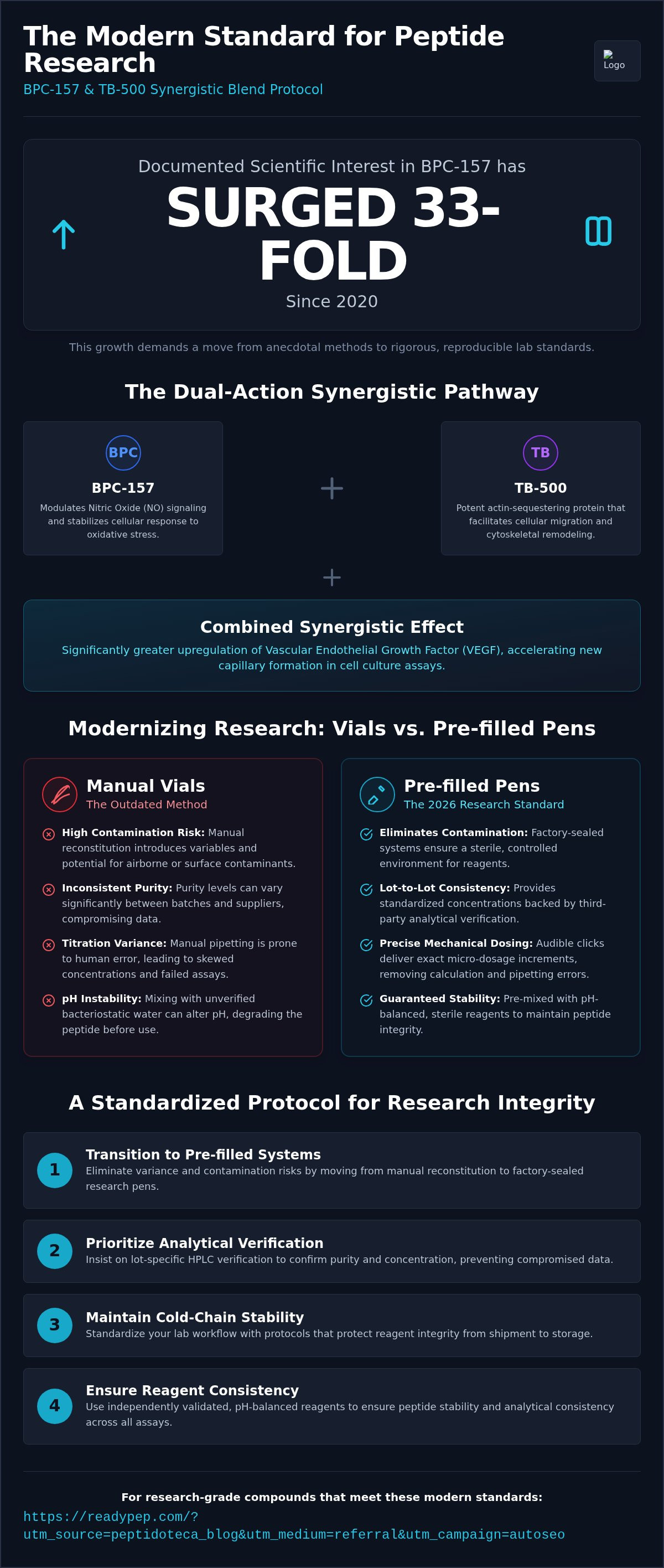
Understanding the dual-action pathway of Pentadecapeptide BPC-157 and Thymosin Beta-4 (TB-500) is fundamental for establishing a BPC-157 TB-500 blend dosage for research. These compounds don't just coexist; they operate through distinct yet complementary molecular mechanisms. BPC-157 functions as a modulator of nitric oxide (NO) signaling, stabilizing the cellular response to oxidative stress and maintaining endothelial integrity. In contrast, TB-500 operates as a potent actin-sequestering protein. It facilitates cellular migration by maintaining a pool of G-actin monomers, which are essential for cytoskeletal remodeling. When combined in in-vitro models, these peptides influence Vascular Endothelial Growth Factor (VEGF) expression more effectively than either compound alone. This upregulation triggers a cascade that accelerates the formation of new capillary structures in cell culture assays.
Upregulation of Growth Factors
Synergistic blends significantly impact fibroblast proliferation. In laboratory settings, the presence of both peptides creates a robust environment for extracellular matrix (ECM) remodeling. Researchers observe specific outcomes in these models:
- Enhanced Proliferation: Accelerated division of fibroblasts compared to single-peptide controls.
- ECM Structural Integrity: Measurable increase in collagen deposition and organization within the culture medium.
- Optimized Uptake: Faster rates of cellular uptake in aqueous solutions when concentrations are precisely titrated.
Quantifying these rates requires a standardized approach. The synergistic effect relies on the synchronized activation of growth factor receptors. This ensures the cellular environment remains primed for regenerative modeling throughout the assay duration.
Research Reproducibility Challenges
The primary barrier to reproducible data isn't the hypothesis; it's the reagent. Purity remains the critical variable. Even minor deviations in chemical composition can alter the synergistic interaction between these peptides. For instance, pH variance directly impacts peptide stability and subsequent assay results. If the solution isn't pH-balanced, the peptides may degrade before cellular uptake occurs. This makes verifying research peptide quality standards an essential step in any 2026 laboratory protocol. Without lot-specific HPLC data, researchers risk publishing results based on contaminated or under-dosed reagents. Utilizing a verified BPC-157 + TB-500 40mg blend ensures that molar concentrations remain stable. This analytical consistency is the only way to validate the BPC-157 TB-500 blend dosage for research across multiple study cohorts.
Calculating BPC-157 TB-500 Blend Dosage for In-Vitro Assays
Establishing a precise BPC-157 TB-500 blend dosage for research requires moving beyond the guesswork of manual reconstitution. In a laboratory setting, precision is the difference between a reproducible study and a failed assay. The challenge lies in converting mechanical delivery into exact molar concentrations for cell culture volumes. Most researchers face significant variance when using traditional vials, where even a slight pipetting error can skew the entire longitudinal study. ReadyPep's 40mg blend solves this by providing a standardized concentration that facilitates rapid titration.
By using a pre-filled pen, you eliminate the risk of contamination during the mixing phase. This allows for a more controlled environment when studying peptide interactions in-vitro. It's about removing the friction of manual prep and focusing on the data. Consistency in reagent delivery ensures that your results are a reflection of the compound's performance, not preparation errors.
Pre-filled Pen Concentration Mechanics
The mechanics of a pre-filled pen allow for micro-dosage increments via audible mechanical clicks. Each click represents a fixed volume of the 40mg aqueous solution. To calculate the exact milligram (mg) dosage, you divide the total peptide content by the total number of clicks available in the device. This reduces mathematical error in high-throughput screening. It ensures every well in a multi-plate assay receives an identical concentration of the synergistic blend. You can maintain a precise BPC-157 TB-500 blend dosage for research without the inconsistencies of manual pipetting.
Consistency is paramount. If your protocol requires a specific molar concentration, the mechanical precision of the pen ensures that the delivery remains uniform across multiple sessions. This level of accuracy is nearly impossible to achieve with manual titration in a high-pressure lab environment. The device acts as a built-in gatekeeper for accuracy.
Dilution Protocols for Cell Media
Peptide bioactivity depends on stability. In aqueous laboratory environments, peptides have a finite half-life. A WADA study on TB-500 metabolism highlights the complexities of detecting and synthesizing metabolites in-vitro. This research underscores why maintaining sterility and pH balance is critical during multi-phase protocols. When introducing the BPC-157 + TB-500 40mg blend to culture media, follow strict aseptic techniques:
- Temperature Equilibration: Bring the pen to room temperature to ensure consistent viscosity.
- Port Sterilization: Sanitize the delivery port with 70% isopropyl alcohol before every dispense.
- Direct Dispensing: Add the calculated volume directly into the sterile media to minimize surface loss.
- Agitation: Gently swirl the solution to ensure uniform peptide distribution throughout the media.
This protocol ensures the peptides remain bioactive and the assay remains uncontaminated. For labs looking to streamline their workflow without sacrificing accuracy, utilizing precision-engineered research tools is the most efficient path forward. Standardizing your titration schedule around these mechanical increments allows for more reliable longitudinal data.
Pre-filled Pens vs. Manual Vials: A Comparative Analysis
Manual reconstitution is the weakest link in high-precision assays. While traditional vials are the industry legacy, they introduce significant variance that can compromise the BPC-157 TB-500 blend dosage for research. Every step of manual preparation-from the introduction of bacteriostatic water to the final pipetting stage-presents an opportunity for human error. These micro-deviations accumulate. By the time the reagent reaches the cell culture, the actual concentration may differ from the theoretical model. Transitioning to factory-sealed, pre-filled pens eliminates these variables by providing a standardized, ready-to-use solution.
Efficiency in the lab is measured by time-to-assay metrics. Manual setups require cleaning, sterilization, and precise mixing, which can take 15 to 20 minutes per batch. Pre-filled pens reduce this to seconds. This streamlined workflow allows researchers to focus on data collection rather than reagent preparation. It's a move from approximation to absolute consistency.
Precision and Accuracy Metrics
Syringe graduations are subjective. One researcher's "0.1ml" might differ slightly from another's based on visual alignment and parallax error. Mechanical clicks are binary. They provide an audible and tactile confirmation of delivery that removes the guesswork from titration. This is especially critical when managing high-purity synergistic blends where milligram accuracy is non-negotiable.
Traditional vial-and-needle setups also suffer from inherent physical limitations. Dead space is defined as the residual volume of fluid remaining in the syringe hub and needle after a full plunger depression, a factor that accounts for up to 15% reagent waste in traditional setups. In contrast, the mechanical piston in a pre-filled pen ensures nearly 100% reagent delivery. This precision ensures that the BPC-157 TB-500 blend dosage for research remains consistent throughout the entire life of the device.
Stability and Oxidation Control
Peptide bioactivity is fragile. Once a vial is punctured, the vacuum is broken, and the contents are exposed to oxygen. This oxidation process begins to degrade the peptide chain immediately, shortening the effective shelf-life of the reconstituted solution. Pre-filled pens utilize a vacuum-sealed, multi-dose chamber that protects the aqueous solution from atmospheric exposure. This design maintains the integrity of the 40mg blend from the first click to the last.
Cold-chain integrity is the other pillar of stability. ReadyPep ensures that every pen is shipped via temperature-controlled logistics to prevent thermal degradation. For a deeper look at optimizing your laboratory environment, see our guide on improving lab workflow with pre-filled pens. By maintaining a factory seal and strict temperature controls, you ensure that the synergistic interaction between BPC-157 and TB-500 is never compromised by environmental factors.
Standardized Research Protocol for Synergistic Peptide Studies
Standardizing the BPC-157 TB-500 blend dosage for research is about more than just accuracy; it's about making your findings bulletproof for peer review. A reproducible protocol starts with the physical reagent and ends with meticulous data logging. Researchers can't afford to overlook the minor variables that derail longitudinal studies. Consistency is the only path to empirical truth in a laboratory environment.
Before any application, match the pen's lot number to the independent HPLC reports provided by Janoshik Analytical. This step is non-negotiable. It confirms that the peptide purity meets the necessary analytical thresholds required for high-stakes in-vitro modeling. Once verified, allow the pen to equilibrate to the laboratory's ambient temperature. Cold reagents can alter viscosity and impact the mechanical click precision of the delivery system. It's a small detail that prevents significant titration errors.
Phase 1: Verification and Preparation
Preparation is where most contamination occurs. Start by cross-referencing Janoshik Analytical reports to ensure purity assurance for your specific batch. Sterilize the pen interface using 70% isopropyl alcohol before bringing it into a clean-bench environment. This prevents the introduction of external microbes into your cell culture. Finally, establish your baseline controls within the in-vitro model. This ensures any observed synergistic effects are statistically significant rather than environmental artifacts.
Phase 2: Execution and Data Collection
Executing the incremental delivery schedule requires a steady hand and precise mechanical calibration. Apply the BPC-157 and TB-500 blend to the target cell line, ensuring uniform distribution across the medium. Monitor for synergistic signaling markers, such as Akt/mTOR phosphorylation, to quantify the cellular response. After the assay is complete, manage the disposal of the device according to the Safe Disposal of Used Research Peptide Pens protocol to maintain biohazard safety standards.
Publication-ready research depends on transparency. Record every lot-specific data point, including the HPLC purity and the exact BPC-157 TB-500 blend dosage for research used in each trial. This level of detail allows other investigators to replicate your results with total confidence. If you're ready to upgrade your laboratory's efficiency with verified reagents, you can access Janoshik-tested peptide pens here to ensure your next study meets the highest analytical standards. Don't let preparation friction slow down your discovery process.
Ensuring Research Integrity with ReadyPep Analytical Standards
Research integrity isn't a suggestion; it's the baseline for credible discovery. When calculating the BPC-157 TB-500 blend dosage for research, the analytical profile of the reagent is your most significant variable. ReadyPep bridges the gap between raw chemical procurement and high-throughput laboratory application by providing factory-verified standards. This transparency ensures that your in-vitro models aren't compromised by batch variance or hidden impurities. It's about maintaining a sterile, predictable environment from the first titration to the final data point.
The transition from manual reconstitution to ready-to-use formats is a strategic choice for modern labs. It eliminates the friction of preparation and the risk of reagent degradation. By utilizing a standardized delivery system, you ensure that every milligram of the synergistic blend is bioactive and stable. This level of control is essential for long-term studies where even minor fluctuations can skew your results.
Analytical Verification Processes
Every research pen is backed by lot-specific documentation. Reviewing HPLC and Mass Spectrometry reports allows you to verify the exact purity and molecular weight of the peptides before they ever touch your cell cultures. Beyond purity, pH-balanced aqueous stability is critical. Maintaining cellular homeostasis requires reagents that don't disrupt the delicate acid-base balance of the culture media. This is why many investigators select the Repair Protocol for tissue culture studies. It provides a reliable, pH-verified BPC-157 TB-500 blend dosage for research that integrates seamlessly with standard laboratory protocols.
Sourcing for Global Research
Acquiring high-purity research chemicals across borders often presents logistical challenges. ReadyPep simplifies this process by offering comprehensive support for navigating international customs. This ensures a consistent reagent supply for multi-year studies, preventing the data gaps that occur when shipments are delayed or compromised. To prevent thermal degradation, all products are shipped via worldwide cold-chain logistics. This maintains the structural integrity of the peptide chains from the manufacturing facility to your lab bench.
Precision reagents are the foundation of reproducible science. Don't let inconsistent sourcing or manual preparation errors undermine your discovery. Secure your research integrity and order pre-filled peptide pens today to ensure your lab operates at the highest analytical standard. It's time to focus on the data, not the preparation.
Advancing Laboratory Standards for Synergistic Peptide Research
Standardizing the BPC-157 TB-500 blend dosage for research is no longer a matter of manual approximation. Modern in-vitro protocols demand the elimination of variables that compromise data integrity. By transitioning to pre-filled delivery systems, investigators remove the friction of reconstitution and the 15% reagent waste associated with traditional syringe dead space. High-throughput screening requires the calm assurance of factory-sealed, pH-balanced reagents that maintain cellular homeostasis throughout longitudinal studies. It's a shift toward absolute consistency.
Accountability is the new industry benchmark. Every study deserves the transparency of lot-specific HPLC and mass spectrometry testing to ensure absolute purity. ReadyPep provides this empirical foundation through Janoshik Analytical verification and guaranteed global cold-chain delivery. These standards protect your reagents from thermal degradation and atmospheric oxidation from the moment of synthesis to the point of assay. Precision tools lead to precision results.
You can now elevate your research with clinically precise BPC-157 and TB-500 pens from ReadyPep. Focus on the breakthroughs that matter by utilizing tools engineered for maximum contamination control and titration accuracy. Your next discovery starts with a more reliable protocol.
Frequently Asked Questions
What is the standard ratio for a BPC-157 and TB-500 blend in research?
The standard ratio in a 40mg synergistic blend is typically a 1:1 concentration of each peptide. This balanced formulation ensures that both Pentadecapeptide BPC-157 and Thymosin Beta-4 are present in equal molar amounts for in-vitro studies. Researchers rely on this consistency to observe how both compounds influence cellular pathways simultaneously. Lot-specific documentation from Janoshik Analytical provides the exact analytical profile for every batch produced by Metatide Healthcare.
How do I calculate the concentration per click for a 40mg pre-filled pen?
To determine the BPC-157 TB-500 blend dosage for research at the micro-level, divide the total 40mg content by the mechanical clicks available in the pen. This calculation provides the exact milligram delivery per increment. Using this method eliminates the mathematical errors often associated with manual syringe graduations. It allows for precise titration in high-throughput screenings, ensuring every well in your multi-plate assay receives a uniform concentration of the synergistic peptide reagent.
Can I use the BPC-157 TB-500 blend for in-vivo animal studies?
No, these reagents are intended solely for in-vitro laboratory research conducted by qualified scientific personnel. ReadyPep doesn't sell products for human or veterinary use, and they aren't suitable for in-vivo animal testing services. Using these compounds outside of a controlled cell culture or biochemical assay environment violates the established research protocol. Maintaining strict adherence to in-vitro applications ensures the integrity of the study and complies with standard safety regulations for research chemicals.
How should the BPC-157 TB-500 research pen be stored for long-term stability?
Long-term stability requires consistent refrigeration between 2°C and 8°C. You should avoid exposing the aqueous solution to direct light or significant temperature fluctuations, as these factors can trigger peptide degradation. The vacuum-sealed environment of the pre-filled pen helps protect the blend from oxidation. Maintaining this cold chain from delivery through the duration of your study ensures that the peptide chains remain bioactive and structurally intact for your assays.
How do I verify the purity of my ReadyPep research pen?
You can verify the purity by reviewing the lot-specific HPLC and mass spectrometry documentation provided with every order. ReadyPep includes independent third-party testing reports from Janoshik Analytical for every batch. These certificates of analysis confirm the chemical identity, purity levels, and pH balance of the reagent. Accessing this data allows researchers to match their specific BPC-157 TB-500 blend dosage for research with empirical proof of the compound's analytical quality.
What are the consequences of using impure peptides in cell culture research?
Impure peptides introduce uncontrolled variables that can completely derail your research outcomes. Contaminants may trigger unintended inflammatory responses in cell cultures or lead to premature cell death, effectively masking the true effects of the peptides. These impurities often result in non-reproducible data, which can prevent publication in peer-reviewed journals. Utilizing factory-sealed pens with verified high-purity standards is the only way to ensure that your signaling observations are statistically significant and accurate.
Is cold-chain shipping required for BPC-157 and TB-500 blends?
Yes, cold-chain shipping is mandatory to prevent thermal degradation during transit. Peptides are sensitive to heat, which can break down the molecular bonds and render the reagent inactive before it reaches the laboratory. ReadyPep provides free worldwide cold-chain shipping to maintain the structural integrity of the 40mg blend. This temperature-controlled logistics chain ensures that the peptides arrive in a stable, bioactive state, ready for immediate use in your standardized research protocols.
How does the BPC-157 and TB-500 synergy affect fibroblast migration in-vitro?
The synergy between these peptides accelerates fibroblast migration by upregulating Vascular Endothelial Growth Factor (VEGF) expression and facilitating actin-sequestering. In cell culture assays, BPC-157 stabilizes the nitric oxide signaling response while TB-500 promotes the cytoskeletal remodeling necessary for movement. This dual-action pathway creates a more robust migratory response than either peptide can achieve alone. It's a primary focus for researchers studying extracellular matrix remodeling and capillary structure formation in controlled in-vitro environments.
Disclaimer
Educational content only. Not medical advice.


