

How much of your research data is actually a byproduct of manual reconstitution error? In the high-stakes environment of 2026, relying on traditional vial-and-syringe methods introduces variables that modern laboratories can no longer afford. You know that even a minor calculation mistake or a slight temperature fluctuation during mixing can compromise an entire study. The shift toward pre-mixed peptide stacks for research represents more than just convenience; it's a fundamental upgrade in data integrity. By moving away from manual preparation, you eliminate the primary source of laboratory contamination and dosing variance in your in-vitro studies.
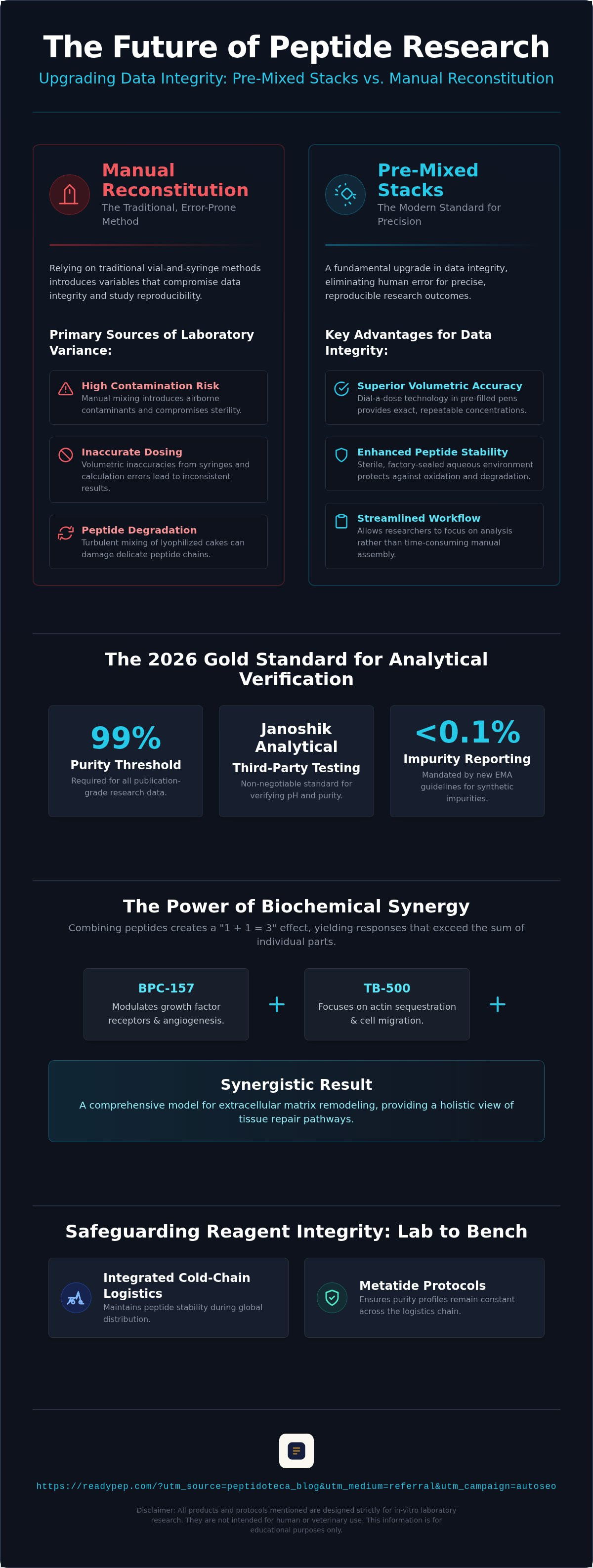
This article explores how switching to pre-filled pens ensures your protocols remain precise and reproducible. You'll discover how these systems protect against peptide degradation and why third-party verification of pH and purity, such as Janoshik analytical testing, is now the non-negotiable standard for publication-grade results. We'll break down the latest 2026 regulatory shifts regarding Category 1 reclassifications and examine how streamlined workflows allow researchers to focus on analysis rather than assembly. For those seeking the highest level of precision, transitioning to verified, pre-filled formats provides a clear path to eliminating friction in the lab.
Key Takeaways
- Understand why the transition from lyophilized vials to aqueous pre-filled formats is essential for minimizing human error in modern laboratories.
- Analyze the biochemical synergy of specific combinations, such as BPC-157 and TB-500, to optimize in-vitro research outcomes.
- Discover how dial-a-dose technology in pre-mixed peptide stacks for research provides superior volumetric accuracy over traditional manual reconstitution.
- Identify the 2026 standards for analytical verification, focusing on the necessity of third-party purity and pH testing via Janoshik Analytical.
- Learn how integrated cold-chain logistics and Metatide protocols safeguard reagent integrity during global distribution to maintain study reproducibility.
Defining Pre-mixed Peptide Stacks for Modern Laboratory Research
A true pre-mixed peptide stack is a single, homogenized aqueous solution containing multiple synergistic compounds. This differs significantly from "bundles" where separate lyophilized vials are simply sold together. In the current research environment, pre-mixed peptide stacks for research represent the transition from manual, error-prone preparation to factory-standardized reagents. The integrity of these stacks begins with high-fidelity solid-phase peptide synthesis (SPPS), ensuring that the primary amino acid sequences meet the 99% purity threshold required for publication-grade data. Precision isn't optional. It's the foundation of reproducible science.
As of 2026, the standard for in-vitro studies has shifted. With the FDA reclassifying compounds like BPC-157 and TB-500 back into Category 1 for compounding eligibility, researchers are demanding higher transparency. New EMA guidelines now mandate the reporting of any synthetic impurity exceeding 0.1%. This makes the precision of the initial mix paramount. Using a BPC-157 + TB-500 40mg pre-mixed solution ensures that the molar ratios remain constant across every assay. This level of precision is impossible to achieve consistently when researchers are forced to manually reconstitute separate powders with varying volumes of bacteriostatic water.
The Mechanical Advantage of Pre-filled Pens
Pre-filled pens eliminate the need for external syringes and external mixing agents. Manual reconstitution is a primary source of laboratory variance. It often introduces air, potential contaminants, and volumetric inaccuracies. Factory-sealed aqueous pens provide a sterile environment that protects the peptide chain from oxidation. By removing these human variables, laboratories can ensure that the concentration delivered to the cellular culture is exactly what the protocol dictates. It's about efficiency. It's about data integrity. You don't have to worry about the degradation that occurs during the turbulent mixing of lyophilized cakes.
In-Vitro Specificity and Compliance
These protocols are designed strictly for in-vitro laboratory research. They aren't for human or veterinary use. Maintaining this distinction is critical for regulatory compliance and scientific ethics. Using pre-mixed peptide stacks for research allows for the precise modeling of complex cellular signaling pathways without the noise of preparation errors. Every pen comes with documented lot numbers. This facilitates radical transparency. Researchers can audit the analytical standards of their reagents against independent testing, ensuring that the pH levels and purity profiles haven't deviated during the logistics chain. High-standard gatekeeping is what separates credible research from anecdotal observation.
The Biochemistry of Synergistic Peptide Combinations
Synergy is the cornerstone of modern molecular biology. In a research context, the application of multiple compounds often yields a biological response that exceeds the sum of individual parts. This "1 + 1 equals 3" effect is why pre-mixed peptide stacks for research are becoming the standard for complex in-vitro modeling. When two peptides target distinct but converging signaling nodes, they can amplify downstream effects such as protein synthesis or mitochondrial biogenesis. These interactions allow researchers to observe high-fidelity cellular behavior that single-compound assays simply can't replicate.
A primary example is the combination of BPC-157 and TB-500 40mg in fibroblast research. While BPC-157 acts as a potent modulator of growth factor receptors and angiogenesis, TB-500 (Thymosin Beta-4) focuses on actin sequestration and cell migration. When applied together, they create a comprehensive model for extracellular matrix remodeling. This synergy provides a more holistic view of tissue repair pathways than analyzing either peptide in isolation. For labs requiring these specific ratios, the Metatide Healthcare inventory provides standardized solutions that eliminate preparation noise.
Neurogenesis modeling also benefits from this approach. Selank and Semax are frequently paired to investigate BDNF (Brain-Derived Neurotrophic Factor) expression and neuroprotective pathways. By utilizing pre-mixed peptide stacks for research, investigators ensure that the concentration of each compound remains identical across all culture plates, which is vital for quantifying changes in neurite outgrowth or neurotransmitter signaling.
Repair and Recovery Signaling Pathways
The Repair Protocol is designed to explore the intersection of peptide signaling and tissue integrity. In-vitro stacks involving GHK-Cu focus on the upregulation of collagen and glycosaminoglycans within the extracellular matrix. Adding Thymosin Alpha-1 to these models allows researchers to examine the immune system's role in the recovery process. These combinations help map the intricate communication between various cell types during the inflammatory phase of repair.
Metabolic and Longevity Research Stacks
Longevity studies frequently utilize NAD+ 1000mg to investigate SIRT1 activation and cellular senescence. When combined with MOTS-c 40mg, researchers can assay mitochondrial function and metabolic flexibility under stress. Stacking CJC-1295 with Ipamorelin further enhances these models by simulating growth hormone signaling, providing a robust framework for studying cellular aging and energy metabolism without the variability of manual mixing.
Pre-mixed Pens vs. Manual Reconstitution: A Quantitative Comparison
Manual reconstitution is the legacy method. It's imprecise. It's slow. Research in 2026 demands better. While competitors often suggest using a "peptide calculator" for manual mixing, this ignores the inherent human error. Every transfer between a vial and a syringe introduces a margin of error. Over 100 research sessions, these deviations accumulate. They skew data. They ruin reproducibility. Using pre-mixed peptide stacks for research eliminates these variables at the source. You aren't just buying a product; you're buying a standardized protocol.
Waste reduction is a measurable advantage. When you reconstitute a 40mg vial manually, you lose a percentage of the reagent to syringe "dead space" and vial wall adhesion. It's an invisible tax on your research budget. Pre-filled pens use a plunger system that minimizes this residual loss. You get exactly the volume specified. Stability is also superior. Factory-sealed aqueous solutions in pens are prepared in controlled environments with precise pH balancing. They don't suffer the rapid oxidation seen in vials that have been repeatedly punctured by needles. The seal remains intact. The integrity remains constant.
Accuracy of Injector Pen Clicks
The Metatide pen mechanism utilizes a dial-a-dose system. Each click provides a fixed, microliter-precise volume. This isn't just about convenience. It's about the physics of fluid dynamics. Traditional insulin syringes rely on visual graduation marks. These are notoriously difficult to read accurately at micro-dose levels. The mechanical advantage of the pen ensures that every culture plate receives the exact same concentration. It removes the human variable from cellular assays. By eliminating open-vial transfers, you also significantly reduce the risk of airborne laboratory contamination.
Cost-Benefit Analysis for Research Institutions
Institutions often focus on the upfront cost of reagents. This is a narrow view. You must account for labor hours. Manual reconstitution takes time. It requires meticulous preparation. When you factor in the cost of a researcher's time, pre-filled pens become the more efficient choice. More importantly, consider the cost of a failed peer-review. Reagent variability is a common reason for rejected publications. High-purity, pre-verified stacks provide the consistency required for top-tier journals. You can find more resources on improving lab workflow with pre-filled pens in our technical library.
Sourcing High-Purity Stacks: Verification and Analytical Standards
Analytical verification isn't a luxury. It's the only way to confirm you're receiving the exact sequence you ordered. In 2026, High-Performance Liquid Chromatography (HPLC) and Mass Spectrometry are the minimum requirements. HPLC provides the purity percentage. Mass Spectrometry confirms the molecular weight. Without both, you're guessing. When sourcing pre-mixed peptide stacks for research, you must demand more than a simple purity claim. For quantitative research, 99% purity is the standard. Any vendor that can't provide lot-specific data is a liability to your research integrity.
pH testing is equally critical for pre-mixed peptide stacks for research. Aqueous solutions are sensitive. If the pH isn't precisely balanced, the peptides will precipitate or degrade. This is where Janoshik Analytical plays a vital role. They provide independent verification of not just purity, but also the pH levels of the aqueous solution. This level of detail ensures the stack remains stable during shipping and storage. Most competitors ignore pH data. We don't. Transparency is our baseline. It's the only way to ensure your in-vitro results aren't skewed by reagent instability.
Reading a Certificate of Analysis (COA)
A COA must be lot-specific. Generic reports are a red flag. Look for the timestamp and the specific batch number. Check the impurity profile. If synthetic impurities exceed 0.1%, the batch may not meet EMA guidelines established in June 2026. You can learn more about research peptide quality standards to ensure your lab remains compliant. Authentic reports from Janoshik Analytical include a QR code for direct verification. Use it. Never trust a report that can't be verified on the lab's own portal.
Metatide Healthcare Manufacturing Standards
ReadyPep operates as the worldwide authorized distributor for Metatide Healthcare. This Swiss-based manufacturer adheres to cGMP standards, ensuring consistency across large-scale research protocols. This partnership isn't just about distribution. It's about accountability. We act as a high-standard gatekeeper. Every lot undergoes rigorous analytical testing before it reaches your lab. This commitment to verification disrupts an industry often plagued by opacity. We provide the empirical proof you need to trust your reagents. It's a sophisticated approach for researchers who value precision above all else.
Ready to upgrade your lab's precision? View our third-party verified peptide stacks.
ReadyPep: Streamlining In-Vitro Workflow with Metatide Protocols
ReadyPep operates as a specialized logistics bridge for the modern researcher. We understand that science moves fast. Procurement shouldn't slow it down. By providing immediate access to the Metatide Healthcare inventory, we remove the technical barriers associated with traditional reagent sourcing. Utilizing pre-mixed peptide stacks for research allows your team to skip the complex math of manual reconstitution. It's about efficiency. It's about getting to the data faster. Our system is built for institutions that prioritize high-throughput results without sacrificing the granular precision of their protocols.
Stability during transit is often the weak point in international peptide sourcing. Aqueous solutions are fragile. They require strict temperature control to prevent peptide chain cleavage. ReadyPep addresses this by providing free global cold-chain shipping for all orders. We manage the environmental variables from our UK distribution hub to your laboratory door. This ensures that the pre-mixed peptide stacks for research you receive maintain the exact molecular integrity verified at the point of manufacture. We handle the logistics friction so you can focus on the cellular assays.
Protocol Overview: From Mind to Repair
Selecting the right protocol depends on your specific in-vitro modeling goals. The Mind Protocol is engineered for cognitive research, focusing on neuroprotective signaling and synaptic plasticity. Labs investigating metabolic efficiency or performance-based modeling often utilize the Edge Protocol. In 2026, global delivery standards have become more rigorous. We've optimized our customs clearance processes to ensure that your reagents arrive on time and fully compliant with international research standards. There's no guesswork involved in our shipping timeline.
Getting Started with Ready-to-Use Reagents
Accessing the ReadyPep inventory is a streamlined experience. You can browse our catalog by protocol or individual compound, depending on your research design. Every product page provides a direct link to the latest Janoshik Analytical testing data. This allows you to verify the purity and pH of your specific lot before the package even arrives. We believe in radical transparency. It's the only way to operate in a high-stakes scientific environment. Once you've selected your protocol, our automated system handles the rest, providing real-time tracking and temperature monitoring throughout the journey.
Don't let manual preparation limit your laboratory's potential. Optimize your research workflow with ReadyPep pre-filled pens.
Elevating Research Integrity with Standardized Protocols
The evolution of laboratory research in 2026 demands a departure from legacy manual processes. By adopting pre-mixed peptide stacks for research, you eliminate the volumetric inaccuracies and contamination risks inherent in vial-based reconstitution. Standardized dial-a-dose technology ensures that every cellular assay receives a precise concentration, maintaining the reproducibility required for top-tier publication. This isn't just about convenience. It's about securing the integrity of your data.
As an authorized Metatide Healthcare distributor, ReadyPep bridges the gap between Swiss manufacturing excellence and global laboratory application. Every lot undergoes independent Janoshik Analytical verification for purity and pH, ensuring your reagents meet the most stringent analytical standards. Combined with free worldwide cold-chain shipping, this approach secures the molecular integrity of your compounds from the factory to your incubator. It's time to remove the preparation variables and focus on your analysis. Your findings deserve the highest level of reagent precision available.
Explore Pre-filled Research Peptide Stacks at ReadyPep and secure the gold standard for your next in-vitro study.
Frequently Asked Questions
What are the benefits of pre-mixed peptide stacks for research?
Pre-mixed peptide stacks for research eliminate the human error inherent in manual reconstitution. These stacks provide standardized ratios of synergistic compounds, such as BPC-157 and TB-500, in a single aqueous solution. This ensures every assay receives a consistent concentration, which is critical for study reproducibility. By removing the need for external bacteriostatic water and manual syringes, laboratories reduce contamination risks and streamline their overall workflow.
How long do pre-filled research peptide pens last after opening?
Research peptide pens typically maintain their integrity for 30 days when stored under refrigerated conditions. Because the aqueous solution is factory-sealed and dispensed via a mechanical plunger, the risk of oxidation and airborne contamination is significantly lower than in traditional vials. Always ensure the pen is returned to refrigeration immediately after use to protect the peptide chain from thermal degradation. Documented stability profiles are available for each Metatide protocol lot.
Are pre-mixed peptide pens compatible with standard in-vitro assays?
Yes, pre-filled research pens are specifically designed for high-precision in-vitro laboratory assays. The dial-a-dose mechanism allows for the delivery of microliter-precise volumes directly into cellular cultures or testing reagents. This mechanical precision is essential for modeling complex signaling pathways where exact molar concentrations are required. Using these standardized reagents ensures that the chemical variables remain constant across multiple study plates or longitudinal research sessions.
Why is cold-chain shipping necessary for pre-mixed peptide stacks?
Cold-chain shipping is necessary because peptides are thermally sensitive molecules. Exposure to ambient temperatures during transit can cause the peptide sequence to break down or lose its secondary structure. ReadyPep provides free worldwide cold-chain shipping to ensure that every pre-mixed peptide stack for research arrives with its purity and pH levels intact. Maintaining a stable temperature from the UK distribution hub to the lab door is a non-negotiable standard for scientific reagents.
How do I verify the purity of my ReadyPep research pen?
Every ReadyPep research pen is linked to a lot-specific Certificate of Analysis from Janoshik Analytical. You can verify the purity and pH of your specific batch by scanning the QR code provided with your documentation. This direct link to third-party HPLC and Mass Spectrometry data ensures radical transparency. High-standard gatekeeping is essential in 2026. It allows researchers to audit their reagents against independent analytical standards before beginning any experimental protocol.
Can I use research peptide pens for animal or human studies?
No, these products are intended solely for in-vitro laboratory research by qualified scientific personnel. They are strictly not for human or veterinary use. ReadyPep does not sell peptides for in-vivo testing or therapeutic applications. Adhering to these guidelines is critical for laboratory compliance and regulatory ethics. Every pen is labeled Research Use Only to maintain the distinction between laboratory reagents and pharmaceutical compounds.
What is the difference between a peptide bundle and a pre-mixed protocol?
A peptide bundle typically consists of separate lyophilized vials that require manual mixing by the researcher. In contrast, a pre-mixed protocol is a single, homogenized aqueous solution containing multiple compounds in a factory-standardized ratio. Pre-mixed protocols, such as those in the Metatide Healthcare inventory, eliminate the preparation noise and volumetric errors associated with manual reconstitution. This standardized format is the gold standard for labs requiring high-fidelity, synergistic modeling.
How do I calculate the dosage from a pre-filled injector pen?
Calculating the volume from a pre-filled injector pen is handled through the mechanical dial-a-dose system. Each click of the pen corresponds to a specific microliter volume defined in the product's technical data sheet. By knowing the concentration of the stack, researchers can precisely calculate the amount of peptide delivered to each assay. This method provides superior volumetric accuracy compared to reading visual graduations on a standard insulin syringe, which can be prone to parallax error.
Disclaimer
Educational content only. Not medical advice.


