

Why do modern laboratories still settle for vendor-supplied data without independent verification? In an era where the FDA reclassified 14 key peptides into Category 1 as of April 23, 2026, the margin for error has vanished. You shouldn't have to guess if your BPC-157 or CJC-1295 will yield consistent results. Inconsistent lot quality and shipping degradation continue to plague in-vitro research, making rigorous research peptide quality standards more critical than ever. Precision isn't just a goal; it's a requirement for scientific validity.
You likely agree that a Certificate of Analysis (COA) is only as reliable as the laboratory that produced it. This guide helps you master the analytical benchmarks and verification protocols required to ensure peptide purity and stability for precise research. We'll break down HPLC and Mass Spectrometry data, establish a reliable sourcing checklist, and show you how to maintain logistical integrity through cold-chain solutions. Stop managing uncertainty and start verifying your science.
Key Takeaways
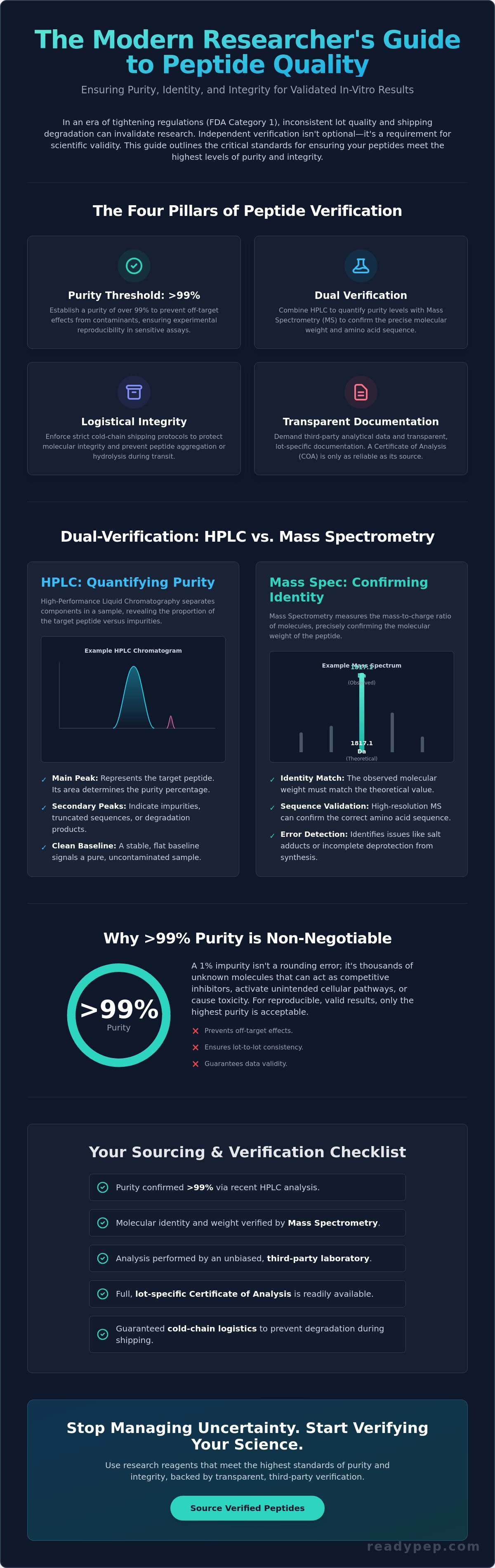
- Establish a purity threshold of >99% to prevent off-target effects and ensure experimental reproducibility in sensitive in-vitro assays.
- Utilize a dual-verification approach combining HPLC for purity levels and Mass Spectrometry for precise molecular sequence confirmation.
- Adhere to rigorous research peptide quality standards by demanding third-party analytical data and transparent lot-specific documentation.
- Protect molecular integrity by enforcing strict cold-chain protocols to prevent peptide aggregation or hydrolysis during transit.
- Streamline laboratory efficiency and dosing precision by utilizing pre-filled research pens sourced from verified manufacturers.
Defining Research Peptide Quality Standards in 2026
Research peptide quality standards are the analytical benchmarks that verify molecular identity, purity, and potency. In 2026, the distinction between industrial grade and research-grade material is the difference between a failed experiment and a breakthrough. Industrial peptides often contain residual solvents, salts, or heavy metals. These are acceptable for bulk chemical applications. They're catastrophic for cellular assays. Research-grade material requires a higher level of scrutiny. It demands the removal of all synthesis byproducts that could interfere with delicate biological pathways.
High-quality reagents typically originate from Solid-Phase Peptide Synthesis (SPPS). This chemical process allows for the systematic assembly of amino acids. Yet, the process isn't perfect. It can produce deletion sequences where an amino acid fails to attach correctly. Without lot-specific documentation, your lab is flying blind. This data is the only valid proof of quality. It bridges the gap between a vendor's claim and empirical reality. If a supplier can't provide a batch-specific report, the material doesn't belong in your lab.
The Anatomy of a Certificate of Analysis (COA)
A valid COA provides a roadmap of the peptide's journey. You must identify the batch number and manufacturing date to ensure full traceability. These identifiers prevent lot-hopping, where a vendor might send old stock under a new label. The Identity field confirms the molecular weight via Mass Spectrometry. The Purity field reports the relative amount of the target molecule using HPLC. Don't overlook the signature. A timestamped signature from the lead analytical chemist is mandatory. It represents professional accountability. It's the difference between a verified document and an unverified spreadsheet.
Why Standard Purity Levels Matter for In-Vitro Precision
Sensitive in-vitro research demands a purity threshold of >99%. A 1% impurity isn't just a rounding error. It's a potential ligand that could activate unintended cellular pathways. These contaminants are often truncated sequences or protecting group artifacts. They can competitively inhibit your target peptide or cause unexpected cellular toxicity. Consistency is the backbone of the scientific method. You can't achieve it with variable reagents. Adhering to strict research peptide quality standards ensures that every replicate in your study responds to the peptide, not the impurities. Precision isn't optional when reproducibility is on the line.
Analytical Verification: The Role of HPLC, MS, and pH Testing
Verification is the only antidote to uncertainty. While synthesis sets the foundation, analytical testing proves the result. In 2026, relying solely on a manufacturer's internal data is a structural failure in laboratory protocol. Independent, third-party labs like Janoshik Analytical provide the objective friction required to uphold research peptide quality standards. They utilize high-resolution instrumentation to strip away vendor bias, ensuring that what you receive is exactly what you ordered. Data is the only currency that matters in a clinical setting.
HPLC: Quantifying the Main Peak
High-Performance Liquid Chromatography (HPLC) serves as the primary tool for determining relative purity. The process generates a chromatogram where the target peptide appears as a distinct peak. The area under this curve represents the total percentage of the desired molecule. Any secondary peaks are immediate causes for concern. They represent impurities, truncated sequences, or degradation products. Standardizing detection wavelengths is critical. For most research peptides, 214 nm or 220 nm provides the clearest view of the peptide bonds. If the chromatogram shows a noisy baseline, the sample is contaminated. Don't use it.
Mass Spectrometry: Confirming Molecular Identity
Purity without identity is useless. You might have a 99% pure substance that is the wrong molecule entirely. Mass Spectrometry (MS) solves this by measuring the precise molecular weight. The observed mass must match the theoretical value within a narrow margin of error. MS also detects salt adducts or incomplete deprotection. For complex chains or peptidomimetics, high-resolution MS is mandatory. It ensures every amino acid is in its correct sequence. For researchers who prioritize data integrity, using verified research reagents from providers who publish third-party MS data is the only logical path forward.
The Impact of pH and Counter-Ions
Analytical verification must extend to the chemical environment of the peptide. pH testing ensures the reagent won't disrupt the delicate balance of your cell culture media. Most synthetic peptides are produced using Trifluoroacetic acid (TFA). While TFA is an excellent solvent, high residual levels are cytotoxic. They can trigger unintended cellular stress responses. Monitoring TFA levels and ensuring pH neutrality is vital for in-vitro precision. Depending on your assay, you may need a counter-ion exchange. Switching from TFA to acetate or HCl can drastically improve solubility and cell viability. Integrity isn't just about the molecule. It's about the entire chemical profile.
Beyond the Molecule: Logistical Integrity and Cold-Chain Standards
Quality control isn't a static event. It's a continuous process that extends from the laboratory bench to the recipient's freezer. Even the most precisely synthesized molecule can fail if logistical integrity is compromised. Thermal stability remains a primary concern for researchers. Temperature fluctuations during transit can trigger peptide aggregation or hydrolysis. These structural changes render the reagent useless. They introduce variables that undermine research peptide quality standards and ruin experimental replicates. If the molecule's shape changes, its biological activity vanishes.
Environmental factors like light exposure and oxidation also threaten peptide bond integrity. Peptides containing methionine or cysteine are particularly vulnerable to oxidative stress. High-standard vendors mitigate these risks using opaque, vacuum-sealed packaging. Verification of shipping conditions is no longer optional. Modern laboratories now demand temperature indicators in every shipment. These small, color-changing sensors provide empirical proof that the cold chain remained intact from the "First-Mile" to the "Last-Mile." Without this data, you're merely hoping for stability.
Maintaining the Cold Chain Globally
International transit presents unique challenges for reagent viability. Vacuum-insulated packaging is the industry standard for preventing thermal spikes. While some vendors treat cold-chain logistics as a premium add-on, it's actually a baseline requirement for quality. Stability testing data shows that many peptides can remain viable at room temperature for short periods. However, "short" is a relative term that varies by sequence. Why introduce that risk? Reliable suppliers prioritize overnight shipping and specialized cooling agents. They understand that a 48-hour delay in a warm warehouse can compromise months of work.
Storage Protocols in the Laboratory
Integrity must be maintained once the reagent arrives. Lyophilized peptides are generally stable at -20°C for long-term storage. Once reconstituted, their lifespan drops significantly. These liquid reagents require constant refrigeration at 2-8°C. You must avoid repeated freeze-thaw cycles. Ice crystals formed during freezing can shear complex peptide chains, leading to mechanical degradation. For labs using advanced delivery systems, Handling Pre-Filled Pens in Sterile Lab Environments requires specific protocols to prevent contamination. Aliquotting is your best defense against degradation. It ensures you only expose the specific amount needed for a single assay. Precision in storage is just as vital as precision in synthesis.
Identifying High-Quality Peptide Crafters and Manufacturers
Sourcing laboratory reagents is a high-stakes risk-management exercise. In 2026, the rise of specialized peptide manufacturers has redefined research peptide quality standards by prioritizing molecular precision over bulk output. For those tracking the capital and growth behind these biotech innovators, you can check out Pre-IPO Hype to see how high-growth companies connect with institutional and retail investors. Many vendors operate as opaque middlemen, obscuring their manufacturing sources to hide inconsistencies. This lack of transparency is a direct threat to your data. You must look for providers who maintain a direct, verifiable relationship with their production facilities. Accountability is the only bridge between a chemical catalog and a successful assay.
The industry is shifting toward pre-filled research pens to solve a long-standing problem in volumetric accuracy. Traditional lyophilized vials require manual reconstitution, which introduces pipetting errors and potential contamination. Pre-filled formats eliminate these variables at the source. This ensures that every microliter of reagent delivered to your in-vitro model is consistent. If a supplier can't provide lot-specific documentation for these formats, they aren't meeting modern benchmarks. Traceability must be absolute, from the synthesis reactor to the final delivery device.
Automated Synthesis: Setting the Manufacturing Benchmark
Automated synthesis represents the pinnacle of modern peptide production. Unlike manual processes, which are prone to human error in amino acid sequencing, automated systems ensure perfect repetition. Leading manufacturers utilize these advanced systems to maintain tight control over every reaction cycle. Quality control doesn't stop at synthesis. It includes rigorous pre-fill inspection and pen calibration to ensure mechanical reliability. This level of manufacturing expertise directly correlates to your experimental reproducibility. If the synthesis foundation is weak, your research results will be equally unstable.
Evaluating Research Peptide Suppliers
Finding a reliable partner requires a systematic audit of their operations. Don't settle for surface-level claims. Follow this four-step framework to verify integrity:
- Step 1: Verify the manufacturer-distributor relationship to ensure the supply chain is short and transparent.
- Step 2: Request the most recent third-party lab reports for the current lot. Outdated data is a major red flag.
- Step 3: Audit the shipping protocol for cold-chain compliance. Reagents must arrive in temperature-controlled packaging.
- Step 4: Confirm the reagent is strictly labeled and intended for in-vitro research use.
Red flags are often easy to spot if you know where to look. Outdated COAs or missing lot numbers indicate a vendor that values turnover more than precision. If a supplier refuses to provide raw HPLC data, walk away. For laboratories that demand uncompromising accuracy, you can browse pre-filled research peptide pens that integrate these high-level manufacturing standards with transparent third-party verification. Your research is only as good as your reagents. Don't compromise on the source.
The ReadyPep Standard: Verified Reagents for In-Vitro Excellence
ReadyPep doesn't just meet research peptide quality standards; it defines them for the next generation of in-vitro science. We've removed the friction between synthesis and verification. By integrating Metatide Healthcare’s automated manufacturing with Janoshik Analytical’s independent testing, we provide a closed-loop system of accountability. Every batch undergoes rigorous HPLC and MS analysis before it ever reaches our inventory. This isn't marketing hyperbole. It's empirical verification. We provide the data so you can provide the discovery.
Radical transparency is our baseline. While other vendors hide behind outdated COAs, we make lot-specific purity, identity, and pH data available to every researcher. You shouldn't have to guess the quality of your reagents. We provide timestamped, third-party reports that link directly to the batch in your hand. This commitment to data integrity ensures that your experimental replicates remain consistent across different lots. We act as the high-standard gatekeeper so you can focus on the science. No uncertainty. No hidden variables. Just pure molecular precision.
Precision Delivery Systems for the Modern Lab
Manual reconstitution is a legacy risk. It introduces human error, pipetting variance, and contamination. Pre-filled research pens offer a modern solution with superior volumetric accuracy. These systems ensure that your dosing is precise and repeatable every time. For instance, when analyzing Tirzepatide Peptide for In-Vitro Research, the difference between a successful assay and a failed replicate often comes down to delivery consistency. Our pens are calibrated to meet the strictest laboratory requirements. They reduce reagent waste. They eliminate user error. They ensure your in-vitro models receive exactly what the protocol demands.
Sourcing Quality Standards with Confidence
Integrity shouldn't stop at the laboratory door. Our commitment extends to the global cold-chain. We offer free worldwide shipping using vacuum-insulated packaging to ensure your reagents arrive at the required temperature. This logistical precision prevents the aggregation and hydrolysis issues discussed in previous sections. You can access the ReadyPep shop to find validated research bundles and stacks designed for high-throughput environments. Every order includes the specific documentation needed for your lab's compliance audits. It’s time to stop managing vendor uncertainty and start verifying your results. Explore our high-purity research peptide pens and experience the ReadyPep standard today.
Securing the Future of In-Vitro Precision
Scientific breakthroughs depend on the absolute reliability of your reagents. You've seen how HPLC and Mass Spectrometry provide the empirical friction needed to verify molecular identity. You also understand that logistical integrity is just as vital as the synthesis itself. Adhering to rigorous research peptide quality standards isn't just about compliance. It's about protecting the validity of your data and ensuring every replicate is reproducible. Uncertainty has no place in a modern laboratory.
ReadyPep removes the friction from your procurement process. Every reagent is manufactured by Metatide Healthcare and includes lot-specific Janoshik Analytical reports for total transparency. We protect that precision with free global cold-chain shipping to ensure your peptides arrive stable and ready for use. It's time to stop managing vendor risk and start focusing on your next discovery. Order Validated Research Peptide Pen Bundles today and bring uncompromising clarity to your laboratory. Your research deserves reagents that are as precise as your own protocols.
Frequently Asked Questions
What is the minimum purity standard for research peptides in 2026?
A purity level of 98% or higher, as determined by High-Performance Liquid Chromatography (HPLC), is the generally accepted threshold for research peptide quality standards in 2026. For highly sensitive in-vitro assays, many laboratories now demand >99% to eliminate the risk of off-target effects. Lower purity levels often indicate the presence of truncated sequences or residual solvents that can compromise experimental integrity. Precision starts with the purity of your raw material.
How do I verify the authenticity of a Janoshik Analytical report?
You can verify a Janoshik Analytical report by entering the unique task ID or scanning the QR code directly on the official Janoshik website. Reputable suppliers provide these reports for every batch to ensure transparency. This digital cross-referencing ensures the data hasn't been altered or recycled from an older lot. Always match the batch number on your product to the one listed on the verified report before beginning your research.
Why is pH testing important for in-vitro peptide research?
pH testing is critical because acidic or basic reagents can disrupt the delicate balance of cell culture media. Most synthetic peptides contain residual TFA from the synthesis process. If the pH isn't monitored, the reagent might trigger unintended cellular stress responses or toxicity. Maintaining a near-neutral pH ensures that observed biological effects are due to the peptide, not the solvent environment. It's a fundamental requirement for assay stability.
Can I use a research peptide pen for in-vivo animal studies?
No, these products are strictly intended for in-vitro laboratory research. Pre-filled pens are designed for precise volumetric dosing in cellular models and biochemical assays. They aren't authorized or sold for in-vivo animal testing services or any form of human or veterinary therapeutic use. Lab protocols must strictly adhere to the "research use only" designation to maintain regulatory compliance and safety standards.
How does cold-chain shipping impact peptide stability?
Cold-chain shipping prevents thermal degradation, which can lead to peptide aggregation or hydrolysis. Peptides are sensitive to temperature spikes that occur during transit. By maintaining a constant cold environment from the manufacturer to the lab, you preserve the secondary structure of the molecule. This logistical integrity is essential for ensuring that the reagent performs as expected in your experiments. Without it, your results are at risk.
What is the difference between peptide purity and peptide content?
Peptide purity measures the amount of the target peptide relative to other peptide-based impurities. In contrast, peptide content refers to the actual percentage of peptide weight in the final powder, which also contains counter-ions and residual water. A sample can be 99% pure but have only 80% peptide content. Understanding this distinction is vital for calculating exact concentrations in your assays. Always check both values on your Certificate of Analysis.
What are the risks of using peptides without lot-specific documentation?
Using reagents without lot-specific documentation introduces unmanaged variables into your research. You risk using degraded material or batches with inconsistent purity levels, which leads to failed replicates and skewed data. Documentation provides the only empirical proof of identity and stability. Without it, you can't verify that the substance you're testing is actually the molecule you intended to study. It's a structural failure in laboratory protocol.
How should pre-filled research pens be stored upon arrival?
Pre-filled research pens should be stored in a refrigerator at 2-8°C immediately upon arrival. Don't freeze these pens unless specifically directed; ice crystal formation can cause mechanical shearing of complex peptide chains. Keep them in their original packaging to protect the reagents from light exposure. Proper storage is the final step in upholding research peptide quality standards within your facility. Consistency in storage leads to consistency in results.
Disclaimer
Educational content only. Not medical advice.


