

How much research capital is lost each year to a single degree of temperature variance? In a 2026 landscape where the peptide therapeutics market has surged to $53.87 billion, the cost of reagent failure is higher than ever. You’ve likely faced the frustration of inconsistent experimental results, only to realize the culprit was a compromised cold chain or improper handling. Mastering the protocols for preventing freeze-thaw damage to peptides is the only way to ensure that your aqueous reagents maintain their structural integrity from the manufacturer to the lab bench.
We agree that experimental variance caused by degraded materials is an unacceptable friction point in high-stakes research. This guide promises to equip you with the technical knowledge required to protect your investments from thermal cycling. We'll examine the science of molecular aggregation, the specific advantages of pre-filled pen storage, and how to utilize independent lot testing to verify stability. By the end of this manual, you'll have a clear framework for maintaining the high-purity standards that modern laboratory precision demands.
Key Takeaways
- Understand the "concentration effect" where solutes are excluded from growing ice crystals, leading to irreversible structural aggregation.
- Implement verified protocols for preventing freeze-thaw damage to peptides by identifying the hidden risks of commercial "frost-free" refrigeration cycles.
- Differentiate between the storage requirements of lyophilized powders and aqueous pre-filled pens to ensure long-term research viability.
- Leverage independent Janoshik Analytical verification to establish a purity baseline before beginning sensitive in-vitro protocols.
- Identify how sequence-specific traits, such as oxidation-prone residues, influence a compound's vulnerability to thermal transitions.
What Is Freeze-Thaw Damage to Peptides?
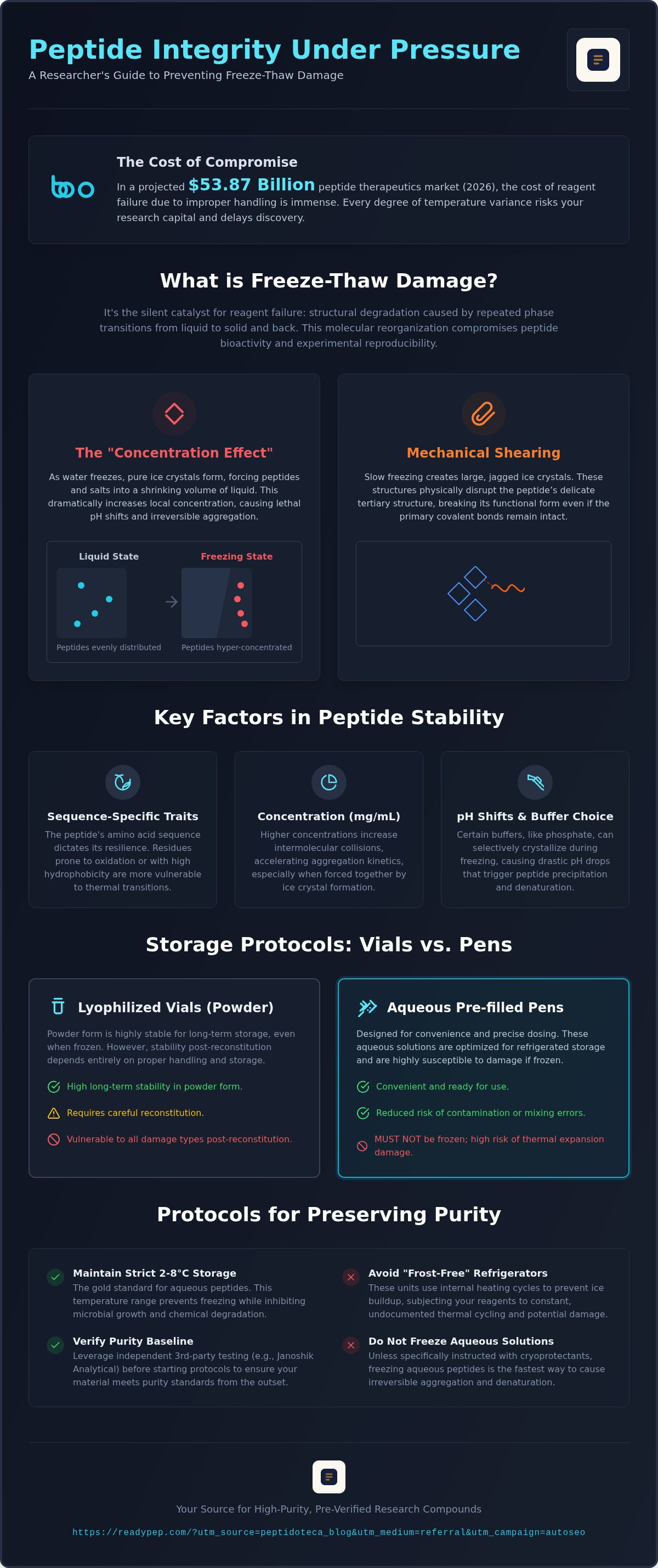
Freeze-thaw damage is the silent catalyst for reagent failure. It's defined as the structural degradation of a compound caused by repeated phase transitions from liquid to solid and back again. This process isn't a passive change in temperature. It's a violent molecular reorganization. Every time a peptide solution freezes, it undergoes a physical and chemical stress test that can compromise its bioactivity. Preventing freeze-thaw damage to peptides is essential for maintaining the reproducibility of in-vitro assays. Without proper protocols, your expensive research materials become little more than inert waste.
The "concentration effect" is the primary driver of this damage. As water begins to freeze, it forms pure ice crystals, excluding solutes like peptides and salts from the growing lattice. These solutes are forced into a shrinking volume of liquid water. Local concentration levels skyrocket. This sudden spike leads to dramatic pH shifts and high salt concentrations. These environmental changes can be lethal to the peptide's structural integrity. Mechanical shearing is the secondary threat. Ice lattices are jagged, sharp structures. They physically disrupt the peptide’s delicate folding. While the primary sequence—the covalent bonds—might remain intact, the tertiary structure is often lost. Function follows form. If the form is broken, the research is compromised.
The Physics of Ice Crystal Formation
Rate of freezing determines the level of destruction. Slow freezing is the enemy of stability. It allows for the growth of large, dendritic ice crystals that maximize mechanical stress on the solute. In the narrow-gauge cartridges used in ReadyPep pre-filled pens, thermal expansion creates additional pressure against the glass or plastic walls. Aqueous solutions are particularly sensitive due to their high surface-to-volume ratio. This increases the exposure of the peptide to the ice-water interface. A standard Cryopreservation process often utilizes cryoprotectants to mitigate this, but most research peptides are reconstituted in simple bacteriostatic water or saline, leaving them vulnerable.
Aggregation and Denaturation Mechanisms
Freezing triggers a shift in hydrophobic interactions. As water molecules organize into ice, the peptide’s internal structure is forced to adapt. This often results in denaturation. The peptide unfolds, exposing its hydrophobic core. These exposed regions then stick to other molecules, creating irreversible aggregation. You'll sometimes see this as visible particulates or a slight opalescence in the solution. Even if the solution looks clear, invisible micro-aggregates can skew your results. Using high-purity sources is the first step in ensuring stability, but preventing freeze-thaw damage to peptides through strict 2-8°C storage is what preserves that purity over time.
Factors Influencing Peptide Stability in Aqueous Solutions
Not all peptides are created equal. Their chemical architecture dictates their resilience. While some sequences survive thermal cycling with minimal loss, others degrade within a single cycle. Preventing freeze-thaw damage to peptides requires a deep understanding of these molecular vulnerabilities. Factors like sequence length, hydrophobicity, and the presence of reactive side chains determine the stability profile of your aqueous reagents. If you don't account for these variables, your experimental results will suffer from high variance.
Concentration levels (mg/mL) play a critical role in aggregation kinetics. Higher concentrations increase the probability of intermolecular collisions. When ice crystals form, they exclude the peptide into a concentrated liquid phase, accelerating these interactions. This is why high-concentration stacks, such as BPC-157 + TB-500 40mg, require even stricter adherence to 2-8°C storage protocols. To ensure your baseline is secure, always reference ReadyPep's lab testing page for verified purity and pH data before beginning your study.
PH Shifts and Buffer Selection
Phosphate buffers are a laboratory staple, but they're a liability during freezing. Selective crystallization occurs when sodium phosphate precipitates faster than potassium phosphate. This causes a sudden, drastic drop in pH. Such shifts trigger pH-induced precipitation, which occurs when the environment moves toward the peptide's isoelectric point [verify: typically pH 4.0–6.0 for many common research sequences]. Pre-shipment pH verification is vital. It ensures the reagent starts at an optimal equilibrium. Following authoritative Peptide storage protocols helps mitigate these electrochemical risks during transit and storage.
Sequence-Specific Vulnerabilities
Sequence composition is the ultimate predictor of stability. Methionine-heavy sequences face high oxidation risks during thermal cycling. Oxygen solubility increases as temperature drops, potentially leading to sulfoxide formation. Cysteine residues pose a similar threat through unwanted disulfide bridge formation. Conversely, cyclic peptides often demonstrate higher mechanical resistance. Their rigid structure limits the unfolding that typically precedes aggregation at the ice-water interface. For a deeper look at these benchmarks, consult the research peptide quality standards guide. Maintaining these standards is non-negotiable for high-fidelity data. For those seeking reagents designed for precision, exploring the ReadyPep inventory provides a foundation of stability and verified purity.
Storage Protocols: Vials vs. Pre-filled Pens
Traditional laboratories often rely on lyophilized powders in glass vials for long-term stability. This format is designed for deep-freeze storage at -20°C or -80°C. However, once reconstituted, the stability clock accelerates. Pre-filled aqueous pens offer a modern alternative designed for immediate in-vitro precision. While vials require manual reconstitution—a process that introduces air exposure and potential contaminants—pre-filled pens arrive factory-sealed. This convenience changes the storage requirements. Preventing freeze-thaw damage to peptides in an aqueous format means strictly avoiding the freezer. These pens are engineered for 2-8°C environments. Freezing them doesn't just degrade the peptide; it risks mechanical failure of the delivery system itself.
Expansion is the primary mechanical threat. Water expands by approximately 9% when it transitions to ice. In a confined glass or plastic cartridge, this expansion exerts immense pressure on the internal components. This pressure often leads to plunger-seal failure. If the seal breaches during a freeze cycle, the reagent's sterility and concentration are compromised upon thawing. For those managing complex stacks like GHK-Cu and NAD+, maintaining this structural integrity is the difference between viable data and a failed experiment. Consult the peptide pen quality control guide to understand the manufacturing standards that protect these aqueous solutions.
The Case for Aqueous Precision
Reconstitution errors are a leading cause of experimental variance. Manual handling often results in inconsistent concentrations or oxidative degradation. Pre-filled formats eliminate these variables. These pens are typically filled in sterile environments using inert gas overlays, such as nitrogen, to displace oxygen. This displacement is vital for preventing freeze-thaw damage to peptides that are prone to oxidation. Authoritative Peptide Storage and Handling Guidelines suggest that minimizing the headspace in a container is a key strategy for maintaining long-term bioactivity in solution.
Mechanical Integrity of Injector Pens
Injector pens are sophisticated mechanical devices. The internal gears and dose-dialing mechanisms are calibrated for specific liquid viscosities. Freezing can warp these plastic components or cause micro-fractures in the cartridge walls. This ruins the precision of the "click" dosing system. Unlike standard syringes, which suffer from "dead space" volume loss, pens offer high-fidelity delivery. If a pen is accidentally frozen, you must verify its function before use. Use the following checklist to assess integrity:
- Visual Inspection: Check the cartridge for hairline fractures or cloudiness in the solution.
- Plunger Alignment: Verify if the rubber plunger has shifted significantly from its last known position.
- Mechanical Resistance: Dial the pen to a small dose. If the mechanism feels "crunchy" or resists movement, the internal gears are likely damaged.
Maintaining a reliable cold chain is the only way to avoid these risks. For researchers who value empirical verification, sourcing from a provider that prioritizes cold-chain logistics ensures that reagents arrive with their mechanical and chemical integrity fully intact.
Protocols for Safely Managing Peptide Pen Storage
Maintaining aqueous research peptides requires more than just a cold environment. It requires thermal stability. Active research pens must remain within a strict 2-8°C range at all times. Deviating from this narrow window compromises the purity and bioactivity of the compound. While lyophilized powders offer more latitude, aqueous formats are unforgiving. Preventing freeze-thaw damage to peptides is a continuous process that begins the moment a shipment arrives at your facility. Empirical verification is the only way to ensure your reagents haven't suffered during transit or storage.
Commercial "frost-free" refrigerators are a significant laboratory liability. These units use internal heating elements to prevent ice buildup on the coils. This design creates intentional temperature fluctuations, often swinging several degrees multiple times per day. For sensitive reagents like Retatrutide 40mg, these micro-cycles can trigger the exact phase transitions you are trying to avoid. Use a calibrated temperature data logger with an external probe. This allows you to monitor the internal environment without opening the door and breaking the thermal seal. When receiving international shipments, follow this verification checklist:
- Thermal Indicator Check: Inspect the ColdChain indicator for any color changes indicating a breach.
- Data Logger Download: Review the time-stamped graph for any excursions below 2°C or above 8°C.
- Physical Integrity: Check the primary packaging for moisture or condensation, which suggests a failure in the insulated container.
- Immediate Transfer: Move the pens to a pre-chilled, monitored refrigerator within minutes of arrival.
Optimizing Refrigerator Placement
Door storage is unsuitable for research reagents. The temperature in the door fluctuates every time the unit is opened. This constant exposure to ambient air creates a high-risk zone for denaturation. Place your peptide pens on the central shelf, away from the cooling fans and the back wall. Secondary containment is a simple but effective buffer. Storing pens inside a small, sealed plastic bin provides an extra layer of insulation against brief air temperature shifts during daily lab use.
Handling Accidental Freezing
If an excursion occurs and a pen is frozen, do not rush the recovery. Rapid thawing at room temperature increases the risk of irreversible aggregation. Follow a slow-thawing protocol by moving the pen to a 4°C environment. Once liquid, visually inspect the solution against a white background. Look for precipitation, cloudiness, or "floaters." Any lack of clarity indicates a loss of structural integrity. For high-stakes research, HPLC-based verification is the only definitive way to confirm lot purity post-excursion. For researchers who require reagents shipped via validated cold-chain logistics to minimize these risks, browsing the ReadyPep inventory ensures your starting material meets these rigorous standards.
ReadyPep’s Approach to Thermal Integrity
ReadyPep operates as a gatekeeper for research quality. We recognize that the technical protocols for preventing freeze-thaw damage to peptides are only effective if the starting material is uncompromised. Every Metatide Healthcare product in our inventory undergoes a validated cold-chain journey. This isn't a standard shipping procedure. It's a rigorous thermal management strategy designed to preserve molecular architecture from the point of manufacture to your laboratory. By utilizing pre-filled aqueous formats, we also minimize the "time-at-room-temperature" during your preparation phases. You skip the reconstitution step. You eliminate the air exposure. You maintain the precision your data requires.
Explore our full range of reagents in the ReadyPep product library to see how we've streamlined high-purity access.
Logistics as a Stability Factor
Standard shipping is a gamble. High-altitude air transit exposes packages to extreme cold, often triggering "stealth" freeze-thaw cycles that go undetected by standard tracking. ReadyPep mitigates this through UK-based distribution, ensuring rapid global transit times that minimize exposure windows. We utilize advanced insulated packaging combined with phase-change materials (PCMs) that maintain a stable 2-8°C environment regardless of external conditions. This commitment to logistics is documented in our certifications and testing standards. We don't just hope the temperature holds. We verify it with every shipment.
Empirical Verification for Researchers
Publication integrity demands lot-specific documentation. Every batch ReadyPep offers is backed by independent testing from Janoshik Analytical. This establishes a baseline for purity and pH before the reagent ever reaches your facility. When you review a Janoshik Certificate of Analysis (COA) for our aqueous pens, you aren't just looking at a percentage. You're verifying the electrochemical stability of the lot. This transparency allows you to account for every variable in your in-vitro protocols. It removes the guesswork from your reagent sourcing.
For those focused on long-term cellular studies, we recommend the Eon Protocol. It's a prime example of a reagent designed for longevity research where stability is paramount. Preventing freeze-thaw damage to peptides starts with choosing a partner that values data as much as you do. ReadyPep provides that foundation of clinical precision and modern efficiency.
Securing the Future of In-Vitro Precision
High-fidelity research doesn't happen by accident. It's the result of uncompromising standards and rigorous thermal management. We've analyzed the mechanical shearing of ice crystals and the chemical volatility of pH shifts. You now have the technical framework for preventing freeze-thaw damage to peptides within your facility. Transitioning from traditional vials to pre-filled aqueous pens isn't just about convenience. It's about reducing the variables that lead to experimental failure. By eliminating manual reconstitution and air exposure, you protect the structural integrity of your reagents from day one.
ReadyPep bridges the gap between manufacturing excellence and laboratory application. Every reagent is manufactured by Metatide Healthcare and undergoes independent Janoshik Analytical lot testing to establish a baseline of purity. We eliminate cold-chain uncertainty by providing free worldwide cold-chain shipping on all orders. This ensures your materials arrive within the required 2-8°C window. Maintain experimental precision with ReadyPep’s cold-chain verified research pens. Your data deserves reagents that remain as stable as your methodology. Let's set a new standard for laboratory accountability together.
Frequently Asked Questions
Can I freeze my pre-filled peptide pen for long-term storage?
No, you should not freeze pre-filled aqueous pens. Freezing causes water expansion that can compromise the plunger seal or fracture the cartridge. For long-term stability, these reagents must remain in a 2-8°C environment. Preventing freeze-thaw damage to peptides in this format is essential to maintain the precision of the mechanical dosing system. Sourcing ReadyPep pre-filled pens ensures you start with a stable, factory-sealed reagent designed for this temperature range.
What happens if my research peptides are accidentally frozen during shipping?
Accidental freezing during transit often leads to irreversible molecular aggregation. If a shipment arrives with frozen cartridges, the peptide's tertiary structure has likely been stressed by ice crystal formation. You should immediately verify the lot against its original Janoshik Analytical COA to ensure purity levels remain within the acceptable research threshold. ReadyPep utilizes validated cold-chain logistics to mitigate these transit-related risks and ensure the integrity of every delivery.
How many freeze-thaw cycles can a typical peptide survive?
Most aqueous research peptides show significant degradation after just one to two freeze-thaw cycles. Each transition from liquid to solid forces solutes into high-concentration pockets, promoting hydrophobic collapse. While some robust sequences may persist, the cumulative mechanical stress of ice lattice growth makes repeated cycling a primary cause of experimental variance. It's best to maintain a steady 2-8°C environment to avoid these destructive phase transitions entirely.
Are aqueous peptides less stable than lyophilized powders?
Yes, peptides in aqueous solution are inherently more sensitive to thermal and oxidative stress than lyophilized powders. Lyophilization removes the water that drives hydrolysis and ice crystal damage. However, pre-filled pens mitigate this by using factory-sealed, inert-gas-filled cartridges. This format offers superior in-vitro precision by removing the human error associated with manual reconstitution. It provides a ready-to-use solution that maintains high-purity standards without the need for laboratory processing.
How do I know if my peptide has degraded after a temperature excursion?
Visual inspection is the first line of defense. Look for opalescence, particulates, or cloudiness in the solution after it returns to 4°C. These are clear signs of macro-aggregation. For definitive verification, HPLC analysis is required to confirm that the purity percentage matches the baseline established in the original lab testing documentation. If the solution lacks clarity, the structural integrity of the peptide has likely been compromised by the temperature shift.
Does the concentration of the peptide affect its freezing stability?
Yes, higher peptide concentrations significantly increase the risk of aggregation during freezing. As ice crystals form, the remaining liquid becomes hyper-concentrated with solutes. This proximity increases the rate of intermolecular collisions and hydrophobic bonding. Preventing freeze-thaw damage to peptides is particularly critical for high-potency stacks where molecular density is greatest. Maintaining a strict 2-8°C protocol is the only way to ensure these concentrated solutions remain viable for sensitive in-vitro use.
What is the ideal temperature for storing research peptide pens?
The ideal storage temperature for active research pens is a consistent 2°C to 8°C (36°F to 46°F). This range prevents microbial growth while avoiding the destructive phase transitions of freezing. Utilizing a monitored refrigerator with central shelf placement ensures the reagent remains stable throughout its intended research protocol. All Metatide Healthcare products are specifically designed to thrive within this thermal window to preserve their analytical and chemical baseline.
Why is flash-freezing better than slow freezing for laboratory reagents?
Flash-freezing using liquid nitrogen promotes the formation of vitreous ice or very small crystals. This minimizes the mechanical shearing of peptide chains. Slow freezing in standard lab units allows large, jagged ice lattices to grow, which physically disrupt molecular folding. While flash-freezing is superior for vials, aqueous pens should still avoid all freezing to protect the mechanical delivery mechanism. Consistent refrigeration remains the gold standard for maintaining the integrity of pre-filled formats.
Disclaimer
Educational content only. Not medical advice.


