

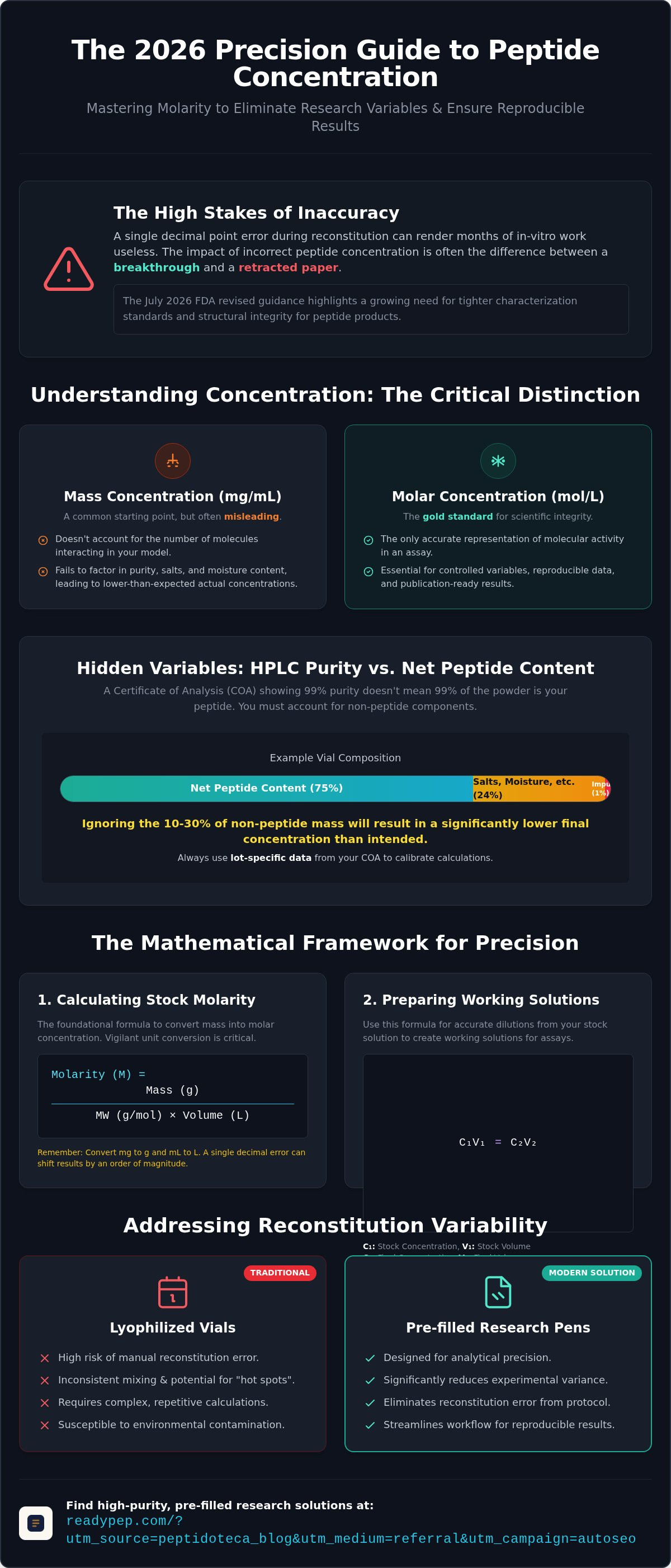
Your entire data set is only as valid as your last molarity calculation. A single decimal point error during reconstitution can render months of in-vitro work useless. You already understand that the impact of incorrect peptide concentration in research is often the difference between a breakthrough and a retracted paper. It's a high-stakes environment where manual preparation variables frequently compromise analytical precision. The July 2026 FDA revised draft guidance for 17 peptide products highlights this growing need for tighter characterization standards and structural integrity. You need absolute certainty in your assays.
We've designed this 2026 precision guide to help you master the mathematics of concentration and eliminate the variables that cause unexpected degradation. You'll learn a foolproof workflow for calculating molarity without the friction of traditional methods. We will examine the latest regulatory shifts regarding impurity thresholds and provide a streamlined strategy for maintaining reproducible results. By the end of this article, you'll have the tools to remove reconstitution error from your laboratory protocol entirely. Precision is no longer a goal. It's the standard.
Key Takeaways
- Master the critical distinction between mass concentration and molarity to prevent foundational errors in your assay design.
- Identify how the impact of incorrect peptide concentration in research originates from manual reconstitution variables and inconsistent mixing protocols.
- Implement a foolproof mathematical framework using the C1V1 = C2V2 formula for highly accurate stock and working solution preparation.
- Reduce experimental variance by replacing traditional lyophilized vials with pre-filled research pens designed for analytical precision.
- Optimize your lab workflow with lot-specific verification data to ensure your results meet the rigorous standards of 2026 scientific publication.
Fundamental Principles of Peptide Concentration in Laboratory Research
Precision is the bedrock of valid data. Without it, your results are mere noise. In the context of in-vitro studies, the impact of incorrect peptide concentration in research can be catastrophic; it leads to false negatives, non-reproducible curves, and wasted resources. You cannot rely on nominal values provided on a label without understanding the underlying chemistry. True analytical standards require a shift from simple mass measurements to rigorous molar calculations.
While mass concentration (mg/mL) is a common starting point, it's often misleading. Molar concentration (mol/L) provides the only accurate representation of the number of molecules interacting within your biological model. To maintain scientific integrity, you must master the Fundamental Principles of Peptide Concentration. This transition ensures that your experimental variables are controlled and your data remains publication-ready. Verification is everything. Data matters.
Understanding Purity vs. Peptide Content
HPLC purity is not the same as net peptide content. A Certificate of Analysis (COA) might show 99% purity, but this only refers to the percentage of the target peptide relative to other peptide impurities. It doesn't account for residual salts, moisture, or counter-ions like trifluoroacetate (TFA). These non-peptide components can represent 10% to 30% of the total powder weight. If you don't adjust your calculations for this "net peptide content," your actual concentration will be significantly lower than intended. Always use lot-specific data to calibrate your math. Ignoring these variables is a primary driver of the negative impact of incorrect peptide concentration in research.
The In-Vitro Environment: Solvent Considerations
Solvents are not neutral observers. The choice between PBS and HEPES can dictate the solubility and stability of your sequence. If the pH of your solution drifts, the peptide may aggregate or precipitate, effectively removing it from the assay. This hidden loss of concentration is a common cause of experimental failure. Maintaining a stable environment is critical for accuracy. You should prioritize the importance of pH testing in aqueous peptide solutions to ensure your compound remains fully dissolved and bioavailable.
Stability also depends on logistics. Cold-chain integrity is non-negotiable. Peptides are sensitive to thermal fluctuations; even brief exposure to room temperature during shipping can trigger degradation. This structural breakdown alters the effective concentration before the vial even reaches your bench. We prioritize transparency and verification to eliminate these uncertainties. High standards are the only standards.
The Mathematical Framework: Converting Mass to Molarity
The standard formula for molarity is the foundation of every controlled experiment: Molarity (M) = Mass (g) / [Molecular Weight (g/mol) × Volume (L)]. While the equation appears straightforward, the impact of incorrect peptide concentration in research often stems from simple unit conversion errors. You must convert milligrams (mg) to grams (g) and milliliters (mL) to liters (L) with absolute vigilance. In high-precision in-vitro microplate assays, you will frequently work with microliters (µL), where a single decimal placement error can shift your results by an order of magnitude. Adhering to established Peptide Quantification and Handling Guidelines is essential to ensure your mathematical framework supports reproducible data.
Precision requires more than just following a formula. It requires using the exact molecular weight (MW) for the specific sequence in your study. For example, when preparing Retatrutide 40mg, using a generic MW estimate instead of the lot-specific value can introduce significant variance. Every microgram matters. Accuracy is non-negotiable.
Worked Example: Calculating MOTS-c Molarity
Consider a MOTS-c 40mg pen. If the pen contains 40mg (0.04g) of peptide in a 2mL (0.002L) total volume, and the molecular weight of MOTS-c is approximately 2363.8 g/mol, the calculation is 0.04 / (2363.8 × 0.002). This results in a stock solution molarity of approximately 8.46 mM, or 8460 micromolar (µM). Molarity in this context defines the exact number of MOTS-c molecules available per liter of solvent to interact with your biological target.
Accounting for Lot-Specific Variations
Generic MW values are theoretical. They don't account for the unique salt content or moisture levels of a specific batch. If you rely on theoretical numbers, you're guessing. Integrating third-party lot testing data into your final concentration figure is the only way to maintain research integrity. This level of independent verification ensures that your "actual" concentration matches your "nominal" concentration. To further streamline your workflow and eliminate these manual calculation risks, you can utilize pre-calibrated research tools that arrive ready for precise analytical application.
Data integrity is a choice. By verifying every variable, you eliminate the friction of experimental uncertainty. High-standard research demands high-standard preparation.
Practical Dilution Protocols for In-Vitro Experimental Models
Transitioning from pure molarity math to bench application requires the master dilution equation: C1V1 = C2V2. It's the only way to maintain absolute control over your experimental variables. The impact of incorrect peptide concentration in research is most visible during these final preparation steps. If your stock solution is off by even a micro-fraction, your entire dose-response curve shifts. Precision starts with a stable master stock. You then derive working solutions for immediate use. This two-step process protects your bulk inventory from repeated freeze-thaw cycles and thermal degradation.
Consistency is your primary objective. Aseptic techniques are mandatory to prevent microbial contamination during high-volume dilution steps. Even a minor bacterial load can introduce proteases that degrade your peptide in hours, effectively lowering the concentration before the assay even begins. Always store your diluted working solutions at 4°C for short-term use. Never keep them longer than the sequence stability allows. Most diluted peptides are significantly more fragile than their concentrated stocks. Protect your data. Verify your process.
Serial Dilution for Dose-Response Assays
Dose-response assays demand a rigorous serial dilution protocol. Whether you're creating a 1:10 or a 1:2 series, cumulative error is your primary enemy. Small pipetting inaccuracies in early tubes amplify exponentially across the plate. For a standard 96-well plate, you'll need to calculate the exact volume of stock required to reach your target micromolar range. Using Accurate Peptide Quantitation methods ensures that each well receives the intended molecular count. Minimizing pipetting error in small volume transfers is the only path to publication-grade data.
Calculating Peptide Dosage from a Pen
Modern research formats simplify the transition from storage to assay. Translating dial settings or 'clicks' into precise microliter volumes removes the guesswork and variability of traditional vial draws. Pre-filled pens represent a significant leap in lab workflow and efficiency. When you're handling high-concentration compounds like NAD+ 1000mg, the mechanical precision of the pen ensures that every microliter is accounted for. You don't have to worry about the volume loss associated with needle-dead space in standard syringes. The impact of incorrect peptide concentration in research is mitigated when the delivery system is calibrated for analytical accuracy. High-standard research requires high-standard tools.
Addressing Reconstitution Variability: Pre-filled Pens vs. Lyophilized Vials
Manual reconstitution is a liability. It's a point of failure you don't need in a high-stakes environment. Every time you add bacteriostatic water to a lyophilized vial, you introduce a margin of error. Did you add exactly 1.00mL, or was it 1.05mL? That 5% variance is the impact of incorrect peptide concentration in research in its most basic form. It's a variable that can skew your entire dataset. Incomplete dissolution is another silent failure. Peptides that appear dissolved may still contain microscopic aggregates. These aggregates settle, creating a concentration gradient that makes every draw from the vial different. You're no longer testing a consistent reagent.
Pre-filled pens eliminate these manual calculations and the friction of solvent addition. They provide a standardized starting point for multi-site research collaborations. This ensures that labs in different locations are working with the exact same concentration. Consistency is the only path to reproducibility. Data integrity is the only path to publication.
The Impact of Manual Preparation on Reagent Integrity
Vigorous shaking is a common error that can shear delicate peptide structures. Swirling is the only acceptable method, but it's slow and prone to human impatience. Vials also suffer from significant 'dead volume'. This is the residual liquid trapped in the vial neck or the syringe tip. You might lose 10% of your reagent to the container itself. Pre-filled pens use a mechanical plunger system that delivers every microliter with analytical precision. It's the difference between the vague 'units' used in clinical settings and the precise 'molarity' required for in-vitro accuracy.
Workflow Optimization in High-Throughput Labs
Efficiency is a metric of success. You can reduce your reagent preparation time by approximately 70% by using pre-filled pens. This speed doesn't sacrifice quality. It enhances it. By removing the open-vial mixing phase, you minimize exposure to airborne contaminants. These pens are also designed for seamless integration into modern laboratory protocols. They arrive ready for immediate use in dose-response assays or automated liquid handling systems.
Eliminate the variables of manual reconstitution by upgrading your laboratory standards with precision-calibrated research tools. Precision is efficiency. Verification is trust.
Streamlining Analytical Workflows with Ready-to-Use Peptide Pens
The laboratory of 2026 demands more than just raw materials. It requires verified precision. Moving from manual preparation to pre-calibrated research tools is the most effective way to mitigate the impact of incorrect peptide concentration in research. When your starting material is already at a verified molarity, you remove the primary source of experimental noise. This shift doesn't just save time; it establishes a higher baseline for analytical integrity. You're no longer wasting the first two hours of your day on reconstitution math. You're focusing on the data.
Efficiency is the byproduct of modern logistics. By leveraging pre-filled formats, you ensure that the concentration you calculate on paper is exactly what you deliver to your cell culture. This level of control is essential for high-throughput screening where even a minor deviation can invalidate an entire plate. The future of research reagents isn't found in a bag of lyophilized powder. It's found in verified, ready-to-use delivery systems. Precision is the new standard.
Data Integrity and Publication Standards
Scientific journals have increased their scrutiny of methodology sections. It's no longer enough to state the mass of the peptide used. Reviewers frequently require lot-specific purity data and verified concentration figures to ensure reproducibility. To meet these standards, you must document independent analytical reports in your publication. Utilizing third-party verification from entities like Janoshik Analytical provides the empirical proof necessary to support your findings. Referencing HPLC verification and lot-specific pH levels ensures your methodology is beyond reproach. Transparency isn't optional; it's a requirement for high-impact research.
Optimizing Your Sourcing Strategy
Your results are tied to your supplier's accountability. Selecting a partner that provides transparent data and rigorous logistics is a strategic necessity. Cold-chain integrity is a critical part of this equation. Without it, the effective concentration of sensitive compounds can drop before the package is even opened. We prioritize ReadyPep’s cold-chain logistics to ensure every pen maintains its structural integrity from the manufacturer to your bench. To avoid the negative impact of incorrect peptide concentration in research, follow this final checklist before your next assay:
- Verify the net peptide content against the total powder weight on the COA.
- Confirm the lot-specific molecular weight for your sequence.
- Check the pH of your stock solution to ensure total solubility.
- Ensure the cold-chain indicators were green upon delivery.
Research excellence is built on the elimination of uncertainty. By standardizing your workflow with verified research pens, you ensure that your laboratory remains at the forefront of precision science. Data matters. Accuracy wins.
Advancing Toward Analytical Certainty
Precision isn't just a goal; it's the baseline for credible science. You've seen how the impact of incorrect peptide concentration in research can derail months of benchwork by introducing hidden variables during reconstitution. Mastering the mathematical transition from mass to molarity and implementing rigorous dilution protocols are essential steps. However, true reproducibility requires eliminating manual preparation error entirely. By standardizing your starting point with pre-calibrated reagents, you ensure that every assay is built on verified data rather than mathematical estimates. High-standard research demands high-standard tools.
Efficiency doesn't have to compromise accuracy. You can now streamline your research with independently tested, pre-filled peptide pens from ReadyPep. As an authorized Metatide Healthcare distributor, we provide lot-specific Janoshik Analytical testing for every batch to verify purity and pH. With free global cold-chain shipping included, your compounds arrive at the bench with their structural integrity fully intact. It's time to move beyond the uncertainty of manual mixing. Focus on the results. Trust the precision. Your next breakthrough depends on it.
Frequently Asked Questions
How do I convert mg/mL to micromolar (µM) for my peptide studies?
Use the formula: (Concentration in mg/mL / Molecular Weight in g/mol) x 1,000,000. For example, if your stock is 5 mg/mL and the MW is 2500 g/mol, the molarity is 2 mM, which equals 2,000 µM. This conversion is critical for ensuring that your biological interactions are measured by molecule count rather than total mass. Precision matters.
Why is the nominal concentration on a peptide pen different from the actual concentration?
Nominal concentration represents the theoretical label value, while actual concentration accounts for the "net peptide content" found in the specific batch. Factors like residual moisture and counter-ions can reduce the actual peptide weight by 10% to 20%. It's a common oversight. Ignoring these variables is a leading cause of the impact of incorrect peptide concentration in research and subsequent experimental failure.
Can I use the C1V1 formula for peptides that have already been reconstituted?
Yes, the C1V1 = C2V2 equation is the standard protocol for diluting pre-reconstituted stock solutions into working solutions. Because pre-filled pens provide a stable, pre-calibrated starting concentration (C1), you can accurately determine the exact volume (V1) required to reach your target concentration (C2) for your specific cell culture or assay volume (V2). It simplifies the workflow significantly.
What is the best way to account for peptide purity in my concentration math?
Multiply the total weighed mass by the net peptide content percentage listed on your Certificate of Analysis (COA). HPLC purity only tells you the percentage of the target peptide relative to other peptide impurities; it doesn't account for non-peptide mass like salts. Using the net peptide content ensures your molarity calculations reflect the actual number of molecules present in the solution.
How does the molecular weight of a peptide affect the volume needed for a specific dose?
Higher molecular weight peptides require more mass to achieve the same molarity as smaller sequences. If you're targeting a specific micromolar concentration across different compounds, the volume or mass required will scale linearly with the molecular weight. Failing to adjust for these differences results in inconsistent molecular exposure between your experimental groups. Data integrity depends on this adjustment.
What happens to peptide concentration if the cold chain is broken during shipping?
The concentration of intact, bioactive molecules decreases as thermal exposure triggers peptide degradation and aggregation. While the total amount of material in the solution may not change, the "effective" concentration drops because the structural integrity of the sequence is compromised. This degradation is a hidden driver of the impact of incorrect peptide concentration in research, leading to non-reproducible data sets.
Do pre-filled pens offer better concentration accuracy than manual reconstitution?
Pre-filled pens provide significantly higher accuracy by eliminating the human error associated with manual volume measurement and mixing. They remove the risk of incomplete dissolution. They also stop "dead volume" loss common in traditional vials. By utilizing factory-calibrated tools, you ensure your starting point is verified and consistent across every assay you perform.
How should I document peptide concentration for an in-vitro study publication?
Document the lot-specific purity, the net peptide content, and the exact molecular weight used for your calculations in the methodology section. High-impact journals now require this level of detail to support publication integrity. Providing third-party verification from labs like Janoshik Analytical proves that your concentrations are empirical rather than estimated. For verified precision, many researchers rely on pre-filled research pens that include lot-specific documentation.
Disclaimer
Educational content only. Not medical advice.


