

A single milligram of deviation can invalidate months of longitudinal data. In the wake of the FDA's 2026 reclassification of 14 key peptides, the margin for error in research documentation has effectively vanished. You've likely felt the frustration of inconsistent experimental results caused by reagent variability or opaque supplier documentation. It's a risk that leads to study retractions and wasted funding. Verifying peptide concentration in research pens is no longer an optional safety check; it's the baseline for high-integrity publication.
We understand that your research depends on absolute precision. You need more than just a label. You need empirical proof. This guide will help you master the analytical methods and documentation standards required to verify exact peptide concentration and purity. We'll explore the 2026 standards for HPLC-UV analysis and the critical role of third-party validation in modern lab workflows. Precision isn't a goal; it's a requirement.
By the end of this guide, you'll have a standardized protocol for ensuring your materials meet the highest scientific benchmarks. We'll preview how to interpret lot-specific reports and why shifting to pre-verified, ready-to-use formats is the most efficient way to eliminate reconstitution error. Reliable science starts with reliable sourcing. Standardizing your protocol with third-party validated materials ensures your data remains beyond reproach.
Key Takeaways
- Identify the analytical gold standards, including RP-HPLC and Mass Spectrometry, required to confirm compound identity and purity levels in 2026.
- Master the precise protocol for verifying peptide concentration in research pens by cross-referencing lot numbers with independent laboratory data.
- Recognize why third-party validation from entities like Janoshik Analytical is essential for maintaining data integrity and avoiding study retractions.
- Eliminate experimental variability and manual math errors by transitioning from traditional vials to pre-filled, analytically verified concentrations.
- Navigate lot-specific documentation to ensure every reagent meets the rigorous transparency standards required for peer-reviewed publications.
Understanding Peptide Concentration in Pre-filled Research Pens
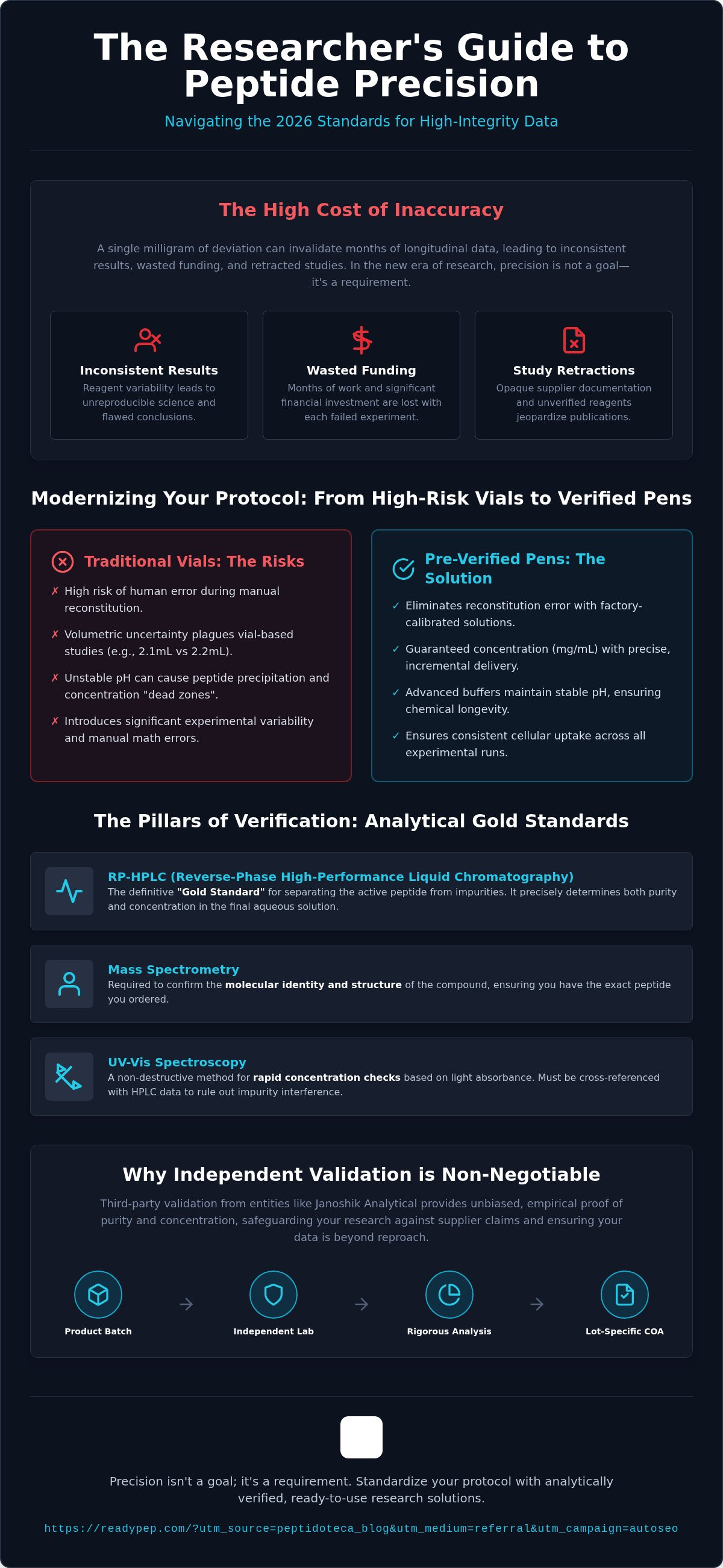
Precision is the non-negotiable standard for 2026. In-vitro research requires absolute control over every experimental variable. Concentration is often the most volatile of these. In the context of pre-filled pens, concentration refers to the precise mass of peptide active ingredient dissolved within a specific volume of bacteriostatic water or buffer. It isn't just about the total amount in the reservoir. It's about the density of the solution delivered with every mechanical increment. This level of detail is what separates reproducible science from failed experiments.
Why does mg/mL precision matter? Cellular signaling assays depend on accurate dose-response curves. If your concentration is off by even 5%, your results are effectively noise. Traditional manual reconstitution introduces a high risk of human error during the dilution phase. Shifting to factory-calibrated pens eliminates the volumetric uncertainty that plagues vial-based studies. This transition ensures that the reagents used in 2026 meet the rigorous Analytical Methods for Verifying Aqueous Peptide Solutions required for high-impact publication. Accuracy in the pen translates directly to accuracy in the petri dish.
Concentration vs. Total Peptide Content
There's a critical distinction between the total milligrams in a pen and the concentration per click. A 40mg pen is only useful if the delivery mechanism is calibrated to a specific mg/mL ratio. Pre-filled formats solve this by locking the volume. You no longer worry about whether you added 2.1mL or 2.2mL of solvent. For the purposes of precise data modeling, concentration in aqueous peptide solutions is defined as the mass of the peptide solute per unit volume of the solvent, typically expressed as milligrams per milliliter (mg/mL). This standardization is the only way to ensure consistent cellular uptake across multiple plates and experimental runs.
The Importance of pH in Aqueous Peptide Stability
Chemical stability is a function of the environment. For compounds like GHK-Cu 100mg or NAD+ 1000mg, the pH level dictates whether the peptide remains in solution or precipitates. Precipitation leads to dead zones in the pen where the concentration drops significantly. Modern pre-filled pens use advanced buffers to maintain a stable environment over the shelf life of the product. This stability is why the Importance of pH Testing in Aqueous Peptide Solutions is a core component of verifying peptide concentration in research pens. Without a stable pH, analytical reports are just a snapshot of a degrading sample. True accuracy requires longevity and chemical balance.
Analytical Methods for Verifying Aqueous Peptide Solutions
Confirming the integrity of a liquid reagent requires a more nuanced approach than testing lyophilized powders. While a powder CoA provides a snapshot of the raw material, verifying peptide concentration in research pens requires analyzing the final aqueous solution. Reverse-Phase High-Performance Liquid Chromatography (RP-HPLC) remains the gold standard. It separates the active peptide from any residual impurities or degradation products that may have formed during the filling process. By measuring the retention time and peak area, analysts can determine the relative purity and concentration of the compound within the pen's reservoir. It's precise. It's definitive.
UV-Vis Spectroscopy offers a faster, non-destructive alternative for liquid samples. By utilizing the Beer-Lambert Law, researchers can calculate concentration based on the absorbance of light at specific wavelengths, typically 280 nm for peptides containing aromatic amino acids. This method is highly effective for rapid verification of aqueous research reagents, provided the extinction coefficient is known. However, UV-Vis alone cannot distinguish between the target peptide and its degradation products. For high-integrity data, spectroscopic results must be cross-referenced with HPLC data to ensure the absorbance isn't being skewed by impurities.
Interpreting HPLC Chromatograms for Pens
Reading a chromatogram for a pre-filled pen differs from standard raw material testing. In a liquid pen, the baseline must account for the presence of bacteriostatic agents or preservatives. These additives create their own distinct peaks. Accurate verification requires identifying the target peak area relative to these intentional additives. Baseline stability is critical. When measuring low-concentration research peptides, even minor fluctuations in the baseline can lead to significant errors in calculated mass. Adhering to best practices for peptide reference standards ensures that the integration of these peaks remains consistent across different lots.
Mass Spectrometry for Sequence Confirmation
Purity doesn't guarantee identity. Mass Spectrometry (MS) is essential for confirming that the peptide in the pen matches the theoretical molecular weight of the target compound. It acts as a chemical fingerprint. For complex synergistic stacks, such as the Repair Protocol, tandem mass spectrometry (MS/MS) provides deeper structural validation. It breaks the peptide into fragments, allowing analysts to verify the amino acid sequence itself. This level of scrutiny is vital for ensuring that your in-vitro assays are targeting the correct biological pathways. For researchers who prioritize validated data over vendor promises, sourcing pre-filled pens with independent verification is the most efficient path to experimental consistency. Testing for degradation products isn't just a safety check; it's the only way to ensure your reagents haven't lost potency before they reach the lab bench.
The Role of Independent Third-Party Testing in Research Integrity
Integrity is the currency of modern science. If your data relies on reagents validated only by the seller, your findings are vulnerable. In-house Certificates of Analysis (COAs) are fundamentally insufficient for high-impact in-vitro research. They lack the necessary firewall between production and verification. In many cases, these documents function as marketing assets rather than empirical proof. To meet 2026 laboratory quality assurance standards, researchers must demand independent verification. This third-party oversight is the only way to eliminate the "batch variation" problem that often ruins longitudinal studies. Verifying peptide concentration in research pens through an external lab ensures that the 10mg or 40mg listed on the label is exactly what reaches your assay. Trust is a luxury the lab cannot afford. Data is only as strong as its weakest reagent.
The 2026 regulatory shift has made transparency a requirement rather than a preference. Researchers now face increased scrutiny regarding the provenance of their materials. Independent testing provides a layer of protection against the legal and safety risks associated with unverified peptides. By moving the burden of proof to a neutral third party, you ensure that your experimental reproducibility isn't compromised by reagent drift. It's about establishing a baseline of accountability that internal testing simply cannot match. High-integrity data requires a high-integrity supply chain.
Janoshik Analytical: The Gold Standard for Transparency
Janoshik Analytical has emerged as the industry standard for this level of transparency. Unlike internal labs, Janoshik provides a unique report key for every lot. This prevents the fraudulent reuse of old documentation. They specialize in the complex task of testing peptides already in solution, verifying purity, pH, and the exact concentration within the pen reservoir. This process is detailed in our deep dive on Peptide Pen Quality Control. It’s about removing the "trust me" factor from the procurement process. When you can verify the analytical report directly on the lab's own server, the risk of data contamination disappears. Verifying peptide concentration in research pens becomes a matter of public record, not manufacturer promise.
Metatide Healthcare Manufacturing Standards
High-grade manufacturing is the foundation of these analytical results. Metatide Healthcare maintains sterile, precise filling environments that ensure stability before the pens ever reach a third-party lab. This rigor is evident in specialized formulations like the Reserve Protocol. When the manufacturing process is this controlled, the subsequent third-party validation simply confirms the excellence already built into the product. It’s a dual-layer approach to reliability. Precise filling at the factory level ensures that the concentration remains uniform from the first click to the last. This synergy between Metatide’s production and Janoshik’s validation creates a reagent that researchers can use with absolute confidence.
How to Interpret a Lot-Specific COA for Peptide Pens
Interpretation is the final gatekeeper of experimental accuracy. Having a Certificate of Analysis (COA) is meaningless if you can't translate the raw data into actionable parameters for your study. Verifying peptide concentration in research pens requires a methodical review of the analytical report to ensure the reagent matches your protocol's requirements. This process moves beyond simply glancing at a purity percentage. It demands a rigorous cross-reference of the compound's physical and chemical identity against established theoretical standards.
Follow this five-step protocol for every new lot:
- Step 1: Identify the unique lot number printed directly on the research pen packaging. This alphanumeric code is the only link between your physical reagent and its analytical history.
- Step 2: Access the corresponding report from the independent lab's server. Do not rely on a PDF hosted solely by the manufacturer. Verification must happen at the source.
- Step 3: Cross-reference the observed molecular weight from the Mass Spectrometry report against the theoretical value. A match within ±1 Dalton is the standard for identity confirmation.
- Step 4: Evaluate the purity percentage. High-integrity in-vitro research requires a purity level of ≥98% as determined by the HPLC peak area integration.
- Step 5: Confirm the concentration (mg/mL). Ensure the total mass divided by the pen's volume aligns with your intended dose-response curve.
Red Flags in Peptide Documentation
Generic COAs are a major failure point. If a report lacks a specific lot number, a clear date, or a verifiable report key, it is functionally useless. Missing chromatogram images are another warning sign. A manufacturer who redacts the visual HPLC data is often hiding baseline instability or secondary peaks. Discrepancies between the theoretical and observed mass spec peaks suggest sequence errors or improper synthesis. If the documentation feels opaque, the reagent is likely compromised. Avoid these risks by sourcing pre-filled pens with transparent, lot-specific analytical reports. Transparency isn't a feature; it's a requirement for reproducible science.
Documenting Reagents for Publication
Citing your materials with precision is essential for peer review. Your 'Materials and Methods' section should include the manufacturer, the specific lot number, and the third-party lab that performed the verification. This level of detail prevents study retractions by providing a clear audit trail for your reagents. It also helps other researchers replicate your findings with the same concentration standards. For more on maintaining these benchmarks, see our guide on Documenting Lot Numbers for Publication Integrity. Verifying peptide concentration in research pens ensures that your data remains beyond reproach throughout the entire publication lifecycle.
ReadyPep’s Verification Protocol: Precision in Every Click
ReadyPep functions as a sophisticated gatekeeper for the research community. Every lot we provide is independently verified by Janoshik Analytical. This rigorous standard ensures total transparency from the manufacturing floor to the laboratory bench. By centralizing the process of verifying peptide concentration in research pens, we remove the burden of analytical validation from the researcher. You don't have to guess. You don't have to calculate. The data is already there. It's precise. It's verified. It's ready.
Pre-filled pens arrive ready for immediate in-vitro use. This format effectively eliminates reconstitution-based concentration errors, which remain a primary cause of experimental drift in 2026. When you remove the manual dilution step, you remove the most common failure point in peptide research. Cold-chain shipping worldwide further secures this integrity. It maintains the molecular stability and concentration levels from the moment of verification until the reagent is deployed in your assay. Full documentation is available for every specialized protocol, including the Mind Protocol and the Lean Protocol.
Why Researchers Choose Pre-filled Pens Over Vials
The shift toward pre-filled formats is driven by a need for modern efficiency. Traditional vials require multiple handling steps. Each step increases the risk of contamination or volumetric error. Pre-filled pens offer a closed-system environment that protects the compound.
- Contamination Mitigation: Reduced exposure to external contaminants during the preparation phase.
- Lot Consistency: Every pen within a specific lot delivers a mirrored concentration, ensuring longitudinal accuracy across multiple plates.
- Workflow Optimization: High-throughput laboratories can bypass hours of manual reconstitution, accelerating the path to publication.
Securing Your Research with Verified Reagents
Data integrity starts with the supply chain. Before initiating a major study, researchers can request specific lot data to align with their experimental parameters. This proactive approach to verifying peptide concentration in research pens ensures that every reagent meets the theoretical standards discussed in previous sections. Metatide Healthcare’s manufacturing rigor, combined with independent third-party validation, provides the calm assurance of a provider with nothing to hide. Don't let reagent variability compromise your findings. Secure your high-purity research pens with full analytical verification at ReadyPep.
Advancing Research with Analytical Certainty
Scientific progress requires reagents that match your ambition. You've now mastered the protocol for verifying peptide concentration in research pens, from interpreting HPLC chromatograms to cross-referencing mass spectrometry data. Moving beyond the "trust me" model of procurement isn't just a best practice. It's the only way to safeguard your data against the variability that ruins longitudinal studies. By shifting to pre-filled, factory-calibrated formats, you've eliminated the primary source of experimental drift: reconstitution error.
ReadyPep provides the infrastructure for this level of precision. We serve as the authorized Metatide Healthcare distributor, ensuring every lot undergoes independent Janoshik Analytical testing before it reaches your bench. With free cold-chain shipping for global research labs, the molecular integrity of your compounds remains uncompromised. You don't have to choose between efficiency and accuracy. You can have both. It's time to elevate your standards and secure reagents that are as rigorous as your methodology.
Access Third-Party Verified Research Peptides at ReadyPep
Frequently Asked Questions
How do I know if the concentration in my research pen is accurate?
Accuracy is confirmed through a lot-specific Certificate of Analysis (COA). You must verify this report directly on the independent lab's server using a unique report key. Verifying peptide concentration in research pens requires this external validation to ensure the mg/mL ratio matches the label. ReadyPep provides these reports for every batch to ensure absolute transparency for your in-vitro assays.
What is the difference between purity and concentration in peptide research?
Purity refers to the compound's cleanliness, usually expressed as a percentage like 99% or higher. Concentration is the actual mass of the peptide dissolved in the solution, measured in mg/mL. A pen can be 99% pure but have the wrong concentration if the filling process was imprecise. Both metrics are essential for ensuring that your experimental results are reproducible and accurate.
Can peptide concentration degrade during shipping if not cold-chained?
Thermal exposure can trigger peptide degradation, which reduces the active concentration in the solution. Cold-chain shipping is the only way to prevent this degradation during global transit. ReadyPep utilizes strict cold-chain protocols to ensure your reagents arrive with their molecular integrity fully intact. Protecting the compound from heat is critical for maintaining the concentration levels verified during the initial laboratory testing phase.
Is Janoshik Analytical a reliable lab for verifying research chemicals?
Yes, Janoshik Analytical has established itself as the gold standard for independent verification. Their reports include unique keys that allow researchers to verify data on Janoshik's own server. This transparency prevents the use of forged or outdated documentation in the research community. Using an independent lab ensures that the data you receive is unbiased and meets the high standards required for publication.
Why do some peptide pens have different pH levels?
Different compounds require specific pH levels to remain in a stable, aqueous state. If the pH is incorrect, the peptide may precipitate out of the solution, causing the concentration to drop. Buffers are used in pre-filled pens to maintain the optimal pH for long-term stability. This is why pH testing is a core component of the verification process for compounds like GHK-Cu or NAD+.
What should I do if my research pen doesn't have a lot number?
A pen without a lot number is an anonymous reagent. You should avoid using these in high-integrity studies because you cannot trace their analytical history. Without a lot number, verifying peptide concentration in research pens is impossible, leading to unreliable experimental data. Always ensure your materials are traceable back to a specific, independently verified lot to maintain your study's integrity.
How often should a supplier test their peptide lots?
Testing must occur for every single production lot. Testing one batch and applying the results to others is a major failure point in research integrity. Reputable suppliers like ReadyPep provide fresh, independent analytical reports for every new lot to account for manufacturing variability. This lot-specific approach ensures that every pen you receive meets the exact specifications listed on the Certificate of Analysis.
Can I verify the concentration of a pre-filled pen myself in the lab?
Verification requires specialized equipment like Reverse-Phase HPLC and Mass Spectrometry. While possible for labs with these resources, it's often more efficient to rely on third-party validation. This ensures an unbiased, expert analysis without diverting your lab's time and resources. Sourcing pre-verified pens allows you to focus on your research while maintaining the highest standards of reagent accuracy and transparency.
Disclaimer
Educational content only. Not medical advice.


