

The convenience of a pre-filled delivery system is worthless if the chemical integrity inside is a black box. In a field where a single percentage point of impurity can skew an entire dataset, assuming a supplier’s standards match your own is a dangerous gamble. Rigorous peptide pen quality control isn't just a compliance hurdle; it's the only way to ensure your research remains untainted by volumetric errors or degraded sequences. You're likely skeptical about the purity of pre-constituted compounds. You should be. Verifying lot-specific data for complex pen systems is notoriously difficult, leading to valid concerns over mechanical accuracy and chemical stability.
This guide serves as a comprehensive reference on the analytical and mechanical standards required to verify the integrity of pre-filled research peptide pens. You'll gain a clear framework for evaluating suppliers and understand the non-negotiable role of independent third-party testing. We'll also break down the latest ISO 11608-1:2022/Amd 1:2026 requirements and cold-chain logistics. By the end, you'll have the technical confidence to ensure your laboratory materials meet the highest empirical standards of precision and purity. No more guesswork. Just data.
Key Takeaways
- Define the tri-factor framework of reagent purity, mechanical accuracy, and sterile integrity required for reliable laboratory results.
- Identify the specific roles of Mass Spectrometry and HPLC in verifying peptide sequence identity and purity percentages.
- Master the mechanical standards for volumetric accuracy to ensure rigorous peptide pen quality control across every dispensed dose.
- Establish strict protocols for cold-chain logistics to maintain thermal stability at 2-8°C from manufacture to the laboratory.
- Utilize independent third-party analytical verification to ensure radical transparency and data-backed confidence in your research materials.
Defining Quality Control in Peptide Pen Systems
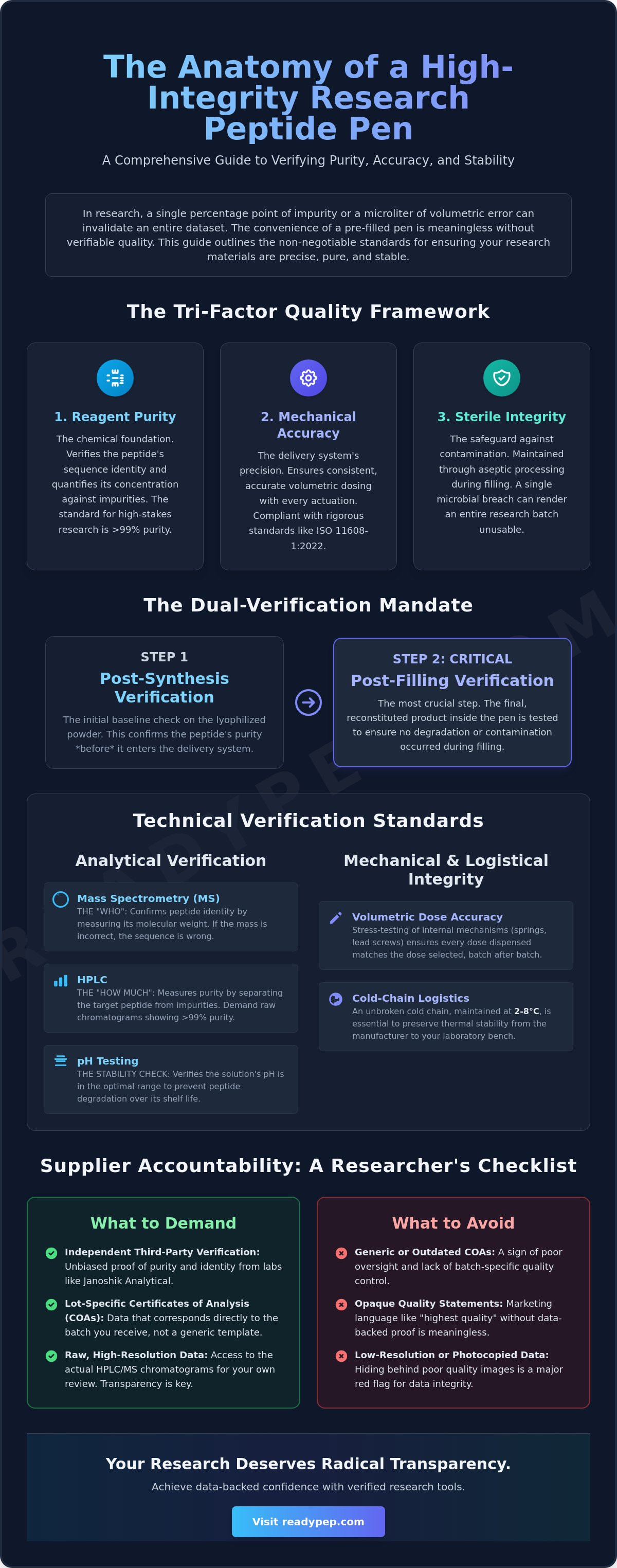
Effective peptide pen quality control is a tri-factor system. It doesn't stop at the chemical sequence. While most providers focus solely on the purity of the lyophilized powder, a pre-filled pen introduces mechanical variables that can compromise your research. True quality control encompasses reagent purity, mechanical accuracy, and sterile integrity. It's a holistic approach. If the peptide is 99% pure but the pen's lead screw fails to dispense the correct volume, your data is compromised. Precision requires both the chemistry and the hardware to function in perfect alignment.
High purity research peptides must be verified twice. The first verification occurs post-synthesis. The second must occur after the filling process. Reconstitution and cartridge loading are high-risk stages where degradation or contamination can occur. Internal manufacturer testing is the baseline, but it isn't the finish line. Independent third-party analytical verification provides the radical transparency required for modern laboratory settings. It removes the "trust me" factor from the equation. In-vitro research demands this level of clarity because industrial-scale applications often allow for wider tolerances that laboratory experiments simply cannot afford.
The Dual-Verification Framework
Analytical and mechanical standards must work in tandem. Chemical verification involves confirming the peptide sequence through Mass Spectrometry and measuring purity via High-Performance Liquid Chromatography (HPLC). You need to know the exact identity of the reagent. Mechanical verification is equally critical. This involves stress-testing the spring-driven mechanisms and housing to ensure consistent volumetric delivery. Finally, sterility standards must be maintained through aseptic processing. A single microbial breach during the pre-filling stage can render an entire batch of research pens useless.
Regulatory vs. Research Standards
Research-grade peptides operate under a different set of expectations than clinical products. They require lot-specific documentation that tracks the material from synthesis to the final pen assembly. Adhering to Good Laboratory Practice (GLP) standards ensures that every step of the procurement process is documented and reproducible. This framework is essential for maintaining the integrity of your longitudinal studies.
Identifying red flags in supplier documentation is a vital skill. Be wary of providers who offer generic Certificates of Analysis (COAs) without batch-specific timestamps. If the HPLC chromatogram looks like a low-resolution photocopy, it's a sign of poor oversight. Transparent suppliers provide raw data. They don't hide behind marketing hyperbole. They prioritize accountability because they know that in a laboratory setting, data is the only currency that matters. Demand the data, verify the mechanics, and never settle for opaque quality statements.
Analytical Verification: Mass Spectrometry and HPLC Standards
Identity and purity are the bedrock of any valid laboratory experiment. Without definitive chemical proof, your research is built on a foundation of assumptions. Analytical verification for peptide pens requires a two-pronged approach using Mass Spectrometry (MS) and High-Performance Liquid Chromatography (HPLC). MS serves as the definitive identity check. It measures the molecular weight of the sample to confirm the amino acid sequence matches the theoretical design. If the mass is off by even a few Daltons, the peptide is incorrect. Identity is the "who," but purity is the "how much."
HPLC measures the concentration of the target peptide relative to impurities. While chemical purity is the starting point, the delivery system must also adhere to rigorous standards, such as those outlined in the FDA Guidance on Injector Dose Accuracy, to ensure the verified reagent reaches the target precisely. For pre-filled pens, pH testing is equally critical. A solution's acidity or alkalinity directly impacts the stability of the peptide sequence. If the pH drifts outside the optimal range, the reagent can degrade before it ever leaves the cartridge. Reliable peptide pen quality control demands that these values are tested post-constitution to guarantee stability throughout the product's shelf life.
The research community increasingly relies on independent testing labs like Janoshik Analytical. Why? Because internal manufacturer reports often lack the objectivity required for high-stakes research. Third-party labs provide an unbiased layer of accountability. They act as a gatekeeper, ensuring that the data you see is the data they found. Researchers seeking verified materials can find high purity research peptide pens backed by this level of batch-specific analytical data.
Interpreting HPLC Chromatograms
HPLC isn't just a graph. It's a map. The primary peak represents the target peptide, while smaller "side peaks" indicate impurities like truncated sequences or residual solvents. In the research sector, 98% purity is the standard benchmark. Anything lower suggests a lack of refinement during the synthesis or purification stages. Common contaminants often include Trifluoroacetic acid (TFA) or leftover cleavage cocktails. Detecting these requires high-resolution equipment and expert interpretation. If the chromatogram shows multiple significant peaks, the reagent is unsuitable for precision work.
Lot-Specific vs. Generic COAs
Generic or "representative" Certificates of Analysis (COAs) are a major red flag. Some suppliers use a single test result to cover years of production. This practice is scientifically bankrupt. Every individual lot of peptide pens must undergo unique testing because synthesis conditions vary between batches. You should always cross-reference lot numbers with independent laboratory databases. If a supplier can't provide a unique, verifiable report for the specific batch you received, the integrity of your research is at risk. Radical transparency isn't optional. It's a requirement for modern science.
Mechanical Integrity: Volumetric Accuracy in Auto-Injector Pens
Chemical purity is only half the equation. If the delivery hardware fails to dispense the exact volume required, your experimental results will be inconsistent. This is where peptide pen quality control moves from analytical chemistry to mechanical engineering. A research pen is a complex assembly of high-precision components. The housing, spring-driven mechanisms, and lead screws must operate with zero friction or lag. Any deviation in the mechanical resistance of the lead screw directly translates to a volumetric error. In a laboratory setting, these errors lead to failed reproducibility and wasted resources.
Metatide Healthcare sets the standard for these precision delivery systems. Their engineering focuses on minimizing "dead volume" and ensuring that the torque required to dial a dose remains constant throughout the pen's lifecycle. High-precision research requires this level of mechanical predictability. When a researcher dials a specific unit, the internal piston must move a distance calculated to the micron. Mechanical failure isn't always a total breakdown. Often, it's a subtle drift in accuracy that compromises the integrity of in-vitro datasets. Precision hardware prevents these invisible variables from ruining your work.
Dose Consistency Testing
Manufacturers must calibrate the "twist-to-dial" mechanism to ensure linear accuracy. This means the first dose must be identical to the tenth. Audible and tactile feedback are not just user-experience features. They are verification tools for manual lab operations. A clear "click" provides the researcher with immediate confirmation of the dialled increment. Testing for "last-dose" accuracy is a critical part of the protocol. A pen must perform with the same volumetric precision until the cartridge is empty. If the spring tension drops as the reagent depletes, the final data points in your study will be skewed.
Hardware Durability and Material Safety
The materials used in pen construction must be inert. High-grade medical plastics and stainless steel are essential to prevent reagent contamination. Leachable and extractable testing ensures that the pen's internal components don't react with the peptide solution over time. This is especially vital when studying complex sequences like Tirzepatide Peptide for In-Vitro Research, where chemical stability is paramount. Every surface that contacts the reagent must be validated. If the hardware leaches polymers into the solution, your purity reports become irrelevant. Quality control is a closed-loop system where the container is just as important as the content.
Beyond the Lab: Cold-Chain Logistics and Lot Documentation
Quality control doesn't stop at the laboratory door. If a shipment sits on a tarmac in 30°C heat, the analytical purity established during synthesis becomes irrelevant. Logistics is the final, often overlooked, stage of peptide pen quality control. High purity research peptides are inherently unstable in liquid form. Thermal fluctuations trigger peptide degradation, leading to aggregation or primary sequence cleavage. Maintaining a strict cold chain of 2-8°C from the point of manufacture to the final laboratory destination isn't a suggestion. It's a requirement for data integrity.
Global shipping requires more than a standard cardboard box. It demands specialized insulated thermal packaging and high-mass gel packs designed to absorb ambient heat during transit. Every shipping manifest must include lot-specific documentation. This ensures that the physical product matches the digital record. Without these safeguards, the "last mile" of delivery becomes a point of failure that can skew an entire research project. Precision in the lab starts with precision in the mailroom.
Thermal Stability Monitoring
How do you verify the thermal history of your shipment? Visual inspection isn't enough. Advanced logistics utilize time-temperature indicators to provide a clear record of any excursions beyond safe thresholds. Freeze-thaw cycles are particularly damaging. They can disrupt the secondary structures of the peptide, causing irreversible denaturation. ReadyPep manages this risk through a centralized global distribution hub in the UK. By optimizing transit routes and using validated thermal containers, we minimize the window of exposure, ensuring the reagent arrives in its optimal state.
Traceability and Accountability
Every peptide pen must carry a digital paper trail. This traceability allows researchers to cross-reference their specific unit with the original synthesis batch and mechanical calibration reports. If an experimental anomaly occurs, lot documentation is your first line of defense in troubleshooting. It allows you to rule out reagent freshness as a variable. Verifying manufacture dates ensures you aren't working with aged materials that have begun natural hydrolytic degradation. For researchers who demand this level of logistical precision, you can order pre-filled research peptide pens with full cold-chain verification and batch-specific manifests.
Implementing GLP Standards with ReadyPep Research Tools
ReadyPep acts as the gatekeeper for your laboratory's integrity. As the authorized distributor for Metatide Healthcare precision pens, we bridge the gap between high-level engineering and the researcher's bench. Our approach to peptide pen quality control is rooted in radical transparency. We don't ask for trust; we provide data. Every batch undergoes Janoshik Analytical verification to ensure that the reagents you receive match the specifications exactly. This commitment simplifies the procurement process for high-volume in-vitro studies. It allows you to focus on the science rather than the logistics of verification.
The QC journey is a rigorous, multi-stage process that leaves no room for ambiguity. It starts with post-synthesis analytical testing using MS and HPLC. It continues through post-filling mechanical calibration and sterility checks. It finishes with cold-chain logistical monitoring and the final verification of lot-specific documentation upon arrival. This end-to-end oversight ensures that the material on your bench is identical to the material that left the lab. No deviations. No surprises.
Procurement Strategies for Research Labs
Efficiency matters in a competitive research environment. Evaluating peptide pen bundles and stacks is a strategic way to manage costs without sacrificing quality. Sourcing pre-filled pens also significantly reduces lab-based reconstitution errors. Manual mixing introduces variables that can skew results. By using a factory-sealed, calibrated system, you remove human error from the equation. All ReadyPep products are strictly for "Research Use Only" (RUO). We ensure every shipment complies with these protocols, maintaining the necessary boundaries for laboratory-based exploration.
The ReadyPep Quality Guarantee
Our guarantee is built on independent validation. We remove the burden of verification from the researcher by providing direct access to purity reports and pH data for every pen. You don't have to guess if your reagent is stable. You'll know it is. This level of accountability is what sets us apart as a modern research partner. Precision is non-negotiable. Secure your research reagents today at ReadyPep and ensure your laboratory operates with the highest empirical standards available. Data-driven confidence starts here.
Securing the Integrity of Your Research Data
Precision in the laboratory relies on two non-negotiable pillars: absolute chemical purity and mechanical accuracy. Without batch-specific verification and validated hardware, your experimental results remain vulnerable to invisible variables. Rigorous peptide pen quality control ensures that your reagents survive the journey from synthesis to the research bench without sequence degradation or volumetric drift. You shouldn't have to settle for "representative" data or opaque supplier claims. Accountability is the only standard that matters in modern science.
By combining Metatide Healthcare’s precision manufacturing with lot-specific Janoshik Analytical reports, you eliminate the guesswork from your procurement. Every pen arrives with verified identity and purity data. Our global cold-chain logistics protect the sequence integrity of your reagents every step of the way. You deserve a partner that prioritizes data as much as you do. Order Independently Tested Research Peptide Pens today and ensure your laboratory operates with the highest empirical standards. Your next breakthrough depends on the quality of your materials. Let's make it count.
Frequently Asked Questions
How do I verify the purity of a peptide pen from ReadyPep?
You verify purity by accessing the lot-specific Janoshik Analytical report provided with every batch. Each pen is linked to a digital paper trail containing raw HPLC and Mass Spectrometry data. You can cross-reference the batch number on the label with the independent laboratory's database to confirm the sequence identity and purity percentage. This ensures the data you're reviewing is current and batch-specific rather than a generic representative sample.
What is the standard purity for high purity research peptides?
The industry benchmark for high purity research peptides is a purity rate of 98% or higher. This level ensures that residual solvents, truncated sequences, or other synthesis byproducts don't interfere with your in-vitro experimental results. Achieving this standard requires multiple stages of purification and rigorous analytical testing to confirm that the target peptide remains the dominant peak on the HPLC chromatogram. Anything less compromises your data.
Why is pH testing important for pre-filled peptide pens?
pH testing is critical because the acidity or alkalinity of the solution directly influences the stability of the peptide sequence. If the pH drifts outside the optimal range after reconstitution, the peptide can undergo rapid hydrolytic degradation or aggregation. Reliable peptide pen quality control includes post-filling pH verification to ensure the reagent remains chemically stable throughout its stated shelf life in the pre-filled cartridge.
Can I use a research peptide pen for human or veterinary use?
No, these products are strictly for laboratory research and in-vitro experimentation. They aren't manufactured under the specific regulatory requirements for human or veterinary therapeutic applications. All materials are sold under "Research Use Only" (RUO) protocols. Any use outside of a controlled laboratory environment violates the terms of service and standard research safety guidelines. Precision research tools aren't intended for clinical application.
How does cold-chain shipping protect peptide integrity?
Cold-chain shipping protects integrity by maintaining a constant temperature of 2-8°C during transit. High-purity peptides are sensitive to thermal fluctuations that can trigger denaturation or primary sequence cleavage. By using insulated packaging and high-mass gel packs, we prevent heat-induced degradation. This logistical precision ensures the reagent arrives in the same state it left the production facility, preserving your data's reproducibility and avoiding sequence breakdown.
What is the role of Janoshik Analytical in peptide testing?
Janoshik Analytical serves as an independent third-party gatekeeper that provides unbiased verification of reagent purity and identity. They act as a transparent layer of accountability between the manufacturer and the researcher. By providing raw data and verifiable reports, they remove the conflict of interest inherent in internal manufacturer testing. This level of transparency is essential for modern peptide pen quality control standards and radical data integrity.
How accurate is the dosing mechanism in an auto-injector pen?
The dosing mechanism is engineered for high volumetric precision, utilizing a calibrated lead screw to dispense specific increments. Metatide Healthcare pens are designed to ensure the dialled dose matches the actual dispensed volume with minimal deviation. This accuracy is maintained through consistent spring tension and audible click feedback. Regular mechanical stress tests confirm that the pen performs reliably from the first dose until the cartridge is empty.
What documentation should I expect with my peptide pen order?
You should expect a comprehensive documentation package that includes a shipping manifest and lot-specific Certificates of Analysis (COAs). These documents provide the manufacture date, batch number, and independent purity reports. This digital and physical paper trail allows you to troubleshoot experimental anomalies and verify the freshness of the reagents. Accountability is maintained through this direct link between the physical pen and its analytical history.
Disclaimer
Educational content only. Not medical advice.


