

Customs clearance for research chemicals is a function of radical transparency and thermal engineering, not luck. You understand the risk of a shipment stalling at the border while sensitive reagents face temperature excursions. In 2026, the margin for error has vanished as global authorities implement stricter digital verification and automated risk assessments. This guide simplifies the complexity of international logistics to ensure your research remains on schedule.
We agree that the anxiety of a shipment sitting in a customs warehouse while dry ice evaporates is a significant research bottleneck. This article promises to help you master the current regulatory landscape, from the June 2026 executive orders on enforcement to the latest HS code updates for synthetic peptides. We will preview the essential documentation needed for a seamless border crossing, including safety data sheets and independent purity verification. You will learn how to maintain publication integrity by securing your supply chain against delays. Professional results depend on sourcing from providers who treat logistics with the same clinical precision as the synthesis itself.
Key Takeaways
- Identify the critical distinction between therapeutic drugs and in-vitro reagents to ensure immediate regulatory alignment at the border.
- Simplify customs clearance for research chemicals by using precise HS codes and Safety Data Sheets that exceed 2026 compliance standards.
- Secure thermal stability by understanding the physics of cold-chain systems during the high-risk 48-hour transit window.
- Eliminate manual audit triggers by avoiding vague product labeling and ensuring full price transparency on all commercial invoices.
- Streamline your laboratory workflow with automated documentation protocols that pair independent purity data with every shipment.
Navigating the Regulatory Framework for Research Peptides
Customs clearance for research chemicals in 2026 is no longer a matter of simple paperwork. It's a rigorous verification of intent. International agencies define "research chemicals" as substances used solely for laboratory experimentation and analytical study. They aren't finished pharmaceuticals or consumer goods. This distinction is the pivot point for every successful border crossing. If a shipment is misclassified as a therapeutic drug, it triggers a cascade of medical regulatory requirements that most research labs aren't equipped to navigate. Precision in nomenclature is your first line of defense against seizure.
The customs authority in any jurisdiction focuses on the Harmonized System (HS) codes and the declared "intended use." In 2026, the global shift toward digital transparency means agents use automated scanning to cross-reference your Safety Data Sheet (SDS) against the physical manifest. Following the June 3, 2026, Executive Order 14411, enforcement has intensified to prevent the diversion of research materials. Every package must explicitly state its status as an in-vitro reagent. Mastering customs clearance for research chemicals requires a deep understanding of these standards before the package leaves the warehouse.
In-Vitro Research Status and Compliance
Legal compliance hinges on the "in-vitro" designation. These are reagents meant for use outside a living organism, typically in glass or plastic vessels. Your documentation must reflect this reality. A "Qualified Scientific Personnel" declaration is often required to prove the recipient understands the chemical's properties. This isn't just red tape; it's a safety protocol that ensures sensitive compounds like MOTS-c 40mg are handled by professionals who maintain necessary laboratory standards. The intended use dictates the customs entry type, and any ambiguity here invites manual inspection.
Global Regulatory Bodies to Monitor
Stay alert to the European Chemicals Agency (ECHA) and Japan's Ministry of Economy, Trade and Industry (METI). As of June 2, 2026, METI updated the Chemical Substances Control Law (CSCL) regarding import procedures. Meanwhile, from July 1, 2026, ECHA requires all biocidal active substance data to be in the IUCLID format. UK-based operations often benefit from established trade agreements that simplify the export of high-purity research tools. By adhering to IATA and ADR shipping regulations for liquid solutions, you ensure the physical integrity of the shipment matches its regulatory perfection. ReadyPep operates out of the UK, ensuring every lot meets these high international benchmarks before it reaches the border.
Essential Documentation for Seamless Border Crossing
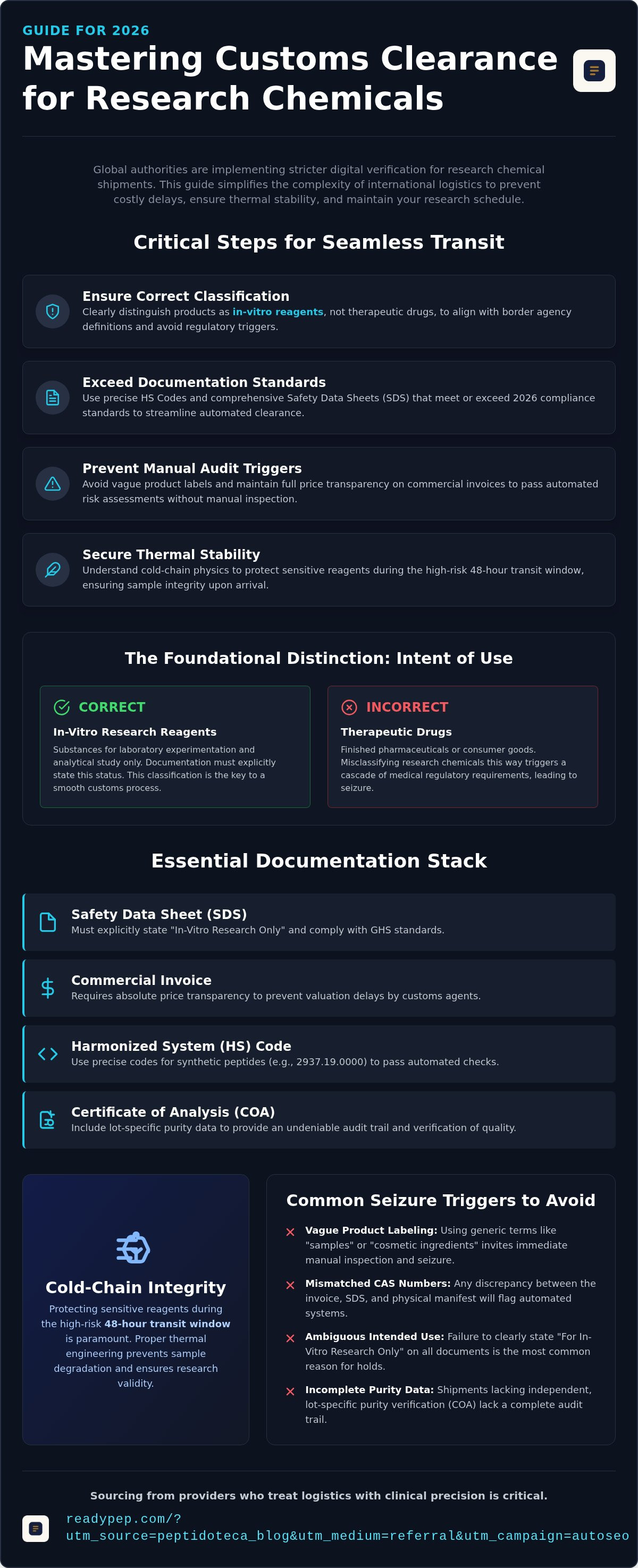
Customs clearance for research chemicals requires a documentation stack that leaves no room for interpretation. In 2026, automated risk-assessment systems prioritize shipments with complete, digitally-verifiable paperwork. The Safety Data Sheet (SDS) is the foundation. It must go beyond basic GHS compliance to explicitly detail the "In-Vitro Research Only" status. Commercial invoices must also reflect absolute price transparency. Valuation delays occur when customs agents cannot reconcile the declared value with market data. As the Importer of Record (IOR), your laboratory institution holds the legal responsibility for these declarations. While following guidelines like those from the NIDA Drug Supply Program is standard for controlled materials, the documentation rigor for high-purity peptides is equally demanding. Failure to provide a clear audit trail can lead to indefinite holds or permanent destruction of sensitive reagents.
Mastering the HS Code for Peptides
Correct classification is your primary defense against manual audits. For synthetic peptides, Chapter 29 of the Harmonized System is the standard starting point. Specifically, code 2937.19.0000 often covers many peptide hormones and their derivatives, though this can vary by specific molecular structure. Misclassifying these as "cosmetic ingredients" or "general samples" is a guaranteed path to seizure. CAS numbers must match the invoice exactly to prevent automated system flags. Precision here ensures the package moves through the "green lane" of customs processing. Don't rely on generic codes. Use the specific 2026 updates to ensure your manifest aligns with the latest global trade standards.
Analytical Verification as a Customs Tool
A lot-specific Certificate of Analysis (COA) serves as your chemical fingerprint. It provides empirical proof of identity and purity. When customs agents question the contents of a shipment, a third-party purity report from a recognized lab settles the matter instantly. These reports link lot numbers directly to the manifest, ensuring publication-ready integrity for your research. ReadyPep Lab Testing provides these essential data points for every lot, utilizing HPLC and Mass Spectrometry to verify standards. By choosing a partner that prioritizes this level of transparency, you eliminate the friction of border crossing. Secure your laboratory's supply chain by sourcing from transparent distributors who provide pre-cleared documentation packages for every order.
Managing Cold-Chain Integrity During Customs Stays
Every peptide shipment operates on a "thermal budget." This is the finite duration a package maintains its internal environment before ambient heat penetrates the insulation. In the context of customs clearance for research chemicals, this budget is often consumed by administrative delays rather than transit time. 48 hours is the critical threshold. Beyond this window, the risk of molecular degradation in sensitive reagents increases significantly. Lyophilized peptides are resilient, but they aren't invincible. Maintaining a consistent environment is the only way to ensure your analytical results aren't skewed by thermal stress.
Passive cold-chain systems are the industry standard for international research logistics. Unlike active systems that require external power or complex mechanical components, passive systems use high-performance vacuum insulation and phase-change materials. They are inherently more reliable. They don't fail if a warehouse loses power or if a package is misrouted. When a shipment stalls at a border, the passive cooling medium continues to work without intervention. It's a fail-safe approach designed for the unpredictability of global trade.
Researchers often fear their peptides will arrive warm and useless. It's a valid concern. While lyophilized powders offer more stability than liquid formats, heat remains the primary catalyst for secondary structure unfolding. A professional cold-chain protocol ensures that reagents remain within the 2-8°C range regardless of seasonal ambient temperatures. If a provider doesn't prioritize this level of thermal engineering, the purity of the chemical becomes irrelevant the moment it hits a warm tarmac.
Thermal Monitoring and Verification
Single-use data loggers provide the empirical proof required for high-stakes research. These devices record the internal temperature at specific intervals, creating a complete excursion report for your review. When you receive a shipment of BPC-157 + TB-500 40mg, you can verify its thermal history before starting your experiment. If the log shows a stay outside the acceptable range, you have the data needed to make an informed decision about reagent integrity. Verification is the antidote to uncertainty.
Pre-emptive Customs Clearing (Pre-clearance)
Pre-clearance is the strategic submission of documentation before the physical arrival of the goods. This allows customs brokers to flag the shipment as a perishable life science reagent. This status triggers "First-In, First-Out" (FIFO) priority handling. To avoid the "weekend trap," we recommend scheduling shipments to arrive between Tuesday and Thursday. This ensures that any unexpected manual inspection occurs during full staffing hours, preventing your package from sitting in a non-refrigerated facility over a holiday. Efficiency at the border is as critical as the synthesis itself.
Common Pitfalls and How to Avoid Seizure
Seizure at the border is rarely a random event. It is almost always the result of a specific documentation failure or a lack of descriptive precision. Vague labeling, such as the generic term "research samples," acts as a red flag for manual inspection. In 2026, customs AI is trained to detect ambiguity. If your manifest lacks technical specificity, the system automatically flags the shipment for an audit. Mislabeling a package to bypass "red tape" is a catastrophic strategic error. It doesn't just lead to the immediate destruction of the chemical. It results in the permanent blacklisting of your laboratory as an importer. Integrity in documentation is your only path to long-term success.
Requests for Information (RFI) from customs officers require an immediate, technical response. When an agent asks for clarification on molecular weight or specific purity, a delay of even 24 hours can result in a rejected shipment. This is especially critical for temperature-sensitive items where every hour counts. You must also understand that "De Minimis" value thresholds rarely apply to chemical substances. Even if a shipment is valued below the standard duty-free limit, it remains subject to full regulatory scrutiny. High-stakes research requires a proactive approach to customs clearance for research chemicals that anticipates these queries before they arise.
The 'Intended Use' Trap
Customs AI now scans commercial invoices for marketing-heavy language. Terms associated with human physiological effects or anti-aging trigger immediate medical regulatory reviews. Your invoice must remain strictly technical. Focus on the "in-vitro laboratory reagent" status. Avoid any mention of "supplements" or "therapeutic potential." This keeps the shipment within the correct regulatory lane and prevents unnecessary delays. Precision in language ensures your reagents, such as Tesamorelin 20mg, move through the system without suspicion.
Sourcing from High-Compliance Jurisdictions
Sourcing from gray-market hubs increases your risk profile significantly. Shipments originating from high-compliance jurisdictions like the UK face less scrutiny due to established regulatory trust. A supplier with a verifiable physical presence and transparent operations provides a safety net for your research. Following the Research Peptide Quality Standards is the most effective way to vet your source. ReadyPep eliminates these logistical variables by providing comprehensive documentation for every lot. Our UK-based operations ensure your reagents meet the highest standards for international transit. Ensure your laboratory remains compliant by purchasing from high-compliance providers who prioritize logistical transparency.
ReadyPep’s Global Compliance and Shipping Protocol
ReadyPep eliminates the logistical friction that stalls critical research. We automate the documentation process for every individual lot. This ensures that customs clearance for research chemicals is a standardized procedure rather than a variable risk. By integrating Metatide Healthcare’s manufacturing standards with our own rigorous compliance checks, we provide a supply chain that satisfies the most stringent border authorities. Our protocols are designed for 2026. We prioritize transparency, data-driven verification, and technical accuracy over industry-standard shortcuts. Your research reagents arrive with a pre-cleared profile that minimizes manual audit triggers.
The format of the reagent itself impacts its movement across borders. Pre-filled research peptide pens present a significantly more "customs-friendly" profile than bulk powders. They are clearly identifiable laboratory tools with professional labeling. Bulk powders often require additional chemical safety declarations that trigger manual inspections and valuation disputes. Our pens arrive ready for analytical use, accompanied by "In-Vitro Laboratory Research" declarations. This clarity reduces the likelihood of "Requests for Information" (RFI) that can delay a shipment indefinitely. Efficiency is engineered into the product format.
The ReadyPep Cold-Chain Guarantee
Thermal stability is a non-negotiable requirement for high-purity peptides. We utilize specialized packaging featuring vacuum-insulated panels and high-capacity phase-change materials. This isn't standard courier shipping. It's advanced thermal engineering. We monitor every shipment from our UK base directly to your laboratory. Our free worldwide cold-chain shipping ensures that your ReadyPep Products maintain their molecular integrity during transit. If a customs delay occurs, our passive cooling systems provide the necessary thermal buffer to prevent degradation. We don't guess. We verify.
Support for Academic and Private Institutions
Academic and private institutions require a higher level of data transparency for publication integrity. We provide customized documentation for large-scale research protocols, ensuring every lot is accounted for. You gain direct access to lot-specific purity, pH, and analytical data for your compliance records. This level of detail is essential for maintaining a seamless laboratory workflow. By improving lab workflow with pre-filled pens, researchers eliminate the errors associated with manual reconstitution and varied purity levels. Secure your laboratory's future by sourcing from a provider that treats international logistics with the same clinical precision as the science itself.
Future-Proofing Your Laboratory Logistics
Navigating customs clearance for research chemicals requires more than just filling out forms; it demands a commitment to technical precision. Success in 2026 hinges on three pillars: rigorous documentation, advanced thermal engineering, and sourcing from high-compliance jurisdictions. You've seen that a lot-specific Certificate of Analysis and an accurate HS code are not just options. They are essential requirements for a seizure-free supply chain. By prioritizing transparent data over gray-market shortcuts, you protect your research from the risks of degradation and regulatory delays.
ReadyPep supports your scientific objectives by removing the friction from international transit. Every shipment includes independent Janoshik purity testing and lot-specific pH documentation to ensure your data remains reproducible. We eliminate the anxiety of thermal excursions with free global cold-chain shipping, providing a stable environment for your reagents from our UK base to your lab bench. There is no need to leave your supply chain to chance when empirical verification is available.
Secure your research integrity with ReadyPep’s compliant global shipping.
Your focus belongs on the science. Let us handle the complexity of the border so your laboratory can continue to innovate with confidence.
Frequently Asked Questions
Is it legal to import research peptides for in-vitro use?
Yes. International trade laws permit the import of synthetic peptides provided they are intended solely for in-vitro laboratory research. You must ensure the "Not for human consumption" declaration is prominent on all paperwork. This classification exempts the materials from standard pharmaceutical import licenses, placing them under chemical substance regulations instead. Compliance depends on the substance not being listed as a prohibited or controlled compound in your specific jurisdiction.
What happens if my research chemical shipment is held at customs?
A "Request for Information" (RFI) is the most common result of a customs hold. You have a narrow window to provide the requested technical data, which often includes molecular weights or specific purity levels. If you don't respond with clinical precision within 24 to 48 hours, the risk of seizure or destruction increases. Having a pre-cleared documentation package ready for customs clearance for research chemicals prevents these administrative bottlenecks from compromising your reagents.
Do I need a special license to import peptides for my lab?
Most synthetic peptides don't require a specific import license for laboratory research purposes. However, you must act as the Importer of Record, meaning you accept legal responsibility for the shipment's contents and declared use. If the compound is a controlled substance, you must coordinate with local health authorities to secure the necessary permits before the package leaves the origin warehouse. Always verify your local "Research Only" exemptions before ordering.
How does ReadyPep ensure the cold chain isn't broken during shipping?
We utilize passive cooling systems that combine vacuum-insulated panels with advanced phase-change materials. This setup provides a stable thermal environment without the mechanical risks associated with active systems. By scheduling departures to avoid weekend arrivals, we maximize the available "thermal budget." This strategy ensures that even minor delays at the border don't compromise the molecular integrity or potency of your sensitive research reagents.
What are the specific HS codes for peptides in 2026?
Peptides generally fall under Chapter 29 of the Harmonized System. While code 2937.19.0000 is common for many hormones and their derivatives, 2026 updates require checking specific sub-headings for modified synthetic chains. Using an outdated code triggers a manual audit. We provide the most current classification data on every invoice to ensure your customs clearance for research chemicals proceeds through automated green lanes without administrative friction.
Will I have to pay import duties on research reagents?
Duties vary by country and the specific chemical classification. While some regions offer exemptions for scientific reagents, you should expect to pay standard VAT or GST based on the declared commercial value. The "De Minimis" threshold often doesn't apply to regulated chemical substances. Absolute transparency in valuation on your commercial invoice prevents valuation delays and ensures your laboratory isn't flagged for under-declaration during the risk assessment phase.
How can I track the temperature of my shipment during transit?
Every high-stakes shipment should include a single-use data logger. These devices record internal temperatures at set intervals throughout the journey, from our UK base to your facility. Upon arrival, you can download the data to verify that no excursions occurred. This empirical proof is vital for maintaining publication integrity, allowing you to confirm that the reagent remained within the required 2-8°C range during its entire international transit.
What documentation should I provide to my university's receiving department?
Your receiving department requires a complete compliance packet to meet internal safety standards. This includes the Safety Data Sheet (SDS), the lot-specific Certificate of Analysis (COA), and the commercial invoice. Providing these documents upfront ensures that internal safety officers can quickly clear the material for laboratory use. ReadyPep includes this documentation with every lot, pairing HPLC and Mass Spectrometry data with your specific shipment for total transparency.
Disclaimer
Educational content only. Not medical advice.


