

Why are you still gambling your in-vitro data on manual weighing and unverified lot purity? In a research environment where a minor variance in impurity can compromise an entire study, relying on outdated procurement methods is a liability. You understand that reproducible results require more than just a label. They require empirical proof. This clinical guide details the rigorous analytical properties and sourcing standards for high-purity tirzepatide peptide reagents. We provide the framework for accessing Janoshik-verified materials and streamlined lab protocols. You'll learn how to secure reagents that meet the ≥98% purity standard while maintaining volumetric accuracy through pre-filled research peptide pens. We'll also cover the critical cold-chain delivery requirements that prevent molecular degradation during transit. It's time to move beyond the uncertainty of manual compounding and embrace a more precise, data-backed approach to your research. By the end of this guide, you'll have the standards necessary to ensure your 2026 lab experiments are built on a foundation of absolute chemical integrity. We examine the shift away from compounded alternatives following the 2025 shortage resolution and focus on the technical necessity of batch-specific HPLC and MS verification.
Key Takeaways
- Analyze the dual-agonist mechanism of the 39-amino acid sequence within GLP-1 and GIP receptor cellular models.
- Identify critical impurity risks, including D-isomer shifts and residue oxidation, that compromise receptor binding affinity and data reproducibility.
- Evaluate procurement methods to see how pre-filled pens for tirzepatide peptide eliminate manual weighing errors and open-vial contamination.
- Establish rigorous sourcing benchmarks using Janoshik-verified analytical data and 2°C to 8°C cold-chain logistics for global transit.
What is the Tirzepatide Peptide? Defining the Dual Agonist Mechanism
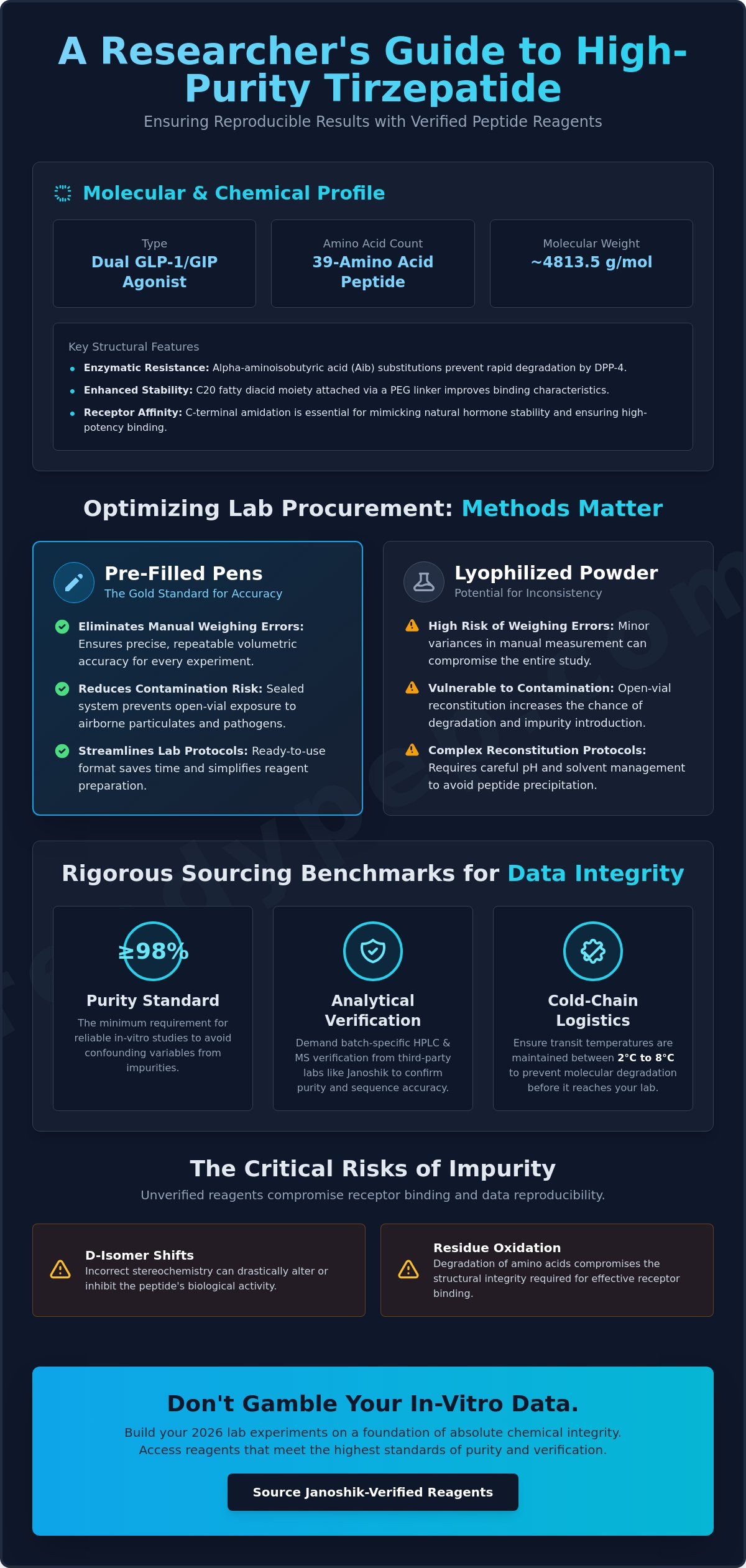
Tirzepatide is a 39-amino acid synthetic peptide engineered for high-affinity interaction with metabolic receptors. It's not a standard mono-agonist. It functions as a dual agonist. This means it simultaneously activates both the glucose-dependent insulinotropic polypeptide (GIP) and glucagon-like peptide-1 (GLP-1) receptors. For laboratory researchers, the tirzepatide peptide represents a sophisticated tool for mapping complex metabolic signaling. Its chemical formula is C225H348N48O68. It carries a theoretical molecular weight of 4813.5 g/mol. Precision is the baseline here. This is a foundational resource for defining the molecule's role in metabolic research.
The Dual Agonist Advantage in In-Vitro Studies
In-vitro models require reagents that simulate multi-pathway biological responses. Tirzepatide delivers this through synergistic receptor activation. When applied to recombinant cell lines, the dual-agonist profile triggers a significant increase in cyclic adenosine monophosphate (cAMP) production. It's more efficient than using separate agonists. This synergy allows for the investigation of insulinotropic pathways with greater depth. Researchers can observe how GIP and GLP-1 signaling intersect at the cellular level. It's about capturing the full metabolic picture. Single-target reagents often miss these cross-talk dynamics. Tirzepatide fills that gap.
Structural Modifications and Stability
The peptide's architecture is a result of calculated engineering. It's built to last in a lab environment. The sequence includes alpha-aminoisobutyric acid (Aib) at specific positions. These substitutions provide robust enzymatic resistance. They protect the molecule from rapid degradation by dipeptidyl peptidase-4 (DPP-4). Another key feature is the C20 fatty diacid moiety. This modification is attached via a PEG linker. It's designed to enhance stability and binding characteristics in specific assays. But stability is fragile. Laboratory use requires strict adherence to environmental controls.
- pH Environment: Optimal solubility depends on the buffer's pH level. Incorrect ranges lead to precipitation.
- Enzymatic Resistance: The Aib substitutions ensure the tirzepatide peptide remains intact during extended incubation periods.
- Receptor Affinity: The specific sequence ensures high-potency binding at both target sites.
Understanding these properties is the first step toward reproducible data. The Tirzepatide structure is complex. Handling it requires an expert approach. You aren't just measuring a chemical; you're managing a precise biological tool. Every modification serves a purpose. Every amino acid is a choice. This level of structural integrity is what separates validated research reagents from generic alternatives. High-purity standards aren't optional; they're the requirement for any serious metabolic study.
Analytical Profiles: Chemical Integrity and Peptide Sequence
The blueprint for the tirzepatide peptide is its specific 39-amino acid sequence: H-Tyr-Aib-Glu-Gly-Thr-Phe-Thr-Ser-Asp-Tyr-Ser-Ile-Aib-Leu-Asp-Lys-Ile-Ala-Gln-Lys(PEG2-PEG2-gamma-Glu-C20-diacid)-Ala-Phe-Val-Gln-Trp-Leu-Ile-Ala-Gly-Gly-Pro-Ser-Ser-Gly-Ala-Pro-Pro-Pro-Ser-NH2. Every lot must undergo verification for C-terminal amidation. This modification isn't just a detail. It's essential for mimicking natural hormone stability. Without verified amidation, receptor binding affinity is compromised. Data becomes unreliable. Precision in the sequence ensures that your in-vitro models respond to the intended molecular structure, not a degraded variant.
Solubility depends heavily on the isoelectric point (pI). If the pH of your laboratory buffer sits too close to the pI, the peptide will precipitate. This results in inconsistent concentration gradients. Maintaining the alpha-helical secondary structure in aqueous solutions is vital for effective receptor activation. While Tirzepatide injection profiles focus on clinical pharmacokinetics, researchers must prioritize these foundational chemical nuances. For those prioritizing volumetric accuracy, using pre-filled research pens eliminates the common errors associated with manual reagent measurement.
Solubility and Reconstitution Protocols
Reconstitution requires a methodical approach. Bacteriostatic water is the preferred solvent for many applications, though sterile saline is a viable alternative depending on the assay requirements. Concentration limits must be respected. High-viscosity research applications can lead to aggregation if the peptide is pushed beyond its solubility threshold. Avoid mechanical shear stress. Don't shake the vial. Gently swirl to ensure complete dissolution. Aggressive handling can fragment the peptide chain and ruin the lot.
Storage Parameters for Long-Term Stability
Stability is a function of environment. Lyophilized tirzepatide peptide should be stored at -20°C. Under these conditions, it maintains multi-year stability. Once reconstituted, the shelf-life shortens significantly. Keep the liquid reagent in a refrigerated environment between 2°C and 8°C. Limit light exposure. Perhaps most importantly, avoid freeze-thaw cycles. Repeated temperature shifts cause peptide fragmentation. This degradation introduces impurities that skew your data. Use aliquots if your protocol requires multiple sessions over time. Protecting the molecular integrity of your starting material is the only way to guarantee the integrity of your results.
Beyond Generic Reagents: Addressing the Impurity Risk
Generic reagents represent a significant gamble in metabolic research. Purity isn't just a percentage on a spreadsheet; it's a measure of molecular reliability. D-isomer shifts are particularly dangerous. These stereochemical variations possess the same mass but different spatial orientations. The result is altered receptor binding affinity. Your in-vitro data becomes skewed by a molecule that looks correct but acts unpredictably. Oxidation is another silent threat. Methionine and Tryptophan residues are highly susceptible. Even minor oxidative stress during synthesis or shipping can compromise the tirzepatide peptide lot.
Peptide deletions occur when the synthesis process fails to attach an amino acid in the sequence. These truncated chains compete for receptor sites without providing the intended signal. While clinical documentation for Tirzepatide (Subcutaneous Route) administration focuses on biological safety, researchers must focus on these chemical failure points. Independent lot testing is the only shield against these errors. We utilize Janoshik Analytical standards to verify both pH and purity before any reagent enters your lab.
Interpreting HPLC and MS Reports
Don't just glance at the Certificate of Analysis (COA). Analyze the High-Performance Liquid Chromatography (HPLC) chromatogram. You're looking for peak purity. A single, sharp peak indicates a homogeneous sample. Secondary peaks suggest impurities or degradation products. Mass Spectrometry (MS) provides the final confirmation. It verifies the molecular weight against the theoretical profile. For Good Laboratory Practice (GLP) standards, 99%+ purity is the baseline. Anything less introduces variables that compromise reproducibility. Accuracy isn't a goal; it's the requirement.
The Role of Third-Party Verification
Manufacturer COAs have limitations. They're often generic or outdated. Independent third-party verification provides an objective layer of accountability. It ensures the tirzepatide peptide you receive matches the data you're promised. ReadyPep provides lot-specific Janoshik documentation with every order. This transparency removes the friction of manual verification. It allows you to focus on the experiment, not the supply chain. For researchers who demand this level of precision, our peptide bundles offer a streamlined way to secure validated reagents across multiple studies. Verification is the difference between a successful study and a costly failure.
Optimizing Lab Procurement: Pre-Filled Pens vs. Lyophilized Powder
Traditional lyophilized vials are the industry legacy. They aren't the industry future. Relying on manual reconstitution for the tirzepatide peptide introduces unnecessary volumetric variance. One pipetting error can invalidate a week of assays. Closed-system research pens eliminate this friction. They provide a streamlined alternative to the open-vial method. You get consistent results without the risk of atmospheric exposure or cross-contamination. Efficiency isn't just about speed; it's about removing the variables that cause laboratory re-work. Data demands consistency. Vials introduce variables.
Standardization is the primary driver for high-throughput labs. When running multiple in-vitro trials, the reagent delivery must be identical across every plate. Manual weighing is slow and prone to drift. Pre-filled systems ensure that every dose is calibrated to the same standard. This level of control is essential for mapping insulinotropic pathways where concentration-response curves are sensitive to minor fluctuations. You're no longer just buying a chemical; you're securing a delivery system that protects your study's integrity.
- Volumetric Accuracy: Eliminates the ±5-10% error margin common in manual reagent preparation.
- Contamination Control: The closed-system architecture prevents environmental pathogens from entering the reagent stream.
- Standardized Trials: Guarantees that every cellular model receives an identical concentration of the tirzepatide peptide.
The Mechanics of Pre-Filled Research Pens
The precision dial is the core of the system. It ensures exact volumetric delivery with every click. Metatide Healthcare manufactures these pens to rigorous clinical-grade standards. They're compatible with standard laboratory needles. This makes integration into existing protocols seamless. You don't need specialized equipment to upgrade your workflow. The mechanism is designed for tactile feedback. It's a simple, effective solution for complex research needs.
Economic Impact on Laboratory Budgets
Waste is a budget killer. Lyophilized vials often leave significant residue. Pens ensure almost zero leftover reagent. This maximizes your research spend. For long-term projects, scaling is simpler. You can utilize peptide pen bundles to maintain supply throughout longevity studies. It's a calculated move for any lab prioritizing both data integrity and fiscal responsibility. Minimizing leftover reagent isn't just tidy; it's cost-effective. Precision procurement starts with choosing the right delivery format for your data. If you value efficiency, order your research bundles to streamline your next study phase.
ReadyPep Standards: Sourcing Validated Tirzepatide Reagents
Procurement is the final link in the chain of research integrity. High-purity reagents lose their value if the supply chain is compromised. We prioritize empirical verification over marketing claims. Metatide Healthcare manufactures our precision research pens to ensure exact volumetric delivery. Every lot of tirzepatide peptide undergoes third-party validation. You don't have to take our word for it. We provide lot-specific Janoshik reports with every order. This transparency is our baseline. It removes the friction of uncertainty. We operate with the calm assurance of a provider that has nothing to hide. Our global logistics network, centered in the United Kingdom, offers free cold-chain shipping to ensure your materials arrive in peak condition. Speed matters, but stability matters more.
Researchers often overlook the impact of transit on molecular structure. A reagent that leaves the lab at 99% purity can arrive degraded if handled poorly. We act as high-standard gatekeepers for your supply chain. We don't rely on generic COAs. We rely on data. By providing access to Janoshik-verified reagents, we allow you to focus on your cellular models rather than your supplier's reliability. It's a modern, tech-forward approach to laboratory sourcing, and you can learn more about the rigorous standards required to vet high-quality research sources. We've simplified the complex so you can execute your protocols without hesitation.
Cold-Chain Integrity and Reagent Potency
Thermal excursions are a silent threat to peptide stability. If the tirzepatide peptide exceeds the 2°C to 8°C range during transit, its dual-agonist efficacy is at risk. Heat causes molecular unfolding. It leads to aggregation. These changes aren't always visible to the naked eye. They only show up as inconsistent results in your assays. ReadyPep utilizes specialized vacuum-insulated packaging and phase-change materials for all international shipments. We don't guess; we verify. Upon receiving your shipment, your lab protocol should include an immediate temperature log check. Maintaining this strict thermal window is the only way to guarantee that the reagent you use on day one is as potent as the day it was synthesized. Logistics is as critical as the synthesis itself. We've engineered our shipping process to withstand the rigors of global transit, ensuring that the cold chain remains unbroken from our facility to your bench.
In-Vitro Research Compliance
Integrity requires strict adherence to regulatory boundaries. Our products are labeled and sold exclusively for in-vitro laboratory research. They're not for human or veterinary use. This distinction is non-negotiable. Institutional procurement requires clear documentation of these standards for compliance audits. We provide the necessary paperwork to streamline your lab's acquisition process. We understand the complexities of institutional oversight. Our documentation is designed to meet the rigorous requirements of modern research facilities. By focusing on radical transparency and high-standard gatekeeping, we serve as a trustworthy partner for researchers who value precision. Ready to upgrade your procurement? Order Janoshik-verified Tirzepatide Pens to secure the reagents your data deserves. Don't settle for unverified sources when precision is just one click away.
Advancing Metabolic Research Standards
Your research depends on the absolute integrity of your starting materials. We've established that the dual-agonist mechanism of the tirzepatide peptide requires precise structural maintenance to ensure reproducible in-vitro data. Moving from traditional lyophilized vials to pre-filled research pens isn't just an efficiency upgrade. It's a commitment to volumetric accuracy and contamination control. You've seen how lot-specific verification and cold-chain logistics protect your study from the risks of molecular degradation and impurity shifts. Precision is no longer a luxury; it's the baseline for credible discovery.
While our focus remains on the precision of your laboratory reagents, we also recognize that metabolic health is a holistic pursuit; for those seeking high-quality, chef-prepared nutrition, Eat Better Meals provides a convenient way to support a balanced lifestyle.
ReadyPep bridges the gap between complex chemical synthesis and practical laboratory application. Every reagent we provide is Janoshik Analytical tested and manufactured to Metatide Healthcare standards. We handle the logistics with free worldwide cold-chain shipping, so you can focus on the science. It's time to eliminate the variables that compromise your results. Secure Validated Tirzepatide Reagents for Your Research and build your next study on a foundation of empirical proof. We're here to support your pursuit of scientific excellence with the transparency you deserve.
Frequently Asked Questions
Is Tirzepatide peptide stable at room temperature during shipping?
Tirzepatide is not stable at room temperature for extended periods. Thermal excursions compromise the peptide’s dual-agonist efficacy. We maintain a strict 2°C to 8°C cold chain throughout global transit using specialized packaging. This prevents molecular unfolding and aggregation. Reagents exposed to high temperatures show inconsistent results in cellular models. Always verify the temperature log upon arrival to ensure reagent potency.
Can Tirzepatide be used for in-vivo animal testing?
Our reagents are strictly for in-vitro laboratory research. They are not intended for in-vivo animal testing or any veterinary applications. Using these materials in living organisms violates safety protocols and institutional compliance standards. Researchers should only apply the tirzepatide peptide to recombinant cell lines or other isolated laboratory models. Always adhere to the "Not for Human or Veterinary Use" label found on all procurement documentation.
What is the purity level of ReadyPep Tirzepatide research pens?
ReadyPep research pens contain reagents with a verified purity level of ≥99% for the tirzepatide peptide. This exceeds the standard ≥98% requirement for GLP-standard research. We utilize High-Performance Liquid Chromatography (HPLC) to confirm peak purity and Mass Spectrometry (MS) to verify molecular weight. High purity is essential for mapping metabolic signaling without interference from synthesis byproducts or peptide deletions. Every batch undergoes rigorous third-party validation.
How much Tirzepatide is contained in a single Metatide research pen?
Each Metatide research pen is standardized to provide a specific total volume for high-throughput laboratory use. While specific concentrations vary by lot, the pens are engineered for precise volumetric delivery. This eliminates the uncertainty of manual weighing and open-vial handling. You receive a consistent reagent concentration across all research trials. Consult your lot-specific Janoshik report for the exact milligram content and concentration details for your current batch.
What happens if the peptide reagent is not kept in a cold chain?
Failure to maintain the cold chain leads to rapid peptide degradation. Thermal stress triggers aggregation and the formation of D-isomer shifts. These changes alter receptor binding affinity. Your in-vitro assays will produce skewed or non-reproducible data. Reagents kept outside the 2°C to 8°C range often lose their secondary structure. This renders the molecule ineffective at activating GLP-1 and GIP receptors in cellular models.
Is the Tirzepatide pen reusable for different research trials?
The pen is designed for multiple volumetric deliveries within a single research trial or across several sessions. Its closed-system architecture protects the remaining tirzepatide peptide from environmental contamination. However, you must store the pen in a refrigerated environment between 2°C and 8°C between uses. Do not freeze the reconstituted reagent. Repeated freeze-thaw cycles cause fragmentation. Proper storage ensures the reagent remains stable until the cartridge is empty.
How do I access the Janoshik test results for my specific lot?
Janoshik Analytical reports are provided with every order to ensure radical transparency. You can access these lot-specific documents through the digital portal or the physical documentation included in your shipment. Each report includes the HPLC chromatogram and Mass Spectrometry data. We verify the purity and identity of every batch before it leaves our facility. This independent validation serves as your shield against laboratory error and manufacturer inconsistencies.
Can I transfer the Tirzepatide from the pen to a vial for specific experiments?
Transferring the reagent to an open vial is possible but not recommended. The primary advantage of the pen system is its closed-system architecture. Opening the reagent to the atmosphere increases the risk of oxidation and environmental contamination. It also introduces the potential for volumetric loss during the transfer process. For maximum precision and stability, we suggest utilizing the pen’s dial mechanism for direct delivery into your experimental assay.
Disclaimer
Educational content only. Not medical advice.


