

Thermal stability in your laboratory isn't just a binary state of cold or warm. It's a precise micro-climate requirement. If you're wondering how to store research peptide pens to prevent sub-visible aggregation and chemical degradation, you're already ahead of the curve. Most researchers recognize that a standard refrigerator isn't a guarantee of integrity. You've likely felt the frustration of inconsistent experimental results. You've seen the high cost of replacing a degraded batch of Retatrutide or BPC-157. A setback that stalls progress. A risk to your data.
This guide provides a standardized 2026 laboratory protocol to master thermal stability and chemical integrity. You'll learn the clinical standards needed to extend reagent shelf life and ensure post-storage purity. We'll examine the technical requirements for maintaining cold-chain continuity. We'll analyze the specific environmental factors that protect your pre-filled pens from potency loss. From Janoshik-verified purity to lot-specific documentation, we'll cover the essential steps to safeguard your research reagents.
Key Takeaways
- Standardize your laboratory environment between 2°C and 8°C to mitigate the thermal energy that drives peptide hydrolysis and oxidation.
- Protect chemical integrity by storing pre-filled pens horizontally in their original packaging, leveraging opaque housing for maximum light shielding.
- Master how to store research peptide pens using 2026 protocols to prevent sub-visible aggregation and ensure consistent experimental results.
- Verify the pH balance and purity of your reagents through Janoshik Analytical standards to confirm stability and structural integrity post-storage.
- Maintain cold-chain continuity from the point of origin to your facility to eliminate the risks associated with temperature fluctuations during transit.
The Science of Peptide Degradation: Why Storage Integrity Matters
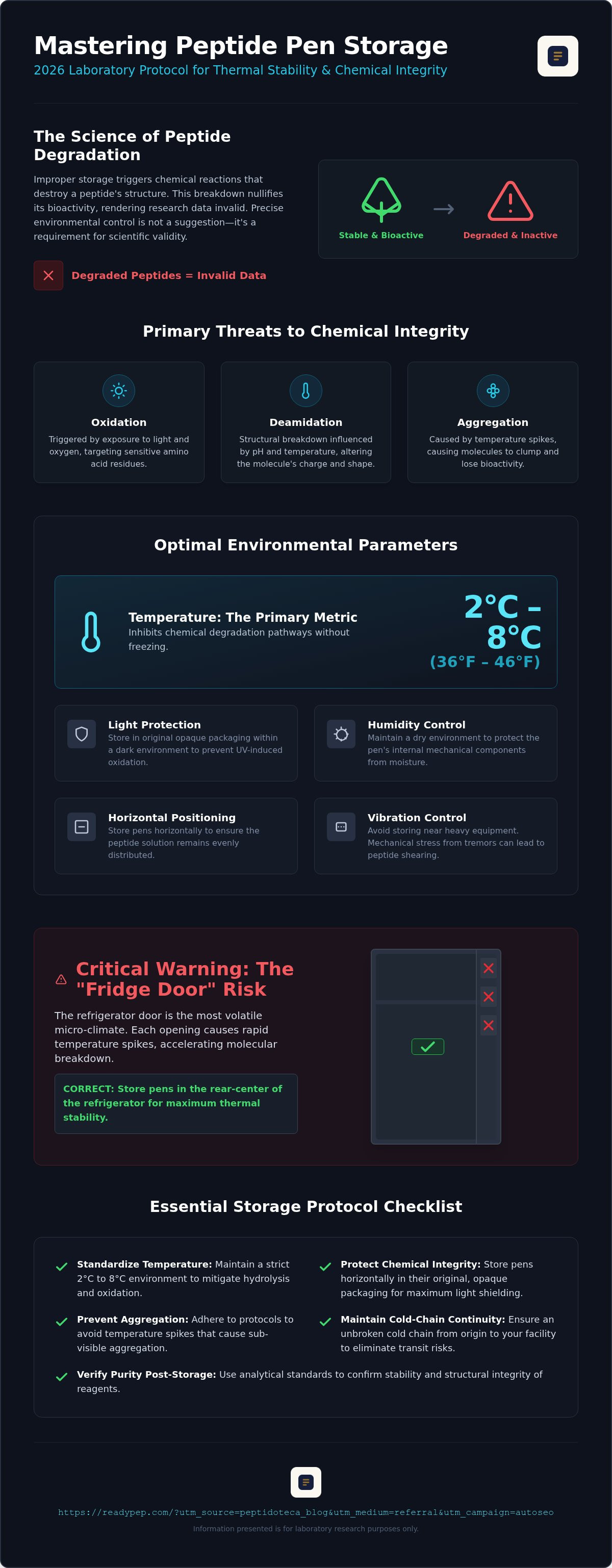
Peptide stability is the preservation of secondary and tertiary structural integrity. It's not a suggestion. It's a requirement for scientific validity. When these structures collapse, the peptide's affinity for specific receptors vanishes. This renders your in-vitro data useless. Understanding how to store research peptide pens is about managing kinetic energy. Thermal energy acts as a catalyst. It drives the hydrolysis and oxidation processes that dismantle aqueous solutions. Without precise control, your reagents become nothing more than expensive, inactive fluid.
Longer peptide sequences are particularly vulnerable to environmental stressors. More amino acid residues mean more potential sites for chemical failure. If your reagent potency fluctuates, your experimental results will follow. High-standard research requires reagents that remain structurally intact from the first draw to the last. Valid data depends on consistent chemical purity. This consistency is only possible when you mitigate the physical factors that lead to molecular breakdown.
Primary Pathways of Chemical Instability
Oxidation remains a primary threat to research integrity. Light and oxygen target sensitive residues like Cysteine. Even minor exposure can trigger a cascade of degradation. Deamidation is equally problematic. This structural breakdown is heavily influenced by pH and temperature fluctuations. It's a silent killer of potency that alters the molecule's charge and shape. Finally, aggregation occurs when temperature spikes cause molecules to unfold. They clump together. They lose bioactivity. They become sub-visible particles that interfere with your assays and skew your observations.
The Vulnerability of Aqueous Research Peptides
Lyophilised powders offer a degree of stability that aqueous solutions lack. Pre-filled pens are sophisticated. They are efficient. But they have a narrower margin for thermal error. Water molecules facilitate the very reactions that lead to degradation. This makes the storage environment critical. Establishing a baseline for peptide pen quality control ensures you start with a stable product. Proper storage maintains that standard.
Knowing how to store research peptide pens is the only way to protect your investment and your data. Aqueous solutions require a stable micro-climate to prevent the rapid hydrolysis that occurs at room temperature. The convenience of pre-filled formats must be balanced with rigorous adherence to thermal protocols. In 2026, laboratory standards demand zero tolerance for the environmental fluctuations that compromise research integrity.
Optimal Environmental Parameters for Research Peptide Pens
Precision storage isn't a suggestion. It's a protocol. To maintain structural integrity, you must standardize your laboratory environment. The primary metric is temperature. Maintaining a strict range between 2°C and 8°C (36°F to 46°F) is essential. This range inhibits the chemical pathways of degradation without reaching the critical freezing point. If you want to know how to store research peptide pens effectively, you must look beyond just the thermostat. Environmental control requires a multi-faceted approach.
Light protection is equally critical. Fortunately, the opaque housing of high-quality pre-filled pens provides a structural advantage. It acts as a primary barrier against UV-induced oxidation. However, this doesn't replace the need for dark storage. Humidity management is often overlooked. You must maintain a dry environment to protect the internal mechanical components of the pen. Excessive moisture can lead to mechanical failure or external contamination. Vibration control is the final pillar. Mechanical stress can lead to peptide shearing. Avoid placing pens near heavy laboratory equipment that generates consistent tremors.
The "Fridge Door" Risk: Temperature Fluctuations
The refrigerator door is the most volatile location in your lab. It's the worst place for research chemicals. Every time the door opens, the micro-climate collapses. Ambient air rushes in. This causes rapid temperature spikes that force the peptide solution to expand and contract. Over time, these fluctuations accelerate molecular breakdown. Store your pens in the rear-centre of the laboratory refrigerator. This location offers the highest degree of thermal stability. It's the furthest point from external air exchange.
Long-Term vs. Short-Term Temperature Targets
Active research requires different considerations than long-term archiving. For pens currently in use, the 2°C to 8°C range remains the standard. Understanding how to store research peptide pens for long-term archiving requires even stricter adherence to these limits. Never freeze aqueous pens. Freezing causes the liquid to expand. This can crack the internal glass cartridge or damage the mechanical plunger. More importantly, the formation of ice crystals can cause peptide shearing. This physically tears the molecular bonds. If you are transferring materials between facilities, ensure you use verified cold-chain protocols to prevent any temperature excursions that could compromise your data.
Storage Protocols for Pre-filled Pens: Best Practices
While environmental variables set the stage, physical handling is the final barrier against reagent failure. Maintaining the pen in its original protective packaging is your first line of defense. It adds a secondary layer of light shielding beyond the opaque pen housing. Orientation matters. Store your pens horizontally. This ensures an even distribution of the aqueous solution. It prevents prolonged pressure on the internal seals and keeps the plunger mechanism primed. It's a simple adjustment that preserves mechanical function and chemical consistency.
Secure the cap after every use. It's a basic step that prevents airborne contaminants from reaching the injection interface. It also mitigates micro-evaporation, which can slowly alter the concentration of your reagent. Labeling is the cornerstone of data integrity. Record the exact date of arrival and the date of first experimental use directly on the packaging. This practice allows you to track the exact age of the reagent. It ensures you rotate your stock correctly. Knowing how to store research peptide pens means treating every unit as a time-sensitive asset.
Aseptic Handling Prior to Storage
Contamination often happens during the transfer from the bench to the refrigerator. Wipe the pen exterior with 70% isopropyl alcohol before returning it to cold storage. This is vital in shared laboratory environments where cross-contamination risks are high. For high-purity reagents like Retatrutide 40mg, use dedicated airtight containers. This provides an additional micro-climate barrier. It prevents exposure to volatile organic compounds often found in lab settings. It also keeps your most sensitive compounds isolated from less stable materials.
Tracking Shelf Life and Potency
Your storage protocol must include a visual verification step. Before each draw, inspect the solution for cloudiness, precipitation, or unexpected colour changes. These are clear indicators of structural breakdown. Monitor lot numbers diligently. This ensures publication integrity and allows for precise troubleshooting if experimental variances occur. Integrating these steps into your routine is part of improving lab workflow and maximizing the utility of pre-filled formats. Every interaction is an opportunity for quality control.
Mastering how to store research peptide pens requires a shift from passive storage to active management. Every interaction with the pen is an opportunity for contamination or thermal excursion. By standardizing these physical handling steps, you eliminate variables that compromise your results. Consistency in storage leads to consistency in data. High-standard research demands nothing less than absolute control over reagent lifecycle.
Maintaining Cold-Chain Integrity: From UK to Laboratory
Cold-chain logistics are the backbone of research integrity for aqueous peptides. Unlike lyophilized powders, pre-reconstituted solutions are chemically active. They are immediately susceptible to thermal excursions. Ensuring you understand how to store research peptide pens begins long before the package arrives at your facility. It starts with the supplier's commitment to thermal stability during transit. ReadyPep utilizes industrial-grade insulated packaging and temperature-controlled shipping to mitigate environmental risks. This infrastructure provides a critical thermal buffer. It protects the molecular bonds of compounds like BPC-157 or MOTS-c from the unpredictable conditions of global logistics.
Professional shipping materials are designed to maintain the 2°C to 8°C range even during transit delays. This buffer is essential for preventing the aggregation and hydrolysis discussed in previous sections. However, the responsibility shifts to the researcher the moment the cargo reaches the laboratory. You must establish an immediate inspection protocol. This is the only way to verify that the cold-chain remained intact from the UK base to your bench. Every minute of exposure to ambient room temperature counts against the reagent's total shelf life.
Verifying Receipt of Temperature-Sensitive Cargo
Check the exterior for structural damage upon arrival. Inspect the internal coolant levels immediately. If the coolant has completely thawed or the packaging shows signs of leakage, the chemical integrity of the pens may be compromised. Document the arrival temperature for your institutional compliance records. This data is vital for future audits and publication peer reviews. Transfer the pens from the shipping container to your designated laboratory refrigerator without delay. Don't leave temperature-sensitive reagents on a loading dock or in a reception area. Speed is the primary factor in preserving potency.
Global Sourcing and Compliance
Navigating customs clearance for research chemicals requires strategic planning to avoid shipping bottlenecks. UK-based distribution offers a significant advantage in this regard. It ensures tighter control over initial storage conditions and shorter transit times to European laboratories. Ensure all lot-specific documentation is filed correctly upon receipt. This includes certificates of analysis and pH verification data. Maintaining these records is essential for verifying the baseline purity of your reagents. For researchers who prioritize data accuracy, leveraging ReadyPep's cold-chain infrastructure is the most efficient way to ensure your peptides arrive in optimal condition.
ReadyPep Standards: Verified Purity and Thermal Stability
A storage protocol is only as effective as the reagent's baseline purity. If a peptide enters the cold chain with existing impurities or incorrect pH levels, degradation is inevitable. ReadyPep addresses this by standardizing every lot through Janoshik Analytical. We verify purity and pH balance before any unit reaches our UK distribution hub. This empirical verification ensures that your knowledge of how to store research peptide pens is applied to a stable, high-purity product. Precision in manufacturing leads to predictability in the laboratory. It eliminates the guesswork that often plagues in-vitro studies.
pH balance is a critical, often overlooked factor in aqueous stability. Peptides are most stable at specific isoelectric points. Deviations from these points accelerate the chemical pathways of failure like deamidation. Metatide Healthcare manufacturing standards prioritize this balance. By maintaining an optimal pH, we extend the effective shelf life of the solution within the 2°C to 8°C range. You aren't just storing a liquid; you're maintaining a carefully calibrated chemical environment. This baseline stability is what allows pre-filled pens to maintain their integrity throughout a multi-week research cycle.
Independent Lot Testing for Research Integrity
Data integrity requires transparency. We provide lot-specific HPLC and Mass Spectrometry data for every product. This establishes a clear baseline for your storage records. For complex stacks like BPC-157 + TB-500 40mg, independent testing confirms the ratio and purity of both compounds. Accessing this documentation is straightforward. It ensures your institutional audits are supported by third-party validation. pH testing remains a core component of this process. It prevents the premature structural breakdown that occurs in poorly buffered solutions. You can't manage what you don't measure.
The ReadyPep Advantage for In-Vitro Studies
Pre-filled pens represent a shift toward modern efficiency. They offer precision dosing. They provide superior light protection. Most importantly, they simplify how to store research peptide pens by reducing the risk of contamination during reconstitution. ReadyPep combines this convenience with uncompromising quality control. Every pen is a tool for high-standard research. Every lot is a commitment to data accuracy. All products are strictly for in-vitro research purposes only. They are not for human or veterinary use. Secure high-purity research pens with verified cold-chain shipping today to ensure your next study is built on a foundation of chemical integrity.
Advancing Laboratory Standards for Peptide Integrity
Maintaining the structural integrity of your reagents is a non-negotiable requirement for valid in-vitro data. You've seen how precise micro-climate management prevents the chemical failure pathways of oxidation and hydrolysis. By standardizing your protocols, you protect your investment and your research results. Mastering how to store research peptide pens ensures that every draw, from the first to the last, remains potent and pure.
Consistency starts with verified baseline data. Every lot must meet rigorous standards for purity and pH balance before it enters the cold chain. ReadyPep provides this transparency through Janoshik Analytical testing and lot-specific documentation. Our global cold-chain logistics ensure that your reagents move from our UK hub to your laboratory without thermal compromise. This level of oversight removes the variables that lead to inconsistent assays. It provides the calm assurance of a provider with nothing to hide.
Optimise your research with verified cold-chain peptide pens and take full control of your laboratory workflow. Precise storage is the final step in ensuring your data stands up to peer review. Your commitment to these standards defines the quality of your scientific contributions. Build your next study on a foundation of empirical verification.
Frequently Asked Questions
How long do pre-filled research peptide pens last in the refrigerator?
Pre-filled research peptide pens generally maintain stability for 28 to 30 days once the seal is broken, provided they remain within the 2°C to 8°C range. Unopened units can often reach a two-year shelf life under continuous refrigeration. Understanding how to store research peptide pens requires verifying lot-specific documentation for exact expiration dates. Degradation rates accelerate once air enters the cartridge. Consistent thermal monitoring is essential for maintaining reagent potency.
Can I store research peptide pens in the freezer for longer shelf life?
Never store pre-filled pens in the freezer. The expansion of aqueous solutions during freezing causes mechanical stress on the internal glass cartridge and plunger assembly. Ice crystal formation leads to peptide shearing, which physically dismantles the secondary and tertiary structures of the molecule. If you freeze a pen, the resulting aggregation renders the reagent inactive for high-standard in-vitro research. Stick to the standardized 2026 refrigeration protocol for all pre-reconstituted products.
What are the visible signs that a peptide pen has degraded?
Visible degradation typically manifests as cloudiness, precipitation, or a distinct change in the solution's color. High-purity peptides should appear as clear, colorless liquids. Any presence of sub-visible particles or clumping indicates that aggregation has occurred. If the solution loses its clarity, the chemical integrity is compromised. Don't use reagents showing these signs. Such variances lead to inconsistent experimental data and skewed results in your laboratory assays.
Does light exposure significantly damage peptides inside a pen housing?
UV radiation triggers rapid oxidation in sensitive amino acid residues like Cysteine and Methionine. While the opaque housing of pre-filled pens provides a primary barrier, it isn't an absolute shield. Prolonged exposure to ambient laboratory light can still degrade the aqueous solution over time. This is why the protocol requires keeping the pen in its original protective box. Dark storage is a critical secondary layer for maintaining long-term chemical stability.
What happens if my peptide pen arrives at room temperature?
If a shipment arrives with completely thawed coolant, the thermal stability of the reagents may be compromised. Immediate inspection is required. Check the internal temperature of the insulated packaging. If the micro-climate has exceeded 8°C for an extended period, the rate of hydrolysis increases significantly. ReadyPep utilizes industrial-grade buffers to manage brief transit excursions. However, significant temperature spikes during the customs process can damage molecular bonds. Always document the arrival state.
Should I store my research pens horizontally or vertically?
Horizontal storage is the recommended laboratory standard for pre-filled pens. This orientation ensures an even distribution of the aqueous solution within the internal cartridge. It also prevents prolonged pressure on the plunger's rubber seals. Storing pens vertically can lead to settling or mechanical air-lock issues over time. Maintaining a horizontal position is a simple but effective way to ensure the pen remains primed and the reagent concentration stays uniform throughout its use.
How does pH affect the storage stability of aqueous peptides?
The pH level determines the rate of chemical failure pathways like deamidation and hydrolysis. Peptides are most stable at their specific isoelectric points. If the solution's pH drifts, the molecule's charge changes, leading to structural collapse. This is why knowing how to store research peptide pens involves starting with a pH-verified product. ReadyPep utilizes Janoshik Analytical to confirm that every lot is balanced for maximum longevity. Proper pH balance prevents premature aggregation during cold storage.
Is it necessary to wipe the pen with alcohol before every storage session?
Aseptic handling is essential to prevent cross-contamination in shared laboratory refrigerators. Wiping the pen exterior with 70% isopropyl alcohol before each storage session removes airborne contaminants and volatile organic compounds. This practice is especially critical when handling high-purity reagents like Retatrutide or BPC-157. It ensures that the storage environment remains sterile. Reducing the microbial load on the pen housing is a fundamental step in maintaining the overall integrity of your research materials.
Disclaimer
Educational content only. Not medical advice.


