

What if the primary obstacle to your next breakthrough isn't a flawed hypothesis but a misplaced decimal point on a commercial invoice? In 2026, customs clearance for research chemicals has transformed into a high-stakes verification process that rewards clinical precision while punishing administrative oversight. You've likely experienced the frustration of watching high-purity reagents stall in a humid transit hub because a harmonized system code was slightly misaligned. It's an unnecessary friction point that compromises both your project's timeline and the chemical stability of your samples.
We recognize that your publication integrity relies on the arrival of uncompromised, laboratory-grade compounds. This guide offers a technical roadmap for mastering international documentation, cross-border compliance, and the cold-chain logistics essential for sensitive reagents. We'll analyze how utilizing standardized formats, like pre-filled research pens for compounds such as MOTS-c or Retatrutide, can streamline the inspection process through transparent labeling and verifiable purity data. You'll learn how to transform logistics from a variable risk into a predictable, automated component of your research workflow.
Key Takeaways
- Identify the essential documentation package, including Commercial Invoice, SDS, and COA, required to validate reagent intent and prevent administrative seizures.
- Navigate the complexities of customs clearance for research chemicals by utilizing precise 2026 HS codes to ensure regulatory alignment across global jurisdictions.
- Prioritize lot-specific documentation over generic analysis sheets to maintain publication integrity and verify chemical purity during transit inspections.
- Implement a strategic compliance checklist focusing on supplier transparency and verified pH data to mitigate the risk of cold-chain logistics delays.
- Streamline international research logistics by sourcing pre-filled pens from established distributors that utilize stabilized UK-based shipping routes for global delivery.
Understanding Customs Clearance for Research Chemicals
Understanding Customs Clearance is the first step toward a functional international supply chain. It acts as the procedural bridge between a global synthesis facility and your specific laboratory application. For many, customs clearance for research chemicals feels like a black box. It shouldn't. It's a systematic verification of identity, intent, and safety compliance. Customs officials aren't looking for reasons to stop your work. They're looking for proof that your shipment matches its declaration.
There's a fundamental difference between commercial chemicals and laboratory reagents. Commercial chemicals are often bulk precursors for industrial manufacturing. Reagents, however, are high-purity compounds used for in-vitro laboratory research. The distinction matters. Reagents require higher standards of documentation and purity verification. When these lines blur, shipments get held. Clear labeling is your best defense against administrative delays.
The "Research Only" designation carries immense legal weight in international trade. It's a formal declaration that the material isn't intended for human or veterinary consumption. This label isn't a loophole. It's a classification that dictates which regulatory rules apply. Customs uses this information to prevent the diversion of materials into unauthorized channels. It ensures that sensitive compounds remain within the controlled environment of scientific inquiry.
The Legal Framework for In-Vitro Reagents
In-vitro reagents are tools for discovery, not treatments. This distinction is the bedrock of international compliance. Clear intent-of-use statements are vital. They tell the inspector exactly what the compound is for. Sourcing from verified distributors like ReadyPep provides an immediate advantage. Their inventory, including specialized formats like Retatrutide 40mg, is backed by the regulatory clarity that modern institutions demand. This transparency removes the guesswork for customs agents and reduces inspection friction at the border.
The High Stakes of Compliance in 2026
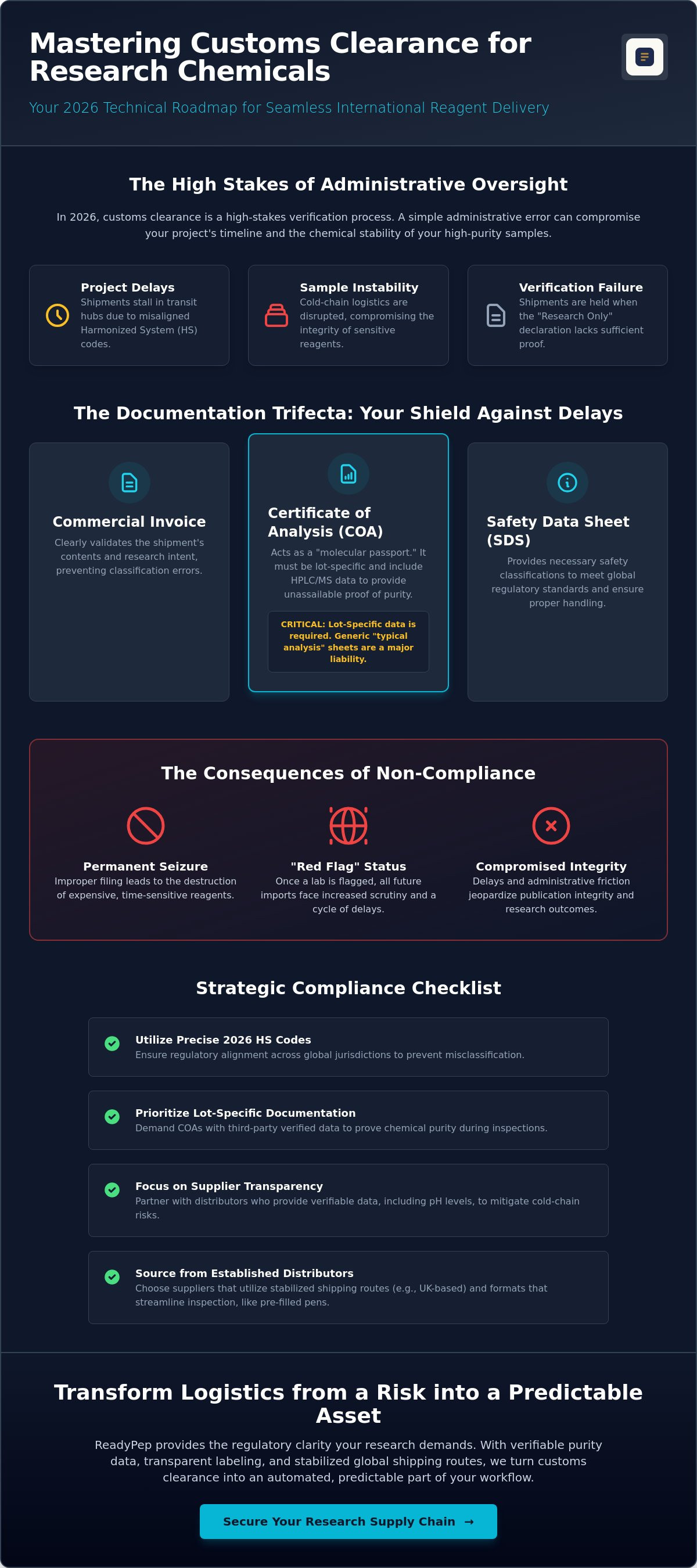
The landscape of 2026 doesn't tolerate administrative sloppiness. Improper filing leads to more than just a late package. It results in permanent seizure and the destruction of expensive reagents. Even worse is the "red flag" status. Once a laboratory is flagged for non-compliance, every future import faces increased scrutiny. This leads to a cycle of delays that compromises time-sensitive research. In 2026, research chemical classification is defined by the absolute alignment of molecular purity data with harmonized regulatory declarations.
Essential Documentation for Laboratory Reagent Imports
Data is the only currency that matters at the border. To ensure seamless customs clearance for research chemicals, your shipment must be anchored by a synchronized trifecta of paperwork: the Commercial Invoice, the Safety Data Sheet (SDS), and the Certificate of Analysis (COA). If these documents don't align perfectly, the shipment is compromised. Customs agents in 2026 use automated scanning to cross-reference molecular weights, chemical names, and safety classifications. Any discrepancy triggers a manual audit, which is where most delays begin.
Generic "typical analysis" sheets are administrative liabilities. You need lot-specific documentation that links the physical product to a specific batch of testing. High-standard distributors utilize independent verification from facilities like Janoshik Analytical to provide unassailable proof of identity and purity. This third-party validation serves as a shield against claims of mislabeling. It proves that the substance in the container is exactly what the paperwork claims it to be. The SDS further supports this by providing the necessary safety classification, a process that requires Navigating International Regulations with precision to meet global standards.
The Role of the Certificate of Analysis (COA)
A lot-specific COA functions as a molecular passport. It should include High-Performance Liquid Chromatography (HPLC) and Mass Spectrometry (MS) data to verify both purity and sequence identity. For aqueous solutions in pre-filled formats, pH verification is a critical but often overlooked metric. It ensures the stability of the reagent during the transit window. You can view examples of this gold-standard verification on the ReadyPep lab testing page, where every batch is subjected to rigorous empirical scrutiny before it ever reaches a customs hub.
Commercial Invoices and Proper Valuation
Accurate valuation is essential to avoid "commercial resale" audits. You must value research reagents based on their laboratory utility, not their potential retail price. Use precise chemical nomenclature on shipping labels rather than internal brand names. For example, instead of just "MOTS-c 40mg," the label should reflect its chemical identity as a synthetic peptide reagent. Every invoice must include a clear declaration of intent. A standard template for this is: "This product is a laboratory reagent for in-vitro research use only. Not for human or veterinary use." For researchers who demand this level of empirical certainty, sourcing through a transparent supply chain ensures every document is audit-ready and compliant with 2026 standards.
Navigating International Regulations and HS Codes
Precision in customs clearance for research chemicals is impossible without a mastery of the Harmonized System (HS). This numerical nomenclature acts as the universal language of global trade. In 2026, customs authorities rely on these codes to automate risk assessment and duty calculation. If your shipment carries an outdated or imprecise code, it won't just be delayed; it will be flagged for manual inspection. This is where the highest risk of reagent degradation occurs. A package sitting on a loading dock while a clerk disputes a classification code is a package losing its molecular integrity.
The cold-chain gap is a critical failure point often ignored by generic logistics advice. When customs agents initiate a manual audit due to coding errors, they rarely prioritize temperature control. Your BPC-157 or MOTS-c 40mg samples are sensitive to thermal fluctuations. Correct coding ensures your shipment moves through automated "green lanes" where transit time is minimized. This isn't just about taxes. It's about protecting the empirical value of your reagents from the moment they leave the synthesis lab until they reach your bench.
HS Coding for Peptides and Proteins
In 2026, synthetic peptides generally fall under Chapter 29 of the HS, specifically within the 2937 subheadings for hormones and their derivatives. However, the introduction of modern delivery formats has complicated this. Pre-filled research pens require dual-classification. You must declare both the delivery device and the chemical reagent itself. This ensures that the shipment is evaluated for both medical device regulations and chemical safety standards. If you're unsure which specific 6-digit code applies to your project, we recommend verifying your documentation with the ReadyPep contact team to ensure alignment with current 2026 global standards.
Regional Nuances in Research Imports
Regulatory requirements vary significantly by jurisdiction. The UK maintains rigorous export standards that often exceed the baseline requirements for EU entry. Conversely, North American imports involve a complex interplay between Customs and Border Protection (CBP) and the FDA. Following NIDA's Ordering Guidelines for Research Chemicals is essential for understanding the specific import permits required for controlled substances and high-purity reagents. While the "De Minimis" threshold allows some small-batch shipments to enter without formal duty, research chemicals are often excluded from these exemptions due to safety oversight. 2026 trade agreements have streamlined movement between specific "trusted partner" institutions, but the burden of proof remains with the importer. You must demonstrate that your reagents are intended for non-clinical, laboratory use to benefit from these expedited lanes.
Avoiding Delays: A Step-by-Step Compliance Checklist
Efficiency in customs clearance for research chemicals isn't a result of luck. It's the outcome of a rigorous pre-shipment audit. You don't want to react to a seizure; you want to prevent it. High-standard research requires a proactive approach to logistics. Start by verifying your supplier's documentation standards. Metatide Healthcare, for example, sets the industry benchmark by providing the granular data that customs agents require for rapid processing. This includes confirmed lot-specific purity and pH data directly in the shipping packet. Every data point serves as a verification of the shipment's legitimacy.
Follow this checklist to ensure your laboratory workflow remains uninterrupted:
- Verify the supplier’s reputation and documentation standards.
- Confirm lot-specific purity and pH data are included in the shipment.
- Ensure the shipment utilizes a tracked, cold-chain service for stability.
- Pre-file any necessary institutional import permits before the shipment departs.
- Audit the commercial invoice for nomenclature accuracy and research declarations.
Pre-filing is your most powerful tool. Don't wait for the package to hit the border to discover an institutional import permit is missing. File these documents before the shipment departs the origin facility. Audit your commercial invoice one last time. Ensure the nomenclature is precise and matches the SDS. These small administrative steps are the difference between a 48-hour transit and a 14-day quarantine.
The Cold Chain Factor
Temperature-sensitive reagents, such as the Repair Protocol, demand priority clearance. Every hour spent in a customs warehouse is an hour of potential degradation. We recommend using shipments that include integrated temperature monitoring devices. These tools provide empirical proof of integrity upon arrival. For a deeper analysis of these logistics, see our guide on Verifying Cold Chain Integrity: A Researcher’s Guide to Peptide Stability. Maintaining this thermal continuity is as vital as the chemical synthesis itself.
Addressing the #1 Objection: The Risk of Seizure
Seizures are rarely random. They're usually the result of vague labeling or missing COAs. Loose vials and unbranded powders often trigger visual "suspicious" profiles during X-ray screening. Pre-filled research pens offer a significant advantage here. Their professional, standardized format projects regulatory compliance and intent. While no international shipment is entirely risk-free, properly documented research materials from verified sources maintain a high statistical rate of successful delivery. To secure your laboratory supply chain with audit-ready reagents, source your compounds from a transparent distributor that prioritizes documentation as much as purity.
ReadyPep: Streamlining Global Research Logistics
ReadyPep functions as more than a supplier; it is a specialized logistics partner for the modern laboratory. In the complex environment of customs clearance for research chemicals, the origin and format of your reagents determine the speed of entry. As the authorized worldwide distributor of Metatide Healthcare pens, ReadyPep operates with a level of transparency that traditional vial-based providers often lack. Every shipment is designed to move through international hubs with minimal friction. This is achieved by aligning physical product design with the rigorous documentation standards analyzed in previous sections.
Shipping from the UK provides a distinct strategic advantage. It utilizes established, high-integrity trade routes to reach global research institutions. This reduces the "origin risk" often associated with shipments from less regulated jurisdictions. Customs agents recognize these stable routes, which often leads to expedited processing. Mastering the nuances of customs clearance for research chemicals requires a partner who understands both the chemistry and the code. Every order includes lot-specific Janoshik Analytical documentation. This third-party verification is a primary asset for your lab records and customs verification alike. It provides the empirical proof agents need to clear a shipment without manual intervention.
Precision in Every Pen
Pre-filled formats, such as NAD+ 1000mg, offer more than just dosing accuracy. They fundamentally redefine the customs profile. By declaring these items as "reagent delivery systems," you align with modern device classifications. This reduces the ambiguity that leads to administrative holds. The manufacturing process at Metatide Healthcare ensures absolute sterility and molecular integrity. The result is a reagent that arrives ready for immediate laboratory application, significantly reducing preparation time.
Free Global Cold-Chain Shipping
Frictionless logistics shouldn't be an additional expense for your institution. ReadyPep removes the administrative and financial burden of international transport with free global cold-chain shipping. This network is optimized for time-sensitive studies. It ensures that your reagents maintain their thermal profile from the UK synthesis site to your laboratory bench. Reliability is built into the system. It's about removing the uncertainty of the border. When your supply chain is predictable, your research timelines become stable. Explore the full range of research protocols at ReadyPep to secure a supply chain that values clinical precision as much as you do.
Optimizing Your Laboratory Supply Chain for 2026
Successful international procurement is no longer a matter of chance; it's the calculated result of aligning precise HS codes with a lot-specific documentation trifecta. By shifting from generic labeling to transparent, device-specific declarations, you eliminate the administrative friction that leads to seizures and reagent degradation. Mastering customs clearance for research chemicals requires this level of clinical detail to protect both your project timelines and your publication integrity. When every document reflects empirical truth, the border becomes a gateway rather than a barrier.
ReadyPep bridges the gap between global synthesis and laboratory application by providing reagents that meet rigorous Metatide Healthcare manufacturing standards. Every shipment is anchored by lot-specific Janoshik Analytical testing, ensuring that your purity data is as unassailable as your methodology. By removing the logistical burden through free worldwide cold-chain shipping, we ensure your high-purity reagents arrive exactly when your research demands them. There is no need to settle for supply chain uncertainty when data-driven solutions are available.
Secure High-Purity Reagents with Guaranteed Global Shipping. Your next breakthrough shouldn't be stalled by a border delay. Build a supply chain that reflects the precision of your work.
Frequently Asked Questions
Is it legal to import research chemicals for laboratory use?
Yes, importing reagents for laboratory use is legal in most jurisdictions when the Research Only designation is clearly documented. You must ensure the compounds are intended for in-vitro studies and aren't scheduled as controlled substances in the destination country. Proper documentation, including a Safety Data Sheet (SDS), is required to prove the shipment complies with international safety and trade standards.
What happens if my research peptide shipment is held by customs?
Customs typically issues a notice requesting specific documentation, such as an institutional import permit or a detailed Certificate of Analysis (COA). If the paperwork isn't provided within the required timeframe, the shipment may be seized or returned to the sender. This is why pre-filing documents is essential for smooth customs clearance for research chemicals. Delays often occur when the declared value or chemical nomenclature is ambiguous.
Do I need a special license to buy peptides for in-vitro research?
Most high-purity peptides don't require a specific individual license for purchase; however, your institution or laboratory may need to be registered for international imports. Some regions require a declaration of intent to ensure the materials aren't diverted for human or veterinary use. Always check your local regulatory guidelines before sourcing sensitive reagents like Retatrutide or MOTS-c to ensure institutional compliance.
How much are the customs duties for research peptides in the UK?
UK customs duties depend on the specific Harmonized System (HS) code used and the total value declared on the commercial invoice. While some laboratory reagents benefit from lower duty rates under specific trade agreements, Value Added Tax (VAT) usually applies to the total import value. Using precise nomenclature and correct classification codes helps ensure you aren't overcharged or penalized for administrative errors during the entry process.
Can I track my cold-chain shipment through customs?
Yes, high-standard tracked services provide visibility throughout the entire transit window, including the moment the package enters a customs hub. Advanced logistics networks also utilize temperature monitoring devices that record thermal stability during the inspection phase. This transparency allows you to verify that sensitive compounds, such as BPC-157 or NAD+, haven't been compromised by prolonged exposure to ambient temperatures while awaiting clearance.
Why does the COA matter for customs clearance?
The Certificate of Analysis (COA) is critical because it validates the chemical identity of the shipment through HPLC and Mass Spectrometry data. Customs officials use this document to confirm that the package contains the declared reagent and not a restricted substance. Lot-specific COAs from independent labs provide the highest level of verification, reducing the likelihood of manual audits and shipment seizures.
What HS code should I use for research peptide pens?
Research peptide pens often require classification under HS Chapter 29 for the chemical compound and Chapter 90 for the delivery device. The specific 6-digit code depends on the peptide's molecular structure and its hormonal or non-hormonal classification. Incorrect coding is a primary cause of delays in customs clearance for research chemicals. We recommend verifying your specific reagent format with a professional broker to ensure alignment with 2026 global standards.
How does ReadyPep ensure my shipment clears customs successfully?
ReadyPep streamlines the process by including lot-specific Janoshik Analytical testing and detailed commercial invoices with every order. Our UK-based shipping network utilizes established trade routes that customs authorities recognize for their regulatory compliance. By using pre-filled research pens, we provide a professional product profile that clearly indicates laboratory intent, reducing the ambiguity that often triggers manual inspections or administrative holds at the border.
Disclaimer
Educational content only. Not medical advice.


