

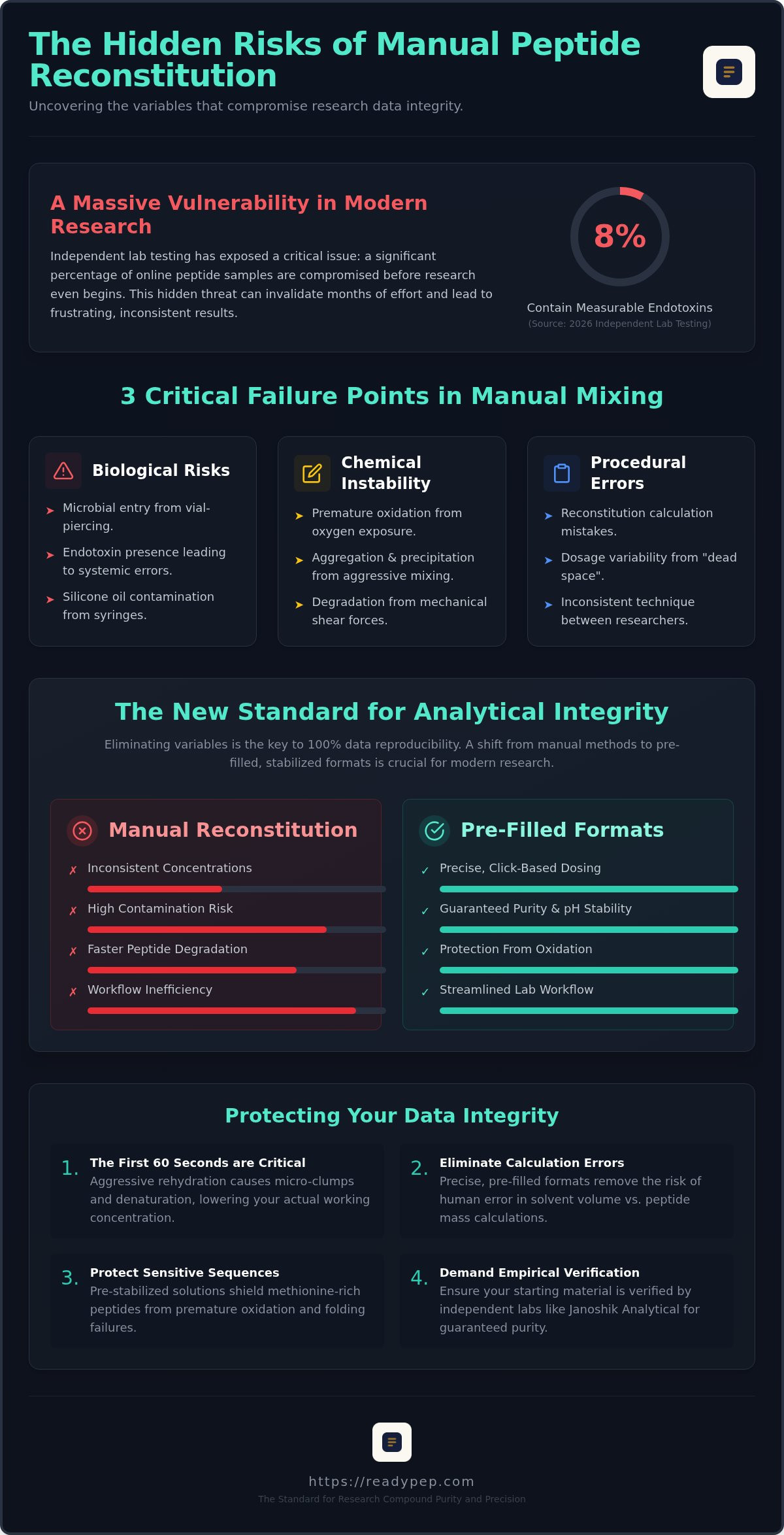
Did you know that independent lab testing in 2026 revealed that 8% of online peptide samples contained measurable endotoxins? This statistic exposes a massive vulnerability in modern research. Most investigators assume their manual protocols are airtight. They aren't. Even minor peptide reconstitution calculation errors can trigger systemic variability that invalidates months of laboratory effort. You've likely experienced the frustration of inconsistent assay results or observed peptide degradation before your experiments conclude. It's an exhausting cycle of troubleshooting that slows down genuine discovery.
We understand that precision is the only currency that matters in the lab. This guide uncovers the hidden technical and chemical risks of manual mixing and explains how to shield your in-vitro data from these variables. You'll learn how to achieve 100% data reproducibility by eliminating contamination and streamlining your workflow. We'll analyze why the shift toward pre-filled, stabilized formats is the new standard for analytical integrity. It's time to remove the friction from your research and focus on the results that move the needle.
Key Takeaways
- Manual mixing introduces immediate chemical stressors that can compromise your data before the experiment even begins. Learn why the first 60 seconds are critical for long-term peptide viability.
- Eliminate peptide reconstitution calculation errors and the "dead space" phenomenon. Precise click-based dosing ensures your concentration remains consistent across every single assay.
- Identify the hidden biological risks of vial-piercing, including microbial entry and silicone oil contamination from syringes. These variables often lead to systemic errors in sensitive cell culture models.
- Discover why self-mixed solutions degrade faster when exposed to oxygen and handling spikes. You'll learn how to protect sensitive methionine-rich sequences from premature oxidation and folding failures.
- Streamline your laboratory workflow by utilizing pre-filled research pens verified by Janoshik Analytical. It's the most efficient way to remove the friction of manual prep while guaranteeing purity and pH stability.
The Critical Failure Points in Manual Peptide Reconstitution
Reconstitution is a high-stakes phase transition. It's the moment a lyophilized, freeze-dried cake converts into a functional aqueous solution. While it looks like a simple dilution, it's actually a delicate chemical re-entry. The first 60 seconds of this process determine the peptide's viability for the remainder of the study. If the solvent hits the lyophilized powder too aggressively, it creates localized areas of extreme concentration. This often leads to immediate aggregation or precipitation. These micro-clumps don't always redissolve, meaning your actual working concentration is lower than your math suggests. This is a common source of peptide reconstitution calculation errors that researchers often overlook.
Mechanical stress is another silent data killer. Aggressive shaking creates shear forces that can physically break the delicate bonds of the molecule. This physical disruption is a core component of peptide stability and degradation. Instead of a functional research tool, you're left with a degraded sequence that produces inconsistent assay results. To maintain integrity, you must manage three distinct pillars of risk:
- Biological: Introduction of microbes during vial piercing or solvent transfer.
- Chemical: Immediate pH shifts or oxidation triggered by rapid rehydration.
- Mathematical: Peptide reconstitution calculation errors regarding solvent volume versus peptide mass.
The Fragility of Lyophilized Research Compounds
Lyophilized peptides possess a highly porous, airy structure. This design facilitates rapid dissolution, but it also makes them hypersensitive to rehydration speed. Many vials are shipped under vacuum pressure. If you don't vent the vial or control the solvent flow, the vacuum pulls the liquid in at high velocity. This jetting effect causes mechanical denaturation. You aren't just mixing; you're potentially destroying the compound's secondary structure before the experiment begins. Rapid rehydration can also trap air bubbles within the peptide matrix, leading to further surface-level denaturation.
Procedural Variability in the Lab Environment
Human technique is the greatest variable in any lab. One researcher might swirl a vial gently for two minutes, while another might invert it ten times rapidly. These inconsistencies create systemic variability in in-vitro data. Ambient factors also play a role. Exposure to light or room-temperature spikes during the mixing phase can trigger degradation in sensitive sequences. Without a standardized, pre-verified approach, your data reproducibility remains at the mercy of individual technique. To ensure your baseline is accurate, reviewing independent lab testing reports for your starting material is essential for establishing empirical verification.
Biological and Chemical Risks: Contamination and pH Instability
Manual reconstitution isn't just a procedural hurdle. It's a primary vector for biological contamination. Every time a researcher pierces a vial stopper, the risk of introducing foreign particulates increases. Standard laboratory environments, while controlled, are rarely certified for sterile compounding. This creates a hidden vulnerability. Even with a perfect aseptic technique, peptide reconstitution calculation errors can exacerbate these risks. If you miscalculate the volume of solvent, you might find yourself piercing the vial multiple times to correct the concentration. Each puncture is a new opportunity for microbial entry.
Chemical stability is equally fragile. The moment the vacuum seal is broken, oxygen enters the environment. For methionine-rich peptides, this starts a countdown toward oxidation. Additionally, standard plastic syringes use silicone oil to lubricate the plunger. During manual mixing, this oil can leach into your research solution. These microscopic droplets interfere with analytical readings and can alter the behavior of peptides in cell culture models. It's a variable that most researchers never account for in their final data.
Endotoxins and Aseptic Technique Failures
Endotoxins are a massive threat to research integrity. Independent lab testing in 2026 found that 8% of online peptide samples contained measurable endotoxins. These pyrogens trigger inflammatory responses in cell culture, essentially rendering your in-vitro data useless. If you're mixing in a non-certified environment, you're rolling the dice with your assay results. Multiple vial punctures don't just risk bacteria; they compromise the physical integrity of the stopper. Small fragments of rubber, known as "coring," can fall into the solution. This creates a heterogeneous mixture that further complicates your dosing accuracy.
Solubility and pH: The Buffer Problem
Peptide solubility is highly dependent on the pH of the solvent. Many researchers rely solely on bacteriostatic water. It's a mistake. Bacteriostatic water is not a buffer. It cannot maintain a stable pH environment when the peptide is introduced. Compounds like GHK-Cu or NAD+ require specific pH ranges to remain in solution. Without professional buffering, you risk "precipitation." This is where the peptide falls out of the liquid as a solid. You might not even see it with the naked eye. To understand the full scope of these requirements, consult our guide on research peptide quality standards. For labs that cannot afford these systemic risks, switching to pre-filled research pens ensures a professionally buffered, stable environment from the first click.
The Precision Gap: Mathematical Errors and Dosage Variability
Precision in the lab is often an illusion. While researchers focus heavily on chemical purity, they often ignore the mechanical limitations of their delivery tools. The "Dead Space" phenomenon is a prime example. Every standard syringe has a residual volume in the needle hub and tip that doesn't reach the target vial. If your protocol requires high-precision volumes, this unaccounted-for fluid skews your data from the very first draw. It's a physical reality that manual measurement simply cannot bypass.
Dilution math is where most peptide reconstitution calculation errors originate. Consider the impact of a minor deviation: a mere 0.1ml error in solvent volume during the reconstitution of a 5mg vial leads to a 10% variability in the final concentration. In sensitive in-vitro models, a 10% swing is the difference between a successful trial and a failed assay. Air bubbles also introduce significant interference. Even a microscopic bubble trapped in the syringe barrel displaces the peptide solution. This leads to under-dosing that is virtually impossible to track or correct manually.
This inherent variability makes reproducing results across different lab lots a significant challenge. If two researchers use slightly different mixing techniques or different syringe brands, their "identical" experiments are fundamentally different. Achieving 100% data reproducibility requires removing these manual variables from the equation entirely.
Calculating Concentration vs. Actual Yield
There is a persistent discrepancy between theoretical and actual peptide concentration. You might calculate for a specific concentration, but the actual yield delivered to the cell culture often falls short due to surface adsorption and transfer loss. Transitioning to a system based on "pen clicks" provides a superior alternative to visual syringe measurement. By utilizing a mechanical delivery system, you remove the guesswork and human error from the process. This shift is a critical step in improving lab workflow with pre-filled pens.
Systemic Error in Serial Dilutions
Serial dilutions amplify mistakes. A minor error in the primary stock vial compounds exponentially as you move down the dilution chain. By the time you reach your final working solution, the concentration may be nowhere near your intended target. This inconsistency destroys publication credibility and wastes expensive research materials. Pre-filled pens eliminate the need for manual serial dilution by providing a stabilized, high-concentration aqueous solution that is ready for immediate, precise dispensing via calibrated clicks. For researchers prioritizing radical transparency and accuracy, choosing ReadyPep provides the most reliable path to data integrity.
Peptide Stability: Why Self-Mixed Solutions Degrade Faster
Chemical stability is a race against time. Once a peptide is reconstituted, its degradation curve accelerates significantly. While researchers often fixate on peptide reconstitution calculation errors during the initial prep, they frequently neglect the chemical decay that follows. Self-mixed solutions lack the sophisticated stabilization required to maintain sequence integrity over multiple days. Without professional intervention, your research compounds are at the mercy of their environment. Oxygen is the primary silent killer. Methionine-rich peptides, such as MOTS-c or Thymosin Alpha-1, are particularly vulnerable. Manual vial mixing leaves a significant headspace of atmospheric air. This oxygen acts as an immediate catalyst for oxidation, stripping the peptide of its biological activity before your experiment concludes.
Temperature spikes during manual handling also compromise folding. The heat from a researcher's hands can transfer through the glass vial, triggering thermal stress. Light sensitivity adds another layer of risk. Clear glass vials offer zero protection against UV or ambient light, which can degrade sensitive research chemicals like NAD+. Lab-mixed solutions are simply a powder and a solvent. Professionally stabilized solutions are a different class of chemistry. They use specific buffers and preservatives to lock the peptide in its functional state.
Oxidation and Hydrolysis Pathways
Inaccurate solvent choice is a primary driver of peptide reconstitution calculation errors that directly impact the compound's half-life. Suboptimal water quality or incorrect pH levels trigger hydrolysis, leading to peptide bond cleavage. This physically breaks the amino acid chain. Pre-filled research pens utilize specialized stabilizers and precise aqueous environments to prevent this breakdown. These formulations ensure that the peptide remains potent and functional from the first click to the last. To protect your data from these invisible chemical failures, you should switch to ReadyPep's stabilized research pens.
The Cold Chain Factor
The moment of reconstitution is often the moment the cold chain breaks. Many researchers allow vials to reach room temperature before mixing. This is a critical risk factor. Every minute spent at ambient temperature increases the rate of enzymatic degradation. ReadyPep's pens are shipped via a strict cold-chain protocol and arrive in a pre-filled, aqueous format. This eliminates the "room temperature" window entirely. Maintaining this thermal integrity is vital, especially when considering the complexities of customs clearance for research chemicals. By receiving a pre-stabilized product, you ensure that your research baseline is never compromised by handling-induced temperature spikes.
The ReadyPep Standard: Eliminating Reconstitution Risk
Research integrity requires the total removal of variables. Manual mixing is the opposite of that goal. It introduces mathematical, biological, and chemical risks that compromise your data baseline. ReadyPep operates as a high-standard gatekeeper, providing a sophisticated alternative to traditional vial-based systems. By utilizing pre-filled, aqueous research pens manufactured by Metatide Healthcare, you eliminate the primary source of systemic variability. These pens arrive ready for immediate use. No syringes. No manual dilution. No opportunity for peptide reconstitution calculation errors to invalidate your results. It's a streamlined approach designed for modern, high-efficiency laboratories that prioritize accountability over industry norms.
The transition from vials to pens is a logical evolution in laboratory protocol. When you remove the physical act of reconstitution, you remove the friction of uncertainty. Every pen is calibrated for precision. A simple click replaces the guesswork of visual syringe measurement. This mechanical accuracy ensures that your concentration remains identical from the first dose to the last. It's about radical transparency and empirical verification. You don't have to trust a manual process when you can rely on a precision-engineered delivery system.
Verification Through Third-Party Analysis
Transparency is our foundation. Every batch of Metatide Healthcare peptides undergoes rigorous independent lot testing by Janoshik Analytical. We don't rely on internal claims. We rely on third-party data. When you review a ReadyPep Certificate of Analysis (COA), you're looking at verified purity levels that consistently exceed the 99% threshold. We also test for specific pH levels to ensure the aqueous solution is perfectly buffered for stability. This level of verification is essential in a market where 8% of online samples are found to contain endotoxins. By choosing a pre-tested, pre-filled format, you secure your research against the hidden contaminants of unverified powders.
Selecting the Right Protocol for Your Lab
We've organized our offerings into functional protocols to streamline your selection process. If your research focuses on tissue recovery and systemic inflammation, the Repair protocol provides a stabilized blend of BPC-157 and TB-500. For studies centered on neuroprotection and cognitive pathways, the Mind protocol offers precise aqueous formats of Semax and Selank. These pre-filled pens are the logical conclusion for high-stakes in-vitro research. They offer a level of stability and precision that manual vial prep cannot match. Stop troubleshooting your mixing technique and start trusting your data. Secure your research integrity with ReadyPep pens and experience the efficiency of professional stabilization.
Standardizing Your Research Baseline
Manual reconstitution is an unnecessary liability. You've seen how mechanical stress, microbial entry, and peptide reconstitution calculation errors create systemic noise in your data. These variables don't just complicate your workflow; they threaten the reproducibility of your entire study. Relying on manual syringe measurements in a non-certified environment is a risk that modern laboratories can no longer justify. Precision requires a professional shift in methodology.
ReadyPep provides a transparent alternative with pre-filled aqueous research pens. Every lot undergoes independent testing by Janoshik Analytical for purity and pH, ensuring your starting material is verified before it reaches your lab. With cold-chain worldwide shipping and lot-specific documentation included, we handle the technical complexities so you don't have to. It's time to remove the friction of manual prep and secure your analytical integrity.
Eliminate reconstitution risk with ReadyPep pre-filled research pens and focus on the results that matter. Your research deserves the accuracy of a calibrated, professionally stabilized system.
Frequently Asked Questions
What are the most common mistakes during manual peptide reconstitution?
The most common mistakes include confusing milligrams with micrograms and allowing solvent to jet into the vial under vacuum pressure. These peptide reconstitution calculation errors often occur when researchers misjudge the total volume required for a specific concentration. Rapid rehydration can cause immediate aggregation, while aggressive shaking introduces shear forces that physically break the peptide bonds. Precision requires a controlled, steady entry of the solvent to maintain sequence integrity.
Can contaminated bacteriostatic water ruin my research results?
Contaminated bacteriostatic water is a primary vector for endotoxins that will absolutely invalidate your research results. Independent testing in 2026 discovered that 8% of online peptide samples contained measurable endotoxins, which trigger inflammatory responses in cell culture models. Once these pyrogens are introduced during manual mixing, the biological integrity of your in-vitro study is fundamentally compromised. Standard lab water is rarely sufficient for high-stakes analytical work.
How does pH imbalance affect peptide stability in-vitro?
A pH imbalance triggers immediate chemical stressors like hydrolysis or precipitation, which strip the peptide of its functional secondary structure. Certain research compounds, such as GHK-Cu or NAD+, are hypersensitive to their aqueous environment. Without a professionally buffered solution, the peptide can fall out of solution or undergo rapid sequence cleavage. This leads to inconsistent assay signals and forces researchers to waste time troubleshooting what should be a stable baseline.
Why is a pre-filled pen more accurate than a standard insulin syringe?
Pre-filled pens are more accurate because they eliminate the "dead space" and visual parallax errors inherent in standard insulin syringes. A syringe hub always retains a residual volume that skews your actual delivered dose. In contrast, mechanical pen clicks provide a calibrated, tactile delivery system that ensures the exact same volume is dispensed every time. This removes human error and ensures your peptide reconstitution calculation errors don't ruin your data.
What are the signs that a reconstituted peptide has degraded?
Visible signs of degradation include persistent cloudiness, precipitation, or a change in the solution's viscosity. However, chemical failures like oxidation in methionine-rich peptides are often invisible to the naked eye. If your assay results show a sudden loss of potency or high variability between lots, it's a strong indicator that your reconstituted compound has degraded. Using stabilized, pre-filled formats is the only way to guarantee potency remains consistent throughout the study.
Is it possible to sterilize a peptide after it has been reconstituted?
It isn't possible to safely sterilize a peptide after reconstitution without risking total denaturation of the compound. Heat sterilization via autoclave destroys the amino acid chain, while filtration through a 0.22-micron membrane can trap aggregated peptide, altering your concentration. Maintaining a sterile, pre-stabilized environment from the start is the only way to ensure research integrity. Prevention of contamination is always more effective than attempting to fix a compromised solution.
How does ReadyPep ensure the purity of its pre-filled pens?
ReadyPep ensures purity by utilizing Metatide Healthcare manufacturing standards and mandatory third-party lot testing by Janoshik Analytical. Every batch is verified for purity levels exceeding 99% and specific pH stability before it enters the cold-chain shipping process. This radical transparency provides researchers with lot-specific documentation that validates the identity and quality of every pen. You don't have to guess about the purity of your research materials when the data is independently verified.
Why should I use pre-filled pens for in-vitro laboratory research?
You should use pre-filled pens to eliminate the systemic risks associated with peptide reconstitution calculation errors and biological contamination. These pens provide a professionally stabilized, aqueous format that removes the friction of manual laboratory preparation. By standardizing your delivery method, you achieve 100% data reproducibility and focus your resources on genuine discovery. Most investigators find that moving away from manual vial prep significantly reduces assay variability and streamlines their daily workflow.
Disclaimer
Educational content only. Not medical advice.


