

How many months of research are you willing to lose to a single batch of unverified peptides? In the high-stakes environment of 2026, relying on a supplier's word isn't just risky; it's a threat to your data's integrity. You likely already know the frustration of reagent variability causing experimental failure. The difference between publishable results and a retracted paper often comes down to iso 17025 accreditation. This standard isn't just a badge. It's an empirical guarantee that the laboratory testing your materials possesses the technical competence to deliver exact results every time.
You're looking for more than just a label. You need transparency and precision. This guide explains the technical rigor behind international laboratory standards and how they safeguard your in-vitro studies. We'll provide a clear framework for evaluating Certificates of Analysis, helping you move past the "black box" of traditional suppliers. You'll gain the tools to verify the purity and pH of your research materials with absolute certainty.
Securing high-quality compounds shouldn't be the hardest part of your work. Modern researchers are already streamlining their procurement by choosing verified formats like pre-filled pens for compounds such as Retatrutide and BPC-157. If you're ready to eliminate the friction of material uncertainty, you can access laboratory-verified research peptides here to ensure your next study is built on a foundation of clinical-grade accuracy.
Key Takeaways
- Learn why iso 17025 is the definitive global standard for technical competence, moving beyond general management to ensure analytical precision in 2026.
- Understand the specific requirements for HPLC and Mass Spectrometry method validation that prevent reagent variability and protect your research data.
- Discover how to identify and mitigate supplier bias by prioritizing independent, third-party laboratory verification over unverified manufacturer claims.
- Master a simplified two-step audit process to verify a laboratory's accreditation status through the ILAC MRA and national accreditation bodies.
- See how switching to pre-filled research pens from Metatide Healthcare minimizes handling errors and preserves the purity of compounds like Retatrutide and BPC-157.
What is ISO 17025 and Why Does it Matter for Laboratory Research?
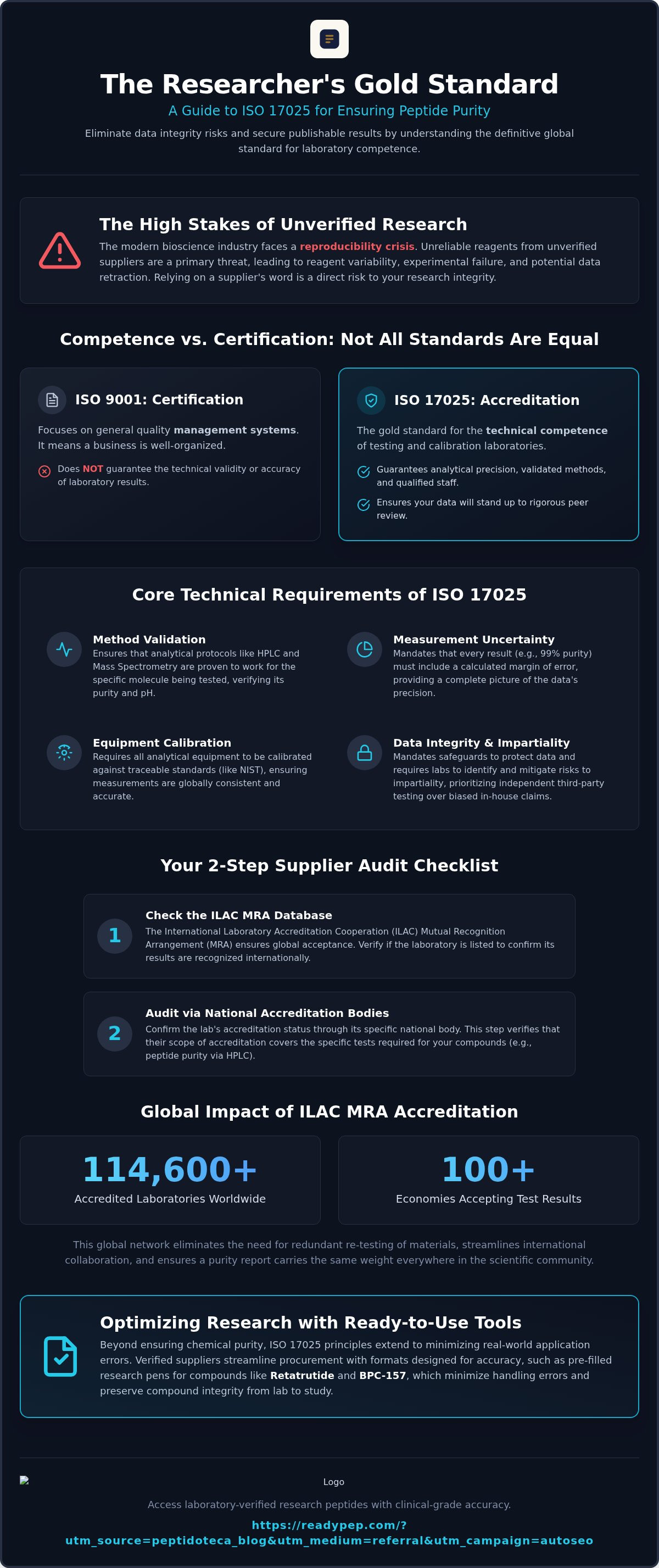
ISO 17025 is the international benchmark for laboratories that perform testing and calibration. It's the gold standard. For researchers in 2026, it represents the line between rigorous science and expensive guesswork. While many providers claim "high purity," an accredited facility proves it through empirical validation. Understanding What is ISO 17025 is the first step in auditing your supply chain. It moves beyond simple business management. It focuses on technical results. It ensures your data stands up to peer review.
The bioscience industry is currently grappling with a reproducibility crisis. Unreliable reagents are a primary culprit. Research peptide integrity depends on three pillars: competence, impartiality, and consistent operation. Without these, your data is vulnerable to retraction. iso 17025 mandates that laboratories identify and mitigate risks to these pillars. It forces transparency where many suppliers prefer shadows. It's the bridge between a manufacturer's claim and the empirical reality required for publishable research.
Competence vs. Certification: Understanding the Difference
Certification under ISO 9001 means a business is well-organized. It doesn't mean their lab results are accurate. You can have a perfectly managed business that produces flawed data. ISO 17025 is an accreditation of technical competence. It requires peer review of analytical methods. It ensures staff qualifications are verified. It guarantees that the person operating the mass spectrometer knows how to interpret complex peptide spectra. For compounds like MOTS-c or Retatrutide, this means verified purity and correct pH levels. ReadyPep prioritizes this by utilizing independent testing to ensure clinical-grade accuracy for every lot. You get data you can trust. Results you can publish.
The Global Impact on Research Trade and Acceptance
The International Laboratory Accreditation Cooperation (ILAC) Mutual Recognition Arrangement (MRA) ensures global acceptance. There are currently over 114,600 laboratories globally holding ILAC MRA accreditation. If a lab is accredited, its results are recognized in over 100 economies. This eliminates the need for redundant re-testing of imported research chemicals. It streamlines international collaboration. Researchers can procure materials with confidence, knowing the standards are universal. It simplifies the path from procurement to publication. It reduces friction. It saves time. Most importantly, it ensures that a purity report generated in one region carries the same weight everywhere else in the scientific community.
Technical Requirements: How ISO 17025 Validates Peptide Purity
Technical rigor isn't a suggestion. It's a requirement. In the world of peptide research, "purity" is a variable term unless it's backed by validated methods. The iso 17025 standard provides the specific framework for this validation. It ensures that every analytical protocol, from High-Performance Liquid Chromatography (HPLC) to Mass Spectrometry, is fit for its intended purpose. This isn't just about following a manual. It's about proving the method works for the specific molecule being tested.
Reliable results depend on calibrated equipment. Every analytical balance and spectrometer must adhere to traceable standards. This alignment is often based on the NIST Quality System, which ensures that measurements are globally consistent and accurate. Without this traceability, a purity reading is just a number without a foundation. ISO 17025 also introduces the concept of measurement uncertainty. Every purity percentage must include a calculated margin of error. If a lab claims 99% purity without defining the uncertainty, the data is incomplete. You need to know the precision of the tools used to measure your Retatrutide or MOTS-c batches.
Data integrity is the final safeguard. The standard mandates secure, tamper-proof electronic records. It prevents the "erasing" of failed tests or the selective reporting of "good" results. This radical transparency is why researchers are increasingly sourcing materials from providers who offer third-party verified research materials. It guarantees that the Certificate of Analysis (CoA) you receive is an honest reflection of the material's chemical profile.
Validating HPLC and Mass Spectrometry for Peptides
Peptide chromatography is complex. ISO 17025 prevents labs from "cherry-picking" the cleanest-looking chromatogram. It requires full documentation of mobile phase composition, column temperature, and flow rates. Baseline stability and peak resolution must meet rigorous thresholds before a result is accepted. This level of detail ensures that impurities aren't hidden under the main peak. It provides the empirical proof that your Selank or CJC-1295 is exactly what the label claims. When methods aren't validated, you're essentially gambling with your experimental outcomes.
The Critical Role of pH Testing in Aqueous Solutions
Calibration doesn't stop at purity. The Importance of pH Testing in Aqueous Peptide Solutions cannot be overstated for in-vitro success. ISO 17025 requires pH meters to be calibrated against certified buffers. This is vital because pH directly impacts peptide stability and solubility. An incorrect pH level can degrade a compound before your experiment even begins. Ensuring your GHK-Cu or NAD+ is delivered at the optimal pH is a hallmark of a technically competent supply chain. It removes a layer of uncertainty that could otherwise derail months of work.
Impartiality: Third-Party Testing vs. In-House Verification
Trust is not a scientific metric. Many peptide suppliers rely on in-house Certificates of Analysis (COAs). This creates an inherent conflict of interest. The manufacturer is essentially grading their own work. Under iso 17025, impartiality isn't just a goal. It's a mandated requirement. Accredited laboratories must identify and mitigate any risks to their objectivity on a continuous basis. This ensures that financial pressure never dictates a laboratory result. It protects the integrity of the data you rely on for your in-vitro studies.
Independent laboratories have no stake in a "Pass" result. If a batch of MOTS-c or BPC-157 fails to meet purity standards, the lab reports it. They lose nothing. This "Blind Testing" advantage is the only way to guarantee transparency in a market often obscured by vague claims. ReadyPep embraces this disruptor model. By partnering with independent laboratories like Janoshik Analytical, we provide empirical proof for every lot. We don't ask you to trust us. We provide the data so you don't have to. You get verified results. No hyperbole. Just science.
The Risks of Internal Laboratory Testing
Internal testing lacks external oversight. It's easy to ignore "outlier" data when a production deadline looms. Without regular iso 17025 audits, equipment calibration can lapse unnoticed. This internal bias leads to the distribution of sub-optimal research materials. It compromises your experimental results. It wastes your budget. Most importantly, it threatens the reproducibility of your work. Relying on a "Manufacturer COA" is a risk that modern research cannot afford.
Why Independent Lot Testing is the Research Gold Standard
Every batch is different. A generic COA from six months ago is useless for today's experiment. You need to know that the specific research pen you hold matches the tested sample. Independent lot testing provides this security. Public-facing results ensure radical transparency. It's about Independent Verification: The Role of Third-Party Labs in maintaining high standards. This approach ensures your research is built on a foundation of verified purity and correct pH levels. You can verify the status of our current inventory by browsing the ReadyPep product catalog, where transparency is the standard, not the exception.
Verification Checklist: How to Audit Your Peptide Supplier
Auditing your supplier is the only way to ensure your reagents don't sabotage your research. Don't take a provider's word for it. Use this five-step checklist to verify every batch before it enters your lab. First, request the full Certificate of Analysis (CoA). Summaries are often just marketing tools. You need the raw data. Second, verify the laboratory's iso 17025 accreditation status. Don't trust a logo on a PDF. Visit the ILAC or national accreditation body’s portal. Search for the lab by name. Ensure their scope specifically includes the analytical methods used for peptide verification.
The third step is cross-referencing. The lot number on your physical product must match the report exactly. If they don't, the data is irrelevant to your experiment. Fourth, analyze the HPLC chromatograms and Mass Spec data. You're looking for clear, separated peaks and a stable baseline. Finally, check the testing date. Peptides are sensitive to time and temperature. A report from eighteen months ago doesn't reflect the current state of the material. In 2026, researchers require real-time verification to maintain data integrity.
Red Flags in a Peptide Certificate of Analysis
Red flags are often subtle but critical. Watch for missing lot numbers or dates. This usually indicates a generic report reused across multiple batches. Vague "Purity >98%" claims without supporting raw data are a major warning sign. If the HPLC graph shows a noisy baseline, impurities may be masked within the signal. Transparency is the only cure for reagent uncertainty. If a supplier hesitates to provide these details, they're likely hiding a lack of technical rigor. You can avoid these risks by choosing to procure laboratory-verified research peptides that include full, transparent documentation for every lot.
Using Lot Numbers to Ensure Publication Integrity
High-impact journals now demand rigorous reagent documentation. They require specific lot numbers to ensure reproducibility across different laboratories. This is where many "black box" suppliers fail. They provide materials without traceable histories. ReadyPep simplifies this process. We provide Documenting Lot Numbers for Publication Integrity support by including lot-specific documentation with every research pen. This ensures your data meets the highest standards for peer review. It protects your reputation. It ensures your work can be replicated. Most importantly, it provides the empirical foundation your research deserves.
Optimizing Research with ISO 17025-Verified Ready-to-Use Tools
Precision research requires more than just high-quality compounds. It requires a delivery system that maintains that quality from the laboratory to the experiment. Traditional bulk powders are becoming a liability in modern biosciences. They introduce human error during weighing and reconstitution. In 2026, the industry is shifting toward pre-filled research pens manufactured by Metatide Healthcare. These tools are designed for maximum efficiency. They eliminate the "black box" of manual preparation. When these tools are backed by iso 17025 standards, you remove the final layer of uncertainty from your workflow.
ReadyPep integrates this technical rigor with robust cold-chain logistics. This isn't just about shipping; it's about maintaining molecular integrity until the moment of use. Every lot undergoes independent testing by Janoshik Analytical. This ensures that the purity and pH levels documented at the source remain intact when they reach your bench. Sourcing verified reagents is a strategic financial decision. It protects your research budget from the catastrophic costs of failed experiments and retracted data. You aren't just buying a compound. You're buying the security of verified data.
Eliminating Variability in Peptide Reconstitution
Manual reconstitution is a primary source of concentration variability. A minor error in weighing can lead to a significant variance in experimental results. Pre-filled pens solve this problem. They provide a standardized, ready-to-use format that ensures consistency across different researchers and timeframes. This reduces contamination risks and streamlines laboratory workflows. It allows you to focus on the data rather than the preparation. You can explore these precision tools in our ReadyPep Products Overview.
Securing Your Laboratory Supply Chain in 2026
Supply chain security is a central pillar of iso 17025 logic. You need a partner with worldwide cold-chain capabilities and a commitment to radical transparency. ReadyPep provides UK-based logistics to ensure rapid, secure delivery of compounds like Retatrutide and MOTS-c. Whether your study requires the Mind Protocol for cognitive research or the Edge Protocol for metabolic studies, the standard remains identical. Precision. Transparency. Empirical verification.
Don't let reagent uncertainty compromise your next publication. You've invested too much time in your hypothesis to fail at the procurement stage. You can secure your research integrity with ReadyPep’s independently verified peptide pens today. Build your data on a foundation of empirical proof. Ensure your results are reproducible. Ensure your research stands the test of peer review.
Securing the Future of Reproducible Research
Data integrity isn't optional. Your research depends on the absolute reliability of your reagents. We've seen how iso 17025 accreditation transforms raw claims into a verified foundation for publishable results. By prioritizing technical competence over simple management certifications, you ensure that every HPLC chromatogram reflects the true chemical profile of your materials. Impartiality remains the final safeguard. It eliminates the conflict of interest inherent in manufacturer-led testing. It provides the transparency required by modern high-impact journals.
ReadyPep simplifies this transition to precision. Every lot is independently tested for purity and pH by Janoshik Analytical. We provide comprehensive documentation for every batch to ensure your publication integrity is never in question. Your materials arrive via free worldwide cold-chain shipping, preserving their molecular structure from our lab to yours. You can secure your research integrity with ReadyPep’s independently verified peptide pens today. Don't let reagent variability stall your progress. Build your next study on a foundation of empirical proof.
Frequently Asked Questions
What is the difference between ISO 17025 and ISO 9001?
ISO 9001 is a general quality management standard applicable to any business, while iso 17025 is specifically designed for testing and calibration laboratories. The latter includes rigorous technical requirements that ensure analytical accuracy and data validity. While 9001 focuses on organizational efficiency, 17025 guarantees that laboratory personnel are technically competent and that equipment is calibrated to traceable international standards.
Is it mandatory for research peptide suppliers to be ISO 17025 accredited?
Accreditation isn't strictly mandatory for suppliers in the "research use only" market, but it is the definitive benchmark for scientific credibility. Without it, a supplier's purity claims are essentially unverified. High-impact research in 2026 increasingly requires materials from accredited sources to ensure reproducibility. Choosing a supplier that utilizes iso 17025 laboratories is the only way to safeguard your data against reagent variability.
How can I check if a laboratory's ISO 17025 accreditation is still valid?
You can verify a lab's status by visiting the official portal of the International Laboratory Accreditation Cooperation (ILAC) or your national accreditation body. Search for the laboratory using its unique accreditation number or legal name. Always review the "Scope of Accreditation" to ensure the lab is certified for the specific analytical methods, such as HPLC or Mass Spectrometry, used to verify your peptide batches.
Does ISO 17025 accreditation guarantee a 100% pure peptide?
No accreditation guarantees 100% purity, but it does guarantee that the reported purity level is accurate and technically sound. The standard requires laboratories to calculate and report measurement uncertainty. This provides you with a clear margin of error alongside your purity percentage. It offers an honest chemical profile rather than a rounded marketing figure, allowing you to account for minor variations in your experimental design.
What happens if a research paper is published using unverified reagents?
Publishing with unverified reagents risks a formal retraction if your results cannot be reproduced by other laboratories. Peer reviewers are increasingly scrutinizing the source and verification of chemical compounds. If your raw materials are contaminated or mislabeled, your entire dataset is compromised. This can lead to a loss of funding, damage to your professional reputation, and months of wasted laboratory resources.
How often should an ISO 17025 lab be audited?
Laboratories typically undergo a full re-assessment every two years, supplemented by annual surveillance visits to ensure ongoing compliance. These audits are conducted by independent third-party bodies to verify that equipment calibration, staff training, and method validation remain at peak standards. This rigorous cycle prevents the technical "drift" often seen in unaccredited facilities, ensuring that your test results remain consistent over time.
Can an in-house lab be ISO 17025 accredited?
Yes, in-house laboratories can achieve accreditation, but they must demonstrate strict impartiality and structural independence from the manufacturing side of the business. The standard requires the identification of any conflicts of interest that could influence test results. Even with accreditation, many researchers prefer third-party verification from independent labs to eliminate any perception of bias and ensure total transparency in the reporting process.
Why is pH testing included in ISO 17025 requirements for peptides?
Accurate pH testing is critical because the acidity or alkalinity of a peptide solution directly impacts its molecular stability and solubility. The standard ensures that pH meters are calibrated against certified buffers for exact readings. An incorrect pH can cause a peptide to degrade prematurely or behave unpredictably in-vitro. Verifying this metric is essential for maintaining the integrity of sensitive compounds throughout your study.
Disclaimer
Educational content only. Not medical advice.


