

A single microgram of variance in your HPG axis model can invalidate months of data. You shouldn't have to gamble on manual reconstitution or opaque purity standards. The Kisspeptin 10mg pre-mixed pen addresses these laboratory vulnerabilities by providing a standardized, high-precision reagent designed for immediate use. With 19 peptides, including Kisspeptin-10, currently classified as Category 2 substances as of August 2026, the demand for verified, publication-grade materials is at an all-time high. Research integrity depends on consistency, not guesswork.
We know that assay reproducibility is the cornerstone of your work. It's frustrating when results fluctuate due to pipetting errors or degradation during international transit. This article shows you how the 10mg pre-mixed format optimizes in-vitro HPG axis research through precision dosing and third-party verified purity. We'll preview the streamlined lab workflow, the importance of Janoshik-tested COAs, and the logistics of guaranteed cold-chain integrity for your next study. Efficiency isn't just a convenience; it's a requirement for modern scientific validation.
Key Takeaways
- Learn how Kisspeptin-10 activates GPR54 receptors to trigger the intracellular signaling pathways essential for modeling the HPG axis in-vitro.
- Understand how the Kisspeptin 10mg pre-mixed pen eliminates reconstitution variance, ensuring your longitudinal studies maintain 0.01ml increment accuracy.
- Discover why cold-chain integrity is vital for preventing thermal degradation and how to verify the stability of your reagents upon receipt.
- Explore the impact of independent lot testing by Janoshik Analytical to confirm the purity and concentration required for publication-grade research.
- Streamline your laboratory workflow by transitioning from manual lyophilized powder to precision-metered injectors manufactured by Metatide Healthcare.
Kisspeptin-10 in Reproductive Research: Understanding the 10mg Pre-Mixed Format
The evolution of reproductive endocrinology research hinges on the precision of GnRH modulation. Kisspeptin (KP-10) serves as the primary upstream regulator of the hypothalamic-pituitary-gonadal (HPG) axis, a complex hormonal relay system that governs reproductive development and function. While many laboratories have historically relied on 5mg lyophilized vials, the shift toward the Kisspeptin 10mg pre-mixed pen represents a significant upgrade in assay reliability. This high-concentration format facilitates the creation of potent stock solutions without the volumetric challenges associated with lower-dosage reagents. Modern in-vitro modeling requires reagents that minimize experimental noise. Pre-mixed aqueous solutions are rapidly becoming the preferred standard because they eliminate the variability inherent in manual reconstitution. Every unit from ReadyPep arrives pre-filled by Metatide Healthcare, ensuring that concentration precision is locked in before it reaches the benchtop. It's important to distinguish these tools from therapeutic products. This pen is strictly a research-grade reagent. Its application is confined to in-vitro laboratory environments where data integrity is the only priority, and it is not intended for human or veterinary use.The Role of KP-10 in GnRH Signaling
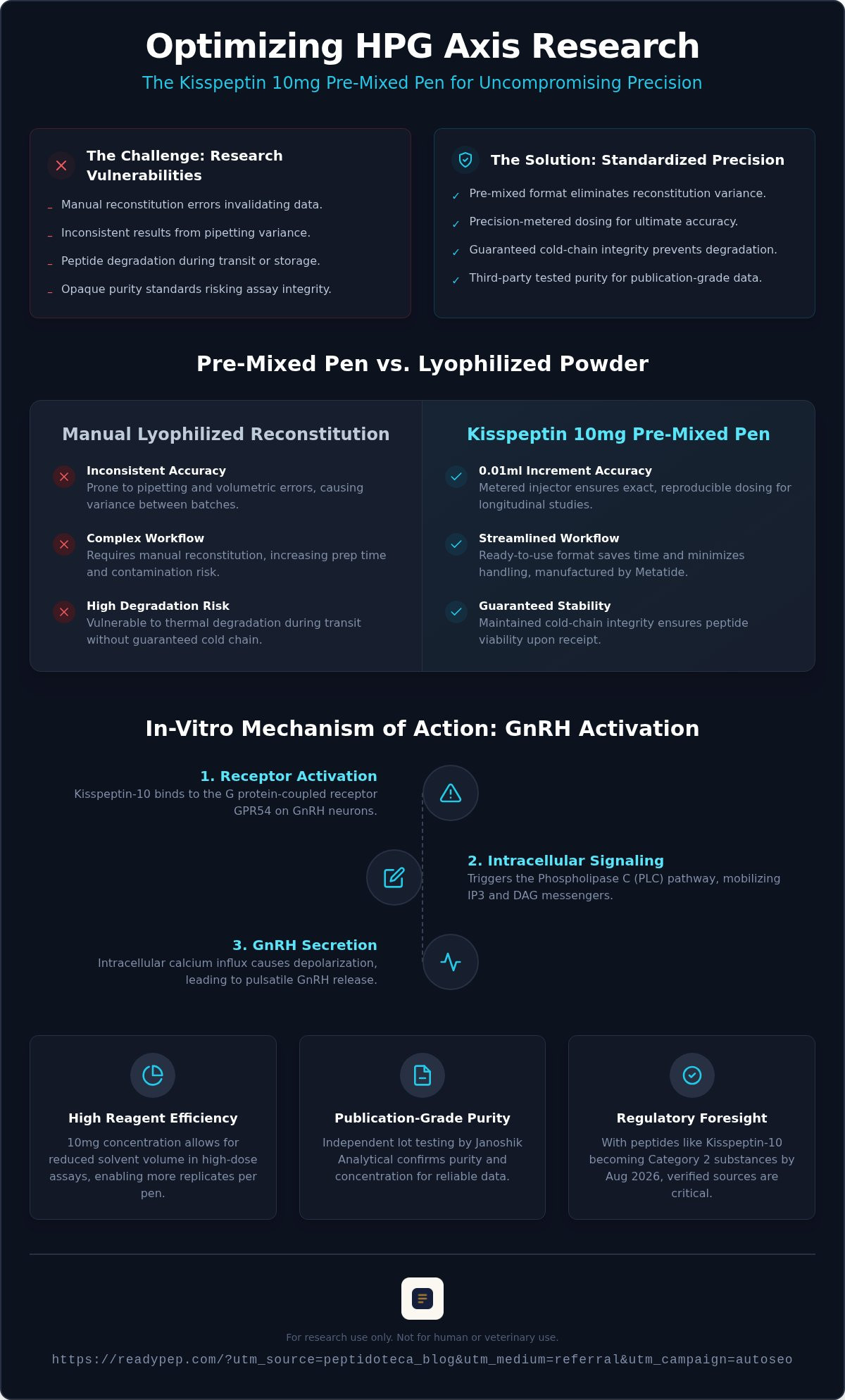
KP-10 acts as a potent activator of the G protein-coupled receptor GPR54. When introduced to GnRH neurons, it induces rapid depolarization, triggering the pulsatile release of Gonadotropin-Releasing Hormone. In controlled in-vitro environments, this mechanism is used to model the subsequent secretion of Luteinizing Hormone (LH) and Follicle-Stimulating Hormone (FSH). The HPG axis is the primary endocrine feedback loop consisting of the hypothalamus, pituitary gland, and gonads, where Kisspeptin serves as the critical upstream gatekeeper for reproductive signaling. By utilizing a Kisspeptin 10mg pre-mixed pen, researchers can simulate these endocrine cascades with a high degree of temporal accuracy.
Advantages of the 10mg Concentration for Laboratories
The 10mg concentration is specifically engineered for high-throughput multi-well plate studies. Using a more concentrated reagent allows for significant volume reduction during high-dose exposure assays. This is critical for delicate cell lines where excess solvent can interfere with membrane stability or lead to osmotic stress. Smaller volumes mean cleaner data.
- Reagent Efficiency: Reduced volume per well allows for more replicates per pen.
- Assay Purity: Lowered risk of solvent-induced interference in sensitive HPG models.
- Budget Optimization: Enhanced cost-efficiency for large-scale longitudinal studies compared to 5mg alternatives.
By providing double the standard concentration found in many retail formats, this pen allows labs to stretch their resources while maintaining the high-purity standards verified by Janoshik Analytical. It's a tool built for the modern researcher who values both precision and laboratory throughput.
Mechanisms of Action: GnRH Activation and HPG Axis Signaling In-Vitro
The biochemical cascade initiated by Kisspeptin-10 relies on high-affinity binding to the GPR54 receptor. This interaction triggers the Phospholipase C (PLC) pathway, leading to the immediate mobilization of inositol trisphosphate (IP3) and diacylglycerol (DAG). These secondary messengers are essential for intracellular calcium release. In neuronal cell cultures, this influx of calcium drives the depolarization necessary for GnRH secretion. Kisspeptin as a key regulator provides the primary signal that sets the pace for the entire reproductive axis, making its signaling precision a focal point for laboratory modeling.
Researchers use the Kisspeptin 10mg pre-mixed pen to maintain tight control over these signaling events. Standardizing the concentration allows for quantitative analysis of GnRH pulse frequency changes. In-vitro models often require specific titration to avoid receptor desensitization. When the delivery format is consistent, the data regarding pulse modulation becomes significantly more reliable. This format eliminates the guesswork often associated with manual dilution, providing a stable baseline for longitudinal observations.
Cellular Receptor Interaction (GPR54)
Binding kinetics vary between Kisspeptin isoforms, but Kisspeptin-10 offers the most potent activation for short-term signaling assays. Precise dosing is required to verify receptor saturation levels without inducing down-regulation. In neuronal cultures, monitoring the downstream effects on calcium signaling provides a real-time window into HPG axis health. The 10mg concentration ensures that even high-saturation protocols don't require excessive solvent volumes that might destabilize the cellular environment. Maintaining these ratios is critical for assay reproducibility.
Modeling Reproductive Disorders
Kisspeptin is a foundational tool for studying complex pathologies like polycystic ovary syndrome (PCOS) and hypogonadotropic hypogonadism. In-vitro assays allow for the isolated study of testosterone and estrogen regulation signaling. Researchers often utilize these models to identify infertility markers before moving to more complex systems. For those exploring broader reproductive health markers, the Bloom Protocol provides a relevant research context for hormonal signaling studies.
Maintaining protocol integrity requires reagents that don't fluctuate between batches. You can explore high-purity options that support these delicate HPG axis models with verified analytical documentation. Precision is the only way to move from observation to validation.
Evaluating Efficiency: Pre-Mixed Pens vs. Manual Lyophilized Reconstitution
Manual reconstitution is often the silent killer of assay reproducibility. When a researcher manually adds diluent to a lyophilized vial, several variables enter the equation: pipette calibration errors, technician technique, and residual peptide loss on the vial walls. The Kisspeptin 10mg pre-mixed pen eliminates this "reconstitution variance" by arriving in a standardized, factory-filled cartridge. This ensures that every microliter contains the exact concentration required for high-precision HPG axis modeling. By removing the need for manual mixing, laboratories can lock in their variables and focus entirely on the biological response being measured.
Beyond concentration precision, the risk of contamination is significantly lower in closed systems. Open vials require frequent rubber stopper punctures, increasing the chance of introducing airborne particulates or microbial contaminants during the multi-day duration of an assay. In contrast, the pre-mixed pen is a closed-loop delivery device. For high-volume laboratory workflows, the time saved by skipping the reconstitution step allows researchers to process more plates per hour. Efficiency in this context isn't just about speed; it's about reducing the number of potential failure points in a delicate research protocol.
Precision and Reproducibility
Precision in reproductive modeling depends on incremental accuracy. These metered-dose pens offer 0.01ml increment accuracy, where specific mechanical "clicks" translate directly to exact microgram delivery. This consistency reduces inter-operator variability. It ensures that different researchers in the same lab achieve identical results without the drift common in manual pipetting. For a deeper dive into optimizing your laboratory processes, see our guide on Improving Lab Workflow with Pre-filled Pens. Standardizing the delivery mechanism is the fastest way to improve the statistical power of your longitudinal data.
Stability of Aqueous Solutions
A common concern with liquid formats is the shelf-life compared to lyophilized powder. However, pre-mixed cartridges utilize bacteriostatic water and specific preservatives to maintain peptide integrity over time. The pH balance of the solution is meticulously adjusted to ensure that the peptide remains stable in its aqueous form, preventing the rapid degradation often seen in poorly buffered manual mixes. While lyophilized vials offer long-term storage in a freezer, the refrigerated stability of a professionally formulated pen is more than sufficient for the duration of most research cycles. Maintaining a consistent pH level is the primary factor in preventing the hydrolysis that can otherwise compromise peptide potency during storage.
Transitioning to a Kisspeptin 10mg pre-mixed pen allows your lab to bypass the logistical friction of traditional vial systems. You get a reagent that is ready for the bench the moment it leaves the cold-chain shipping container. It's a modern solution for researchers who prioritize data over preparation.
Protocol Integrity: Cold-Chain Stability and Storage for Research Peptides
Thermal sensitivity is the primary threat to peptide longevity in a laboratory setting. Kisspeptin-10 is a decapeptide that is highly susceptible to degradation when exposed to ambient temperatures for extended periods. Heat accelerates the processes of hydrolysis and oxidation. These chemical reactions alter the peptide's primary structure and can lead to aggregation. To maintain the functional integrity of a Kisspeptin 10mg pre-mixed pen, strict temperature management is mandatory. Optimal storage is fixed between 2°C and 8°C. Any deviation from this range can lead to irreversible protein unfolding. This renders the reagent ineffective for high-precision HPG axis modeling. Verification of the thermal state upon laboratory receipt is the first step in experimental validation.
When thermal thresholds are breached, the peptide may undergo structural shifts that are often invisible to the naked eye. These changes can result in decreased binding affinity at the GPR54 receptor. In-vitro models rely on the predictable behavior of reagents. If the peptide has degraded, the resulting data on GnRH activation will be skewed. This leads to false negatives or inconsistent pulse frequency measurements. Maintaining a stable environment from the point of manufacture to the final assay is the only way to ensure the reproducibility of your reproductive research.
Monitoring Temperature During Transit
Aqueous formats require more rigorous thermal protection than their lyophilized counterparts. In a liquid state, water molecules act as a medium for the chemical reactions that heat triggers. Cold-chain logistics must remain unbroken during international transit. Freeze-thaw cycles are particularly destructive. They create mechanical stress that can shear delicate peptide bonds. This physical degradation results in a significant loss of potency. For labs exploring related compounds in other fields, our roundup on Neurological Peptide Research Tools provides insights into stability requirements for CNS modeling reagents. Protecting the secondary structure of the peptide is a priority for any longitudinal study.
Documentation for Research Integrity
Publication-grade data requires a transparent audit trail. Researchers must document lot numbers, storage conditions, and the specific manufacturer—Metatide Healthcare—in their methodologies. Every Kisspeptin 10mg pre-mixed pen must be supported by a lot-specific Certificate of Analysis (COA). This document provides the empirical verification of purity, pH balance, and concentration required for peer-reviewed journals. Independent testing by Janoshik Analytical adds a necessary layer of transparency. It removes the uncertainty that often plagues the research peptide industry. Maintaining a documented chain of custody ensures that your results are scientifically sound and beyond reproach.
Precision starts with a reliable supply chain. You can procure verified research peptides with guaranteed cold-chain integrity to ensure your reproductive modeling studies remain consistent and valid.
Procuring Research-Grade Kisspeptin: The ReadyPep Standard for 2026
High-impact reproductive research requires more than just a chemical compound; it demands empirical verification. The Kisspeptin 10mg pre-mixed pen is the primary tool for labs seeking to eliminate the "black box" of reagent sourcing. While many providers rely on generic quality badges, the ReadyPep Standard is built on radical transparency. This involves providing direct, lot-specific access to Lab Testing reports for every cartridge distributed. You don't have to guess if your reagent meets the required specifications. The data is available before the pen ever reaches your benchtop.
Manufacturing consistency is managed by Metatide Healthcare. Their facility standards ensure that each pre-filled injector meets strict concentration and pH requirements. In 2026, navigating international customs for research chemicals has become increasingly complex. ReadyPep manages these logistics through specialized global shipping protocols. This includes free global cold-chain shipping to prevent the thermal degradation that often compromises liquid peptides during transit. By handling the regulatory and logistical friction, the system allows researchers to focus entirely on their HPG axis models rather than supply chain hurdles.
The Janoshik Analytical Verification
Third-party verification is essential for high-impact research. HPLC (High-Performance Liquid Chromatography) is the gold standard for verifying peptide identity and purity. When you review an HPLC chromatogram for Kisspeptin, you're looking for a sharp, singular peak. This peak indicates the absence of truncated sequences or residual solvents. Janoshik Analytical provides this independent verification for every lot. It's a level of accountability that goes beyond industry norms. ReadyPep’s commitment to this level of transparency ensures that the Kisspeptin 10mg pre-mixed pen provides the chemical baseline necessary for reproducible results. Data integrity starts with verified reagents.
Streamlined Procurement for 2026
Academic institutions and private laboratories require a procurement process that minimizes administrative friction. The ReadyPep ordering system is designed for modern efficiency. By maintaining a robust inventory of pre-filled pens, the lead time from order to laboratory receipt is significantly reduced. Global shipping capabilities are backed by cold-chain guarantees. This ensures your reagents arrive in peak condition regardless of your location. ReadyPep acts as a high-standard gatekeeper, prioritizing analytical validation above marketing hyperbole. It's a professional partnership for those who value precision. You can Acquire Kisspeptin 10mg Pre-Mixed Pens for Your Next Study and secure the precision your reproductive modeling deserves.
Advancing HPG Axis Research with Precision Reagents
Research integrity in reproductive endocrinology depends on the absolute elimination of procedural noise. By transitioning to the Kisspeptin 10mg pre-mixed pen, laboratories effectively remove the variables associated with manual reconstitution and volumetric error. We've explored how precision dosing and thermal stability directly impact the validity of in-vitro GnRH signaling models. Maintaining these rigorous standards isn't just a laboratory best practice; it's a fundamental requirement for high-impact publication in 2026.
ReadyPep ensures this integrity through an uncompromising commitment to radical transparency. Every lot undergoes independent testing by Janoshik Analytical, providing you with verified data on purity, pH, and concentration. Precision manufacturing by Metatide Healthcare and guaranteed global cold-chain logistics ensure your reagents arrive ready for immediate benchtop application. Don't let logistical friction or opaque sourcing compromise the statistical power of your next study. You can Secure High-Purity Kisspeptin 10mg Pens for Laboratory Research today. Your work deserves a partner that values empirical verification as much as you do.
Frequently Asked Questions
Is the Kisspeptin 10mg pen suitable for in-vivo animal studies?
No, the Kisspeptin 10mg pre-mixed pen is strictly for in-vitro laboratory and research purposes. It's not intended for in-vivo animal testing, human consumption, or veterinary use. All experimental protocols should be limited to controlled laboratory settings where cell lines or tissue cultures are utilized to model HPG axis signaling.
How long is the Kisspeptin 10mg pre-mixed pen stable after the first use?
Once opened, the solution remains stable for approximately 28 to 30 days when stored at a constant temperature of 2°C to 8°C. The formulation includes bacteriostatic water to inhibit microbial growth, but refrigeration is mandatory to prevent thermal degradation. Always inspect the cartridge for clarity before use; any cloudiness indicates that the peptide has been compromised.
What is the exact concentration of Kisspeptin per click in the 10mg pen?
The metered-dose pen provides 0.01ml increment accuracy per click. Because the cartridge contains 10mg of total peptide, each click delivers a precise microgram dosage based on the total volume of the aqueous solution. This mechanical precision allows researchers to perform exact titrations without the risk of pipetting errors associated with manual reconstitution.
Can I verify the Janoshik test results for my specific Kisspeptin lot?
Yes, you can access lot-specific Janoshik Analytical reports through the transparent portal on our website. Every batch is independently tested to verify purity, pH balance, and peptide concentration. This documentation is essential for research integrity and can be cited in your methodology sections to support the validity of your experimental data.
What happens if my Kisspeptin pen arrives at room temperature?
Every shipment is sent via global cold-chain logistics to prevent exposure to ambient heat. If your package arrives at room temperature, you should immediately contact the customer support team for a technical review. Thermal exposure can lead to irreversible protein unfolding, which renders the peptide ineffective for high-precision reproductive modeling assays.
Does ReadyPep provide bulk discounts for university research departments?
Institutional procurement and bulk research inquiries are handled by our specialized support team to accommodate large-scale studies. Academic departments requiring consistent, high-purity reagents can explore our full inventory for volume-based arrangements. We prioritize long-term partnerships with laboratories that value rigorous analytical standards and logistical reliability.
What is the difference between Kisspeptin-10 and Kisspeptin-54 in research?
Kisspeptin-10 is the shortest functional decapeptide fragment required for potent GPR54 receptor activation. Kisspeptin-54 is the full-length precursor hormone. While both activate the same signaling pathways, their binding kinetics and metabolic half-lives differ significantly. KP-10 is typically preferred for short-term in-vitro assays due to its high potency and immediate receptor interaction.
How should I dispose of used research peptide pens in a laboratory setting?
Used research pens must be disposed of as biohazardous sharps waste according to your institution’s safety protocols. Do not discard these devices in standard laboratory trash. Use a puncture-resistant sharps container to ensure the safe handling of the internal needle and any residual chemical reagents remaining in the cartridge after the study.
Disclaimer
Educational content only. Not medical advice.


