

The standard practice of manual peptide reconstitution is the single greatest threat to your laboratory's data integrity. While traditional vials have been the industry norm, they introduce significant risks of contamination and molar concentration variability. You likely recognize the frustration of inconsistent in-vitro results caused by a minor pipetting error or an unstable pH level. Transitioning to a CJC-1295 Ipamorelin research pen eliminates the reconstitution variable entirely, ensuring that your study is built on a foundation of precision rather than guesswork.
This article explores how this pre-filled format serves as a professional-grade instrument for modern laboratories. By integrating these synergistic compounds into a standardized delivery system, you can achieve highly reproducible results and streamlined protocols. Research from 2026 indicates that this specific combination can produce a growth hormone pulse amplitude up to five times greater than either peptide used in isolation. We'll break down the dual-pathway mechanism of action and show you how to leverage third-party verified reagents to ensure your study meets the highest analytical standards.
Key Takeaways
- Understand the dual-pathway synergy between GHRH analogs and GHSR agonists to maximize growth hormone pulse amplitude in cellular models.
- Learn how the CJC-1295 Ipamorelin research pen eliminates the common reconstitution errors and contamination risks associated with manual vial handling.
- Establish precise in-vitro protocols by determining optimal molar concentrations for highly reproducible secretion data.
- Discover the critical role of third-party HPLC verification and pH stability testing in maintaining reagent integrity for publication-grade research.
- Streamline laboratory logistics with standardized pre-filled formats and reliable worldwide cold-chain distribution.
Understanding the Dual-Pathway Mechanism: CJC-1295 and Ipamorelin Synergy
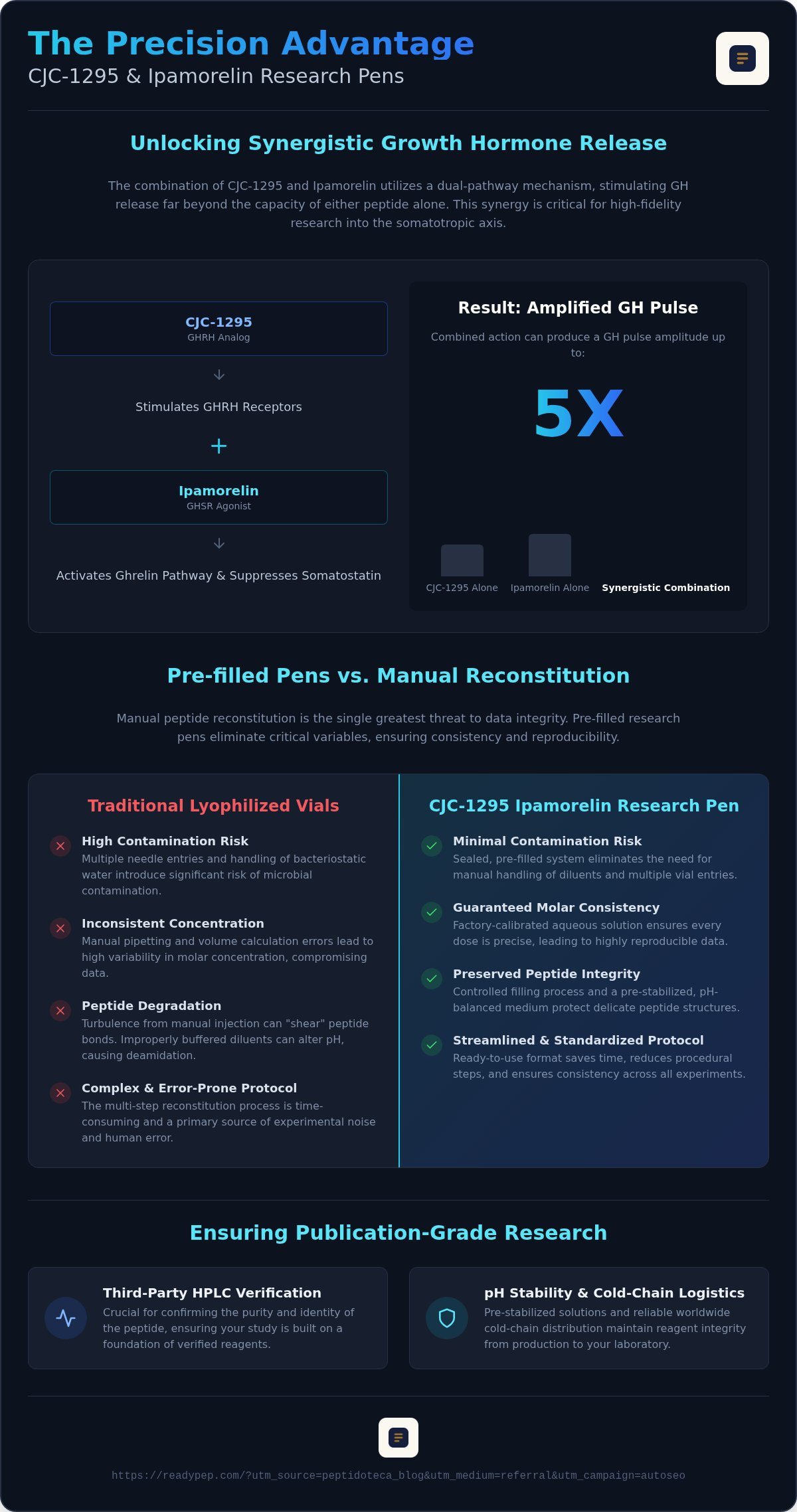
Modern endocrinology research relies on the precise manipulation of the somatotropic axis. The synergy between CJC-1295 and Ipamorelin is a calculated interaction between two distinct pharmacological classes. CJC-1295 functions as a synthetic GHRH analog. It targets GHRH receptors on pituitary somatotrophs to initiate growth hormone production. Ipamorelin acts as a selective ghrelin receptor agonist. It targets the Growth Hormone Secretagogue Receptor (GHSR). By employing a CJC-1295 Ipamorelin research pen, investigators can explore the "dual-signal" hypothesis. This model posits that simultaneous stimulation through independent pathways produces a synergistic GH release that exceeds the additive effects of each compound.
CJC-1295: The GHRH Pathway in Cellular Models
CJC-1295 mimics the bioactivity of endogenous GHRH by binding to specific G-protein coupled receptors. This binding triggers the adenylate cyclase pathway. It raises intracellular cAMP levels. In cellular models, this process is essential for studying the transcription of GH mRNA. Researchers must choose between "No DAC" and "DAC" variants based on their study's temporal requirements. The "No DAC" version has a half-life of approximately 30 minutes. This makes it ideal for observing acute, pulsatile release patterns. The DAC variant extends this half-life to roughly 8 days. CJC-1295 provides a sustained stimulus that maintains the somatotroph's capacity for pulsatile GH release in-vitro.
Ipamorelin: Selective Ghrelin Mimetic Precision
Ipamorelin is a pentapeptide that represents the peak of growth hormone secretagogues in terms of specificity. It binds to the GHSR-1a receptor with high affinity. Earlier compounds like GHRP-2 or GHRP-6 often caused unintended increases in cortisol and prolactin. Ipamorelin eliminates these confounding variables. It focuses purely on GH release and metabolic signaling. This makes it an invaluable tool for studying cell proliferation and lipid metabolism without the noise of secondary hormonal spikes. For those investigating these pathways, the Ipamorelin 10mg pen provides the necessary purity for sensitive assays.
The combination of these two agents in a CJC-1295 Ipamorelin research pen allows for the study of somatostatin inhibition. Ipamorelin suppresses somatostatin, the "off switch" for GH, while CJC-1295 10mg provides the "on switch." This dual-action approach is a staple in GH secretion modeling. It closely replicates endogenous physiological rhythms. It provides a high-fidelity environment for observing how cells respond to complex hormonal stimuli. This synergy is why the research pen format is essential. It ensures the precise molar ratio required to observe these effects without the risk of manual dosing errors.
Pre-filled Research Pens vs. Lyophilized Vials: A Comparative Analysis
Manual reconstitution is a primary source of experimental noise. Traditional lyophilized vials require the researcher to calculate volumes, handle bacteriostatic water, and manage multiple needle entries. These steps introduce human error. A CJC-1295 Ipamorelin research pen removes these variables by providing a factory-calibrated, aqueous solution. This standardization is critical when measuring the subtle synergistic effects discussed in the previous section. Consistency in the starting material is the only way to ensure the reproducibility of your GH secretion data.
Eliminating Reconstitution Variability
Peptide chain integrity is fragile. When researchers manually inject diluent into a vial, the resulting turbulence can cause "shearing" of delicate peptide bonds. This physical degradation reduces the effective concentration of the reagent before the study even begins. Pre-filled pens utilize a controlled filling process that preserves molecular structure. They also solve the issue of bacteriostatic water quality. Poorly buffered water can shift the pH, leading to rapid peptide deamidation. By using a pre-stabilized medium, the pen ensures consistent molarity across every "click" of the dosing mechanism. Referencing FDA Safety and Compliance Information for CJC-1295 highlights the importance of maintaining strict purity and handling standards to avoid unintended chemical variations.
Workflow Efficiency and Aseptic Integrity
High-throughput screening environments don't have time for manual prep. Every minute spent reconstituting is a minute lost to data analysis. Pre-filled pens offer a "click-to-volume" ratio that is both intuitive and precise. This streamlined approach is detailed in our guide on Improving Lab Workflow with Pre-filled Pens. Beyond speed, the aseptic benefits are significant. Vials with multiple-entry septums are prone to coreing and microbial ingress. The closed-system design of a CJC-1295 Ipamorelin research pen maintains reagent sterility throughout its lifecycle. This is vital for long-term cell culture studies where contamination can ruin weeks of work. It eliminates the friction of vial handling while protecting the purity of the compound.
Precision is the benchmark of modern science. If your laboratory requires verified reagents with minimal preparation friction, you can explore high-purity research pens designed for rigorous in-vitro application.
Optimizing In-Vitro Protocols for Growth Hormone Pathway Studies
Developing a precise in-vitro protocol requires more than just high-purity reagents; it demands a standardized method of delivery. Establishing a robust baseline for growth hormone (GH) secretion in somatotroph cell lines is the first requirement. Researchers must account for the natural pulsatility of these cells before introducing secretagogues. The CJC-1295 Ipamorelin research pen offers a level of standardization that traditional vials cannot match. It allows for the rapid titration of concentrations to find the "sweet spot" where synergy occurs. This is critical because combined-dose studies in 2026 have demonstrated that these compounds can produce a GH pulse amplitude up to five times greater than either peptide used alone.
Determining the optimal molar concentration for synergistic exposure involves a careful titration series. Most protocols begin with a low-nanomolar range to observe initial receptor binding. Because Ipamorelin is a selective ghrelin receptor agonist, monitoring for receptor desensitization is essential during chronic exposure models. Overexposure can lead to the downregulation of the GHSR-1a receptor, which skews long-term data. By using a pre-filled pen, you can ensure that every assay plate receives an identical concentration, which is vital for identifying the exact point of receptor saturation.
Measuring downstream effects is the final step in validating the secretagogue synergy. Investigators typically track IGF-1 expression and specific metabolic markers to confirm that the GH release is biologically active. Since CJC-1295 has a half-life of approximately 30 minutes in its "no-DAC" form, the timing of these measurements must be precise. Standardizing the introduction of the compound via a pen format reduces the time-lag between wells, ensuring that metabolic data is captured across the entire plate within the same pharmacological window.
Dosage Precision and Click-Calibration
Converting the mechanical "clicks" of a research pen into precise microgram (mcg) measurements is straightforward but requires calibration. Each click corresponds to a specific volume of the aqueous solution. This eliminates the volumetric errors common in manual pipetting from a reconstituted vial. For sequential introduction protocols, where one compound is added before the other to study priming effects, this mechanical precision ensures that the molar ratio remains constant across multiple assay runs.
Data Integrity in Publication-Grade Research
Peer-reviewed journals increasingly demand rigorous documentation of reagent purity and handling. Every study should include lot numbers and third-party Certificates of Analysis (COAs) to verify the starting material. Utilizing verified reagents like CJC-1295 10mg allows researchers to cite independent Janoshik analytical testing. This transparency prevents "reagent drift," a phenomenon where inconsistent manufacturing standards lead to irreproducible results. Standardized manufacturing ensures that the results you publish today can be replicated by other laboratories tomorrow.
Verification Standards: HPLC Purity and pH Stability for Research Pens
Data integrity begins with rigorous analytical verification. High-Performance Liquid Chromatography (HPLC) remains the gold standard for identifying impurities and confirming the mass identity of growth hormone secretagogues. For a CJC-1295 Ipamorelin research pen, this testing is even more critical than for raw powders. An aqueous solution is a dynamic environment where deamidation and oxidation can occur if the chemical environment isn't perfectly controlled. HPLC testing ensures that the peptide sequence hasn't degraded during the filling process, maintaining the ≥99% purity standard required for modern in-vitro studies.
pH stability is the second pillar of reagent integrity. Peptides are sensitive to their solvent's acidity or alkalinity. If the pH of an aqueous pen shifts outside the optimal range, the peptide's tertiary structure can unravel. This leads to a loss of binding affinity at the pituitary receptors. Every batch must undergo mandatory pH testing to ensure the solution remains stable throughout its stated shelf life. This prevents the reagent drift mentioned previously and ensures that your experimental baseline remains constant. Without verified pH levels, you're essentially introducing an unknown variable into your assay.
Janoshik Analytical: Third-Party Transparency
Don't trust "in-house" manufacturer data. It lacks the necessary independence for publication-grade research. ReadyPep utilizes Janoshik Analytical for lot-specific verification. This third-party firewall provides objective proof of purity and concentration. Researchers can verify these results instantly. Every pen comes with a QR code or serial number that links directly to the Janoshik report. This level of Peptide Pen Quality Control is essential for peer-reviewed credibility. It acts as a verifiable record that your reagents meet the exact specifications claimed.
Stability and Cold-Chain Logistics
Peptides are thermolabile. Heat stress can cause rapid denaturation of the peptide chain. In an aqueous CJC-1295 Ipamorelin research pen, maintaining a stable temperature is non-negotiable. Cold-chain logistics ensure the product stays within the required thermal window from the laboratory to your facility. This includes specialized packaging and temperature monitoring protocols during transit. If the cold chain is broken, the structural integrity of the compounds is compromised, rendering your research data invalid. Proper logistics protect the tertiary structure and ensure the peptide arrives in its most bioavailable state.
You can access third-party verified research pens that meet these exact analytical standards for your next laboratory study.
Sourcing and Compliance: ReadyPep as a Laboratory Partner
ReadyPep serves as the bridge between advanced manufacturing and precise laboratory application. As a dedicated worldwide distributor for Metatide Healthcare, the focus remains on delivering high-fidelity reagents that meet the rigorous demands of 2026 research standards. Every CJC-1295 Ipamorelin research pen in the catalog is strictly for in-vitro laboratory use. This clarity in compliance ensures that researchers can focus on data collection without regulatory ambiguity. Inventory options, including Ipamorelin 10mg and various CJC-1295 concentrations, are maintained at high stock levels to prevent study delays. By centralizing the supply chain, ReadyPep removes the uncertainty often found with multi-vendor sourcing.
Global Logistics and Customs Clearance
International research requires a logistics partner that understands the complexity of chemical transport. UK-based logistics provide a strategic advantage for global distribution; they offer reliable transit times to major research hubs in Europe, North America, and Asia. ReadyPep eliminates the friction of shipping costs by providing a free cold-chain shipping guarantee on all orders. This isn't just about cost. It's about maintaining the tertiary structure of the peptides from the moment they leave the temperature-controlled facility. Reliable logistics prevent the thermal degradation that can occur during standard international transit. For detailed guidance on international protocols and mitigating border delays, see our report on Customs Clearance for Research Chemicals.
A Commitment to Scientific Integrity
Transparency is the antidote to industry uncertainty. ReadyPep prioritizes empirical data over traditional marketing hyperbole. This means providing direct access to lot-specific Janoshik COAs for every order. You don't have to guess about the purity or pH stability of your reagents. The CJC-1295 Ipamorelin research pen you receive is the same one verified in the analytical report. This commitment to accountability positions the brand as a disruptor in the field. It prioritizes scientific truth over profit margins. It's a partnership built on data, ensuring that your laboratory results aren't compromised by inferior or unverified compounds. Every lot is a testament to high-standard gatekeeping.
Precision in the lab starts with precision in the supply chain. If your next study requires verified reagents and streamlined delivery that respects the sensitivity of your compounds, you can browse the full research inventory to find the exact protocols required for your project.
Advancing Laboratory Precision Through Standardized Secretagogue Delivery
The shift toward pre-filled delivery systems marks a significant evolution in growth hormone secretagogue research. By eliminating the manual reconstitution variable, you protect the molecular integrity of your reagents and ensure that your in-vitro data is reproducible. This transition isn't just about laboratory convenience; it's about the scientific necessity of molar precision. Relying on verified standards like HPLC purity and pH stability testing is the only way to meet the rigorous demands of peer-reviewed publication. Every study deserves a foundation built on empirical data rather than preparation-based guesswork.
Your choice of a CJC-1295 Ipamorelin research pen provides this foundation of reliability. It allows your laboratory to focus on observing complex synergistic signals rather than managing preparation errors. With Metatide Healthcare manufacturing standards and Janoshik lot-tested purity, the uncertainty of reagent quality is removed from the equation. You can secure high-purity CJC-1295 Ipamorelin pens for your laboratory at ReadyPep and benefit from free global cold-chain shipping. Start your next assay with the confidence that only radical transparency and expert engineering can provide.
Frequently Asked Questions
Is CJC-1295 Ipamorelin research intended for human use?
No, these compounds are strictly for in-vitro laboratory research only. They are not FDA-approved for human therapeutic use and must not be administered to humans or animals. ReadyPep supplies these reagents specifically for biochemical analysis, cellular modeling, and metabolic assays. Adhering to these compliance standards ensures the legal and ethical integrity of your laboratory's operations while maintaining focused research parameters.
How do I calculate the dosage of CJC-1295 from a pre-filled pen for in-vitro studies?
You calculate the dosage by using the pen's calibrated click-to-volume ratio. Each mechanical click dispenses a precise microliter volume of the aqueous solution. By knowing the total concentration of the CJC-1295 Ipamorelin research pen, you can determine the exact micrograms delivered per click. This allows for rapid titration into assay plates without the volumetric errors common in manual pipetting from reconstituted vials.
What is the stability of a pre-filled peptide pen after it has been opened?
Once opened, the aqueous solution remains stable for approximately 30 days when stored at 2°C to 8°C. The closed-system design of the pen protects the peptide from microbial ingress and atmospheric oxidation. However, prolonged exposure to light or room temperature will accelerate deamidation. Always return the pen to refrigerated storage immediately after use to maintain the tertiary structure and binding affinity of the compounds.
Why is Janoshik testing important for CJC-1295 and Ipamorelin research?
Janoshik testing provides independent, third-party verification of the reagent's purity, identity, and pH levels. This is critical because manufacturer-provided data often lacks the objectivity required for publication-grade research. By reviewing a Janoshik COA, you confirm that your CJC-1295 Ipamorelin research pen contains the exact molar concentration specified. This transparency eliminates a major variable in GH secretagogue studies and ensures your results are reproducible.
How does cold-chain shipping affect the integrity of the CJC-1295 Ipamorelin blend?
Cold-chain shipping is essential for preventing the thermal denaturation of delicate peptide chains during transit. ReadyPep utilizes specialized insulated packaging and temperature monitors to ensure the blend stays within the required 2°C to 8°C window. If the temperature fluctuates significantly, the peptides can lose their biological activity through unfolding or aggregation. Maintaining this thermal stability ensures the reagent arrives with its structural integrity fully intact.
Can I use the CJC-1295 Ipamorelin research pen for animal testing?
No, these pens are not intended for in-vivo animal testing or veterinary use. ReadyPep's products are formulated and labeled specifically for in-vitro laboratory applications, such as cell culture studies and biochemical assays. Using these reagents for animal administration violates compliance standards and may lead to unpredictable results. Researchers must ensure their protocols align with the "for research use only" designation of the product.
What is the difference between CJC-1295 with DAC and without DAC in research?
The difference lies in the half-life and duration of the growth hormone stimulus. CJC-1295 with DAC (Drug Affinity Complex) has a half-life of roughly 8 days, providing a sustained elevation of GH production. The "no-DAC" version has a half-life of approximately 30 minutes. Researchers choose the no-DAC variant for studies focusing on pulsatile GH release, while the DAC version is used for modeling chronic, long-term somatotroph stimulation.
How do I verify the lot number of my ReadyPep research pen?
You can verify the lot number by locating the QR code or serial number on the product packaging. Scanning this code directs you to the specific Janoshik Analytical report for that batch. This report includes the HPLC purity chromatogram and pH testing results. This direct link to third-party data allows you to document the exact specifications of your reagents for peer-reviewed journals and internal quality control audits.
Disclaimer
Educational content only. Not medical advice.


