

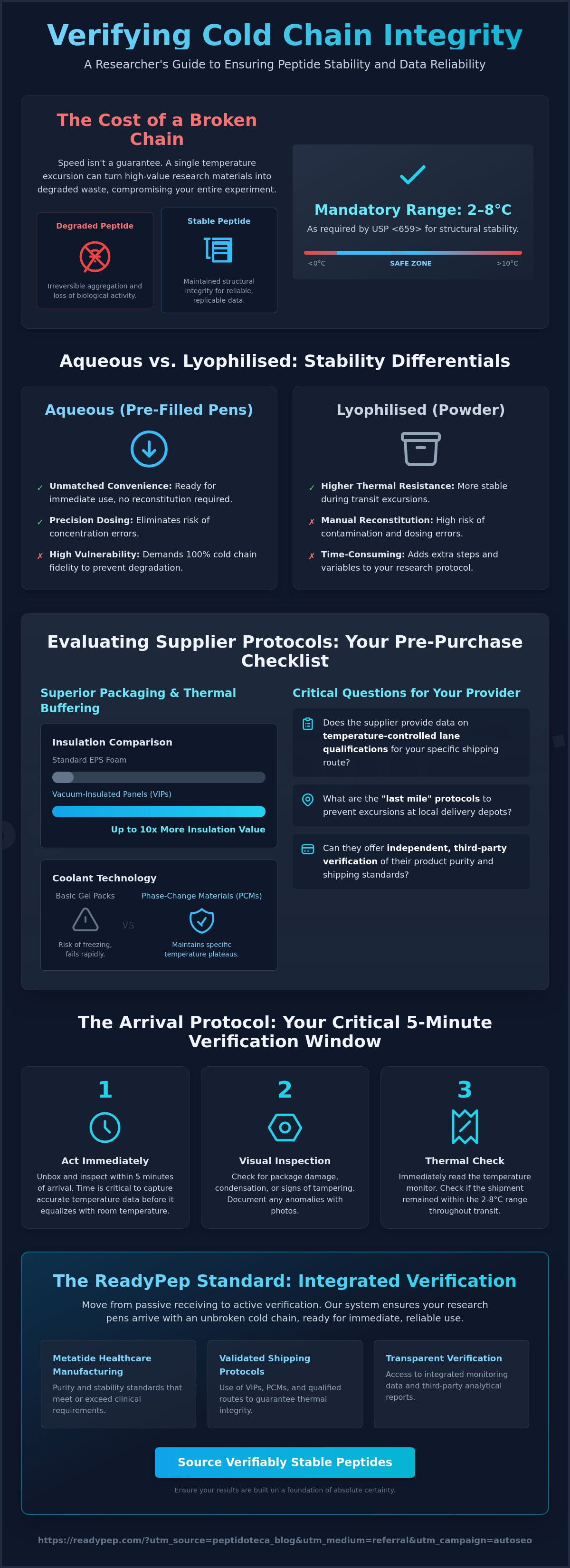
Speed is not a cold chain. While overnight shipping offers a sense of security, it doesn't guarantee that your fragile compounds stayed within the mandatory 2–8°C range required by USP <659>. You've likely felt that familiar pang of uncertainty when unboxing a high-value shipment. You wonder if a single transit delay turned your research materials into expensive, degraded waste. Verifying cold chain integrity is the only way to move past guesswork. It secures the structural stability of your peptides before they ever reach the lab bench.
We know the frustration of seeing experimental variability spike because of a compromised reagent. It's an avoidable risk. This guide provides the empirical methods you need to verify that your research peptides remained within strictly controlled thermal parameters during transit. You'll learn a clear protocol for inspecting incoming shipments, interpreting complex shipping monitors, and using Mean Kinetic Temperature data to validate your inventory. We'll show you how to move from passive receiving to active verification. This ensures every peptide pen in your facility meets the highest analytical standards.
Key Takeaways
- Understand why thermal stress leads to irreversible peptide aggregation and how to identify structural risks before they compromise your experimental data.
- Learn to audit supplier packaging protocols by comparing vacuum-insulated panels to standard materials for superior thermal shielding during transit.
- Establish a rigorous arrival protocol for verifying cold chain integrity using a critical five-minute window for visual and thermal inspection.
- Identify the specific scenarios where High-Performance Liquid Chromatography serves as the gold standard for confirming peptide purity after a suspected breach.
- Explore how ReadyPep’s integrated shipping standards and Metatide Healthcare manufacturing protocols ensure your research pens arrive ready for immediate use.
The Science of Stability: Why Cold Chain Integrity is Non-Negotiable
Cold chain integrity is the uninterrupted maintenance of a specified temperature range from the moment of manufacture to the laboratory bench. It's not a suggestion; it's a requirement for molecular survival. In the pharmaceutical and research industries, a robust cold chain ensures that biological reagents never exit their validated thermal window. For peptides, this window is typically the 2–8°C range defined by USP <659>. When this chain breaks, the research data breaks with it.
Peptides in aqueous solutions are uniquely vulnerable. Unlike small molecules, their efficacy depends on precise folding and structural orientation. Thermal stress triggers both primary and secondary structure degradation. Heat accelerates chemical pathways like hydrolysis and deamidation. These aren't just minor potency losses. They represent a fundamental change in the compound's chemical identity. For researchers, verifying cold chain integrity is the only way to ensure the material in the syringe matches the material on the COA.
Thermal Excursions and Peptide Efficacy
Even brief temperature spikes can be catastrophic. A 30-minute excursion into ambient temperatures can initiate irreversible aggregation. These protein clumps are biologically inactive and can't be "fixed" by re-cooling. This relationship is governed by the Arrhenius equation; as temperature rises, the rate of chemical degradation increases exponentially. In-vitro modeling relies on consistency. Degraded reagents produce "noisy" or unreplicable data that wastes time and funding. If your thermal history is a mystery, your results are a guess.
Aqueous vs. Lyophilised: Stability Differentials
Lyophilised peptides offer higher thermal resistance but come with a hidden cost. They require manual reconstitution. This step is a common vector for contamination and concentration errors. ReadyPep prioritizes precision through pre-filled research pens. These aqueous formats offer unmatched convenience but demand 100% cold chain fidelity. While we utilize bacteriostatic water to inhibit microbial growth and maintain stability, it's not a substitute for thermal control. Precision matters. For researchers who demand empirical certainty, sourcing from the ReadyPep inventory ensures that the cold chain remains unbroken from our lab to your bench. We treat every order as a high-value clinical reagent because your data deserves nothing less.
Evaluating Supplier Protocols: Pre-Purchase Verification
Verification begins long before the courier arrives. It starts with a rigorous audit of your supplier’s logistics infrastructure. Many vendors rely on "best effort" shipping. This is unacceptable for high-stakes research. You need proof of a validated system. This includes secondary packaging that exceeds basic standards. While expanded polystyrene (EPS) is common, it lacks the thermal resistance of vacuum-insulated panels (VIPs). VIPs provide up to ten times the insulation value in a thinner profile. This is critical for international transit where delays are inevitable.
Effective buffering requires more than simple gel packs. These often freeze the product initially and then fail rapidly. Use phase-change materials (PCMs) instead. PCMs are engineered to maintain specific temperature plateaus, such as 2–8°C, by absorbing or releasing energy during phase transitions. Adhering to NIST best practices for biological material handling ensures that these thermal buffers are used correctly. Verifying cold chain integrity means knowing exactly how your provider mitigates the "Time in Transit" (TIT) stress.
What to Ask Your Peptide Provider
Don't settle for vague promises of "refrigerated shipping." Ask for data on temperature-controlled lane qualifications. Has the supplier validated the specific route from their facility to your lab? You should also inquire about "last mile" protocols. Many excursions happen at local delivery depots. Packages sit in non-refrigerated zones for hours. Finally, ask for independent verification. A reputable provider will offer results from third-party labs like Janoshik Analytical. This transparency is why many researchers prefer the ReadyPep product catalog. We treat logistics and purity with equal clinical gravity.
The Role of Independent Lot Testing
An internal Certificate of Analysis (COA) is a starting point, not a conclusion. It lacks the objectivity required for high-stakes modeling. Independent lot testing provides a necessary check on both manufacturing purity and potential degradation. You should be able to verify lot numbers against public databases for total transparency. For a deeper dive into these requirements, see our guide on Independent Verification: The Role of Third-Party Labs. Verifying cold chain integrity is easier when you work with partners who provide the data upfront.
The Arrival Protocol: A Step-by-Step Guide to Verifying Your Shipment
The package is on your desk. The clock is ticking. The first five minutes after delivery are the most critical for verifying cold chain integrity. This is the window where the thermal mass of the packaging still accurately reflects the transit conditions. Delaying inspection by even an hour can allow internal temperatures to equilibrate with your lab’s ambient air, masking a potential breach. Your protocol must be immediate and methodical.
Start with a visual assessment of the tertiary (outer) box. Check for crushed corners or punctures. Moisture ingress on the cardboard often indicates a coolant leak or excessive condensation from a failed thermal seal. Move to the secondary insulation. If you see standing water or the interior feels warm to the touch, the chain is compromised. Take photos. Record the state of the coolant. Is the ice pack solid, slushy, or entirely liquid? This "State of Arrival" documentation is your primary evidence if you need to flag a shipment for replacement.
Don't integrate the peptides into your main stock yet. Move the shipment into a calibrated laboratory refrigerator immediately. This maintains compliance with FDA storage and handling requirements while you review the monitoring data. Quarantine is a mandatory step in ensuring research integrity.
Interpreting Temperature Indicators
Chemical "Stop-Go" indicators are common. You must understand their limits. Some trigger on a single threshold breach; others are time-temperature integrators. If your shipment includes a digital data logger, download the report immediately. Don't just look for peak temperatures. Analyze the Mean Kinetic Temperature (MKT). The MKT provides a weighted average that accounts for the accelerated degradation rates at higher temperatures. A brief spike might be acceptable. A sustained elevation is a failure. If an indicator shows a violation, initiate your excursion management protocol and contact the supplier.
Physical State Verification
Examine the solution in the pens. Look for cloudiness, precipitate, or unusual viscosity. These are hallmarks of "Freeze-Thaw" damage or heat-induced aggregation. Verify the seal integrity of each pen. Any atmospheric exposure can introduce contaminants or alter the concentration through evaporation. Finally, cross-reference the lot numbers on the pen body with the COA provided in your order. This level of detail is standard for the ReadyPep inventory. Every unit is serialized for total traceability. Verifying cold chain integrity ensures that the high-purity compounds we ship are the same high-purity compounds you use in your research.
Beyond the Thermometer: Advanced Verification via Analytical Testing
Physical monitors tell you where the box has been. Analytical testing tells you what the peptide has become. If a temperature monitoring device fails or a chemical strip provides an ambiguous result, you need a "Verification Assay." This moves the process from logistics to chemistry. It's the final word on whether a thermal excursion was a minor event or a catastrophic failure. Verifying cold chain integrity through analytical data ensures that your research begins with a known quantity, not a variable.
High-Performance Liquid Chromatography (HPLC) is the gold standard for this process. It identifies degradation products that remain invisible during a visual inspection. While Mass Spectrometry (MS) confirms the molecular weight is consistent with the intact peptide, HPLC provides the purity profile. It can distinguish between the primary peptide and the related substances created by heat-induced hydrolysis. If the molecular weight is correct but the HPLC purity has dropped, you have a structural integrity issue. This is why verifying cold chain integrity requires a multi-faceted approach.
Understanding HPLC Chromatograms for Verification
You must compare your arrival purity against the supplier's baseline lot testing. Look for "impurity peaks" or "shoulders" on the primary chromatogram peak. These represent oxidized or deamidated variants that often emerge after thermal stress. Even a 2% shift in purity can signal significant degradation in high-concentration aqueous solutions. For a technical breakdown of these peaks, consult our guide on Understanding HPLC for Peptide Purity Verification. Precision is the difference between a successful trial and a failed replication.
PH Stability as an Indicator
pH testing offers a fast, bench-top method for assessing stability. Thermal degradation often triggers a pH drift in aqueous peptide solutions. As amino acids break down, they can release acidic or basic byproducts that alter the solution's environment. This relationship is influenced by peptide concentration and the buffering capacity of the solvent. A shift of more than 0.5 pH units in a buffered solution is a major red flag. It warrants an immediate halt to research activities until further HPLC testing is completed. Practical pH verification is a simple but effective gatekeeper for reagent quality.
Don't jeopardize your data with unverified materials. Ensure every reagent meets the rigorous ReadyPep analytical standards before it ever touches your bench. We provide the transparency you need to research with absolute confidence.
ReadyPep’s Integrated Verification: Precision from Lab to Bench
Verification shouldn't be a burden for the researcher. It should be a standard feature of the supply chain. At ReadyPep, we've engineered the verification process into every step of our operations. By adhering to Metatide Healthcare manufacturing standards, we build stability into our research applications from the molecular level up. This proactive approach simplifies the task of verifying cold chain integrity for our clients. We treat every order as a high-value clinical reagent, not just another package.
Our pre-filled pen format is a strategic choice for stability. Traditional lyophilised powders require manual reconstitution. This process often extends the time reagents spend at ambient temperatures. Our pens minimize "time-out-of-refrigeration" during laboratory preparation. You move from the fridge to the bench with minimal thermal exposure. This reduces experimental variability and protects the structural integrity of the compounds. When you're verifying cold chain integrity, the format of the delivery system is as important as the temperature of the box.
The ReadyPep Cold Chain Commitment
We ship globally from the UK using validated thermal packaging systems designed for extreme transit conditions. Every lot undergoes rigorous verification of pH and purity before it's cleared for dispatch. We don't ask you to take our word for it. We provide independent testing by Janoshik Analytical with every lot. You get direct access to lab reports for every unit of Retatrutide 40mg or BPC-157 + TB-500. Transparency isn't just a value; it's our operating protocol.
Optimising Your Research Workflow
Efficiency drives discovery. By using pre-filled, pre-verified pens, you eliminate the variables of manual reconstitution and inaccurate dosing. This streamlined workflow allows you to focus on data collection rather than reagent troubleshooting. Whether you're conducting metabolic studies or structural analysis, starting with a verified baseline is non-negotiable. Empower your next study with the Edge Protocol for metabolic research. Precision starts with the right partner. It ends with replicable, high-integrity data that moves your field forward.
Securing Your Research Baseline
Your research is only as reliable as your reagents. A single thermal excursion can invalidate months of data and waste significant funding. By implementing a rigorous arrival protocol and understanding the chemical indicators of degradation, you move from passive receiving to active verification. Verifying cold chain integrity is a mandatory step for any laboratory prioritizing empirical accuracy. It ensures that the molecular structure of your peptides remains intact from the moment of synthesis to the point of application.
Don't leave your results to chance. ReadyPep provides the transparency you need with Metatide Healthcare manufacturing standards and independent Janoshik Analytical testing for every lot. We eliminate the friction of logistics through free worldwide cold-chain shipping in validated thermal packaging. This commitment to quality allows you to focus on discovery while we handle the complexities of stability. It's time to demand higher standards for your laboratory materials.
Secure your research with verified cold-chain peptides from ReadyPep and move forward with absolute confidence in your experimental data.
Frequently Asked Questions
What is the acceptable temperature range for most research peptides during shipping?
Most research peptides require a maintained temperature range of 2–8°C during transit. This range, defined by USP <659> as "Controlled Cold Temperature," ensures the structural stability of the fragile molecules. While transient excursions up to 15°C are permitted for under 24 hours in some pharmaceutical contexts, research integrity is best preserved by adhering to the strictly controlled lower bound throughout the entire journey.
Can I still use a peptide if the gel packs in the shipment have melted?
Melted gel packs don't automatically mean the peptide is compromised. It indicates the thermal buffer has reached its energy absorption limit. You must immediately check the temperature monitoring device or chemical indicator strip for a threshold breach. If the packs are entirely liquid and the interior of the box feels warm to the touch, the risk of structural degradation is significantly higher.
How do I read a digital temperature logger report from a peptide shipment?
You should prioritize the Mean Kinetic Temperature (MKT) when reviewing a digital data logger report. The MKT provides a weighted average that reflects the cumulative thermal stress on the shipment rather than just a simple arithmetic mean. Look for the total duration of any excursions outside the 2–8°C range. If the MKT exceeds 8°C over a 24-hour period, the shipment requires further analytical verification.
Does a single temperature excursion always mean the peptide is ruined?
A single temperature excursion doesn't always result in a ruined peptide. The impact depends on the duration of the spike and the specific sensitivity of the compound's amino acid sequence. Brief exposures to ambient temperatures often result in negligible potency loss. However, sustained heat can trigger irreversible aggregation, making verifying cold chain integrity through HPLC or pH testing essential for confirmation before starting an experiment.
What are the visible signs of peptide degradation in a pre-filled pen?
Visible signs of degradation in pre-filled pens include cloudiness, the presence of precipitate, or significant changes in solution viscosity. A high-quality aqueous peptide solution should be clear and free of particulates. If you observe any "floaters" or a milky appearance, these are hallmarks of heat-induced aggregation. Such units should be quarantined and subjected to analytical testing to confirm they meet the required purity standards.
Why is pH testing important for verifying cold chain integrity?
pH testing is important for verifying cold chain integrity because thermal degradation often releases acidic or basic byproducts into the solution. These chemical shifts alter the solution's environment and can be detected with a calibrated bench-top pH meter. A shift greater than 0.5 pH units in a buffered solution is a reliable indicator that the peptide's primary or secondary structure has been compromised during transit.
How long can a pre-filled peptide pen stay out of the refrigerator during an experiment?
You should keep a pre-filled peptide pen out of the refrigerator for the shortest time possible, ideally under 30 minutes. While many compounds are stable at room temperature for brief intervals, repeated thermal cycling can accelerate degradation through condensation and pressure changes. Always return the pen to its 2–8°C storage environment immediately after use to maintain the validated stability profile of the research reagent.
What should I do if my shipment arrives late and the box is warm?
You must immediately quarantine the shipment in a calibrated refrigerator and document the arrival state if the box is warm. Take photographic evidence of the melted coolant and download the data logger report. Contact your supplier with the lot number and the specific excursion data. Don't use the material for research until you've received analytical confirmation of its purity and potency from an independent lab.
Disclaimer
Educational content only. Not medical advice.


