

There is no single temperature that applies to every peptide. If you’re deciding how to store research peptides long term, start with instructions and stability evidence that match the specific material, formulation, and container. Copying a freezer or refrigerator setting from another product can create false confidence.
Build a practical plan by identifying the material, locating relevant product information, and recording the conditions used. Pay attention to temperature, light, moisture, handling, and traceable storage records. Recommendations for shipping are not automatically instructions for storage after delivery, and no single shelf life applies to every peptide.
Product format matters, too. Guidance for lyophilized material may not apply to a pre-filled research peptide pen. ReadyPep pens are intended solely for in-vitro laboratory research by qualified scientific personnel. Each pen is independently tested for purity and pH, with documentation supplied per lot. These records support traceability, but they do not establish long-term stability. Cold-chain shipping describes transit, not storage after delivery. Keep these distinctions clear when building a lab workflow.
Key Takeaways
- Base a storage plan on the peptide’s identity, product format, and applicable documentation rather than a universal temperature rule.
- Record storage conditions, dates, container status, and any temperature excursions to maintain a traceable history.
- Compare instructions by format and supporting evidence. Document unanswered questions instead of filling gaps with assumptions.
- Consider factors such as oxygen and pH alongside environmental conditions, while recognizing that their relevance varies by peptide and formulation.
- Use lot records for traceability, but do not treat testing documentation as evidence of long-term stability.
How to Store Research Peptides Long Term: Start With the Evidence
Assuming every peptide needs the same storage conditions is an unreliable shortcut. Sequence, formulation, physical state, and container can all affect which instructions apply. Guidance for one material may not apply to another, even if both are described as research peptides. Long-term storage means maintaining and documenting conditions supported for the material, not simply placing it somewhere cold.
Start by identifying the material in hand. Record its compound or product name, formulation or format, lot, and container. Then locate instructions and stability information that apply to those details. Product-specific instructions and relevant stability evidence should take precedence over generalized laboratory advice. Limiting unnecessary exposure to heat, light, and moisture can be a sensible handling precaution, but it does not establish a validated storage temperature or shelf life for a particular material.
Storage conditions should be supported for the specific material and its intended research use. If the documentation does not support a proposed condition or storage period, record that limitation rather than borrowing a rule from another peptide. This is central to how to store research peptides long term: use evidence that matches the product, and make uncertainty visible in the plan.
Why peptide storage instructions are not interchangeable
Sequence and formulation can influence how a peptide responds to its surroundings. Material in a dry state is not automatically governed by the same instructions as material in solution. The container may also affect exposure to moisture, oxygen, or light. Treat these as variables to assess, not as proof that a particular compound is sensitive to each one.
Keep general precautions separate from compound-specific directions. A lab may reduce avoidable exposure during handling, but that practice does not validate a particular temperature, duration, or degradation rate. For example, do not apply instructions for one formulation to another solely because the peptide names are similar.
What long-term stability evidence can, and cannot, show
A handling instruction describes how to manage material during a task. A storage label states conditions for a product, but may not explain the evidence behind a stated period. A stability study can provide more specific information if it evaluates the relevant material under defined conditions over time. Check that the evidence matches the formulation and container being stored. An unrelated study is not a direct substitute.
Purity and pH test results describe measured characteristics. On their own, they do not show how those characteristics change during storage. ReadyPep’s research pens include lot documentation and undergo independent purity and pH testing by Janoshik Analytical, but these checks do not establish long-term stability. Good research peptide quality documentation distinguishes lot-characterization results from evidence that supports storage conditions over time. ReadyPep products are intended solely for in-vitro laboratory research by qualified scientific personnel.
What Can Affect Research Peptide Stability During Storage?
Temperature is not the only factor to consider. Light, moisture, oxygen, pH, and handling may also be relevant, depending on the peptide, formulation, and container. A factor that matters for one material may have little effect on another. A general risk is not proof of a specific product’s sensitivity.
General stability risks can guide careful handling, but only applicable evidence establishes compound-specific limits. For each factor, note whether it is addressed by product instructions or stability data, and flag what remains unknown. Combined events may raise questions that a single event does not. For example, a temperature excursion alongside exposure to light or moisture may need a different assessment than either event alone. Without relevant evidence, do not assign a numerical effect or assume the material remains unchanged.
Environmental conditions and storage stability
Document temperature excursions because time outside stated conditions may affect stability, depending on the material. Their significance cannot be determined using a universal threshold. Follow applicable product instructions and record the duration and conditions of a known excursion rather than guessing whether it matters.
Follow product guidance on protection from light and moisture. Sensitivity can vary, and packaging can influence exposure. Oxidation or pH-related change may be relevant in some cases, but neither should be presumed without product-specific evidence. Evaluate the factors together and distinguish documented limits from general precautions.
Handling, container, and formulation considerations
An unopened container and one that has been accessed may have different exposure and handling histories. Opening or repeated access can introduce additional variables. Record whether the container is unopened or has been accessed, when its status changed, and any relevant handling events.
Container compatibility and closure integrity are part of the storage system. A compromised closure or a container not suited to the formulation could affect exposure, but the risk depends on the material and packaging. Do not transfer instructions between dry material, solutions, and pre-filled pens by assumption. A pen is a distinct product format and should be managed according to its applicable instructions. For researchers evaluating documented options, ReadyPep’s pre-filled research peptide pens are intended solely for in-vitro laboratory research by qualified scientific personnel. Use relevant product information when making storage decisions.
Make each storage record useful by connecting observed conditions to the material’s identity and handling history. Note the factor involved, when it occurred, and what is known about the conditions. This creates a clear basis for reviewing deviations against applicable instructions without turning an unverified assumption into a storage rule.
How to Compare Storage Guidance for Different Peptide Formats
Storage guidance is useful only when it matches the material’s state and packaging. Dry material, a solution, and a pre-filled research pen are not interchangeable categories. Before applying an instruction, check the product identity, format, and evidence behind it. Format helps define which questions to ask, but does not establish a safe storage temperature or duration on its own.
Use this comparison to organize the information. Fill in the details from applicable product instructions and stability documentation, not assumptions about what a format usually requires.
- Dry material: Record the stated form, container, instruction source, and supporting stability evidence. Check whether the evidence applies to the same material and packaging. Flag questions about protection from environmental exposure that the documentation does not address.
- Solution-state material: Identify the formulation and container, then record applicable product instructions and stability evidence. Check whether the documentation covers the solution as supplied or a separately prepared material. Do not infer a storage period from guidance for a dry state.
- Pre-filled research pen: Record the product identity, supplied instructions, and relevant product documentation. Note unanswered questions about storage after delivery. Do not substitute guidance for a different pen, solution, or dry material.
Dry material versus solution-state material
Material state changes the stability questions to investigate. For dry material, review instructions and evidence for that specific form and container. For solution-state material, look for documentation relevant to the actual formulation and packaging. Neither category establishes a universal storage range or shelf life. If applicable product instructions and stability evidence do not address the intended period, document the gap instead of borrowing a number from another format.
Pre-filled research pens and product-specific instructions
A pre-filled pen is a distinct product format, so its storage requirements should be based on documentation applicable to that pen. Cold-chain shipping describes transit. By itself, it does not establish conditions after delivery or a storage duration. Product quality-control documentation can help clarify what product checks address, but separate evidence is needed to determine storage conditions.
Keep the comparison tied to the exact product and lot in your records. Note the instruction source, the evidence supporting it, and what remains unanswered. This prevents a general precaution from being mistaken for a validated product condition. Researchers evaluating a documented pre-filled format can review ReadyPep’s research peptide pens as part of that assessment.
This is the foundation for deciding how to store research peptides long term: match instructions to material state and packaging, then let relevant evidence, not assumptions, guide the plan.
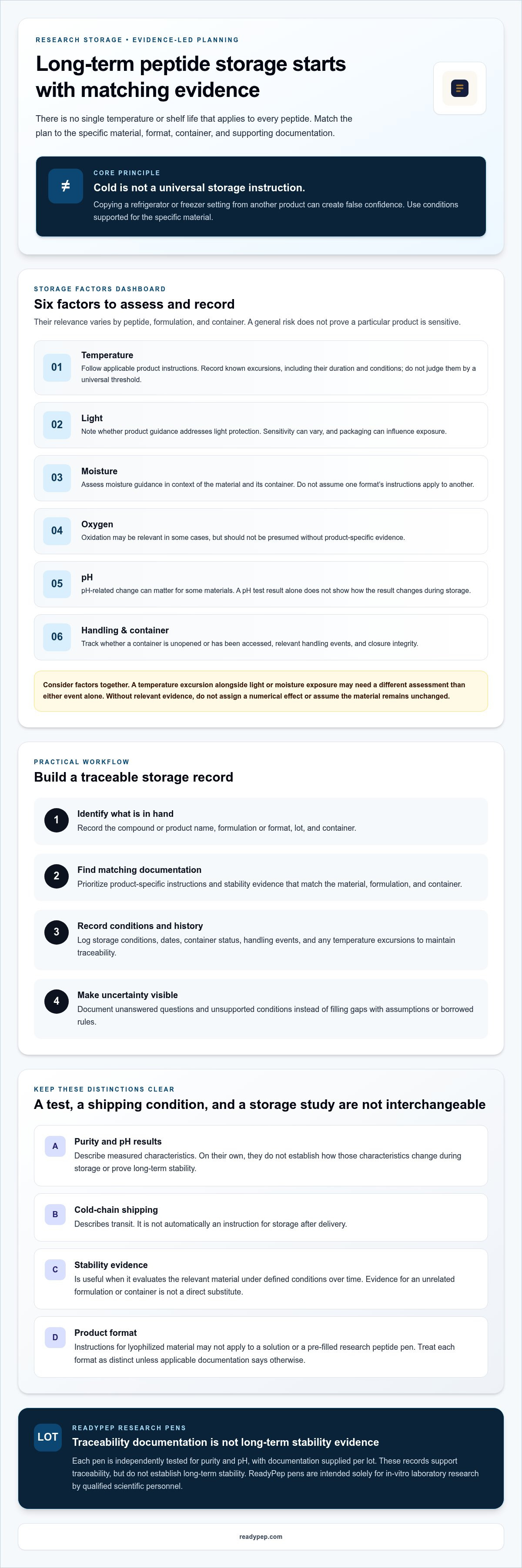
How to Build a Long-Term Research Peptide Storage Workflow
A reliable workflow turns product information into a record that can be reviewed later. It makes gaps and deviations visible instead of leaving the team to reconstruct conditions from memory. For anyone deciding how to store research peptides long term, begin by identifying the exact material and keeping its storage history traceable.
- Identify the material. Record the product name or identity, formulation or format, lot number, and receipt date. Confirm that the instructions apply to that product and lot.
- Capture the instruction source. Save applicable product directions and supporting stability information with the record. Note the conditions and storage period covered, and flag anything they do not address.
- Assign a storage location. Record the designated location and the monitoring method used under your laboratory’s procedures. Follow local requirements for equipment, monitoring, and record retention rather than relying on an assumed universal setup.
- Record condition and status. Log the assigned conditions, the date the material entered storage, and whether the container is unopened, opened, or otherwise handled. Update the record when its status changes.
- Review and respond to deviations. Record excursions or other departures from documented conditions promptly. Follow the laboratory’s applicable assessment process instead of assuming the material remains suitable.
Set up a traceable storage record
A useful record lets another qualified team member connect stored material to its instructions and history. Include the product identity, lot number, receipt date, instruction source, assigned location, monitoring method, and container status. Keep supporting documents with the entry so the basis for each decision is easy to review. Lot documentation supports traceability, but it is not a substitute for stability evidence. ReadyPep provides documentation per lot, and its research peptide testing information gives context about testing.
Manage changes, excursions, and review dates
If an excursion occurs, record what happened, when it was observed, and what is known about its duration and conditions. Keep the entry factual. Do not infer remaining stability from appearance, delivery history, or an assumption that the material was unaffected. Set review points using applicable stability information and laboratory procedures, and document the rationale for any disposition decision. If the evidence does not resolve the deviation, escalate it through the established lab process.
A traceable workflow makes storage decisions reviewable; it does not guarantee that material remains unchanged. For research teams evaluating a documented peptide-pen format within their own procedures, explore ReadyPep’s research peptide pens.
Choosing Documented Research Peptide Pens for a Storage Plan
A sound storage plan relies on two related but distinct records: what the material is, and what evidence supports its storage conditions. Lot documentation can connect a research material to its associated records. On its own, it does not establish how long a product remains stable or which conditions apply after delivery. Keep those questions separate, and base storage decisions on product-specific instructions and relevant stability evidence.
What lot documentation contributes to research planning
ReadyPep research peptide pens are manufactured by Metatide Healthcare and independently tested for purity and pH by Janoshik Analytical. Documentation is supplied per lot. Researchers can associate the documentation with materials used in a study, supporting traceability across receipt, storage, and experimental records.
Testing results have a defined scope. Purity and pH findings describe measured characteristics; they do not prove long-term stability, establish a shelf life, or guarantee experimental outcomes. A lot record and a stability study answer different questions. Use the lot record to identify and trace material, and rely on applicable stability information for supported storage conditions and time periods. If that evidence does not address the intended period, record the gap rather than treating test results as a substitute.
Connect sourcing records with storage records
At receipt, enter the product identity and lot number in the storage log, then associate the relevant documentation with that entry. Add the receipt date, the source of the storage instructions, the assigned location, and the container status. If the material is moved or its status changes, update the record so the link between the product and its handling history remains clear.
ReadyPep uses cold-chain shipping for transit. That describes shipping conditions, not storage requirements after delivery. Base post-delivery decisions on applicable product instructions and supporting stability evidence, and record the source. Delivery history alone cannot establish remaining stability.
The research peptide product catalogue provides a place to review available research materials. Keep the product name and lot identifier from the received material central to your records. Catalogue descriptions do not replace lot-specific documentation or stability evidence.
The practical takeaway is straightforward: select documented research materials, connect each lot to its storage record, and distinguish testing claims from stability claims. ReadyPep’s pre-filled research peptide pens are intended for qualified in-vitro laboratory research. Explore ReadyPep’s research peptide pens and review the available products for your research-material selection process.
Make the Storage Plan Part of the Research Record
A storage decision is useful only if the team can apply it consistently and revisit its basis. Turn the chosen conditions into a written lab procedure: identify the materials it covers, where applicable instructions are kept, and how staff should document a change or excursion. Review the procedure when product documentation or study requirements change. A written reference is more reliable than memory or assumptions transferred between formats.
Keep each material’s record specific. A clear link between product identity, lot, storage instructions, and handling history makes later review more practical. It also helps the team distinguish what its documentation supports from what still needs assessment. That is the foundation for deciding how to store research peptides long term without treating a general rule as a product-specific answer.
ReadyPep’s pre-filled research peptide pens are intended solely for in-vitro laboratory research by qualified scientific personnel. Explore the available pens and lot documentation as you build a plan grounded in traceability and applicable product information.
With a consistent record and evidence-led review, your team can make storage decisions with greater clarity.
Frequently Asked Questions
How should research peptides be stored long term?
Use conditions documented for the specific peptide, formulation, and container. To decide how to store research peptides long term, locate applicable product instructions and stability evidence, then record the intended conditions and review period in the lab’s storage record. Do not apply directions for dry material to a solution or pen. If the documentation leaves a question unanswered, record the gap and follow your laboratory’s review process.
Do all research peptides need to be refrigerated?
No. Refrigeration is not a universal requirement for every peptide or product format. Conditions depend on the material and applicable instructions, so a refrigerator setting copied from another product may be inappropriate. Check whether the guidance applies to the peptide as supplied and in its current container. If you have multiple documents, compare product identity, lot, and formulation before treating an instruction as relevant.
Can research peptides be frozen for long-term storage?
Only if instructions or stability evidence for the specific material support freezing. Do not assume freezing extends stability or suits every formulation and container. If documentation permits freezing, follow its handling directions and do not add freeze-thaw cycles unless the evidence supports them. If instructions do not address freezing, do not create a protocol from general advice. Document the uncertainty and refer it to the laboratory’s established review process.
How long do research peptides remain stable in storage?
There is no single storage life for all research peptides. Stability depends on the specific material, formulation, container, conditions, and available evidence. Use a time period only when applicable product documentation or stability data supports it. A printed date or general guideline is not proof for a different formulation. In your records, distinguish the documented period from the date your lab received or placed the material into storage.
What happens if a peptide experiences a temperature excursion?
An excursion means the material was exposed to conditions outside its documented range, but that alone does not establish the extent of any effect. Record when it was discovered, available temperature information, the duration if known, and the affected product and lot. Keep the material’s status clear while the deviation is reviewed under laboratory procedures. Do not decide it remains suitable based only on appearance or the fact that the excursion was brief.
Does cold-chain shipping mean a peptide should stay refrigerated after delivery?
Not necessarily. Cold-chain shipping describes handling during transit, not the correct conditions after receipt. At delivery, record the receipt time and any available shipment-condition information, then consult applicable product instructions for ongoing storage. Do not infer a long-term temperature requirement from packaging, a cold pack, or the shipment route. If delivery conditions appear inconsistent with instructions, document the observation for review.
Do purity test results confirm a peptide’s storage life?
No. A purity result reports what was measured in the tested sample under the conditions of that analysis. It does not show how the material changes during storage or establish a shelf life. Storage-life evidence must address stability over time under relevant conditions for the material and format. Keep quality-test records for material assessment, but do not use them in place of applicable stability data when setting storage dates or review points.
Disclaimer
Educational content only. Not medical advice.


