

A Certificate of Analysis reporting mass accuracy to a mere ±0.1% isn't a badge of quality; it's a red flag that could invalidate your entire 2026 research portfolio. In an era where modern LC-MS/MS instruments confirm molecular weight within 5 parts per million, mastering the skill of interpreting peptide certificate of analysis data is a prerequisite for laboratory success. You understand that experimental reproducibility depends entirely on the integrity of your starting materials. Yet, the persistent uncertainty surrounding third-party lab credibility and complex HPLC chromatograms often leaves researchers questioning their results before the first pipetting step.
This guide provides a clinical deep dive into reading purity percentages, cross-referencing lot numbers with independent portals like Janoshik, and identifying the subtle markers of high-tier synthesis. We'll break down the critical differences between HPLC purity and net peptide content, ensuring your materials meet the rigorous standards required for peer-reviewed publication. By the end of this manual, you'll navigate technical documentation with the same precision you apply to your methodology.
Key Takeaways
- Learn to verify manufacturer and laboratory credentials to ensure your reagents originate from a transparent, accountable source.
- Master the technical nuances of interpreting peptide certificate of analysis data by cross-referencing HPLC purity with Mass Spectrometry molecular weight.
- Identify the critical role of pH testing and solution stability in maintaining peptide integrity for sensitive in-vitro research.
- Protect your laboratory from fraudulent documentation by using third-party verification portals and modern QR code security features.
- Discover how utilizing pre-filled research pens from Metatide Healthcare minimizes reagent variability and simplifies the documentation process for peer-reviewed publication.
The Anatomy of a Peptide Certificate of Analysis (COA)
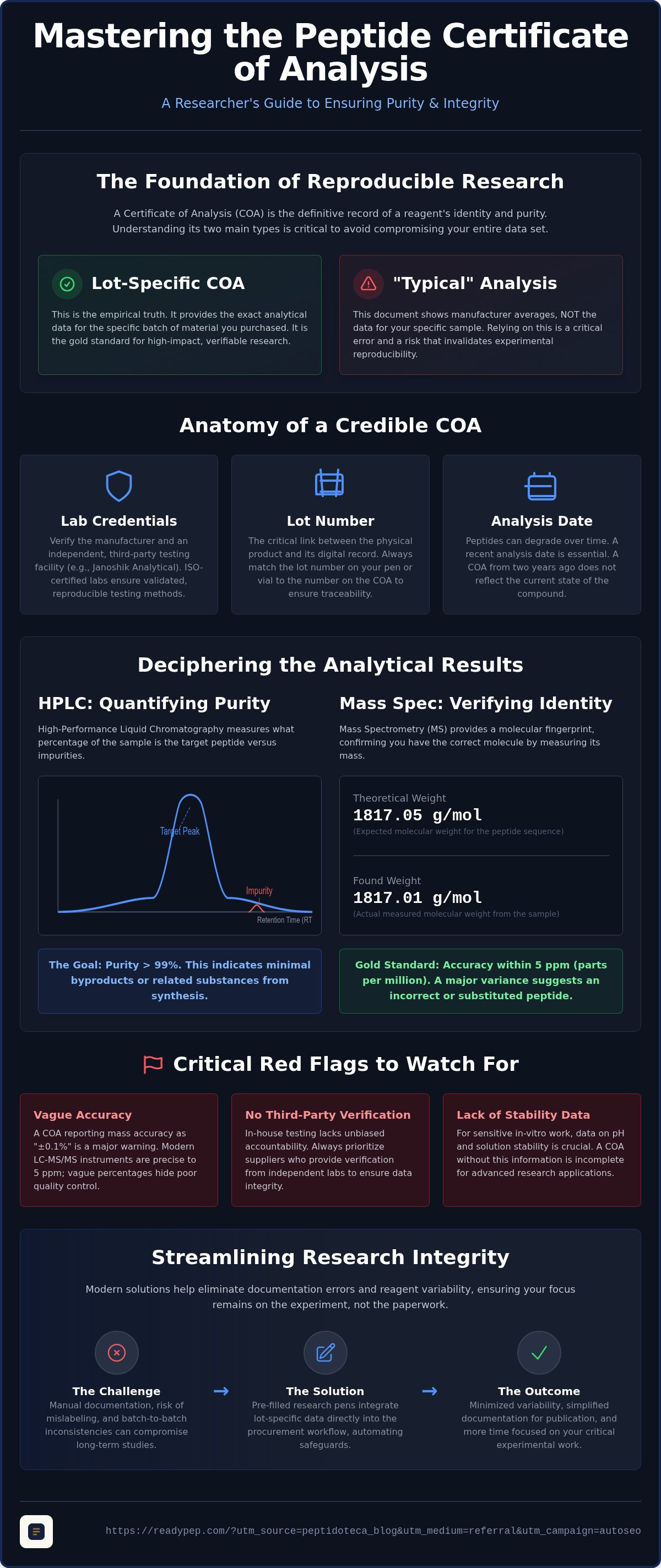
A Certificate of Analysis (COA) is a laboratory-issued document confirming the chemical identity and purity of a specific batch. It serves as the definitive record for any reagent entering a controlled environment. Interpreting peptide certificate of analysis reports correctly prevents the contamination of data sets. You must distinguish between "Typical Analysis" and "Lot-Specific" documentation. A "Typical" report lists manufacturer averages. A "Lot-Specific" COA provides the empirical truth of the exact material you've purchased. Relying on averages is a risk that serious researchers don't take.
Essential Header Data and Laboratory Credentials
The document header establishes the chain of custody. It identifies the manufacturer, such as Metatide Healthcare, and the independent testing facility. In 2026, third-party verification from labs like Janoshik Analytical remains the industry gold standard. These facilities provide an unbiased layer of accountability that in-house testing cannot match. Always verify the analysis date. Reagent freshness is critical; a COA from two years ago doesn't reflect the current state of a potentially degraded peptide. Modern researchers prioritize ISO-certified laboratory standards to ensure that the testing methods themselves are validated and reproducible.
Batch Traceability and Lot Identification
Lot numbers are the functional link between a physical research pen and its digital analytical record. This identifier allows you to track batch-to-batch consistency across long-term studies. When you receive a shipment, the first step is matching the pen's lot number to the provided COA. Discrepancies here indicate a failure in quality control. Lot traceability is the backbone of research accountability. Without this direct link, your peer-reviewed publication lacks the necessary validation for high-impact journals.
Many laboratories now utilize pre-filled research pens because they streamline this documentation process. By integrating lot-specific data directly into the procurement workflow, you eliminate the risk of mislabeling. Interpreting peptide certificate of analysis data becomes an automated safeguard rather than a manual chore. This level of precision ensures that your focus remains on the experiment, not the validity of the catalyst. It's about removing friction from the scientific process while maintaining uncompromising standards.
Deciphering HPLC and Mass Spectrometry Results
HPLC and MS are the dual pillars of analytical verification. One validates quantity; the other validates quality. Together, they form the basis for Regulatory Guidelines for Peptide Analysis. Interpreting peptide certificate of analysis data requires looking at both. MS confirms you have the right molecule, while HPLC confirms how much of it is pure. Without both, the COA is incomplete and your research remains unverified.
Interpreting the HPLC Chromatogram
The chromatogram is a visual map of chemical purity. The X-axis represents Retention Time (RT). It shows when the compound exits the column. The Y-axis measures Intensity in milli-Absorbance Units (mAU). Purity is calculated using the Area Under the Curve (AUC) method. By comparing the area of the target peak to the total area of all peaks, labs derive a percentage. A purity of 99% means that 1% of the sample contains related substances or synthesis byproducts. Small spikes at the baseline are often baseline noise. Distinct peaks elsewhere indicate significant impurities. These contaminants can trigger unintended cellular responses in your experiments, leading to false positives or failed replications. Identifying the target peak versus secondary peaks is the difference between controlled data and experimental noise.
Verifying Identity via Mass Spectrometry
Mass Spectrometry (MS) provides the molecular fingerprint. It measures the mass-to-charge ratio of the ions. You must compare the "Found" molecular weight against the "Theoretical" weight listed for the sequence. Modern LC-MS/MS instruments are highly precise. An accuracy of 5 parts per million (ppm) is the 2026 standard. If the variance exceeds 0.01% or 0.1% depending on the lab, the compound's identity is suspect. This check ensures that the peptide sequence hasn't been substituted or incorrectly synthesized. Even a single amino acid substitution can drastically alter the molecular weight. MS is your first line of defense against mislabeled products. High-precision research requires reagents that match these analytical benchmarks. When you source verified research materials, you eliminate the guesswork associated with identity and purity. Transparent data is the only way to ensure research reproducibility.
Aqueous Standards: pH Testing and Solution Stability
Traditional analytical reports often overlook pH because lyophilized powders have historically been the industry standard. For 2026 research utilizing pre-filled formats, interpreting peptide certificate of analysis data must include verified pH levels. An incorrect pH doesn't just destabilize the molecule; it alters the fundamental chemistry of your experiment. ReadyPep ensures that every lot of pre-filled research pens undergoes independent pH verification through Janoshik Analytical. This commitment to transparency removes the variable of acidity or alkalinity from your laboratory workflow. It ensures that the reagent you receive is ready for immediate application without additional titration or adjustment.
Why pH Matters for In-Vitro Research
Maintaining physiological relevance is the primary goal of any cell culture model. If a peptide solution is too acidic or basic, it can cause immediate cellular stress or premature cell death. This masks the actual biochemical effects of the compound you're studying. pH also dictates the rate of peptide degradation. Many sequences are highly sensitive to their environment; even a slight deviation from the optimal range can lead to rapid hydrolysis or aggregation. You can learn about our lab testing standards to see how we maintain these narrow tolerances. By verifying pH at the batch level, we ensure the reagent behaves predictably once introduced to your assays. It's a critical step in ensuring that your results are caused by the peptide, not the solvent.
Aqueous Stability and Shelf Life in 2026
Understanding the difference between "Time-Zero" testing and long-term stability is vital for accurate project planning. Time-Zero data reflects the purity and pH immediately after manufacturing. While lyophilized powders offer long-term storage benefits, modern stabilized aqueous solutions provide immediate utility and reduce measurement errors during reconstitution. Researchers must account for the shelf life once a pen is active. You can review our detailed Stability Data: Peptide Shelf Life After Opening to better understand these specific timelines. Best practices for maintaining integrity include consistent refrigerated storage at 2-8°C and minimizing light exposure. These steps prevent photo-degradation and maintain the analytical purity reported on your COA throughout the duration of your study.
Verification Protocols: How to Spot a Fraudulent COA
The peptide industry faces a growing challenge: "Photoshop Purity." Static PDF reports are easily manipulated, leading to a rise in fraudulent documentation. Interpreting peptide certificate of analysis reports requires more than just reading the numbers on the page; it demands active verification. In 2026, relying on a provided document without checking the source lab's database is a catastrophic oversight for any serious laboratory. ReadyPep addresses this by utilizing the Janoshik verification portal for every lot. This ensures that the data you see is the data the lab recorded. It's about moving beyond blind trust toward empirical certainty.
Step-by-Step Janoshik Verification Guide
Authenticating a report is a straightforward process. First, locate the unique 8-digit or 12-digit verification code. This is typically found in the header or footer of the Janoshik report. Next, navigate to the official Janoshik portal. Enter the code to pull the digital record directly from the lab's secure server. Compare the digital results, including the HPLC chromatogram and the Mass Spectrometry peaks, against the document provided by your supplier. If the digital record is missing, or if the purity percentages differ by even a fraction, you must reject the material. This direct cross-referencing is the only way to guarantee reagent integrity.
Red Flags and Rejection Criteria
Fraudulent reports often leave subtle traces. Look for inconsistent fonts. This suggests that numbers have been overlaid on an existing template. Missing lab signatures or altered analysis dates are immediate grounds for disqualification. Additionally, check the theoretical molecular weight against established databases. If the COA lists a weight that doesn't match the known sequence of the peptide, the document is likely a fabrication. Mastering the nuances of interpreting peptide certificate of analysis documents is your primary defense against analytical fraud. The "trust but verify" protocol serves as the final safeguard for high-stakes research.
Maintaining this level of scrutiny ensures your data remains beyond reproach. When you purchase research peptides from ReadyPep, you receive lot-specific documentation that is pre-verified and ready for independent audit. This transparency eliminates the risk of experimental failure due to compromised materials. It allows you to focus on discovery rather than questioning the validity of your catalysts.
Maintaining Research Integrity with Pre-filled Peptide Pens
Analytical transparency is only half the battle. The other half is maintaining that integrity during the actual application phase. Pre-filled research pens from Metatide Healthcare represent a significant shift in laboratory efficiency. By delivering stabilized, pre-measured aqueous solutions, these devices eliminate the common errors associated with manual reconstitution and vial-to-vial variability. This is especially critical in high-throughput laboratories where speed and precision are non-negotiable. When you're interpreting peptide certificate of analysis data, you're looking at the potential of the reagent. Pre-filled pens ensure that potential is realized in every aliquot. Mastery of interpreting peptide certificate of analysis reports isn't just about reading a PDF; it's about ensuring those numbers translate to the bench without degradation.
Documentation for Publication and Peer Review
High-impact journals increasingly demand granular detail regarding reagent provenance. You can't just list a compound like Retatrutide or MOTS-c in your methods. You must cite the specific lot number, the manufacturer, and the verified purity percentage. This level of detail makes your work reproducible. Review our Research Peptide Quality Standards: A Guide for In-Vitro Laboratories to refine your documentation protocols. Rigorous material tracking ensures that when other researchers attempt to replicate your findings, they are using identical analytical benchmarks. It's the only way to build a credible research portfolio that survives the scrutiny of peer review.
The ReadyPep Advantage: Precision and Transparency
ReadyPep bridges the gap between high-level analytical chemistry and practical laboratory utility. We combine the clinical-grade manufacturing of Metatide Healthcare with the absolute transparency of Janoshik Analytical. Every pen is shipped via a validated cold-chain to prevent thermal degradation before it reaches your bench. This ensures that the purity reported on your COA remains accurate at the point of use. We prioritize the removal of friction. No more manual calculations. No more contamination risks from open vials. You can explore our full range of research protocols to find the exact configuration for your study.
Stop guessing. Start verifying. Secure high-purity, independently verified peptides for your next study and ensure your research integrity is beyond question.
Securing Analytical Certainty in Your Laboratory
Analytical transparency isn't a courtesy; it's the prerequisite for scientific discovery. You've learned that interpreting peptide certificate of analysis data requires a dual-verification strategy. You must cross-reference HPLC purity with Mass Spectrometry molecular weight while utilizing the Janoshik portal to expose fraudulent documentation. These protocols, combined with lot-specific pH testing, protect your data from the variables that lead to experimental failure. Precision at the bench starts with precision at the source.
ReadyPep provides the infrastructure for high-stakes research. We offer pre-filled pens manufactured by Metatide Healthcare, all backed by independent lot testing from Janoshik Analytical. Every shipment utilizes cold-chain worldwide shipping to ensure analytical integrity remains intact from our facility to your incubator. It's time to eliminate reagent uncertainty from your methodology. Access independently verified research peptides for your laboratory and focus on the breakthroughs that matter. Your research deserves the highest standard of empirical truth.
Frequently Asked Questions
What is the difference between a peptide's purity and its content?
HPLC purity measures the target peptide relative to other peptide impurities. It doesn't account for non-peptide substances like water or acetate salts. Net peptide content represents the actual mass of the peptide in the vial. For accurate dosing, you must use the net content value rather than the total powder weight. Most research-grade materials have a net content between 70% and 85% despite having 99% HPLC purity.
How do I verify a Janoshik COA for a ReadyPep product?
Locate the unique verification code on your report. Visit the official Janoshik Analytical portal and enter this 8-digit or 12-digit key. This pulls the original record from their secure database. You must ensure the HPLC chromatogram and mass spectrometry data match the document provided with your ReadyPep order. This direct verification is the only way to confirm document authenticity and ensure reagent integrity in 2026.
Does a 99% purity rating guarantee the peptide is free of endotoxins?
A 99% purity rating doesn't guarantee the absence of endotoxins. HPLC measures chemical purity by identifying peptide-related substances. It doesn't detect bacterial byproducts or biological contaminants. For sensitive in-vitro or in-vivo research, you require a specific Limulus Amebocyte Lysate (LAL) test. Standard industry thresholds for research reagents are typically less than 5 EU/mg, but these must be tested separately from the purity analysis.
Why does the molecular weight on the COA differ slightly from the theoretical weight?
Small variances occur due to isotopic distribution and instrument calibration tolerances. Modern mass spectrometry identifies the most abundant mass, which can shift slightly from the theoretical average weight. An accuracy within 5 parts per million (ppm) is the current 2026 laboratory standard. If the found mass is within this narrow range, the identity is confirmed. Significant deviations suggest an incorrect amino acid sequence or synthesis error.
Can I use an old COA for a new lot of the same peptide?
You can't use an old COA for a new lot. Every synthesis batch possesses unique analytical characteristics, including specific purity levels and impurity profiles. Interpreting peptide certificate of analysis data requires matching the lot number on your research pen to the specific report. Using a previous report for a new batch invalidates your documentation and compromises the reproducibility of your peer-reviewed publication.
How often should a peptide lot be re-tested for purity?
Re-testing frequency depends on the peptide's stability and storage conditions. Lyophilized powders should undergo purity verification every 12 to 24 months. Aqueous solutions in pre-filled pens require more frequent monitoring if stored beyond their initial shelf life. If you notice changes in solution clarity or experimental performance, immediate re-testing is necessary. Consistent refrigerated storage at 2-8°C helps maintain the analytical purity reported on the original COA.
What should I do if the HPLC chromatogram shows multiple large peaks?
Multiple large peaks indicate significant impurities or peptide degradation. The primary target peak should represent at least 98% of the total area under the curve for research-grade materials. Secondary peaks suggest synthesis failures or the presence of truncated sequences. If these peaks are prominent, the lot doesn't meet quality standards. Interpreting peptide certificate of analysis chromatograms is vital to prevent contaminated reagents from skewing your research data.
Is pH testing included in a standard peptide COA?
Standard COAs for lyophilized vials rarely include pH testing. However, pH verification is a critical component for pre-filled research pens from ReadyPep. Because these reagents are provided in an aqueous format, maintaining a stable pH is essential for peptide integrity and cellular uptake. Every lot of our pre-filled pens includes independent pH data to ensure the reagent is ready for immediate laboratory use without additional titration.
Disclaimer
Educational content only. Not medical advice.


