

A 15% variance in manual dosing isn't just a minor technicality; it's a direct threat to the integrity of your longitudinal data. You've likely spent hours perfecting reconstitution protocols only to face the inevitable reality of dead-volume waste or inconsistent concentrations. When evaluating the peptide pen vs vial for lab use, the decision hinges on whether your research can tolerate the human variables inherent in traditional methods. Legacy standards shouldn't dictate your precision limits in a landscape that demands absolute verification.
We understand that laboratory efficiency relies on removing friction and uncertainty. It's exhausting to manage the contamination risks of repeated vial access or the hidden costs of auxiliary supplies. This 2026 comparison explores how pre-filled pens reduce dosing errors to under 2% while streamlining multi-dose workflows. You'll discover how to maximize reagent stability, minimize preparation time, and ensure that your assay results remain beyond reproach. We'll examine the critical trade-offs between legacy vial systems and the modern precision of pre-filled technology to help you optimize your laboratory standards.
Key Takeaways
- Eliminate volumetric errors and "dead space" waste by transitioning from visual syringe markings to precise, mechanical click-based dosing.
- Reduce contamination risks by utilizing sealed pen systems that prevent the repeated air exchange and septum degradation common in traditional vials.
- Protect sensitive research compounds like MOTS-c and GHK-Cu from oxidation through superior light and oxygen shielding inherent in pre-filled formats.
- Analyze the total cost-efficiency of the peptide pen vs vial for lab use by factoring in the removal of auxiliary supplies like bacteriostatic water and syringes.
- Optimize high-throughput in-vitro workflows by removing reconstitution friction to ensure consistent reagent concentrations across all assay plates.
The Evolution of Peptide Delivery in In-Vitro Research
The laboratory landscape of 2026 demands a level of reproducibility that traditional lyophilized vials often struggle to provide. For decades, researchers relied on the manual reconstitution of powdered reagents. This process is inherently variable. It introduces human-led inconsistencies at the very first step of an assay. As high-throughput labs scale their operations, the shift toward modern pre-filled systems has become a logistical necessity. The debate of peptide pen vs vial for lab use isn't just about convenience. It's about the "Precision Gap" between a technician's eyesight and a calibrated mechanical delivery system.
The Friction of Manual Reconstitution
Manual preparation is a significant bottleneck. Calculating specific diluent volumes requires absolute focus. A single milliliter of error can skew the concentration of a 40mg MOTS-c stack, rendering an entire plate of results invalid. Beyond volume errors, the physical act of mixing poses risks. Aggressive shaking or rapid injection of bacteriostatic water can cause peptide shearing. This degrades the fragile amino acid chains before they even reach the incubator.
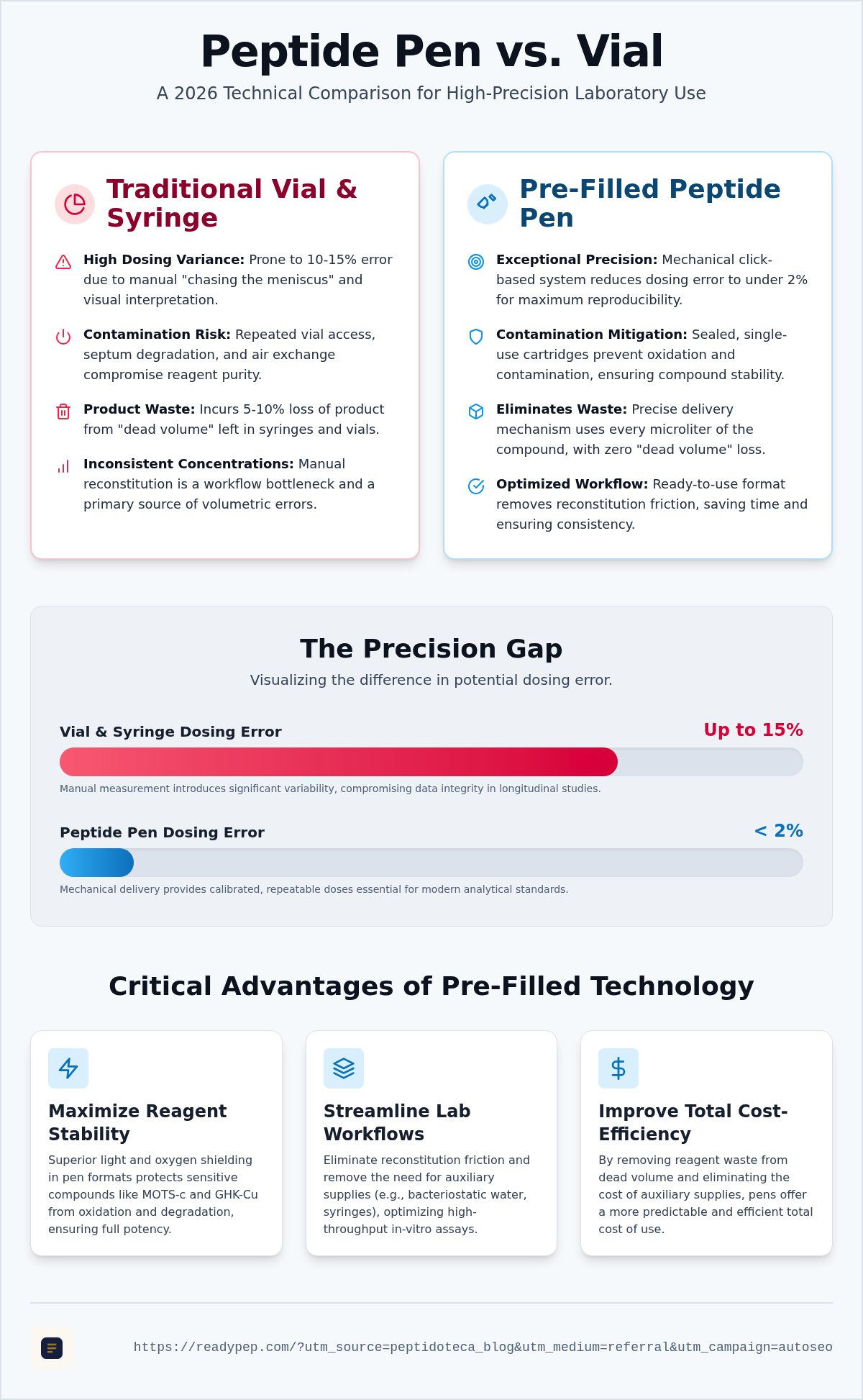
In high-throughput settings, preparing 50+ vials manually consumes hours of skilled labor. Research indicates that peptide pens can reduce dosing error to under 2%. This is a stark contrast to the potential 10-15% variance seen with manual, syringe-drawn dosing from vials. Additionally, vial-based use often results in a 5-10% loss of product due to dead volume in syringes. Pre-filled pens eliminate this "reconstitution friction" entirely. They allow for immediate application without the risk of volumetric variance.
Meeting Modern Analytical Standards
Modern research integrity relies on empirical verification. In 2026, standards like HPLC (High-Performance Liquid Chromatography) and pH testing are the baseline for any serious publication. The stability of these compounds is central to peptide therapeutics research. Understanding how a compound maintains its bond integrity under different storage conditions is vital for accurate modeling.
To ensure these standards are met, researchers now prioritize lot-specific documentation and third-party verification. Relying on a manufacturer's word is insufficient. Independent testing by labs like Janoshik Analytical provides the transparency required for high-stakes in-vitro studies. This level of rigorous lab testing ensures that every click of a pen delivers exactly what the protocol specifies. When comparing the peptide pen vs vial for lab use, the pen represents a move toward a closed-loop system where reagent purity and concentration are locked in before the product ever enters your facility.
Technical Comparison: Dosing Precision and Reconstitution Variables
Visual syringe marking is a legacy method that introduces unnecessary subjectivity into in-vitro protocols. When a researcher draws from a vial, they're often "chasing the meniscus." This process, where slight angle changes or lighting conditions lead to volumetric drift, is inherently flawed. In contrast, the peptide pen vs vial for lab use debate is settled by mechanical objectivity. Clicks replace guesses. Pre-filled pens utilize a calibrated internal piston that delivers precise increments through tactile feedback. This removes the 10-15% variance common in manual dosing, ensuring that every well in a 96-plate assay receives an identical concentration.
Reproducibility is the cornerstone of valid research. If three different lab members perform the same assay, their visual interpretation of a 0.1ml syringe mark will differ. Pens standardize this variable. By shifting to a mechanical delivery system, laboratories can achieve a dosing error rate of under 2%. This precision is particularly critical when working with high-potency compounds where micro-liter deviations significantly alter cell signaling outcomes. Adhering to rigorous standards is essential, much like following the FDA guidance on multi-dose vials, which highlights the inherent risks of volume interpretation and repeated access in traditional formats.
The Mechanics of Precision
The internal piston mechanism of a research pen is designed for high-repetition accuracy. Unlike a rubber syringe plunger that can "stutter" or compress, the pen's drive screw provides a linear, non-compressible force. This allows for micro-liter accuracy that visual methods cannot replicate. For cell culture work, where reagents are often diluted into small media volumes, this level of control prevents the concentration spikes that trigger unintended cellular responses. It's about removing the human element from the delivery hardware. Consistency is maintained across the entire cartridge.
Waste Reduction and Inventory Management
Vial-based research is notoriously inefficient regarding reagent utilization. "Dead space" or residual volume in the vial neck and syringe hub typically accounts for a 5-10% loss of the total compound. Over a dozen assays, this waste necessitates over-ordering bulk powder to compensate for the hardware's limitations. Pre-filled formats solve this by utilizing a plunger that travels the full length of the cartridge, leaving virtually zero residue. Labs can more accurately predict their reagent needs and reduce overhead costs. Exploring the ReadyPep Inventory reveals how these standardized formats can simplify your procurement process.
Standardizing your workflow doesn't just save time; it protects your data. When you source pre-filled research pens, you're investing in a system that eliminates the variables that compromise longitudinal studies.
Contamination Mitigation: Multi-Dose Vials vs. Sealed Pen Systems
Vial septums are not impenetrable barriers. Every time a researcher pierces a vial with a needle, they create an "open system" event. This allows for an immediate exchange between the sterile interior and ambient laboratory air. In sensitive in-vitro research, even a minor introduction of microbes can lead to catastrophic data drift. When evaluating the peptide pen vs vial for lab use, the primary aseptic advantage lies in the pen's sealed architecture. Pre-filled pens function as a closed environment, maintaining reagent integrity from the first dose to the last. This is especially critical for cell-line studies where bacterial endotoxins can trigger inflammatory responses that invalidate experimental results.
Integrated delivery hardware removes the most common points of failure in aseptic technique. Traditional vials require multiple steps: cleaning the septum, drawing air, injecting air, and drawing the liquid. Each step is a contamination risk. Pens bypass this complexity. The internal reservoir is never exposed to the external environment during the dosing process. This structural security ensures that high-purity compounds, such as those verified through independent lab testing, remain uncontaminated throughout their usage cycle.
Septum Integrity and Repeated Access
Micro-coring is a silent threat to research purity. When large-gauge lab needles repeatedly strike a vial's rubber septum, small fragments of elastomer can shear off and fall into the solution. These particles don't just interfere with spectrophotometry; they can harbor bacteria that survive standard refrigeration. Pen systems eliminate this risk by utilizing a specialized dual-seal mechanism. You don't have to pierce a thick rubber barrier every time you need a dose. This preserves the physical purity of the peptide and prevents the introduction of foreign materials that could alter the chemical profile of your assay.
Sterile Handling Protocols
Maintaining sterility within a laminar flow hood is significantly easier with pre-filled hardware. The streamlined design reduces the "clutter" of syringes, needles, and bacteriostatic water vials, all of which can disrupt airflow. Researchers can focus on precision rather than managing multiple components. Effectively improving lab workflow starts with reducing these manual touchpoints. Once an assay is complete, the integrated nature of the device simplifies the cleanup process. Following a standardized protocol for the safe disposal of research pens ensures that the laboratory environment remains clear of biohazardous waste while maintaining the highest safety standards.
Stability and Oxidation: Protecting Sensitive Research Compounds
Reagent degradation is often a silent variable that skews in-vitro data. Peptide bonds are inherently fragile. They remain susceptible to two primary stressors: UV radiation and oxygen exposure. When comparing the peptide pen vs vial for lab use, the physical housing of the compound becomes a critical factor in maintaining bond integrity. Clear glass vials offer minimal protection against light-induced degradation. In contrast, pre-filled research pens utilize UV-opaque housings. This shielding is vital for photosensitive compounds like GHK-Cu, where light exposure can catalyze unintended oxidative reactions before the assay even begins.
Aqueous solutions require more rigorous protection than lyophilized powders. Once reconstituted, a peptide’s functional shelf-life starts ticking. Vials inevitably contain headspace oxygen. This trapped air facilitates oxidation every time the vial is handled or stored. Pre-filled cartridges in pen systems are vacuum-sealed. They eliminate the air-liquid interface entirely. This structural difference ensures that sensitive reagents remain stable throughout their entire usage cycle. Key stability factors include:
- UV Shielding: Opaque pen bodies block wavelengths that break down amino acid chains.
- Vacuum Sealing: Eliminating headspace oxygen prevents the formation of oxidative impurities.
- Material Inertia: High-grade cartridges minimize reagent-container interactions.
Oxidation Pathways in Aqueous Solutions
The role of headspace oxygen cannot be overstated. In a multi-dose vial, the volume of air increases with every draw. This accelerated oxidation can lead to the formation of impurities that interfere with HPLC profiles. This is a primary concern for high-concentration protocols such as MOTS-c 40mg research. Vacuum-sealed pen cartridges extend functional shelf-life by preventing this atmospheric contact. They ensure that the final dose is as chemically identical to the first as possible. This consistency is vital for longitudinal studies where reagent drift can invalidate months of work.
Cold-Chain Integrity During Transit
Transit conditions are the first test of reagent stability. Aqueous formats are significantly more sensitive to temperature fluctuations than their powdered counterparts. Maintaining a strict cold chain is non-negotiable for preserving pH stability and peptide folding. ReadyPep addresses this through free worldwide cold-chain shipping. This logistics framework ensures that compounds arrive at your facility without thermal degradation. To verify this integrity, every lot undergoes independent testing by Janoshik Analytical. This empirical verification provides the transparency required for high-standards laboratory work. If you value data reproducibility, you should source pre-filled research pens that prioritize these stability standards.
Optimizing Lab Workflow with Pre-filled Research Pens
Efficiency in the lab is measured by the removal of manual bottlenecks. Traditional vial handling is a high-friction process. When analyzing the peptide pen vs vial for lab use, the operational return on investment (ROI) becomes clear through reduced labor hours and reagent waste. Integrating pre-filled pens allows researchers to move from preparation to execution without the variability of manual reconstitution. This shift supports an agile research environment where data integrity is the priority.
Training staff on click-dosing is remarkably straightforward. Unlike the subjective nature of visual syringe marking, tactile feedback provides a binary confirmation of success. This standardization minimizes inter-operator variance. It ensures that data remains consistent regardless of which technician handles the assay. A pilot study framework can demonstrate these gains within a single week of implementation, providing the empirical proof needed for full-scale adoption.
Protocol Implementation
Standardizing your research starts with adopting verified protocols. For neurological modeling, the Mind Protocol provides a framework for consistent dosing in sensitive cell cultures. Similarly, the Repair Protocol streamlines the setup for fibroblast assays. Using these established systems allows for more accurate reporting in peer-reviewed publications. It provides a clear, reproducible methodology that other researchers can follow with high confidence.
The ReadyPep Advantage
Transitioning from legacy vial systems requires a reliable supply chain. ReadyPep offers direct access to Metatide Healthcare verified stock, ensuring that every pen meets strict analytical standards. Procurement is streamlined for worldwide laboratories. This removes the uncertainty of sourcing from unverified vendors. By shifting to a pre-filled system, you eliminate the need for auxiliary inventory like bacteriostatic water and insulin syringes. This reduces administrative overhead significantly. You can secure high-purity research pens today to begin your pilot study and justify the workflow shift to stakeholders and PIs. The evidence of reduced contamination and increased precision makes the case for modernization undeniable.
Standardizing the Future of In-Vitro Precision
The choice between a peptide pen vs vial for lab use determines more than just convenience; it defines the reliability of your empirical data. Transitioning to pre-filled systems eliminates the potential 15% dosing variance common in manual syringe methods while shielding sensitive compounds from light and oxidation. By adopting a closed-loop delivery system, you remove the human variables that compromise longitudinal research integrity.
Standardizing your workflow requires reagents that match your analytical rigor. Every cartridge adheres to Metatide Healthcare manufacturing standards and undergoes independent testing by Janoshik Analytical for purity and pH. We ensure your research stacks arrive via global cold-chain shipping, protecting bond integrity from our facility to your incubator. It's time to replace legacy reconstitution friction with modern mechanical precision.
Secure your laboratory's precision with pre-filled research pens from ReadyPep and elevate the standards of your next assay.
Frequently Asked Questions
Is a peptide pen more accurate than a syringe and vial for lab use?
Yes, mechanical click-dosing is significantly more accurate than manual syringe draws. While syringes rely on subjective visual alignment, pens use a calibrated drive screw. This hardware reduces dosing variance to under 2%, ensuring consistent reagent delivery across multiple assay plates. It effectively removes the human variable from the peptide pen vs vial for lab use comparison during high-precision research.
How do I calculate the concentration of a pre-filled research pen?
Concentration is calculated by dividing the total mass of the peptide by the volume of the aqueous solution. For instance, a 40mg MOTS-c pen containing 2ml of solution results in a concentration of 20mg/ml. Each click on the pen corresponds to a specific volume, allowing researchers to determine the precise mass delivered per increment based on this standardized and verified ratio.
Do pre-filled peptide pens need to be refrigerated during lab storage?
Yes, pre-filled research pens must be stored in a laboratory refrigerator at 2-8°C to maintain stability. Aqueous solutions are more susceptible to thermal degradation than lyophilized powders. Consistent cold-chain storage prevents the breakdown of amino acid chains, ensuring that the reagent's analytical profile remains unchanged throughout its usage cycle. Don't leave pens at room temperature for extended periods during your assays.
Can I use research peptide pens for in-vivo animal studies?
No, these products are strictly for in-vitro laboratory research and chemical analysis. They aren't intended for human or veterinary therapeutic use. All ReadyPep products, including pre-filled pens, are designed for controlled laboratory environments where they serve as reagents for cellular modeling and biochemical assays. This ensures that the compounds are handled within the specific parameters of documented scientific protocols and safety standards.
What is the shelf life of an aqueous peptide pen vs a lyophilized vial?
A lyophilized vial typically has a longer shelf life in its powdered state, often lasting up to two years when frozen. However, once reconstituted, its stability drops rapidly. An aqueous peptide pen is designed for immediate use and maintains functional stability for 3 to 6 months when refrigerated. The vacuum-sealed cartridge protects the solution from the oxidation that often plagues open vial systems.
How does pH testing affect the stability of research peptides?
pH testing is critical because it determines the solubility and stability of the peptide bonds. If the pH deviates from the optimal range, the compound may precipitate or undergo rapid hydrolysis. ReadyPep ensures that every lot is independently verified for pH balance to prevent reagent degradation. This is a primary technical consideration when evaluating a peptide pen vs vial for lab use for sensitive in-vitro work.
Are pre-filled pens more expensive than traditional vials for research?
Pre-filled pens often have a higher initial unit price, but they reduce the total cost of research by eliminating auxiliary expenses. You don't need to purchase bacteriostatic water, insulin syringes, or separate reconstitution supplies. The reduction in reagent waste from dead space often makes pens more cost-effective over a long-term study compared to traditional vials that require more manual handling and auxiliary inventory.
How do I verify the purity of a peptide pen lot?
Purity is verified through third-party analytical reports, specifically High-Performance Liquid Chromatography (HPLC). Every ReadyPep lot undergoes independent testing by Janoshik Analytical to confirm purity levels and chemical identity. Researchers should always review these reports to ensure their reagents meet the rigorous standards required for peer-reviewed publications. This transparency is essential for maintaining accountability and high standards in modern laboratory environments.
Disclaimer
Educational content only. Not medical advice.


