

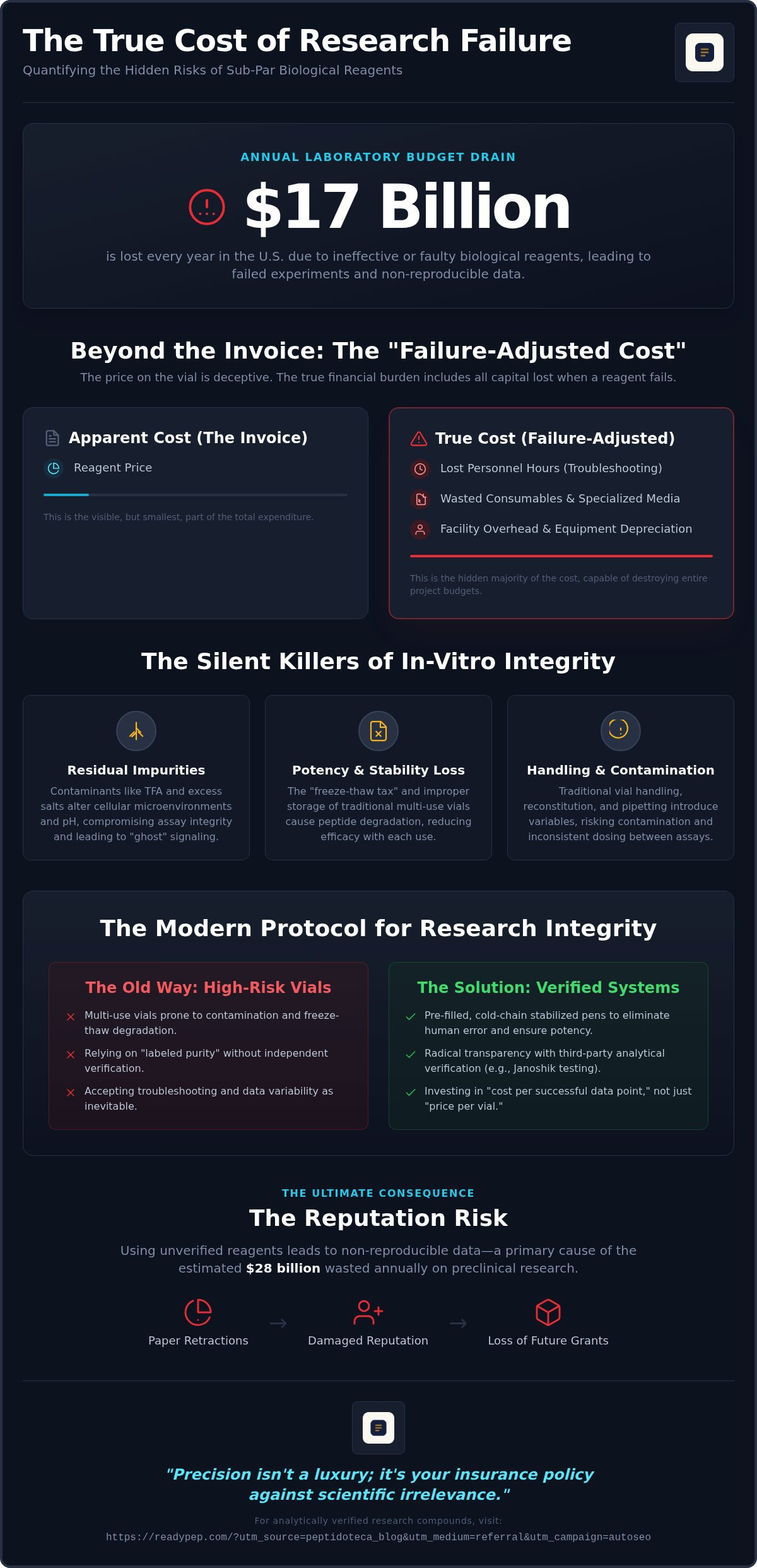
Over $17 billion is drained from laboratory budgets every year because of ineffective or faulty biological reagents. This isn't just a procurement headache. The true cost of failed experiments due to bad reagents includes the months of lost labor, wasted grant money, and the reputational damage of non-reproducible data. You've likely felt the frustration of troubleshooting "ghost" variables for weeks, only to find the culprit was a degraded peptide or contamination from traditional vial handling.
It's a systemic risk that many researchers accept as inevitable. It shouldn't be. You need a clear framework to justify reagent quality to stakeholders and ensure your in-vitro assays remain consistent. This 2026 guide quantifies the hidden risks of sub-par materials and shows you how to safeguard your research integrity through rigorous analytical verification. We'll examine the impact of recent FDA reclassifications on Category 2 substances like BPC-157 and GHK-Cu. You'll also discover how moving toward pre-filled, Janoshik-tested peptide pens can eliminate human error and accelerate your time-to-publication. Precision isn't a luxury; it's your insurance policy against scientific irrelevance.
Key Takeaways
- Calculate the "Failure-Adjusted Cost" of research chemicals to reveal the true financial burden of lost labor and sample destruction.
- Identify how residual TFA and salt concentrations in peptides alter cellular microenvironments, compromising the integrity of your in-vitro assays.
- Quantify the cost of failed experiments due to bad reagents using a structured comparison framework that justifies investment in higher-quality standards.
- Minimize the "freeze-thaw tax" and potency loss by transitioning from traditional multi-use vials to pre-filled, cold-chain stabilized delivery systems.
- Implement a protocol of radical transparency through third-party analytical verification to ensure every reagent meets rigorous purity and pH requirements.
The Anatomy of Research Failure: Beyond the Reagent Invoice
The invoice price of a research chemical is a deceptive metric. To understand the true financial burden, you must calculate the "Failure-Adjusted Cost." This encompasses the total capital lost when a reagent fails to perform as expected. In 2026, the scientific community faces stricter oversight. The update to ISO 15189:2022 and new FDA reclassifications for compounds like BPC-157 mean that simple "labeled purity" is no longer enough. If a reagent is labeled at 98% purity but contains residual TFA that shifts the pH of your cellular microenvironment, the assay fails. The cost of failed experiments due to bad reagents isn't just the cost of the vial; it's the collapse of the entire experimental timeline. Beyond the numbers, there's a psychological toll. Repeated failures erode researcher confidence and breed a culture of second-guessing that slows innovation.
Direct vs. Indirect Costs of Reagent Failure
Direct costs are easy to track. They include the reagent price, pipette tips, and specialized media. Indirect costs are the silent killers of a lab budget. According to a 2020 report, over $17 billion is lost annually to ineffective reagents. When an experiment fails, you don't just lose the materials. You lose the opportunity to have run a successful study in that same time slot. Effective laboratory quality control procedures are the only way to mitigate these hidden expenses:
- Personnel Hours: The salary cost of scientists spent on troubleshooting instead of discovery.
- Facility Overhead: The daily cost of maintaining lab space and utilities for a failed run.
- Equipment Depreciation: Wear and tear on expensive machinery for data that must be discarded.
The Publication Risk: Retractions and Reputation
Reputation is the ultimate currency in research. High-tier journals now demand rigorous lot-specific documentation. Using unverified reagents can lead to "ghost" signaling, where impurities trigger biological responses unrelated to the target peptide. This variability makes data non-reproducible. A 2015 study in PLOS Biology estimated that $28 billion is wasted annually on irreproducible preclinical research. Correcting or retracting a paper due to material variability is a career-altering event. It's why modern labs are moving toward verified purity standards to ensure their data stands up to peer review. The cost of failed experiments due to bad reagents can ultimately be the loss of your next major grant.
Quantifying the Financial Impact: A Comparison Framework
Purchasing departments often fall into the "Cheap Reagent Trap." They prioritize the lowest price per milligram without calculating the Total Cost of Ownership. This oversight is a recipe for fiscal disaster. Consider a 30-day cell culture study. You've already invested in specialized media, growth factors, and hundreds of hours of PhD-level labor. If a peptide reagent fails on day 25 due to poor stability or hidden impurities, the entire investment evaporates. The cost of failed experiments due to bad reagents scales exponentially with the duration and complexity of the study. Verification isn't an added expense. It's a hedge against grant-burn.
The multiplier effect makes bad reagents even more dangerous in multi-arm studies. A single bad batch of a common reagent invalidates the control group and every cross-comparison arm. You don't just lose one data point. You lose the entire project's integrity. By shifting the focus from "price per vial" to "cost per successful data point," labs can justify the investment in higher-quality standards. Utilizing analytically verified peptide pens ensures that your budget is spent on discovery rather than damage control.
The Cost of Troubleshooting 'Bad Data'
When results drift, researchers rarely blame the reagent first. Teams typically spend 40 to 60 hours ruling out pipetting errors, incubator fluctuations, and cell line drift. Only then do they turn to secondary verification. Paying for independent HPLC or Mass Spec testing to confirm a bad batch adds further delay and unbudgeted expense. Troubleshooting Overhead is the most expensive lab activity. It diverts high-value personnel from primary research goals to menial investigative work. This hidden drain on resources often exceeds the original cost of failed experiments due to bad reagents by a factor of ten.
Vials vs. Pre-filled Pens: A Cost-Benefit Analysis
Traditional vials are inherently inefficient. Residual lyophilized powder often remains trapped in the glass, leading to significant material waste. Furthermore, repeated access to a single vial increases contamination risk. A single bacterial outbreak can destroy an entire incubator's worth of samples, resulting in thousands of dollars in losses. Pre-filled pens eliminate these variables. They provide precise dosing and minimize human error during the reconstitution process. You can learn more about improving lab workflow with pre-filled pens to see how this format drastically reduces variability and protects your laboratory's financial health.
Peptide Purity and pH: The Silent Killers of In-Vitro Integrity
Purity isn't just a number on a Certificate of Analysis. It's the boundary between reliable signal and biological noise. The cost of failed experiments due to bad reagents often stems from what the label leaves out. While many suppliers focus on the primary sequence, they ignore the residual Trifluoroacetic acid (TFA) and salts that remain after synthesis. These hidden components alter cellular microenvironments. They shift the baseline of your assays. In-vitro models are exceptionally sensitive to these variables. A slight deviation in reagent quality can render months of data non-reproducible. Verification is the only path to certainty.
The 2% Problem: What Impurities Actually Do
Major industry providers often claim that 98% purity is sufficient for all research. This is a dangerous simplification. The remaining 2% isn't just "empty space." These impurities are often truncated sequences or chemical byproducts from sub-par synthesis. They cause off-target binding. This masks true receptor-ligand interactions and creates false positives. Cytotoxicity from residual solvents can trigger premature apoptosis in sensitive cell lines. You need lot-specific HPLC reports to prove your data's validity to peer reviewers. Without them, your research rests on a foundation of guesswork. Watch for these signs of degradation:
- Oxidation: Changes in chemical structure that neutralize potency.
- Deamidation: Alterations in amino acid side chains that disrupt binding affinity.
- Aggregation: Peptide clumping that leads to inconsistent dosing and "ghost" signaling.
PH Variability in Research Chemicals
pH stability is a critical variable that many labs overlook. Incorrect pH levels trigger immediate cellular stress responses. This includes Heat Shock Protein (HSP) activation. Such stress creates biological noise that obscures your actual results. Peptide stability itself is highly dependent on solvent pH. If the environment is too acidic or too basic, the peptide degrades before it even reaches the target. ReadyPep addresses this through a commitment to verified pH levels for every batch. Each pre-filled pen undergoes analytical testing to ensure the aqueous solution maintains in-vitro integrity. This radical transparency removes a major source of variability. It protects your lab from the cost of failed experiments due to bad reagents. Don't let a 2% impurity ruin a 100% effort.
Mitigating Risk Through Advanced Storage and Delivery
Reagent quality is a moving target. It doesn't end at the manufacturer’s door. Shipping conditions and storage protocols are critical quality variables that many labs overlook. Vials are vulnerable. Every time a researcher opens a traditional multi-use vial, they pay the "Freeze-Thaw Tax." Ambient air enters. Temperature fluctuates. Potency drops. This progressive degradation is a primary driver for the cost of failed experiments due to bad reagents. According to a 2023 report in BioSpectrum India, 52% of researchers discard unused or expired stock due to these stability issues. Pre-filled pens solve this. They act as a closed-system solution; they shield the compound from environmental stressors until the moment of use. Standardizing these protocols across multi-researcher laboratories is nearly impossible with vials, but effortless with a pre-filled format.
Maintaining the Cold Chain from Lab to Bench
Stability varies significantly by compound. Peptides like GHK-Cu and NAD+ are particularly sensitive to thermal stress. Even a few hours at room temperature during transit can trigger oxidation or aggregation. This variability ruins your baseline before the study even begins. Most suppliers offer standard shipping; we offer empirical verification. Adhering to modern Research Peptide Quality Standards requires a guaranteed cold chain from the point of manufacture to your lab bench. ReadyPep provides free cold-chain shipping worldwide to eliminate transit-related failure. This ensures that the cost of failed experiments due to bad reagents doesn't include the damage caused by a hot delivery truck. Your reagents arrive in the exact state required for high-precision in-vitro research.
Eliminating Reconstitution Errors
Manual reconstitution is a high-friction process. It's where human error thrives. Calculating diluent volumes and ensuring complete solubility requires precision that is often compromised in a busy lab. A mistake of just a few microliters alters the final concentration. This ruins dose-response curves and invalidates multi-arm studies. Pre-filled pens provide concentration accuracy by design. They are pre-mixed and pre-filled under sterile conditions, which reduces the constant need for sterile hoods during every dosing event. This format also eliminates the risk of cross-contamination that plagues multi-use vials. To secure your data's integrity and stop wasting grant money on avoidable errors, transition your lab to pre-filled research peptide pens that remove the reconstitution variable entirely.
ReadyPep: Securing Research Integrity with Analytical Verification
The Metatide Healthcare manufacturing standard isn't a marketing label. It's a commitment to purity by design. While traditional vendors treat analytical testing as an occasional spot-check, we view it as a mandatory gatekeeper. Every lot is subjected to rigorous verification before it reaches your bench. This proactive stance significantly lowers the cost of failed experiments due to bad reagents by ensuring chemical identity and concentration are exactly as specified. Radical transparency is our baseline. By partnering with Janoshik Analytical, we provide independent, third-party proof that your reagents meet the highest technical standards. We have nothing to hide.
The ReadyPep Verification Protocol
Each production batch undergoes a multi-stage validation process. For instance, every lot of Retatrutide 40mg is validated for both peptide purity and precise pH levels. We utilize high-performance liquid chromatography (HPLC) to confirm sequence integrity and mass spectrometry to identify potential contaminants. This documentation is not just for our records. It's for your publication. Top-tier journals in 2026 require this level of lot-specific data to support in-vitro laboratory research. Having third-party HPLC reports readily available ensures your data integrity is never questioned during peer review. It removes the risk of "ghost" variables that lead to non-reproducible results. You can access these reports directly, which provides a verifiable audit trail for your stakeholders and grant committees.
Streamlining Procurement for High-Stakes Studies
Consistency is the backbone of longitudinal research. If you change lots mid-study, you introduce a new variable. ReadyPep allows you to leverage bundles and stacks to secure a single, verified lot for the duration of your project. This eliminates inter-lot variability and protects your baseline. Our global cold-chain shipping ensures that international collaborations maintain the same high standards, regardless of the laboratory's location. We handle the logistics of stability so you can focus on the science. There's no wasted effort. Transitioning your lab to pre-filled pens is a strategic move toward modern efficiency and clinical precision. Don't let unverified materials compromise your career. You can secure your research integrity with ReadyPep's verified peptide pens and eliminate the financial risks associated with sub-par reagents today.
Securing the Future of Precision Research
The data is definitive. Reagent quality isn't just a line item; it's your most critical insurance policy against scientific obsolescence. We have quantified the cost of failed experiments due to bad reagents as a multi-billion dollar drain on global innovation. It's a systemic risk that you can now eliminate. By prioritizing empirical verification over the initial invoice price, you protect your laboratory from the "Cheap Reagent Trap" and the devastating reputational damage of non-reproducible data. Transitioning to a protocol of radical transparency ensures that every peptide used in your in-vitro assays meets the highest analytical standards.
ReadyPep provides the framework for this high-precision transition. With independent Janoshik Analytical testing, free global cold-chain shipping, and lot-specific HPLC and pH documentation for every pen, we remove the "ghost" variables that compromise your results. You don't have to settle for the industry's lack of accountability. Eliminate reagent variability-shop verified research peptide pens today. Your next breakthrough depends on the integrity of your materials. Precision is within reach.
Frequently Asked Questions
How much does a failed experiment actually cost in a modern lab?
The financial impact includes direct expenses like reagents and consumables, but the indirect costs are often higher. A 2015 study in PLOS Biology estimated that $28 billion is spent annually in the U.S. on preclinical research that is not reproducible. For a single lab, the cost of failed experiments due to bad reagents includes weeks of wasted PhD-level labor and the loss of valuable incubator time.
Can bad reagents cause false-positive results in cell culture?
Yes, impurities can trigger off-target binding that mimics intended biological signals. Chemical byproducts from sub-par synthesis often interact with cell surface receptors, creating "ghost" variables. These false positives lead researchers down unproductive paths, wasting months of grant funding on data that cannot be replicated in subsequent studies. Verification is the only way to ensure your signal is genuine.
What are the specific risks of using peptides with less than 98% purity?
Lower purity levels mean higher concentrations of truncated sequences and residual solvents. These contaminants can be directly cytotoxic or act as competitive inhibitors in receptor-ligand assays. While some suppliers suggest that 95% is sufficient, high-precision quantitative analysis in 2026 demands at least 98% purity to ensure that impurities don't interfere with delicate cellular signaling pathways or baseline metabolic readings.
How does pH variability in reagents affect in-vitro research?
Fluctuations in pH fundamentally alter the cellular microenvironment. Incorrect pH levels trigger cellular stress responses, including the activation of heat shock proteins, which creates significant biological noise. This variability can obscure the actual effects of the peptide being studied. Using reagents with verified pH levels ensures that your in-vitro models remain stable and that your results are purely a product of your experimental variables.
Is it more cost-effective to buy pre-filled pens or lyophilized vials?
Pre-filled pens are generally more cost-effective when you factor in the "Failure-Adjusted Cost." Traditional vials often lead to material waste and higher contamination risks during reconstitution. The cost of failed experiments due to bad reagents or manual dosing errors often exceeds the initial savings of bulk vials. Pens provide precision and consistency that protect your lab's long-term budget and research integrity.
What happens if the cold chain is broken during peptide shipping?
Peptides are thermally sensitive and can undergo rapid oxidation or aggregation if temperatures spike. A broken cold chain compromises the secondary structure of the molecule, which neutralizes its biological potency. This degradation is often invisible to the naked eye. Shifting to providers that offer guaranteed cold-chain shipping is essential to ensure your reagents arrive in a state suitable for high-stakes research.
How can I verify the purity of my peptide reagents independently?
You can send samples to independent laboratories like Janoshik Analytical for HPLC and mass spectrometry testing. However, this adds significant time and expense to your workflow. ReadyPep eliminates this friction by providing lot-specific, third-party documentation for every pen. This radical transparency allows you to skip the secondary verification step while maintaining absolute confidence in your reagent's chemical identity and purity.
Why is lot-specific documentation critical for scientific publication?
Top-tier journals are increasingly scrutinizing material variability to address the ongoing reproducibility crisis. Peer reviewers often require lot-specific HPLC reports and pH data to validate that your findings aren't the result of reagent impurities. Providing this documentation in your supplemental materials strengthens your paper's credibility and speeds up the time-to-publication by pre-empting technical questions about your experimental setup.
Disclaimer
Educational content only. Not medical advice.


