

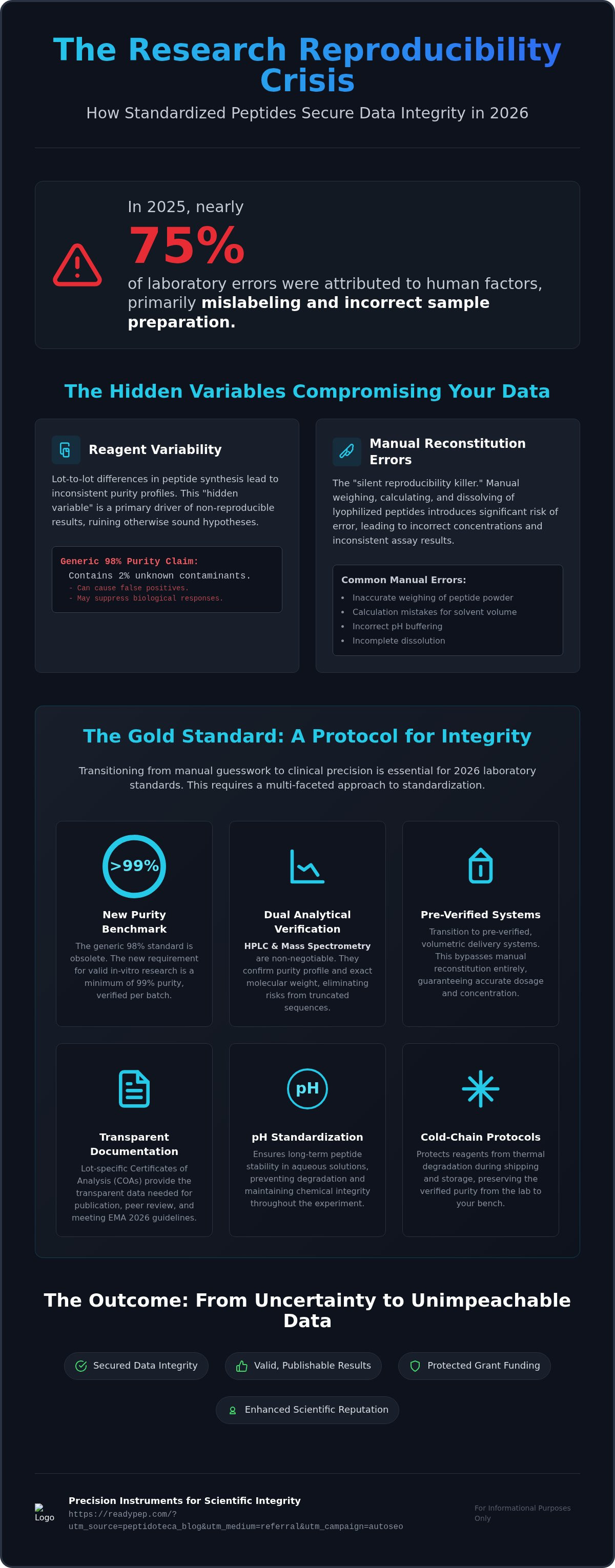
Did you know that nearly 75% of laboratory errors in 2025 were attributed to human factors, specifically mislabeling and incorrect sample preparation? For researchers in 2026, the stakes have never been higher. With the EMA’s June 2026 guidelines increasing oversight on synthetic peptides, the margin for error has effectively vanished. You aren't just fighting the clock. You're fighting the inherent variability of your reagents. Improving experimental reproducibility with standardized peptides is no longer a luxury for top-tier labs. It's a fundamental requirement for any study aiming for peer-reviewed validation.
We understand the anxiety that comes with inconsistent assay results between lots and the looming threat of publication retractions due to reagent impurity. It's a friction point that slows discovery and drains budgets. This guide will show you how utilizing standardized, pre-verified peptides eliminates reagent variability and secures the integrity of your in-vitro research data. We'll examine the shift toward 99% purity benchmarks, the elimination of manual reconstitution errors, and the transparent documentation standards required for 2026 laboratory citations. It's time to replace manual guesswork with clinical precision.
Key Takeaways
- Identify how reagent variability drives the reproducibility crisis and why standardized compounds are the essential solution for modern life sciences.
- Evaluate the necessity of High-Performance Liquid Chromatography (HPLC) and pH standardization to ensure long-term peptide stability in aqueous environments.
- Eliminate the human-factor errors inherent in manual reconstitution by transitioning to pre-verified, volumetric delivery systems.
- Secure your data’s integrity by improving experimental reproducibility with standardized peptides that offer lot-specific analytical documentation.
- Implement cold-chain protocols and independent third-party verification to protect your research from thermal degradation and impurity risks.
The Reproducibility Crisis and Peptide Reagent Variability
Experimental reproducibility in in-vitro research is the ability to achieve consistent results using the same methodology across different time points and laboratory settings. For peptide-based studies, this depends entirely on the chemical stability of the reagents. If the peptide sequence or its purity profile shifts between experiments, the data becomes meaningless. The Reproducibility Crisis has exposed a significant flaw in life sciences: the over-reliance on unverified reagents. Reagent variability is often the hidden variable that ruins otherwise sound hypotheses.
Slight fluctuations in peptide purity aren't just minor details. They're biological disruptors. An impurity level of 2% means your assay contains 2% unknown contaminants. These residues can cross-react with cellular signaling pathways, leading to false positives or suppressed responses. Improving experimental reproducibility with standardized peptides requires a shift from "good enough" to absolute verification. Researchers must distinguish between technical replicates, which test the same sample, and biological replicates that rely on lot-to-lot consistency. Technical replicates show the precision of your equipment. Biological replicates test the validity of your model. If the lot changes, your baseline changes with it.
The Cost of Inconsistent Research Data
Poor reproducibility destroys academic reputations and burns through grant funding. When an experiment fails to replicate, the financial burden of troubleshooting often exceeds the original cost of the reagents. Standardized peptides serve as a critical safeguard for maintaining high research peptide quality standards. Improving experimental reproducibility with standardized peptides is the most direct path to securing long-term funding and avoiding the stigma of retracted data. By utilizing pre-verified compounds, labs reduce the risk of data drift. This ensures that every dollar spent on cell cultures and analytical time yields valid, publishable results. It's about protecting the integrity of the scientific record.
Identifying Sources of Reagent Variance
Variance often begins at the synthesis stage. Lot-to-lot differences in coupling efficiency can leave behind truncated sequences or deleted amino acids. Residual trifluoroacetic acid (TFA) is another silent variable. It's a common ion-pairing agent in HPLC purification. If not properly exchanged, it remains in the final product. High TFA levels are cytotoxic. They skew cell viability assays and change the protonation state of your peptide. This isn't just a technicality. It's a fundamental threat to your data. Generic "98% purity" claims are insufficient in 2026. Without batch-specific, third-party verification, that percentage is just a number on a page. True precision requires empirical proof of what's actually in the vial.
Standardizing Peptide Purity: Beyond the 98% Benchmark
Standardization starts with empirical verification. A generic certificate claiming 98% purity is a relic of less rigorous eras. For modern in-vitro assays, the path to improving experimental reproducibility with standardized peptides requires batch-specific High-Performance Liquid Chromatography (HPLC) and Mass Spectrometry (MS). HPLC identifies the purity profile by separating the target peptide from synthesis byproducts. MS confirms the exact molecular weight. This eliminates the risk of using truncated peptides or sequences with deleted amino acids. Without these dual analytical pillars, your research foundation is built on assumptions. Verification is the only antidote to reagent-driven data drift.
Analytical Verification Protocols
Interpreting HPLC chromatograms is a non-negotiable skill for the modern investigator. You must identify the primary peak and account for any secondary signals. These secondary peaks represent impurities that can cross-react with cellular receptors, causing unintended signaling events. Lot-specific Certificates of Analysis (COAs) provide the transparency needed for publication citations. These documents are essential for developing comprehensive research protocols that meet 2026 peer-review standards. For a deeper dive into these verification metrics, review our guide on Peptide Pen Quality Control. Independent third-party testing by labs like Janoshik Analytical creates a "chain of trust" between the provider and the bench. It ensures that the substance in the pen matches the data on the sheet.
PH and Stability in Aqueous Research
Peptides are notoriously fragile molecules. Once transitioned into an aqueous state, they become highly susceptible to aggregation and hydrolysis. Incorrect pH levels can cause a peptide to precipitate or degrade within hours. This renders your concentration calculations inaccurate and your results irreproducible. Standardizing the buffer environment is critical for maintaining consistent cellular uptake across different experimental runs. To ensure maximum stability and prevent degradation, aqueous research peptides should be maintained within a physiological pH range of 6.0 to 7.5 unless the specific sequence requires an acidic or basic environment for solubility. Achieving this level of precision is significantly simpler when utilizing pre-verified research instruments that arrive with standardized pH profiles and purity data already confirmed. This level of control is what separates high-impact research from failed replications.
Human Error in Reconstitution: The Silent Reproducibility Killer
Precision at the microgram scale is often a myth in high-traffic laboratories. Manual weighing of lyophilized powders introduces immediate variance. Even with calibrated analytical balances, factors like static electricity or minor air currents can shift measurements by a significant percentage. This initial error cascades through every subsequent step of the assay. When you add volumetric pipetting errors into the mix, the molar concentration of your working solution becomes a moving target. A 2025 study of clinical laboratories found that nearly 75% of all lab errors had a human-factor component. Mislabeling accounted for 25% of these incidents, while incorrect sample collection made up 20%. These aren't just statistics; they're the reasons why your last three experimental runs didn't align.
Improving experimental reproducibility with standardized peptides requires removing these manual touchpoints. Handling multiple vials in a shared workspace increases the risk of cross-contamination. One misplaced pipette tip can compromise an entire series of tests. Pre-filled, standardized pens eliminate these risks by providing a sealed, pre-verified environment. You don't weigh. You don't pipette. You focus on the data. The removal of human intervention is the most effective way to stabilize your baseline.
The Pitfalls of Manual Reconstitution
The method used to dissolve a peptide is just as critical as its purity. Many researchers mistakenly use a vortex mixer to speed up dissolution. This mechanical stress can degrade sensitive peptide sequences or cause irreversible aggregation. Gentle inversion is the standard, yet it's rarely performed with identical force by different lab members. Temperature fluctuations during the mixing process also affect molecular folding. In high-traffic environments, aseptic technique failures are common. Opening a vial multiple times to withdraw aliquots invites environmental contaminants that can alter your results before the experiment even begins.
Standardized Volumetric Delivery
Traditional insulin syringes are prone to "dead space" volume loss. This residue stays in the hub and needle, leading to inaccurate delivery of the calculated dose. Mechanical injector pens solve this by utilizing a precision-engineered piston system. This ensures that every microliter of the solution is accounted for. This level of accuracy is vital for maintaining consistent molar concentrations across different experimental days. By switching to these instruments, you're improving lab workflow with pre-filled pens while securing your data's integrity. Standardized delivery systems are the final step in improving experimental reproducibility with standardized peptides, ensuring that the precision achieved during synthesis is actually delivered to your cell culture or assay.
Implementing Standardized Protocols with Pre-filled Research Pens
Standardization isn't just about the product. It's about the process. Transitioning from traditional lyophilized powders to pre-filled aqueous pens requires a fundamental update to your Standard Operating Procedures (SOPs). This shift eliminates the most volatile variable in the lab: the human factor. By adopting pre-filled instruments, you ensure that every aliquot is identical to the last. This consistency is the bedrock of improving experimental reproducibility with standardized peptides. Utilizing fixed concentrations, specifically the 20mg or 40mg formats available in modern research pens, simplifies molarity calculations. It reduces the likelihood of decimal-point errors that often lead to 10-fold dosing discrepancies. It's a strategic move from artisanal preparation to industrial precision.
A Protocol for Reagent Standardization
Implementing a robust protocol ensures that the precision of the pen is maintained from reception to application. You don't guess. You verify.
- Step 1: Immediately verify lot-specific HPLC and pH data through independent lab testing. This confirms the chemical identity and purity before any assay begins.
- Step 2: Establish a cold-chain reception protocol. Peptides are thermally sensitive molecules. You must maintain strict storage at 2-8°C post-delivery to prevent structural degradation or aggregation.
- Step 3: Utilize the mechanical 'click' mechanism of the pen to calibrate dosing increments. This removes the visual guesswork associated with manual syringe markings.
For labs seeking to upgrade their infrastructure, exploring standardized research peptide pens is the first step toward total protocol alignment.
Documentation for Publication
Publication integrity depends on transparency. Journals in 2026 increasingly demand lot-specific data for all chemical reagents. Citing the standardized source and specific lot number in your "Materials and Methods" section provides a clear audit trail for peer reviewers. Providing third-party proof of purity can significantly expedite the review process by removing doubts about reagent quality. Lot-specific transparency effectively neutralizes data skepticism by providing empirical evidence of the chemical baseline used in every experimental run. This level of detail transforms your data from a single observation into a verifiable scientific fact. It demonstrates a commitment to the highest quality standards, making your findings more robust and easier for others to replicate.
ReadyPep: Precision Instruments for Scientific Integrity
ReadyPep operates at the intersection of analytical chemistry and operational efficiency. We don't just provide reagents; we deliver the infrastructure for improving experimental reproducibility with standardized peptides. By serving as the authorized global distributor for Metatide Healthcare, we ensure that every laboratory has access to precision-engineered research pens. These aren't simple containers. They're calibrated instruments designed to maintain the chemical baseline of your study from the first aliquot to the last. When your research requires absolute consistency, the delivery system must be as reliable as the compound itself.
The integrity of your data depends on the quality of your inputs. Every batch we distribute undergoes independent verification to confirm it meets the highest scientific standards. This commitment to transparency is why top-tier in-vitro laboratories trust our platform. By removing the uncertainties of manual preparation, we allow researchers to focus on discovery rather than troubleshooting reagent variance. Improving experimental reproducibility with standardized peptides is the only way to secure the long-term validity of your findings.
Uncompromising Quality Control
Quality control isn't a suggestion at ReadyPep. It's a mandate. Every lot is independently tested by Janoshik Analytical to verify purity and pH levels before it reaches your bench. We provide lot-specific documentation for every researcher, ensuring you have the empirical data required for publication citations. This transparent approach eliminates the guesswork often associated with "research-grade" labels. Our focus remains strictly on in-vitro laboratory research conducted by qualified personnel. By providing verified pH and purity results, we ensure that your cellular models respond to the peptide, not to unknown contaminants or acidic imbalances. It's about maintaining a "chain of trust" from the manufacturer to your incubator.
Simplifying Your Research Workflow
Assay execution shouldn't be delayed by tedious reconstitution steps. Pre-filled formats like Retatrutide 40mg or MOTS-c 40mg streamline complex protocols by providing ready-to-use solutions. These high-concentration pens are particularly effective for dose-response studies where volumetric precision is paramount. Our global cold-chain shipping ensures that your materials arrive in peak condition, preventing the thermal degradation that ruins fragile sequences. This reliability reduces the time between procurement and data collection. You can explore the full range of standardized research pens to find the exact configuration for your next project. Precision is no longer a bottleneck. It’s your new standard.
Securing the Future of In-Vitro Discovery
The transition toward absolute reagent transparency is no longer optional. The path to improving experimental reproducibility with standardized peptides lies in the systematic elimination of manual variables. By replacing traditional weighing and pipetting with pre-filled, volumetric delivery systems, you remove the human-factor errors that frequently compromise laboratory results. Precision is a choice. It requires a commitment to analytical verification and rigorous protocol adherence. You don't just need a compound; you need a verified baseline.
Your data's integrity depends on the quality of your inputs. ReadyPep provides this certainty through independent lot testing by Janoshik Analytical and guaranteed cold-chain global shipping. With lot-specific HPLC and pH documentation provided for every instrument, your citations will withstand the most rigorous peer-review processes. It's time to elevate your laboratory standards and focus on the discovery itself. Secure your research integrity with standardized peptide pens at ReadyPep. Your next breakthrough deserves a foundation of empirical certainty.
Frequently Asked Questions
Why is lot-to-lot variability a problem in peptide research?
Lot-to-lot variability introduces uncontrolled variables that can lead to false positives or suppressed responses in cellular signaling. Inconsistent purity levels mean that your assay baseline shifts with every new batch. This makes it impossible to distinguish between a genuine biological response and a reaction to synthesis byproducts. Standardized compounds eliminate this drift. They ensure that your data remains consistent across months or years of study. This level of control is vital for verification.
How do pre-filled pens improve experimental reproducibility?
Pre-filled pens improve experimental reproducibility by removing manual reconstitution and weighing steps. These instruments are pre-calibrated to deliver volumetric precision with every click. This eliminates the 10-fold dosing errors common with microgram-scale powder handling. By utilizing a sealed environment, they also minimize cross-contamination risks in shared lab spaces. Improving experimental reproducibility with standardized peptides starts with replacing artisanal prep with mechanical accuracy. You can find these standardized research instruments online to secure your baseline.
What should I look for in a peptide Certificate of Analysis (COA)?
A valid COA must include lot-specific HPLC chromatograms and Mass Spectrometry (MS) data. Look for a purity percentage that exceeds 98% and a clear pH reading for aqueous solutions. Independent third-party verification by labs like Janoshik Analytical is critical. This ensures the data isn't just self-reported by the manufacturer. Lot-specific documentation is the only way to provide the transparency required for high-impact publication citations. It protects your academic reputation and secures your data.
Can manual reconstitution be as accurate as pre-filled pens?
Manual reconstitution is rarely as accurate as pre-filled pens due to human-factor errors. Research indicates that nearly 75% of lab errors involve human factors like mislabeling or incorrect sample collection. Even minor pipetting variances or "dead space" volume loss in traditional syringes alter molar concentrations. Pre-filled pens use precision-engineered pistons to ensure every microliter is accounted for. This level of mechanical consistency is impossible to replicate manually. It secures your data integrity for every run.
How does cold-chain shipping impact peptide reproducibility?
Cold-chain shipping prevents thermal degradation that can alter the structural integrity of fragile peptide sequences. Exposure to room temperature during transit can cause aggregation or hydrolysis. This results in a solution with lower active concentrations than calculated. By maintaining a strict 2-8°C environment, you ensure the peptide arriving at your bench matches the purity profile verified at the lab. Consistency in transit leads to consistency in results. It eliminates a major source of reagent-driven drift.
What is the role of pH in peptide experimental consistency?
pH levels directly influence peptide solubility and stability in aqueous environments. If the pH is outside the physiological range of 6.0 to 7.5, peptides may aggregate or degrade rapidly. This alters their bioavailability and cellular uptake in in-vitro models. Standardized pens provide pre-verified pH profiles. This ensures that your cell cultures are responding to the intended compound rather than an acidic or basic imbalance in the buffer. It maintains assay precision across multiple experimental runs.
Are pre-filled research pens suitable for all in-vitro models?
Pre-filled pens are optimized for most in-vitro laboratory research models requiring precise molar delivery. Their standardized concentrations, such as 20mg or 40mg, simplify the creation of working solutions for dose-response assays. These instruments are precision-engineered for use by qualified personnel in controlled settings. They are particularly valuable in high-throughput environments where reducing preparation time and reagent variance is essential for maintaining a clear experimental timeline. It is the modern standard for laboratory efficiency.
How do I cite standardized peptides in a scientific publication?
Cite the standardized source, the specific compound name, and the unique lot number in your "Materials and Methods" section. Include the manufacturer and the distributor to ensure a clear audit trail. Attaching the third-party COA as supplementary material provides reviewers with empirical proof of purity. Improving experimental reproducibility with standardized peptides requires this level of transparency to neutralize data skepticism and facilitate the peer-review process. It demonstrates a commitment to high scientific standards.
Disclaimer
Educational content only. Not medical advice.


