

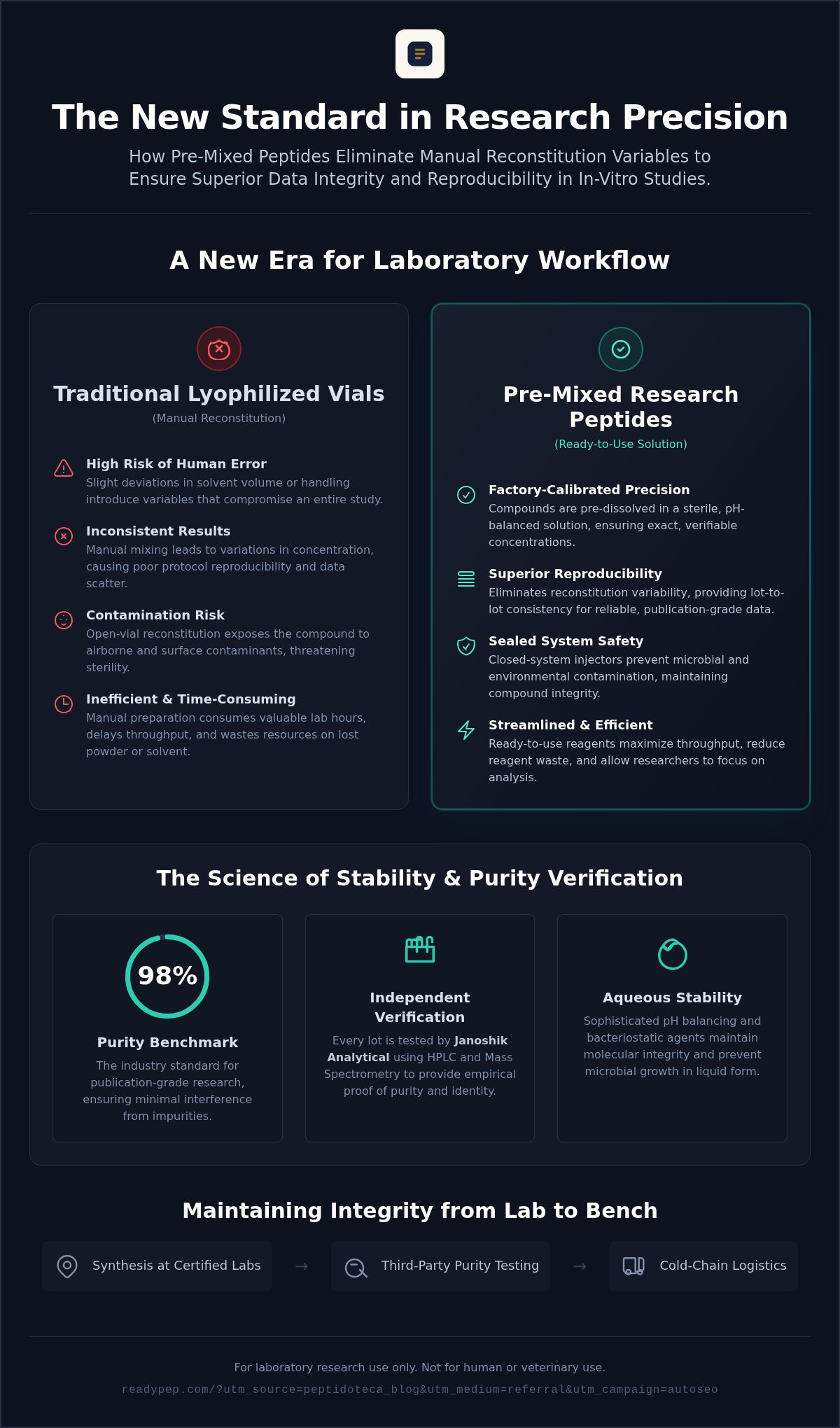
Manual reconstitution is the single greatest threat to your data integrity in 2026. Even a slight deviation in solvent volume or a moment of syringe handling can introduce variables that compromise an entire study. You’ve likely experienced the frustration of inconsistent results or the looming risk of contamination during preparation. It’s an inefficient use of laboratory hours that delays throughput and threatens publication-grade accuracy. Precision demands a more controlled approach.
This guide explores how pre-mixed research peptides eliminate these reconstitution variables to ensure superior protocol reproducibility in in-vitro studies. By shifting from manual mixing to factory-calibrated precision, you remove the friction of preparation and the uncertainty of human error. We’ll examine the latest analytical standards, including the 98% purity benchmarks verified by Janoshik testing, and how these ready-to-use reagents streamline your workflow. Discover why the evolution of peptide research favors streamlined, certified solutions that are built for peer-review readiness. It’s time to modernize your protocol and prioritize analytical precision.
Key Takeaways
- Learn how pre-mixed research peptides eliminate manual reconstitution variables to ensure superior protocol reproducibility in your in-vitro studies.
- Discover the role of independent Janoshik Analytical testing and precise pH balancing in maintaining long-term aqueous stability and lot-to-lot consistency.
- Compare the contamination risks and human error factors of open-vial reconstitution against the streamlined efficiency of sealed injector systems.
- Understand the critical requirements for cold-chain logistics and thermal monitoring to maintain reagent integrity during international transit.
- Identify how to select specific compounds like Retatrutide or Selank and leverage synergistic stacks to optimize your 2026 research design.
What are Pre-Mixed Research Peptides and Why They Matter
Pre-mixed research peptides are high-purity compounds pre-dissolved in a sterile, pH-balanced aqueous solution. In 2026, the laboratory landscape has shifted away from traditional lyophilized powders toward these ready-to-use reagents. This transition prioritizes analytical precision over manual preparation. By delivering compounds in a stabilized liquid format, researchers bypass the volatility of manual reconstitution. These solutions are engineered strictly for laboratory research by qualified personnel and are not intended for human or veterinary use. The primary utility of pre-mixed research peptides lies in the total elimination of reconstitution-induced variability. When every microliter is factory-calibrated, the "human error" factor in in-vitro models disappears.
The Mechanics of Pre-Mixed Aqueous Solutions
Maintaining stability in a liquid state requires sophisticated solubility parameters. For complex compounds like Retatrutide and BPC-157, achieving a homogenous solution is critical for dosage accuracy. These peptides are often produced via chemical peptide synthesis, specifically solid-phase methods, before being meticulously integrated into an aqueous environment. This process ensures the molecular structure remains intact while allowing for immediate solubility upon application to a medium.
Sterility is maintained through the strategic use of bacteriostatic agents. These additives prevent microbial growth without interfering with the peptide's molecular integrity or the experimental outcome. Precision is the ultimate goal. A concentration of 40mg per pen allows for exact volumetric measurements that dictate the accuracy of a study. This level of calibration is nearly impossible to replicate consistently with manual vial-and-syringe methods, where micro-losses of powder or solvent are common.
In-Vitro Applications and Protocol Standardization
Protocol standardization is the backbone of peer-review readiness. Pre-mixed solutions allow for the standardization of cellular uptake assays by providing pre-calibrated dosages. This ensures that every cell culture receives an identical concentration of the reagent, reducing the standard deviation in your data. It's a level of control that manual pipetting from a hand-mixed vial simply cannot match.
Efficiency also extends to resource management. Precision injector delivery systems significantly reduce reagent waste compared to open-vial handling. Every drop is accounted for. There's no residual powder left in the neck of a vial and no loss during the transfer between containers. High-standard labs now favor these pre-mixed research peptides to ensure that their budgetary resources are as optimized as their results.
Pre-mixed peptides serve as the 'plug-and-play' solution for modern labs seeking to maximize throughput without sacrificing data integrity.
The Science of Stability: pH Balancing and Purity Verification
Stability in aqueous solutions is a chemical balancing act. It requires more than just high-purity powder. Once a compound is dissolved, it becomes susceptible to environmental stressors that don't affect lyophilized solids. Ensuring pre-mixed research peptides remain viable for the duration of a study necessitates rigorous analytical oversight. Independent verification by Janoshik Analytical serves as the definitive benchmark for this consistency. By testing every lot, researchers receive empirical proof that the concentration and purity meet the 98% industry standard before the reagent ever reaches the lab bench. This removes the uncertainty of "trust-based" sourcing.
High-Performance Liquid Chromatography (HPLC) and Mass Spectrometry are non-negotiable tools for this process. HPLC measures the purity by separating individual components within the solution. Mass Spectrometry verifies the identity by confirming the molecular weight of the peptide sequence. Together, they ensure that the reagent is exactly what it claims to be. This level of verification is the foundation of publication integrity. Peer-reviewers increasingly demand lot-matched Certificates of Analysis (COAs) to validate that experimental outcomes aren't skewed by baseline impurities or degraded compounds.
Understanding HPLC for Pre-Mixed Reagents
Reading a COA for pre-filled pens is a critical skill for any lead investigator. You aren't just looking at a final percentage. You're looking for the absence of specific degradants that could interfere with in-vitro metabolic signaling. Even a 1% impurity can trigger unintended cellular responses, leading to false positives or unreplicable data. Transparency is the only solution to this variable. Learn more about our rigorous lab testing standards to understand how we isolate these variables through third-party verification.
The Role of pH in Peptide Longevity
pH is the silent guardian of peptide longevity. Aqueous environments can trigger deamidation and oxidation if the solution isn't perfectly balanced. For compounds like GHK-Cu and NAD+, maintaining an optimal pH range is vital for preserving structural integrity. If the solution becomes too acidic or basic, the peptide chain can fragment or lose its biological activity. This is why factory-calibrated balancing is superior to manual mixing. For a deeper look at these technical benchmarks, review our guide on Peptide Pen Quality Control: Ensuring High Purity. Precision in the solution leads to precision in the results. If you value data that stands up to scrutiny, consider utilizing verified research reagents for your next protocol.
Pre-Mixed Pens vs. Lyophilized Vials: A Research Workflow Comparison
Manual reconstitution is an archaic bottleneck that compromises data integrity. It introduces variables that no amount of post-hoc statistical correction can fix. Lyophilized vials require a rigid sequence of manual interventions: measuring diluent, sterile venting, and controlled agitation. Every touchpoint is a potential failure. A slight tremor or a misread syringe marking can alter the final concentration by 5% or more. In contrast, pre-mixed research peptides utilize a factory-sealed injector system. This closed-loop environment protects the integrity of the reagent from the point of manufacture to the petri dish. It's not just about lab convenience; it's about removing the 'human factor' from your primary variables.
Consider the logistical burden of a high-throughput study. A time-motion analysis reveals a stark disparity between formats. Preparing 100 samples using traditional vials involves hours of meticulous pipetting, vortexing, and syringe handling. This labor-intensive process scales poorly and inevitably introduces fatigue-related errors during long laboratory shifts. Using pre-filled pens allows for rapid, sequential delivery without the need for external syringes, needles, or bacteriostatic water. The cost-benefit ratio clearly favors the pen format when factoring in technician hours and the catastrophic cost of a failed, unreplicable study. Efficiency is the new standard for 2026.
Workflow Efficiency and Reproducibility
Reproducibility relies on volumetric precision that is mechanically enforced. The 'clicks' on a precision injector translate directly to calibrated microliter delivery. This mechanical consistency replaces the subjective visual estimation required when reading syringe gradients under lab lighting. By improving lab workflow with pre-filled pens, researchers can redirect their focus from tedious preparation to active observation. There's no longer a need to maintain extensive stocks of specialized reconstitution equipment or risk the purity of your pre-mixed research peptides with varying grades of sterile water.
Waste Reduction in Laboratory Settings
Traditional syringe draws suffer from significant 'dead volume' loss. Reagent remains trapped in the needle hub, the syringe tip, and the neck of the vial. Over a large study, these micro-losses represent a substantial financial and material drain. Precision injectors minimize this residue, ensuring nearly 100% of the solution is utilized for the experiment. This is particularly critical for micro-scale in-vitro models where every microgram of the compound is essential for signaling accuracy. While preparing a batch of lyophilized vials can consume 30 minutes of technical labor, deploying pre-filled pens requires fewer than 30 seconds.
Logistics and Storage: Maintaining the Cold Chain
Aqueous stability is tied directly to thermal regulation. While lyophilized powders offer some resilience against temperature fluctuations, pre-mixed research peptides require a strict cold chain to prevent molecular degradation. Heat is the primary catalyst for deamidation and oxidation. In a liquid state, molecules have higher kinetic mobility. This makes them more susceptible to structural breakdown if exposed to ambient temperatures for extended periods. Maintaining a consistent temperature range of 2 to 8 degrees Celsius is the laboratory standard for ensuring reagent longevity. For pre-filled pens, refrigeration is mandatory. Freezing should be avoided. The expansion of aqueous solutions during freezing can compromise the mechanical integrity of the pen's injector system or cause micro-fractures in the internal reservoir.
International transit from the UK necessitates a robust logistics framework. Every shipment must be treated as a time-sensitive biological reagent. ReadyPep utilizes specialized thermal packaging designed to maintain the required temperature profile during global transit. This ensures that the compound's bioactivity remains intact from the point of dispatch to the moment it enters your laboratory refrigerator. Protocols for receiving must be rigorous. Upon arrival, technicians should immediately verify the integrity of the thermal indicators included in the packaging. If the indicator shows a breach of the safety threshold, the reagent's analytical precision can no longer be guaranteed.
International Shipping and Customs Compliance
Worldwide delivery of research reagents involves more than just physical transport. It requires meticulous adherence to evolving global regulations. Navigating the legal landscape for 2026 research chemicals involves precise documentation and clear labeling to ensure rapid customs clearance. Delays at the border are the most common cause of cold-chain failure. Providing lot-matched COAs and detailed safety data sheets (SDS) facilitates a smoother transition through international checkpoints. For a deeper analysis of these requirements, see our Customs Clearance for Research Chemicals: A 2026 Guide. Efficiency in documentation is as critical as efficiency in the lab.
Verification of Thermal Stability
How do you identify a compromised reagent? Visual inspection is your first line of defense. High-purity aqueous solutions should appear clear and colorless. Cloudiness, visible particulates, or precipitation are definitive signs of peptide degradation or microbial contamination. These physical changes indicate that the peptide has likely fallen out of solution or its molecular structure has been altered. If you observe these signs, the reagent should be discarded to avoid skewed experimental data. For specific questions regarding your shipment's transit history or current storage requirements, contact our support team for logistics inquiries. Secure your study's success by choosing cold-chain verified research peptides for all your in-vitro protocols.
Integrating Pre-Mixed Peptides into Your 2026 Research Design
Integrating pre-mixed research peptides into a 2026 research design requires a strategic alignment between the compound’s biochemical profile and your experimental objectives. It isn't enough to simply select a peptide; you must match the reagent’s delivery format to the sensitivity of your in-vitro model. For metabolic signaling studies, Retatrutide provides a sophisticated multi-agonist profile that allows for complex investigations into receptor crosstalk. In contrast, neurobiological research into cognitive pathways often utilizes Selank for its specific molecular targeting. Selecting the correct tool ensures that your design is robust enough to withstand the scrutiny of high-impact peer review.
Transparency is the cornerstone of modern scientific integrity. When drafting your methodology, you must document specific lot numbers and manufacturer data. This practice validates that your reagents haven't undergone degradation or contamination during their lifecycle. Sourcing from a verified Metatide Healthcare distributor provides the necessary audit trail for publication readiness. This level of detail allows other laboratories to replicate your results, which is the ultimate validation of your work. Adhering to the 'In-Vitro Only' mandate is a non-negotiable ethical standard. It ensures that research chemicals are used strictly within the controlled laboratory environments for which they were engineered.
Specialized Research Protocols
Synergistic modeling is the next frontier of peptide research. Investigating how multiple compounds interact within a cellular environment requires a standardized framework to avoid confounding variables. The Edge Protocol is specifically optimized for high-intensity cellular assays where metabolic demand is at its peak. For mitochondrial function studies, MOTS-c 40mg pre-filled pens offer the volumetric precision needed to maintain constant concentrations across diverse cell lines. If your study focuses on cellular recovery or protein synthesis pathways, the Repair Protocol provides a synergistic model that reduces experimental noise.
Securing High-Purity Reagents
The transition from a successful pilot study to a large-scale trial is often where research fails due to reagent inconsistency. If the purity levels fluctuate between batches, your data becomes unreplicable and your conclusions are weakened. Sourcing pre-mixed research peptides from a verified distributor eliminates this variable by providing lot-to-lot consistency. This longitudinal stability ensures that your data remains valid throughout the entire duration of a multi-year study. Protecting your research integrity starts with the reagents you choose. Secure your verified pre-mixed research peptides here and ensure your lab operates at the highest analytical standard.
Advancing Laboratory Standards for 2026
The transition from manual reconstitution to precision delivery is the new benchmark for research integrity. By adopting pre-mixed research peptides, you eliminate the volatility of manual mixing and the risk of contamination associated with open vials. This shift ensures that every microliter delivered is factory-calibrated for exact concentration. Stability is no longer a variable; it's a verified constant supported by independent Janoshik Analytical testing and comprehensive pH documentation provided with every lot. Peer-review readiness depends on this level of empirical transparency.
ReadyPep facilitates this evolution by providing lot-matched COAs and maintaining strict global cold-chain shipping with Metatide Healthcare integrity. You don't have to manage the friction of logistics or the uncertainty of purity. Focus on your data while we handle the analytical precision of your reagents. It's time to modernize your protocol and secure the reproducibility of your in-vitro studies. Upgrade your lab precision with pre-filled research pens at ReadyPep. Your research deserves the highest standard of verification.
Frequently Asked Questions
Are pre-mixed research peptides as stable as lyophilized powder?
Lyophilized powder offers superior long-term stability at ambient temperatures, but pre-mixed solutions are engineered for immediate analytical use. These reagents utilize precise pH balancing and bacteriostatic agents to maintain molecular integrity. While powders are less sensitive during storage, pre-mixed research peptides eliminate the degradation risks associated with improper manual reconstitution. When kept refrigerated at 2 to 8 degrees Celsius, they provide the stability required for consistent in-vitro results.
How do I verify the purity of a pre-filled peptide pen?
Verification is managed through lot-matched Certificates of Analysis (COA). Every batch undergoes independent Janoshik Analytical testing using HPLC and Mass Spectrometry. These tests confirm the peptide's identity and ensure it meets the 98% purity benchmark. You should always cross-reference the lot number on your pen with the provided documentation. This transparency ensures your reagents are publication-grade and free from degradants that could skew your data.
What is the shelf life of an aqueous peptide pen after opening?
Once the seal is breached, the reagent typically remains stable for 28 to 30 days under refrigeration. Bacteriostatic agents prevent microbial growth during this period. However, bioactivity in an aqueous state can gradually diminish over time. To ensure maximum analytical precision, it's best to utilize the solution promptly. Always store the pen upright at 2 to 8 degrees Celsius and avoid exposure to light or extreme temperature fluctuations.
Do pre-mixed peptides require cold-chain shipping?
Yes, cold-chain logistics are mandatory for liquid-state reagents. Unlike lyophilized solids, pre-mixed research peptides are highly susceptible to thermal degradation. Heat serves as a catalyst for deamidation, which can break down the peptide chain. ReadyPep utilizes specialized thermal packaging to maintain a consistent temperature profile during global transit. This ensures the compound's bioactivity remains intact from the point of manufacture until it reaches your laboratory refrigerator.
Can I use pre-mixed pens for in-vivo animal testing?
No, these products are strictly for in-vitro laboratory research by qualified personnel. They are not intended for human or veterinary use. The formulations are specifically designed for cellular assays, biochemical modeling, and other laboratory-based studies. Using research chemicals for in-vivo testing violates ethical compliance standards and the research-only mandate. Adhering to these guidelines is essential for maintaining the integrity and legal standing of your laboratory operations.
What should I do if my peptide shipment arrives at room temperature?
Immediately check the thermal indicators included in the packaging. These indicators provide a visual record of the transit temperature. If the indicator shows the safety threshold was breached, contact support before proceeding with your experiment. While short-term exposure might not cause visible precipitation, it can accelerate molecular breakdown. Using a thermally compromised reagent risks introducing unknown variables into your study, which can lead to unreplicable or inaccurate data.
How are Janoshik Analytical tests performed on pre-mixed solutions?
Testing involves High-Performance Liquid Chromatography (HPLC) to measure purity and Mass Spectrometry to confirm the molecular sequence. Janoshik samples the finished aqueous solution directly. This verifies that the concentration, such as 40mg per pen, is accurate and that the peptide has not degraded during the mixing process. This direct testing of the final product provides a higher level of assurance than testing the raw powder alone before it is dissolved.
Why is pH balancing critical for research peptides in solution?
pH balancing is the primary defense against deamidation and oxidation in an aqueous environment. Each peptide compound has a specific "isoelectric point" where it is most stable. If the solution's pH deviates from this range, the peptide chain can fragment or lose its secondary structure. Factory-calibrated balancing ensures the solution remains within these precise parameters. This level of chemical control is nearly impossible to achieve consistently with manual, bench-top reconstitution methods.
Disclaimer
Educational content only. Not medical advice.


