

Inconsistent manual reconstitution is the single greatest threat to the integrity of your in-vitro tissue repair data. When you're analyzing complex cellular pathways, the margin for error is non-existent. You've likely dealt with the frustration of vial contamination or the uncertainty of exact peptide concentrations during manual mixing. These operational hurdles don't just waste time; they jeopardize the reproducibility of your findings. The modern laboratory requires a more streamlined approach to handling high-purity reagents.
This article dives into the molecular synergy of these compounds and explains why the BPC-157 + TB-500 research pen has become the 2026 standard for experimental precision. You'll discover how these peptides interact to promote angiogenesis and actin-mediated cell migration in controlled environments. We'll examine the specific mechanisms that drive tissue remodeling and provide a clear roadmap for optimizing your laboratory workflow. By the end, you'll understand how to secure publication-quality data through verified, pre-filled delivery systems that prioritize analytical accuracy over outdated manual methods.
Key Takeaways
- Identify the specific molecular pathways where BPC-157 growth factor upregulation and TB-500 actin-sequestering proteins intersect to accelerate extracellular matrix deposition.
- Analyze the workflow advantages of using a BPC-157 + TB-500 research pen to eliminate manual reconstitution errors and atmospheric contamination risks.
- Understand the role of Janoshik third-party testing in verifying the purity and pH stability of 40mg peptide blends for publication-quality data.
- Learn how to optimize benchtop protocols by maintaining cold-chain integrity and calculating precise molar concentrations for in-vitro cellular assays.
Understanding the BPC-157 + TB-500 Synergistic Mechanism
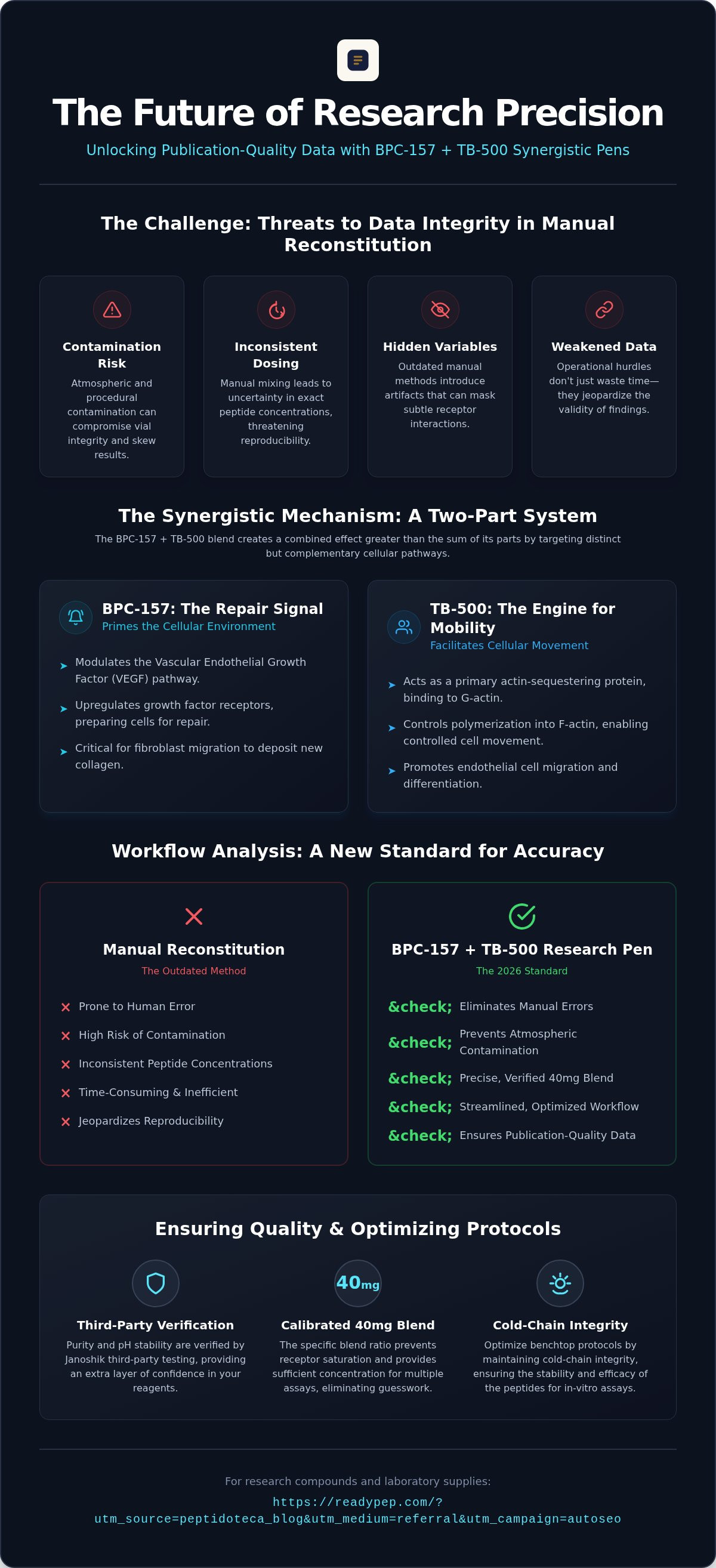
Biochemical synergy occurs when two compounds produce a combined effect greater than the sum of their individual contributions. In-vitro research into tissue repair often focuses on this "handshake" between regulatory signaling and mechanical action. Using a BPC-157 + TB-500 research pen allows investigators to deploy a standardized 40mg blend that targets these distinct pathways simultaneously. The theoretical basis for this combination lies in the overlapping timelines of angiogenesis and cellular migration. By presenting both compounds in a single, stable solution, researchers can observe how they work in tandem to resolve simulated cellular injuries.
BPC-157: Upregulating the Repair Signal
The pentadecapeptide BPC-157 serves as a potent modulator of the Vascular Endothelial Growth Factor (VEGF) pathway. In cell culture assays, it functions by upregulating growth factor receptors, which essentially primes the cellular environment for repair. This upregulation is critical for fibroblast migration, the process where specialized cells move into a site of simulated injury to deposit new collagen. High-purity reagents are mandatory for these observations, as impurities can mask subtle receptor interactions. Adhering to Research Peptide Quality Standards ensures that the observed signaling is a result of the peptide itself rather than laboratory artifacts or contamination.
TB-500: Facilitating Cellular Mobility
While BPC-157 sends the signal, TB-500 provides the engine for movement. As a synthetic fragment of Thymosin Beta-4, TB-500 is a primary actin-sequestering protein. It binds to G-actin, preventing its polymerization into F-actin until the cell is ready to move. This mechanism is vital for promoting endothelial cell differentiation and migration in laboratory models. Research specifically highlights the Ac-SDKP active region of the molecule for its role in these processes. By maintaining a stable environment with a BPC-157 + TB-500 research pen, scientists can observe how TB-500 facilitates the physical transit of cells across the extracellular matrix. This process directly complements the signaling initiated by BPC-157.
The 40mg blend ratio is specifically calibrated to prevent receptor saturation while providing sufficient concentration for multiple assays. This balance is essential for consistent data. It eliminates the guesswork often associated with individual vial titration. Using a 40mg total blend allows for a more focused analysis of how these two compounds work in tandem to accelerate extracellular matrix deposition without the variables of manual mixing.
Synergistic Effects in Cellular Proliferation and Tissue Repair
Synergistic interactions between BPC-157 and TB-500 create a robust environment for extracellular matrix (ECM) deposition. In laboratory settings, the use of a BPC-157 + TB-500 research pen ensures these compounds are introduced at a precise ratio. This precision is critical. Isolated peptide applications often fail to replicate the complex biological feedback loops found in combined assays. Observations in combined models show a marked increase in fibroblast proliferation compared to single-agent controls. This suggests that the two compounds don't just coexist; they actively enhance each other's biological signaling pathways.
Research indicates that BPC-157's ability to modulate nitric oxide (NO) synthesis enhances the systemic effects of TB-500. This relationship is particularly evident in tendon-to-bone healing models where structural integrity is the primary metric. While BPC-157 stabilizes the repair environment through growth factor upregulation, TB-500 drives the migration of progenitor cells to the synthetic scaffold. The result is a more organized deposition of collagen fibers. These findings are foundational for studies focused on accelerating musculoskeletal soft tissue healing in-vitro.
Angiogenesis and Vascular Regeneration
Activation of vascular endothelial growth factors (VEGF) occurs through dual pathways when these peptides are combined. BPC-157 upregulates receptor expression while TB-500 facilitates the physical organization of endothelial cells into tubular structures. In the context of VEGF upregulation, synergy is the simultaneous increase in receptor density and cellular motility that results in faster vascular network formation. This combined action significantly improves nutrient delivery models in synthetic tissue scaffolds. Researchers exploring these mechanisms often utilize the Repair Protocol to maintain high-purity standards throughout the assay duration.
Anti-inflammatory Pathways in Preclinical Models
Modulation of pro-inflammatory cytokines is a hallmark of this peptide blend in isolated cell lines. Laboratory observations show a synergistic reduction of oxidative stress markers when both compounds are present. This biochemical "handshake" is explored further in the BPC-157 and TB-500 Synergy analysis. The data highlights how the blend suppresses TNF-alpha expression more effectively than either peptide alone. By utilizing a BPC-157 + TB-500 research pen, investigators can eliminate the variables of manual titration. This ensures that the anti-inflammatory response observed is a direct result of the synergistic ratio rather than dosing inconsistencies.
Pre-filled Pens vs. Manual Reconstitution: A Workflow Analysis
Manual reconstitution of lyophilized peptides introduces a significant degree of variability into laboratory workflows. Each step of the process, from calculating the volume of bacteriostatic water to the physical act of mixing, presents an opportunity for error. Metatide Healthcare has standardized this process by providing factory-sealed, pre-filled solutions. Utilizing a BPC-157 + TB-500 research pen ensures that the concentration of the 40mg blend remains constant across every assay. This standardization is vital for researchers who require reproducible results for publication. It's simply a more reliable way to manage high-purity reagents.
- Elimination of Reconstitution Errors: Pre-filled pens remove the need for manual titration and mixing.
- Reduced Atmospheric Exposure: The closed-loop design prevents the peptide solution from interacting with oxygen or humidity.
- Mechanical Precision: "Click" increments provide a level of volumetric accuracy that manual syringe graduations can't match.
Sterility and Contamination Control
Closed-loop delivery systems are essential for maintaining a sterile environment during multi-step laboratory protocols. Traditional vial handling requires repeated needle punctures. This increases the risk of introducing microbial contaminants into the cell culture. The pen format mitigates this by keeping the reagent in a sealed cartridge. There's less opportunity for environmental exposure. This design choice is particularly beneficial for high-throughput experiments where efficiency is a priority. For a deeper look at how these tools impact productivity, see Improving Lab Workflow with Pre-filled Pens. By reducing the number of manual steps, labs focus more on data analysis and less on reagent preparation.
Stability of the BPC-157 + TB-500 Blend
Peptide stability is highly dependent on pH balance and temperature control. Pre-mixed reagents from Metatide Healthcare are formulated to maintain a precise pH level. This ensures the BPC-157 + TB-500 research pen remains chemically stable throughout its shelf life. Oxidation is a common issue with open-vial reconstitution. Air enters the vial during every draw. Pre-filled pens utilize a vacuum-sealed or plunger-driven system that prevents air from entering the cartridge. To ensure these high-stability research tools reach the benchtop in peak condition, cold-chain logistics are strictly maintained. Researchers looking for a reliable, stable reagent often choose the Repair Protocol to minimize environmental variables in their tissue repair studies.
Analytical Verification: Ensuring Purity in Peptide Blends
Verifying two distinct peptide sequences in a single 40mg solution requires a higher level of analytical rigor than testing isolated compounds. When you utilize a BPC-157 + TB-500 research pen, you're working with a complex biochemical mixture. High-Performance Liquid Chromatography (HPLC) must show two clearly defined, separate peaks. One peak represents the pentadecapeptide BPC-157, while the other identifies the Thymosin Beta-4 fragment. If these peaks overlap or exhibit "noise," it indicates the presence of synthesis byproducts or degradation. Lot-specific documentation isn't just a secondary feature; it's a fundamental requirement for research integrity. Reviewers for scientific journals often demand these certificates of analysis to verify the chemical foundation of your study.
The Janoshik Standard for Research Peptides
ReadyPep maintains an uncompromising commitment to third-party verification through Janoshik Analytical. This independent testing ensures that every lot meets the specified 40mg total blend concentration. Janoshik doesn't merely provide a purity percentage. They also conduct Mass Spectrometry to confirm the correct molecular mass of both peptides. This process eliminates research bias by providing empirical proof that the reagent in your pen matches the intended molecular sequence. You can review the latest Lab Testing reports to confirm the purity and concentration of current lots before starting your next assay.
PH Testing and Reagent Stability
Stability in aqueous research solutions is highly sensitive to the chemical environment. Incorrect pH levels can cause rapid degradation of sensitive peptide sequences during laboratory storage. For the BPC-157 + TB-500 research pen, the solution is buffered to a precise range to prevent hydrolysis and maintain molecular integrity. If the pH drifts from its target, the peptide bonds can break down into inactive fragments. These fragments won't produce the synergistic signaling required for your tissue repair models. There's a direct correlation between pH stability and data reproducibility; without a stable reagent environment, your cell culture observations will lose consistency across different experimental runs.
Securing publication-quality data starts with verified reagents that have survived rigorous analytical scrutiny. You can access Janoshik-tested peptide pens through ReadyPep to ensure your laboratory operates with the highest standards of transparency and verification. This level of detail removes the uncertainty of chemical purity, allowing you to focus entirely on your experimental outcomes.
Optimizing Lab Protocols with BPC-157 + TB-500 Research Pens
Precision in the laboratory starts with rigorous mathematical modeling. Converting a 40mg blend into usable molarity for in-vitro assays requires a fixed, known concentration. Using a BPC-157 + TB-500 research pen simplifies this calculation by providing a standardized volumetric delivery system. If the cartridge contains a specific volume of solution, the concentration per microliter remains constant throughout the experiment. This eliminates the titration drift often seen when researchers manually reconstitute individual vials. Consistency is the foundation of reproducibility. By utilizing a pre-filled system, you ensure that the reagent concentration on day one matches the concentration on day thirty.
Concentration Precision in Cellular Assays
Mechanical delivery ensures consistency across large-scale experiments. Translating pen clicks to microliter volumes is essential for dosing multi-well plates with high accuracy. For instance, if a researcher knows the exact volume delivered per click, they can precisely spike culture media without the variability of manual pipetting. Reviewing the BPC-157 + TB-500 40mg technical specifications provides the volumetric data needed for these molar calculations. This level of control is vital for dose-response studies. It allows for tight margins of error when observing how different concentrations impact fibroblast migration or growth factor expression.
These pens also integrate into semi-automated laboratory workflows. Their standardized form factor allows for repeatable reagent application by different technicians. Handling and disposal should follow standard biohazard protocols for sharps. Once the cartridge is exhausted, the unit must be disposed of in a designated container to maintain laboratory safety standards. This streamlined approach reduces the time spent on reagent preparation, allowing the team to focus on data acquisition.
Sourcing and Compliance for 2026
Research integrity depends on the transparency of your supply chain. Documenting reagent sources is a prerequisite for both academic and commercial research papers. ReadyPep facilitates this by providing lot-specific Janoshik testing for every BPC-157 + TB-500 research pen. Navigating international logistics is simplified with free cold-chain shipping. This ensures that the peptides never exceed stable temperature ranges during transit. Maintaining this thermal stability from the moment of delivery to the benchtop is the final step in securing reliable, publication-quality data. Peptides should be stored at 2 to 8 degrees Celsius to prevent degradation of the molecular sequences.
You can secure high-purity BPC-157 + TB-500 research pens for your next study to ensure your laboratory operates with the modern standards of efficiency and precision. This transition from manual vials to pre-filled pens removes the most common variables in tissue repair research, providing a stable foundation for your findings.
Standardizing the Future of Tissue Repair Research
Modern laboratory protocols demand more than just high-purity compounds. They require the elimination of human error and environmental variables. You've seen how the molecular synergy of BPC-157 and TB-500 targets angiogenesis and cellular migration with clinical precision. Transitioning to a BPC-157 + TB-500 research pen ensures that your concentration remains constant from the first assay to the last. This isn't just about convenience. It's about securing publication-quality data that stands up to analytical scrutiny. Manual reconstitution is a relic of the past.
ReadyPep provides the transparency your research deserves. Every lot is manufactured by Metatide Healthcare and independently verified by Janoshik Analytical. You get lot-specific documentation and global cold-chain logistics as standard. There's no room for uncertainty when you're modeling complex biological pathways. Focus on your discoveries while the technical precision of your reagents is guaranteed. Your next breakthrough starts with a verified foundation.
Order Janoshik-tested BPC-157 + TB-500 research pens with free cold-chain shipping.
Frequently Asked Questions
What is the total concentration of the BPC-157 + TB-500 research pen?
The total concentration of each BPC-157 + TB-500 research pen is 40mg. This blend is specifically formulated by Metatide Healthcare to provide a consistent ratio for cellular repair assays. Having a fixed concentration allows you to maintain standardized experimental conditions across multiple assay plates. This eliminates the titration variables often encountered with manual reconstitution. It's the modern standard for laboratory efficiency and data precision.
How is the purity of the BPC-157 + TB-500 blend verified?
Purity is verified through independent testing conducted by Janoshik Analytical. Every batch undergoes High-Performance Liquid Chromatography (HPLC) and Mass Spectrometry to confirm both the purity percentage and the correct molecular mass. You don't have to rely on internal manufacturer claims; the third-party reports provide empirical proof of the chemical integrity of your reagents. This transparency ensures that your research foundation remains beyond reproach.
Is the BPC-157 + TB-500 pen stable for long-term research?
Yes, these pre-filled pens are designed for high stability in a laboratory setting. The aqueous solution is buffered to maintain an optimal pH, preventing the degradation of the peptide sequences. Additionally, the closed-loop system prevents atmospheric exposure and oxidation. This ensures that the peptides remain active and chemically intact throughout the duration of your study. It's a reliable alternative to open-vial reconstitution methods.
Can this research pen be used for in-vivo animal studies?
No, this product is intended solely for in-vitro laboratory research. It's not for human or veterinary use. The formulations are strictly developed for applications in controlled environments like cell culture assays or synthetic tissue scaffolds. Using these reagents outside of an in-vitro context is a violation of the research-only protocols established for high-purity chemical compounds. It's essential to adhere to these standards to maintain institutional compliance.
What are the storage requirements for pre-filled peptide pens?
Pre-filled pens must be stored at a temperature between 2 and 8 degrees Celsius to maintain molecular integrity. It's critical to preserve cold-chain stability from the moment of delivery until the reagent is used on the benchtop. Exposure to high temperatures can cause the peptide bonds to break down. This degradation will compromise the accuracy and reproducibility of your experimental data. Always verify your refrigeration settings before storing your reagents.
How do I calculate the dosage per click for my in-vitro experiment?
To calculate the dosage, you divide the total 40mg concentration by the total number of mechanical clicks available in the pen. This provides the exact mass of the peptide blend delivered per volumetric increment. You can then translate these increments into the microliter volumes required for your specific culture media. This mechanical precision ensures consistent reagent application across every well in your assay, which is vital for dose-response studies.
Does ReadyPep provide lot-specific COAs for every pen?
Yes, ReadyPep provides lot-specific Certificates of Analysis (COAs) for every BPC-157 + TB-500 research pen. These documents are accessible through the laboratory testing section of the website. Transparency is essential for research integrity. Having access to these reports allows you to document your reagent sources accurately for academic or commercial publications. It provides the empirical verification required by modern peer-review standards.
What is the shipping protocol for maintaining peptide integrity?
ReadyPep utilizes free worldwide cold-chain shipping to ensure all reagents arrive in peak condition. The shipping protocol involves specialized packaging designed to maintain stable, low temperatures throughout transit. This prevents thermal degradation of the peptide sequences during international logistics. Maintaining this thermal stability is a fundamental requirement for ensuring the analytical accuracy of your laboratory findings. Every shipment is tracked to ensure prompt delivery to your facility.
Disclaimer
Educational content only. Not medical advice.


