

How much of your laboratory data is currently compromised by the simple act of manual mixing? For years, researchers accepted reconstitution as a legacy variable that introduces error. Manual mixing leads to inconsistent concentrations and heightened contamination risks. The shift toward no reconstitution peptides represents more than just a convenience; it is a move toward empirical precision. In 2026, the traditional vial and bacteriostatic water method is no longer the benchmark for high-stakes laboratory workflows. It's an outdated process that invites variability where there should be none.
You likely recognize that manual preparation is the weakest link in your protocol. It's time-intensive and creates uncertainty regarding peptide stability. This guide provides a comprehensive look at the 2026 pre-filled pen landscape. We'll show you how ready-to-use research reagents eliminate manual errors and streamline your laboratory workflow. You will learn how these systems guarantee specific pH levels and purity through independent verification. We're moving past the era of guesswork. Modern science demands the guaranteed analytical accuracy of pre-filled delivery systems.
Key Takeaways
- Identify how manual mixing introduces micro-errors in concentration and why pre-filled systems eliminate these variables for consistent in-vitro results.
- Understand the technical advantages of no reconstitution peptides, including advanced buffering techniques that maintain aqueous stability without the need for lyophilization.
- Discover the importance of lot-specific Janoshik Analytical testing to verify purity and pH levels, ensuring reagents meet high-standard research requirements.
- Compare the operational efficiency of ready-to-use pens against traditional vials to significantly reduce laboratory preparation time and material overhead.
- Explore how Metatide Healthcare pens, supported by worldwide cold-chain shipping, provide a streamlined solution for modern laboratory protocols.
The Reconstitution Hurdle: Why Manual Mixing Compromises Research
Reconstitution is the technical process of restoring lyophilized peptide powder to an active aqueous form using a bacteriostatic or sterile solvent. While this has been the standard protocol for decades, it remains a significant liability in modern laboratory settings. Manual mixing is more than a logistical chore; it is a primary source of analytical noise. Every manual step introduces a new variable that can skew results. In high-precision research, these variables are the enemy of reproducibility. The shift toward no reconstitution peptides reflects a growing demand for protocols that prioritize empirical accuracy over legacy habits.
Human Error in Solvent Measurement
Precision is the backbone of any valid in-vitro assay. Even experienced researchers face the reality of pipetting variance. A micro-error of just 5 microliters in a 1mL reconstitution can alter the final peptide molarity by 0.5%. These compounding errors make it difficult to replicate results across different batches or different labs. Beyond volume accuracy, the physical act of mixing poses its own risks. Aggressive shaking or rapid solvent injection can cause peptide aggregation or mechanical shearing. This compromises the structural integrity of the molecule before the assay even begins. By utilizing pre-formulated reagents, you remove these manual steps entirely. This ensures that every dose has a verified, consistent concentration from the first microliter to the last.
Contamination and Degradation Risks
Manual reconstitution usually requires an open system. Every time a researcher draws bacteriostatic water and injects it into a vial, the risk of aseptic failure increases. Non-sterile laboratory environments are teeming with microscopic contaminants that can compromise sensitive research models. Traditional vials also suffer from repeated puncture degradation. Each time a needle enters the rubber septum, it introduces oxygen and potential particulate matter. This leads to rapid oxidation and peptide degradation, significantly shortening the reagent’s viable shelf life.
Ready-to-use systems solve these issues by maintaining a closed, sterile environment from the point of manufacture through the final application. The time-cost of manual preparation is also substantial. In high-throughput settings, hours are lost to measuring, mixing, and verifying batches. Shifting to no reconstitution peptides eliminates the need for syringes, separate solvents, and the associated material overhead. This allows researchers to focus on data acquisition rather than reagent logistics. Precision isn't just about the chemical compound; it's about the integrity of the delivery system. High-purity research requires a workflow that minimizes friction and maximizes stability.
What Are No Reconstitution Peptides? The Pre-filled Pen Format
The pre-filled pen format represents a fundamental shift in reagent delivery. It moves away from the fragmented "kit" model—vials, syringes, and separate solvents—toward a single, integrated instrument. These are not just containers; they are precision-calibrated research tools designed for immediate application. When we discuss no reconstitution peptides, we are referring to reagents that arrive already stabilized in an aqueous solution. This eliminates the need for manual mixing, reducing the distance between receiving a sample and initiating an assay. It's a streamlined approach that prioritizes data integrity over laboratory tradition.
A common misconception in the field is that peptides are only stable as a lyophilized powder. While this was historically true, modern engineering has evolved. Advanced buffering techniques now maintain peptide integrity in liquid form for extended periods. These specialized buffers control pH levels with surgical precision. This prevents the hydrolysis and deamidation that often occur in poorly mixed manual solutions. Factory-sealed pens provide a standardized concentration that lab-mixed vials simply cannot match. Every dose is identical, removing concentration variance as a potential confounding variable in your research.
Engineering Precision: The Pen Mechanism
The pen mechanism is a masterpiece of dial-a-dose engineering. Each "click" increment on the dial translates to an exact milligram measurement, removing the visual guesswork associated with reading tiny graduations on an insulin syringe. You no longer need to draw liquid manually from a vial, which significantly reduces the risk of needle sticks and material waste. The internal plunger system ensures consistent pressure and volume delivery during every use. This mechanical accuracy is vital for maintaining the integrity of in-vitro models. For a deeper look at how this impacts your laboratory efficiency, see our guide on Improving Lab Workflow with Pre-filled Pens.
Available Compounds in Pre-filled Formats
The variety of available compounds in this format covers several critical research disciplines. These ready-to-use systems are tailored for specific experimental needs:
- Metabolic research tools: High-concentration options like Retatrutide 40mg and MOTS-c 40mg allow for rapid assessment of metabolic pathways without the risk of dilution errors.
- Signaling peptides: CJC-1295 and Ipamorelin 10mg are available for studying growth hormone secretagogue interactions in controlled environments.
- Neurological models: Pre-mixed formats of Semax 10mg and Selank 10mg simplify the study of neuropeptide signaling and cognitive research applications.
By removing the manual preparation phase, researchers can focus their resources on data acquisition and analysis. Utilizing ready-to-use research pens ensures that your laboratory workflow is as precise as the compounds you are testing.
Stability and Purity: The Science of Pre-mixed Aqueous Peptides
The scientific community long held that lyophilization was the only way to preserve peptide longevity. This "powder-only" perspective is now outdated. Modern aqueous buffering techniques allow for high-level stability in liquid form. These buffers manage ionic strength and prevent the deamidation that typically occurs when researchers mix their own solutions in sub-optimal lab conditions. By choosing no reconstitution peptides, you are utilizing a reagent that has been professionally stabilized at the molecular level before it ever reaches your bench.
pH balance is the silent guardian of peptide integrity. Even a slight deviation in acidity can catalyze the breakdown of peptide bonds through hydrolysis. Factory-prepped solutions are titrated to specific pH levels that align with the compound's unique chemical structure. This precision is impossible to replicate with manual stirring or generic bacteriostatic water. Professional formulation ensures that the aqueous environment supports, rather than degrades, the peptide chain.
Independent Analytical Testing (Janoshik)
Analytical verification is the only way to ensure that a pre-mixed solution maintains its stated concentration. High-Performance Liquid Chromatography (HPLC) and Mass Spectrometry (MS) are non-negotiable standards for any serious research reagent. Every lot of Metatide Healthcare pens undergoes rigorous testing by Janoshik Analytical. This process verifies purity levels above 99%, even in aqueous formats. Having access to lot-specific documentation is essential for maintaining the transparency required for peer-reviewed research publications. For more details on these protocols, explore our resource on Peptide Pen Quality Control. It's critical to remember that these reagents are strictly for in-vitro laboratory research and are not for human or veterinary use.
The Role of Cold-Chain Logistics
Stability doesn't end at the laboratory door. Thermal degradation is a constant threat to biological activity. Pre-mixed reagents are particularly sensitive to temperature fluctuations during transit. ReadyPep utilizes a specialized worldwide cold-chain protocol to mitigate this risk. This involves constant temperature monitoring and insulated packaging to ensure reagents remain within their required thermal window. Upon arrival, researchers should verify the integrity of the cold-chain indicators to ensure the sample hasn't been compromised. This end-to-end oversight ensures that the no reconstitution peptides you receive are as biologically active as the day they were synthesized. Maintaining this integrity is why third-party verification remains a cornerstone of our distribution model.
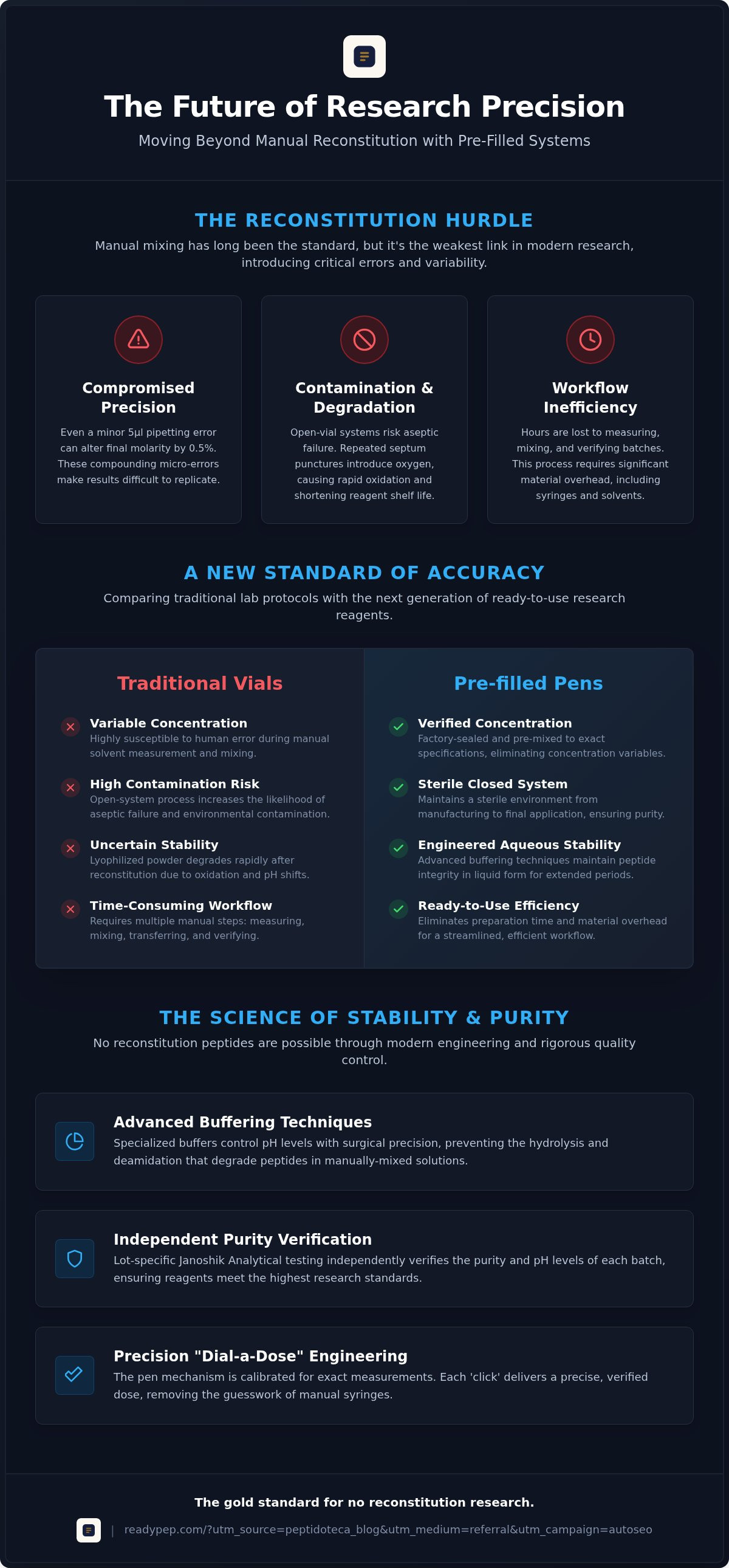
Workflow Efficiency: Manual Vials vs. Ready-to-Use Systems
Legacy workflows are defined by friction. Every manual reconstitution step is a potential point of failure. When you compare traditional lyophilized vials to ready-to-use systems, the efficiency gap is undeniable. It's not just about the five minutes spent mixing a single vial. It's about the cumulative material overhead and the risk of "technician-variable" noise in large-scale studies. Standardizing your lab with no reconstitution peptides removes these obstacles entirely. It replaces a multi-step preparation process with a single, calibrated action.
Reproducibility is the gold standard of science. In manual systems, different technicians may employ slightly different mixing techniques. One might shake a vial too vigorously; another might under-measure the solvent. These micro-variances lead to subtle differences in concentration that can compromise an entire data set. Pre-filled pens eliminate this human variable. You get factory-sealed precision every time. This also leads to significant waste reduction. Precise "dial-a-dose" mechanisms mean you only use what the assay requires, leaving less discarded reagent at the end of the day.
Time-Motion Study in the Lab
Reconstitution is a hidden time-sink. Consider the hours your team spends measuring solvents, waiting for dissolution, and verifying concentrations. Removing these steps allows your laboratory to focus on high-value data analysis rather than reagent preparation. Training new personnel becomes significantly faster when the complexities of precise mixing are removed. Transitioning to no reconstitution peptides streamlines the entire protocol. It moves your project from receipt to assay in record time. Efficiency isn't just a convenience; it's a competitive advantage in high-throughput research.
Safety and Compliance Benefits
Every manual draw from a vial increases sharps exposure. Minimizing the use of needles and syringes improves your laboratory's safety profile and reduces the volume of hazardous waste. Storage is another factor. Cluttered vial racks and separate solvent bottles create logistical chaos. Pre-filled pens offer a compact, organized solution that fits seamlessly into existing cold-storage protocols. For those focused on CNS modeling, our Neurological Peptide Research Tools guide highlights how these systems improve efficiency in sensitive neural assays. You don't have to settle for legacy errors. You can streamline your laboratory workflow today with verified, ready-to-use reagents.
ReadyPep: The Gold Standard for No Reconstitution Research
ReadyPep serves as the primary global distributor for Metatide Healthcare research peptides. Our model is built on the removal of laboratory friction. While traditional suppliers focus on the mass distribution of lyophilized vials, we prioritize the integrity of the delivery system. High-purity no reconstitution peptides represent the next phase of research efficiency. We provide a bridge between advanced chemical synthesis and practical laboratory application. Our UK-based distribution center ensures that every pen is handled with the clinical precision required for high-stakes assays.
Transparency is not a marketing term for us. It's an operational standard. Every lot is independently verified by Janoshik Analytical. We don't just claim purity; we provide the data to prove it. Researchers have direct access to HPLC and Mass Spec reports for every batch. This level of accountability is essential for data reproducibility. When your reagents are verified for both purity and pH stability, you eliminate the most common sources of experimental noise. Utilizing no reconstitution peptides from a verified source ensures that your results are based on chemistry, not preparation variables.
Featured Research Protocols
The 'Protocol' range offers tailored stacks designed for specific in-vitro models. These are not generic solutions. They are formulated to support complex research objectives through precise, pre-mixed delivery. This eliminates the need for manual stacking and the associated calculation risks.
- The Lean Protocol is engineered for metabolic pathway studies, providing a standardized baseline for metabolic research.
- The Repair Protocol supports cellular regeneration assays by ensuring consistent delivery of signaling peptides.
- For projects requiring maximum potency, high-concentration options like Retatrutide 40mg provide the necessary molarity without the risk of dilution error.
Commitment to Research Integrity
ReadyPep operates with a strict focus on in-vitro laboratory research. Our products are not for human or veterinary use. We maintain rigorous documentation standards to support academic and independent researchers. This commitment to compliance ensures that your laboratory remains aligned with international research standards. We include worldwide cold-chain shipping at no cost to preserve the biological activity of every reagent. This end-to-end oversight guarantees that your reagents arrive ready for immediate use. Precision is a choice. You can secure high-purity pre-filled pens for your next study and eliminate manual variables today.
Advancing Laboratory Precision through Integrated Systems
The transition to no reconstitution peptides is an evolution in research methodology. By eliminating the micro-errors inherent in manual mixing, you secure the integrity of your experimental data. Laboratory efficiency is no longer a trade-off for purity. With Metatide Healthcare's advanced manufacturing and rigorous Janoshik Analytical lot testing, every dose is a verified constant. You don't have to manage the logistical burden of separate solvents or the risk of contamination during preparation. ReadyPep provides the necessary infrastructure for high-throughput science, backed by free global cold-chain shipping to maintain reagent activity.
It's time to remove legacy variables from your protocol. You can streamline your research with ReadyPep pre-filled pens and focus entirely on your findings. High-purity reagents should be accessible and reliable. Modern science demands modern tools. Precision is the only path to reproducible results. Your laboratory deserves the assurance of factory-sealed accuracy.
Frequently Asked Questions
What are no reconstitution peptides?
No reconstitution peptides are research reagents already stabilized in an aqueous solution, removing the need for manual mixing with bacteriostatic water. These products arrive in a pre-filled format, ensuring a standardized concentration from the moment of delivery. By eliminating the reconstitution step, researchers reduce the risk of micro-errors and contamination. This streamlined approach is ideal for high-throughput laboratory environments where precision and reproducibility are the primary objectives.
How long do pre-filled peptide pens remain stable after opening?
Most pre-filled peptide pens remain stable for approximately 30 days once the seal is broken, provided they're stored under consistent refrigeration. The specialized buffers used in these formulations protect the peptide bonds from rapid degradation. It's essential to maintain a temperature range of 2 to 8 degrees Celsius to preserve biological activity. Always refer to the specific lot documentation for stability data regarding individual compounds like Retatrutide or BPC-157.
Is the concentration in pre-filled pens accurate for laboratory research?
Yes, the concentration in these pens is factory-calibrated to provide a level of accuracy that manual drawing can't match. Each "click" on the dial corresponds to a specific milligram measurement, removing the visual guesswork of syringe graduations. Because these are no reconstitution peptides, the molarity is set during the manufacturing process under cGMP standards. This ensures that every dose used in your in-vitro assay is identical to the last.
Do pre-filled research pens require refrigeration during shipping?
Pre-filled research pens require strict temperature control to prevent thermal degradation of the aqueous solution. ReadyPep's worldwide cold-chain shipping protocol ensures reagents stay within the required thermal window at no extra cost. This logistics chain includes insulated packaging and temperature monitoring from the UK distribution center to your laboratory. Maintaining this cold-chain integrity is vital for ensuring the biological activity of the peptides remains intact. It's a standard part of our delivery process.
How do I verify the purity of a no reconstitution peptide?
You can verify the purity of a no reconstitution peptide by accessing the lot-specific analytical reports provided with each purchase. Every batch of Metatide Healthcare pens undergoes independent testing by Janoshik Analytical. These reports include HPLC and Mass Spectrometry data, confirming purity levels often exceeding 99%. Access to this raw data allows researchers to document reagent integrity for publications and internal audits, ensuring radical transparency across the supply chain.
Can I use pre-filled pens for in-vitro cell culture studies?
These pre-filled pens are specifically designed for in-vitro laboratory research, including cell culture studies and biochemical assays. The standardized pH and purity levels make them highly reliable for sensitive experimental models. Since the solutions are professionally buffered, they minimize the risk of pH-induced cellular stress that can occur with poorly prepared manual mixtures. Researchers find these systems helpful for maintaining consistent experimental conditions across multiple plates or long-term longitudinal studies.
What is the difference between a pre-filled pen and a pre-mixed vial?
A pre-filled pen is a self-contained delivery instrument with an integrated dial-a-dose mechanism, whereas a pre-mixed vial is simply a container of liquid reagent. The pen format offers superior protection against oxidation and contamination because it's a closed system during use. Vials require repeated punctures with a syringe, which introduces air and potential particulates. The pen's mechanical precision also eliminates the need for manual drawing, further reducing the chance of measurement error.
Are ReadyPep products intended for human consumption?
ReadyPep products are strictly for in-vitro laboratory research and aren't intended for human or veterinary use. Adherence to these constraints is a non-negotiable requirement for all laboratory protocols. These reagents are designed for chemical analysis and biological testing in controlled environments. They don't have FDA approval for therapeutic applications. All research must be conducted by qualified professionals within a recognized laboratory or academic setting. We don't sell peptide vials or capsules.
Disclaimer
Educational content only. Not medical advice.


