

In 2026, the success of your laboratory data depends more on the logistics of a transit hub than the synthesis of the compound itself. You understand that sourcing high-purity reagents is only half the battle. For most investigators, the real friction lies in research peptides international shipping, where customs complexities and thermal instability threaten to turn a precise experiment into a costly failure. It's a frustrating reality that even the highest grade material is useless if it degrades during a 72-hour delay in a non-refrigerated warehouse.
This guide provides the technical blueprint for mastering global procurement. You'll learn how to navigate the 2026 regulatory environment, from increased FDA enforcement trends to specific EU documentation standards. We'll examine the critical mechanics of cold-chain delivery at 2-8°C and why third-party verification from labs like Janoshik Analytical is non-negotiable for in-vitro research. By the end, you'll have a clear framework for ensuring your reagents arrive stable, compliant, and ready for the bench. We'll focus on the shift toward pre-filled formats that prioritize stability and precision in a global marketplace.
Key Takeaways
- Identify the stability gap in global distribution and learn to mitigate common failure points like customs delays and temperature excursions.
- Establish research integrity by verifying every lot through independent Janoshik Analytical testing for confirmed purity and pH levels.
- Master the logistics of research peptides international shipping by utilizing advanced vacuum-sealed insulation to maintain the critical 2–8°C thermal range.
- Ensure 2026 regulatory compliance for in-vitro research reagents through precise Safety Data Sheet documentation and regional legality verification.
- Streamline your procurement process by leveraging UK-based distribution centers that offer free global cold-chain shipping for pre-filled peptide pens.
Challenges in Global Research Peptide Distribution
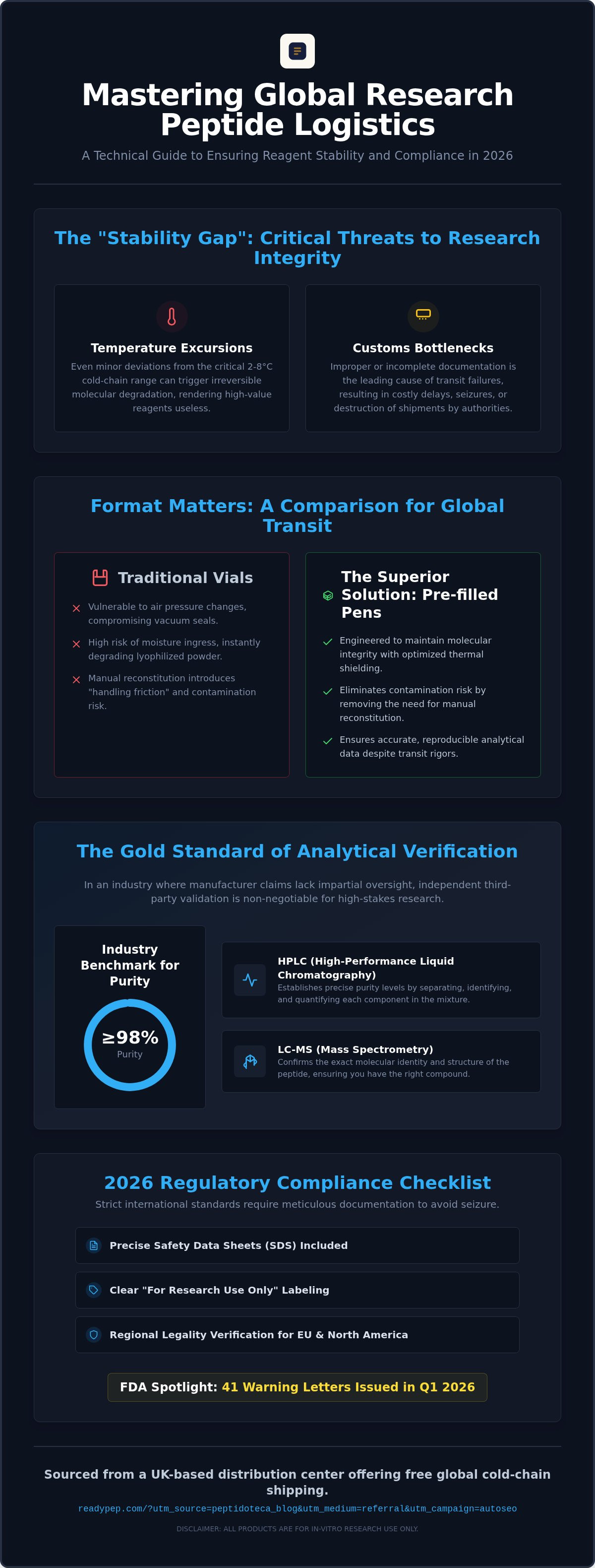
Global logistics for laboratory reagents are fraught with what scientists call the "stability gap." This is the critical window between dispatch and delivery where molecular integrity is most vulnerable. In the context of research peptides international shipping, the primary threats are temperature excursions and customs bottlenecks. Even a minor deviation from the 2-8°C range can trigger irreversible degradation. It's a risk that turns high-value reagents into useless biological waste before they ever reach the bench.
The Reality of Customs Seizures in 2026
Regulatory scrutiny is at an all-time high. In early 2026, the FDA issued 41 Warning Letters in just three months, signaling a major crackdown on the research chemical sector. This tightening of international standards means that improper documentation is now the leading cause of transit failure. Shipments must include precise Safety Data Sheets (SDS) and clear "For Research Use Only" labeling to survive inspection. Without these rigorous compliance markers, reagents risk indefinite seizure or destruction by customs authorities in regions like the EU or North America.
Format Matters: Vials vs. Pre-filled Pens
Traditional glass vials with rubber stoppers are fundamentally poorly suited for international air freight. Rapid pressure changes in cargo holds can compromise the vacuum seal, leading to moisture ingress. This is a significant concern because Chemical peptide synthesis produces high-purity lyophilized powder that is extremely sensitive to atmospheric exposure. Once the seal is breached, the degradation process begins instantly, often before the package is even unloaded.
Pre-filled aqueous solutions in specialized pens offer a superior alternative for global transit. These formats eliminate the "handling friction" associated with manual reconstitution, which is a common point of contamination. By removing the need for researchers to handle loose vials and bacteriostatic water, the risk of introducing bacterial endotoxins is virtually erased. Pre-filled pens, such as the research peptide pens offered by ReadyPep, are engineered to maintain molecular integrity through optimized thermal shielding. They provide a more stable environment than loose vials, ensuring your analytical data remains accurate and reproducible despite the rigors of international transit.
Analytical Verification: Janoshik Testing and Lot Documentation
Verification is the bedrock of empirical integrity. In an industry where manufacturer-issued Certificates of Analysis (COAs) are often self-reported and lack impartial oversight, independent third-party validation is essential. Relying solely on a producer's internal data creates a significant "blind spot" for researchers. High-stakes in-vitro studies require empirical proof that the chemical identity and purity levels align with the documented specifications. This is particularly vital when managing research peptides international shipping, as the logistical chain introduces multiple variables that can impact reagent quality.
Janoshik Analytical has emerged as the definitive standard for this verification. Their testing protocols utilize High-Performance Liquid Chromatography (HPLC) to establish purity levels, with ≥98% being the recognized industry benchmark for research-grade reagents. Simultaneously, Mass Spectrometry (LC-MS) confirms the molecular identity of the peptide. Together, these reports provide a transparent audit trail. For those who demand this level of scrutiny, you can explore the process of Understanding Lab Testing and Verifying Purity to see how every batch is handled.
Reading the Janoshik Report
Interpreting a Janoshik report requires a focus on the purity peak and the impurity profile. A professional report will clearly display the chromatogram, showing the primary peptide peak relative to any secondary "noise." In 2026, standard reports also emphasize pH balance. A stable pH is critical for maintaining molecular structure during in-vitro applications. Researchers must cross-reference the unique lot number on the report with the physical product tags on the delivery. This ensures the data matches the specific reagent in the laboratory, mitigating the risk of batch-swapping or outdated documentation.
Transparency as a Research Requirement
Reagent quality directly dictates the success of peer-reviewed publications and the reproducibility of data. If the starting material is compromised, the entire experimental outcome is skewed. This commitment to transparency is closely linked to the Research Use Only (RUO) classification, which governs how these chemicals are documented for global transit. Maintaining high standards is not just about compliance; it's about protecting the validity of your work. You can find more details in our guide on Research Peptide Quality Standards: A Guide for In-Vitro Laboratories. By sourcing from providers who prioritize lot-specific transparency, you remove the uncertainty that often plagues international procurement.
ReadyPep facilitates this by ensuring every lot of pre-filled research pens undergoes this rigorous independent analysis before it enters the global supply chain.
Cold-Chain Integrity for International Peptide Transit
Maintaining a precise thermal environment isn't just a preference; it's a structural requirement for molecular stability. Most reconstituted peptides require a consistent temperature of 2-8°C, a standard codified by USP General Chapter <659>. When managing research peptides international shipping, the stakes are elevated by the duration of intercontinental transit. If the temperature exceeds this narrow band, the peptide's secondary structure can unfold. This leads to a loss of potency and compromised analytical results that can derail months of laboratory work.
Advanced logistics providers have moved beyond standard ice packs, which often fail during 5-day transits to North America or Asia-Pacific. Vacuum-sealed insulation and validated thermal containers are now the baseline for protecting high-value reagents. These systems are designed to withstand the varying pressures and temperatures of cargo holds. The "Last Mile" remains the most volatile segment, where local courier handling in extreme climates can undo days of careful logistics. Without validated packaging, a shipment sitting on a tarmac in 30°C heat will degrade in hours.
Metatide Healthcare Manufacturing Standards
Metatide Healthcare addresses these vulnerabilities at the source. By utilizing aseptic filling processes, they ensure that pre-filled aqueous formats remain sterile and stable from the production line. These pre-filled pens are engineered for immediate in-vitro use, removing the contamination risks inherent in manual reconstitution. This format is particularly effective for maintaining molecular integrity during the rigors of global transit. It provides a layer of protection that loose vials lack, ensuring the compound arrives in its most stable, ready-to-use form.
Verifying Cold-Chain Arrival
Upon receipt, researchers must perform immediate physical checks. Visual indicators, such as temperature-sensitive labels or data loggers, provide empirical proof of the shipment's thermal history. If a shipment arrives outside the validated 2-8°C range, it's critical to follow a documented handling protocol before proceeding with any research. You can find more detail on these protocols in our guide on Peptide Pen Quality Control: Ensuring High Purity. While navigating FDA Human Drug Import Regulations is a separate compliance task, ensuring thermal stability is the technical foundation of successful procurement. ReadyPep removes this friction by specializing in free global cold-chain logistics, ensuring that high-purity research peptide pens maintain their integrity from the UK warehouse to your laboratory bench.
Navigating Global Customs and Regulatory Compliance
Compliance is the final gatekeeper in successful reagent procurement. In the 2026 regulatory environment, investigators must treat documentation with the same precision as their experimental design. The first step involves verifying that your specific laboratory reagents are permitted for in-vitro use within your jurisdiction. This isn't a mere formality; it's the technical foundation of research peptides international shipping. Without verifying regional legality, even the highest purity compounds risk permanent seizure at the border.
A successful transit requires a five-step compliance protocol. First, confirm in-vitro research legality. Second, ensure a precise Safety Data Sheet (SDS) is included in the package. Third, verify that all products carry clear "Laboratory Research Use Only" labeling. Fourth, prepare for the management of local VAT and import duties, as these are typically the responsibility of the receiving institution. Finally, utilize a stable international corridor, such as the UK-to-Global route, to minimize logistical friction. ReadyPep utilizes the international harmonized code UN 3316 for research chemicals, providing the necessary clarity for customs agents to process shipments efficiently.
Documentation Requirements for 2026
Customs authorities now demand lot-specific transparency. It's no longer sufficient to provide generic product descriptions. Border agents often require independent testing reports to verify the identity of the chemical being imported. Janoshik Analytical reports facilitate this transition by providing empirical proof of the compound's molecular structure. This level of detail transforms a "suspicious" chemical shipment into a documented laboratory reagent. For a deeper dive into these logistical hurdles, consult our guide on Customs Clearance for Research Chemicals: A 2026 Guide. Precise documentation reduces the likelihood of "administrative holds," which can be fatal for cold-chain integrity.
Sourcing for Academic and Private Labs
Institutional procurement demands inventory stability and risk mitigation. For private and academic labs, the goal is to remove the uncertainty of international transit. Managing recurring orders requires a partner that understands the nuances of institutional protocols and high-value compound protection. By sourcing from a provider that prioritizes radical transparency and lot-by-lot verification, labs can ensure their research remains on schedule. You can streamline your procurement and order high-purity research peptides directly from our UK-based distribution center. This strategic corridor ensures that your reagents spend less time in transit and more time in the lab, backed by the documentation required for seamless global entry.
ReadyPep: Streamlining International Research Logistics
ReadyPep positions itself as the technical solution to the procurement friction discussed throughout this guide. By centralizing operations in a UK-based distribution center, the brand leverages a stable international corridor that avoids the logistical "dead zones" common in other regions. This location is strategic. It ensures that research peptides international shipping remains fast and reliable; average delivery times are 2-3 business days to Western Europe and 3-5 days to North America and the Asia-Pacific. This speed is critical for maintaining the molecular integrity of the compounds.
The brand's "Free Global Cold-Chain" commitment is more than a cost-saving measure. It's a quality assurance protocol. By absorbing the high costs of validated thermal packaging and express courier services, ReadyPep removes the financial incentives that lead other providers to cut corners on temperature control. This guarantees that high-purity reagents maintain the critical 2-8°C range from the warehouse to the laboratory bench. It's a standard that eliminates the uncertainty of intercontinental transit.
The Pre-filled Pen Advantage
The transition from vial-based reagents to Metatide Healthcare pre-filled pens represents a significant upgrade in laboratory workflow. Vials require manual reconstitution. This process introduces contamination risks and measurement errors that can skew results. Pre-filled formats eliminate these variables. This is essential for Precision Research with Retatrutide 40mg Pens, where exact dosing is vital for metabolic data reproducibility. Similarly, investigators using Metabolic Pathway Tools: MOTS-c 40mg benefit from the aqueous stability of a professionally filled, aseptic reagent.
Securing Your 2026 Research Supply
Inventory stability is the backbone of long-term in-vitro modeling. ReadyPep ensures continuity of supply through a robust manufacturing partnership, offering specialized combinations like the BPC-157 + TB-500 40mg stack. These pre-filled protocols allow researchers to focus on data collection rather than logistical troubleshooting. Every shipment includes the lot-specific Janoshik documentation required for institutional compliance and verification. You can explore the full range of verified reagents in the ReadyPep Product Catalog. By integrating rigorous testing with advanced cold-chain logistics, ReadyPep provides the modern infrastructure necessary for high-stakes research in 2026.
Securing the Future of Global Laboratory Procurement
Procurement in 2026 demands a shift from reactive sourcing to proactive verification. Successful research hinges on reagents that survive the transit without losing their molecular structure. You've seen how independent Janoshik Analytical testing and Metatide Healthcare manufacturing standards create a foundation of integrity. By prioritizing pre-filled formats and utilizing a stable UK-based corridor, investigators can bypass the common points of failure in research peptides international shipping. This methodical approach ensures that your data remains reproducible and your laboratory resources are protected from environmental degradation.
Removing logistical friction allows you to focus on the science rather than the shipping label. It's about establishing a supply chain that is as precise as your experiments. Secure your laboratory's supply of verified research peptides with free global cold-chain shipping at ReadyPep. Your next breakthrough depends on the stability of your starting material; ensure it arrives ready for the bench.
Frequently Asked Questions
Does ReadyPep offer free international shipping on all research peptides?
ReadyPep provides free global cold-chain shipping on all orders, removing the financial barriers often associated with high-stakes research peptides international shipping. This service utilizes express couriers like DHL or FedEx to ensure rapid transit from our UK-based distribution center. By absorbing these logistical costs, the brand ensures that investigators receive their reagents without compromising on thermal protection or documentation accuracy during the global delivery process.
How are peptides kept cold during international transit in 2026?
In 2026, thermal integrity is maintained through advanced vacuum-sealed insulation and validated thermal containers rather than simple ice packs. These systems are engineered to sustain the critical 2–8°C range for up to five days of transit. This technology protects the molecular structure from the rapid temperature fluctuations common in intercontinental cargo holds. Every package is designed to withstand the "last mile" challenges of diverse climates during final delivery.
Can research peptides be shipped to the EU and Australia without customs issues?
Research peptides can be shipped to the EU and Australia, provided they are documented for in-vitro laboratory use only. ReadyPep utilizes the international harmonized code UN 3316 to facilitate smoother customs clearance for these reagents. While shipping within the EU single market is streamlined, investigators in Australia should be aware that local taxes and import duties remain the responsibility of the recipient. Precise Safety Data Sheet inclusion is mandatory to prevent administrative holds.
What is the purity standard for Metatide Healthcare peptides?
Every reagent manufactured by Metatide Healthcare meets an industry-leading purity standard of at least 98%. This is established through High-Performance Liquid Chromatography (HPLC) and confirmed by Mass Spectrometry (LC-MS) for every batch. These rigorous benchmarks ensure that the chemical identity of the peptide is verified before it enters the global supply chain. Maintaining this level of precision is essential for producing reproducible analytical data in sophisticated in-vitro research environments.
How do I verify the Janoshik testing for my specific peptide lot?
Verification is handled through independent, lot-specific Janoshik Analytical reports. Every shipment includes documentation that corresponds directly to the unique lot number found on your physical product tags. Researchers can cross-reference these numbers on the Janoshik website to confirm the authenticity of the purity and pH balance data. This transparent audit trail eliminates the "blind spots" associated with manufacturer-issued certificates and ensures total laboratory reagent accountability for every order.
Are pre-filled peptide pens more stable than vials for international shipping?
Pre-filled aqueous pens offer superior stability for research peptides international shipping compared to traditional glass vials. Vials are vulnerable to vacuum breaches caused by pressure changes in aircraft cargo holds, which can lead to moisture ingress and degradation. Pre-filled formats from Metatide Healthcare utilize aseptic filling processes that protect molecular integrity and eliminate the contamination risks inherent in manual reconstitution. This format ensures a more robust and shelf-stable reagent for global transit.
What should I do if my international shipment is delayed at customs?
If a shipment is delayed, investigators should immediately contact ReadyPep's customer support to verify the status of the documentation provided. Most delays in 2026 are administrative and can be resolved by resubmitting the lot-specific Safety Data Sheet or Janoshik report. ReadyPep's UK-based team monitors international transit closely to mitigate these risks. Early communication with customs agents regarding the "Research Use Only" classification often facilitates a faster release of the laboratory reagents.
Are these peptides suitable for in-vivo animal research?
These peptides are strictly for in-vitro laboratory research and are not suitable for in-vivo animal testing or any human or veterinary use. All reagents are sold under the "Research Use Only" classification, and their application must be confined to cell culture models or biochemical assays within a controlled laboratory setting. ReadyPep does not provide synthesis for therapeutic or clinical applications, maintaining a clear focus on high-purity reagents for empirical research purposes.
Disclaimer
Educational content only. Not medical advice.


