

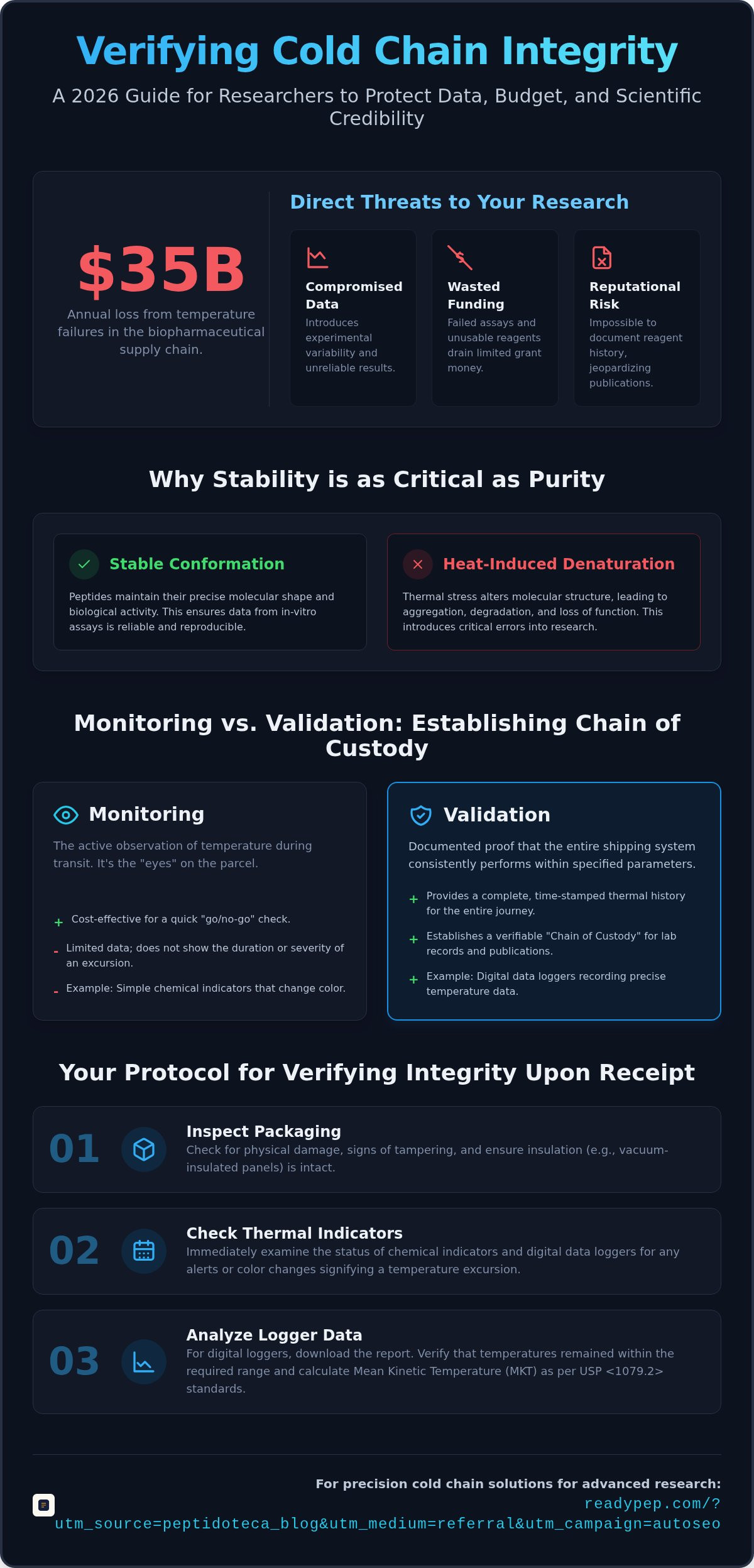
The biopharmaceutical industry loses approximately $35 billion annually due to temperature failures in the supply chain. For a researcher, this isn't just a corporate statistic; it's a direct threat to your data. You spend months designing a study only to have experimental variability introduced by a single shipping delay. Compromised materials waste grant funding and make it impossible to document reagent history for high-impact publications. This 2026 guide provides the rigorous protocols required for verifying cold chain integrity to protect your bench work and your budget.
You'll learn the analytical standards required to confirm thermal stability and ensure the integrity of your in-vitro research reagents. We'll clarify the critical difference between simple monitoring and full validation. We also cover the implementation of Mean Kinetic Temperature (MKT) calculations as defined in the updated USP <1079.2> standards. This article outlines a clear protocol for shipment verification and explains how to identify suppliers who provide the documented thermal history necessary for absolute empirical confidence. It's time to remove the friction of uncertainty from your logistics.
Key Takeaways
- Understand how heat-induced denaturation alters molecular conformation and why thermal stability is as critical as chemical purity.
- Distinguish between simple temperature monitoring and the rigorous validation required to document a complete chain of custody.
- Master a standardized protocol for verifying cold chain integrity by inspecting thermal indicators and data logger status upon delivery.
- Evaluate the efficiency of Phase Change Materials and vacuum-insulated panels in maintaining precise temperature ranges during global transit.
- Discover how pre-filled pen formats and verified logistics minimize contamination risks for high-precision in-vitro research.
The Critical Role of Thermal Stability in Peptide Research Integrity
A Cold chain is the uninterrupted maintenance of a specified temperature range from manufacture to the lab bench. In peptide research, this isn't just a logistical detail. It's a fundamental analytical variable. Verifying cold chain integrity is the first step in ensuring that reagents are molecularly sound before they ever touch a pipette. Peptides are notoriously sensitive to thermal stress. Heat-induced denaturation alters their molecular conformation and biological activity. This creates a cascade of experimental variability. Data reliability hinges on thermal stability. Without it, in-vitro studies fail to meet the rigorous standards required for modern scientific publication.
In-vitro models are hypersensitive to impurities. Standard bulk chemical handling often allows for wider tolerances, but research peptides do not. Degraded fragments can act as competitive inhibitors. They might even produce toxic byproducts that skew assay results. This is why maintaining a documented thermal history is a non-negotiable protocol for qualified scientific personnel. Precision requires accountability at every stage of transit. If the temperature range breaks, the integrity of the science breaks with it.
Molecular Vulnerability of Research Peptides
Peptides in aqueous solutions face higher risks than lyophilized powders. Water facilitates chemical degradation pathways like hydrolysis and deamidation. Temperature spikes accelerate these reactions. pH and concentration also play critical roles. A slight shift in thermal energy can trigger aggregation or precipitation. You won't always see a change in the vial with the naked eye. Primary indicators of compromised integrity often only emerge during analysis. Look for unexpected baseline noise or reduced binding affinity in your results. These are the fingerprints of thermal degradation.
Economic and Scientific Costs of Failure
The financial impact of cold chain failure is immediate. Compromised reagents lead to failed assays and wasted grant funding. However, the scientific cost is often much higher. Unverified material quality puts your entire body of work at risk. If you can't prove the reagents remained stable during transit, your results are scientifically questionable. This leads to retracted publications and a loss of professional credibility. Adhering to strict Research Peptide Quality Standards is essential for laboratories prioritizing data integrity. Don't let a shipping error derail a multi-year project. Verifying cold chain integrity protects your research and your reputation.
Monitoring vs. Validation: Establishing a Chain of Custody
Monitoring involves the active observation of temperature during transit. It's the clinical "eyes" on a parcel. Validation is more robust; it's the documented proof that the entire shipping system consistently performs within specified parameters. For researchers, verifying cold chain integrity isn't just about checking a sticker. It's about ensuring the data collected during transit matches the stability requirements of the specific peptide lot. This process establishes a "Chain of Custody." This chronological paper trail documents the reagent's thermal history from the manufacturing facility to the laboratory bench. It removes the friction of uncertainty.
Standardizing this documentation is essential for lab records. When results show unexpected variability, the first question should be: was the chain of custody maintained? High-standard providers prioritize this transparency, offering verified logistics solutions that remove the guesswork from international shipping. Accountability shouldn't be an industry disruptor; it should be a baseline requirement.
Types of Thermal Indicators and Loggers
Chemical indicators are cost-effective but limited. They provide an irreversible color change if a threshold is crossed. While useful for a quick "go/no-go" check, they don't show the duration of an excursion. Digital data loggers are the professional standard. They record precise timestamps and temperature readings throughout the journey. For international shipping, single-use digital loggers are often preferred to avoid the logistics of returning hardware. Interpreting these reports is straightforward. You're looking for the Mean Kinetic Temperature (MKT) and any spikes that exceed the peptide's stability threshold. This data should be saved alongside your Certificate of Analysis for every experiment.
Regulatory Standards for Research Chemical Logistics
The logistics industry follows Good Distribution Practice (GDP) to ensure product quality. While research chemicals aren't always held to the same legal requirements as finished pharmaceuticals, top-tier labs adopt these standards voluntarily. This includes alignment with FDA cold storage and handling regulations and USP chapters like <1079>. ISO-certified distribution ensures that every parcel is handled with a repeatable, high-accuracy process. This level of oversight is a core component of Peptide Pen Quality Control, where the synergy between chemical purity and thermal stability is protected by rigorous analytical standards.
Passive vs. Active Cooling Systems for Research Reagents
Active cooling systems rely on powered refrigeration units. These are the standard for large-scale pharmaceutical pallets or dedicated cargo flights. However, they're rarely feasible for small-volume research parcels. For individual shipments of reagents, passive cooling is the clinical choice. It utilizes advanced insulation and thermal mass to maintain a stable environment without external power. Verifying cold chain integrity in these systems depends entirely on the quality of the thermal barriers used. High-performance polyurethane insulation significantly outperforms standard expanded polystyrene (EPS). It offers a higher R-value, ensuring that external ambient temperatures don't compromise the internal payload during transit delays.
The transition from bulk shipping to precision logistics requires a shift in mindset. You aren't just moving a box; you're protecting a molecular structure. Passive systems using vacuum-insulated panels (VIPs) provide the most robust defense against thermal excursions. These panels are thinner and more efficient than traditional materials. They allow for more coolant volume while keeping the total parcel size manageable. This efficiency is critical for maintaining the tight tolerances required by sensitive in-vitro reagents.
Phase Change Materials (PCMs) Explained
Phase Change Materials are the gold standard for international peptide shipping. Unlike standard gel packs that freeze or thaw unevenly, PCMs are engineered to absorb or release energy at specific temperatures. They maintain a precise 2°C to 8°C range with clinical accuracy. This is achieved through latent heat. As the material changes phase, it locks the internal temperature at the melting point for extended periods. PCMs are indispensable for long-haul flights where parcels may sit on a tarmac in extreme heat. Understanding your shipping configuration is vital. Most high-standard protocols utilize 96-hour PCM configurations to account for customs clearance or weekend arrivals. This buffer ensures that verifying cold chain integrity remains possible even if the transit time exceeds the initial estimate.
The Pre-filled Pen Advantage
The pre-filled pen format provides a unique advantage in thermal protection. Traditional glass vials have a high surface area-to-volume ratio. This makes them more susceptible to rapid temperature shifts. In contrast, the engineered casing of a pre-filled research peptide pen acts as a secondary thermal barrier. It reduces the rate of heat transfer to the internal solution. This physical design also minimizes the risk of micro-fractures in the glass, which can lead to contamination. When integrated with PCM-based packaging, the pen format offers maximum stability for international transit. It's a streamlined solution for researchers who value precision and reduced contamination risks in their laboratory settings.
Step-by-Step Protocol: How to Verify Integrity Upon Receipt
The arrival of a shipment marks the most critical window for verifying cold chain integrity. Start with an immediate visual inspection of the external packaging. Look for signs of crushing, moisture, or leaks. If the outer box is compromised, the internal vacuum-insulated panels may have failed. Do not let the parcel sit at room temperature while you finish other tasks. Open it immediately to access the thermal indicators. Speed is essential to maintain the baseline stability established during transit.
Check the status of internal chemical indicators or stop the digital data logger to extract its report. Cross-reference the shipment lot number with the Certificate of Analysis (COA) provided for your specific reagents. This ensures that the material in your hands matches the independent purity verification on file. Integrating this step into your routine is a key component of Improving Lab Workflow with Pre-filled Pens, as it reduces the time spent on manual reagent verification. Precision at the bench starts with precision in the box.
Document the "Received" state in your laboratory reagent log. Note the arrival timestamp, the initials of the receiving scientist, and the indicator status. Once the data is confirmed, transition the reagents to long-term cold storage. Use a stable, central shelf in your laboratory refrigerator rather than the door to avoid temperature fluctuations. For researchers who demand this level of accountability, ReadyPep's verified logistics provide the necessary documentation for every shipment. This removes the friction of unverified reagent history.
Handling Temperature Excursions
A temperature excursion is any deviation from the specified 2°C to 8°C range. The scientific impact of an excursion depends on the specific peptide's degradation kinetics. If an indicator shows a violation, do not discard the material immediately. Quarantine the shipment to prevent accidental use. Contact the supplier to request lot-specific stability data. They should provide information on how the compound performs under accelerated thermal stress. This data determines if the reagent remains viable for your in-vitro assays or if it must be replaced to protect your data integrity. Never guess when the reliability of your study is at stake.
Documenting for Publication
Proving reagent stability is becoming a standard requirement for high-impact journals. Citing your protocol for verifying cold chain integrity adds weight to your methodology section. It demonstrates a commitment to controlling all experimental variables, including those introduced before the reagent reached the lab. Archive every thermal report and COA alongside your primary data. This provides a clear audit trail for peer reviewers. It ensures that your findings are rooted in verified material quality. Proper documentation turns a logistical step into a scientific asset.
ReadyPep Logistics: Precision Cold Chain for Advanced Research
ReadyPep serves as a high-standard gatekeeper for the scientific community. It eliminates the friction often associated with international reagent procurement. Metatide Healthcare manufacturing protocols ensure baseline stability before any pen leaves the facility. This is critical; stability doesn't start at the courier. It starts at the point of synthesis. Every shipment originates from the UK. This strategic location facilitates rapid global transit times, reducing the window for potential thermal excursions. To further lower the barrier to entry for high-impact research, ReadyPep includes free worldwide cold-chain shipping for all pre-filled pens. It's a disruptive approach that prioritizes accountability over industry norms.
Verifying cold chain integrity is a data-driven process at ReadyPep. Every lot undergoes independent verification by Janoshik Analytical for purity. This chemical data is then paired with specific logistics documentation to create a complete profile of the reagent. This synergy between chemical purity and thermal history is what defines a verified supply chain. It provides the calm assurance of a provider with nothing to hide. By focusing on empirical verification rather than marketing hyperbole, ReadyPep acts as a sophisticated guide for laboratories that value precision above all else.
Verified Reagents for In-Vitro Excellence
The inventory focuses on high-precision compounds in stabilized formats. This includes Retatrutide 40mg and MOTS-c 40mg pre-filled pens. These formats eliminate the "reconstitution risk" common with traditional lyophilized vials. By providing a pre-filled, stabilized reagent, Metatide Healthcare reduces the chance of contamination during lab preparation. Researchers can use the Lab Testing portal to access independent purity results for their specific lot. It’s a transparent system designed solely for in-vitro laboratory research by qualified scientific personnel.
Securing Your Research Supply Chain
Procurement shouldn't be a bottleneck for academic or private laboratories. ReadyPep streamlines the process by acting as a transparent, data-driven partner. The focus remains on removing uncertainty from the logistics chain. This commitment to radical transparency ensures that your next experiment is built on a foundation of verified integrity. By integrating the protocols for verifying cold chain integrity into the standard ordering process, ReadyPep sets a new benchmark for research reagent distribution. You can secure your research supply chain here and move forward with absolute empirical confidence.
Securing the Future of Analytical Precision
Thermal stability is a foundational requirement for high-impact in-vitro research. It's not an optional metric. By standardizing your bench-side protocol, you ensure that every reagent performs exactly as intended. This guide has established the critical path from manufacturing precision to laboratory receipt. The synergy between chemical purity and thermal history is now the industry standard for analytical excellence. You've learned how to distinguish between simple monitoring and full validation while establishing a robust chain of custody.
Protecting your data means verifying cold chain integrity with every shipment. ReadyPep eliminates the friction of unverified logistics. We provide Metatide Healthcare precision manufacturing paired with independent Janoshik purity verification for every lot. Our commitment includes free global cold-chain logistics to ensure your reagents arrive without compromise. It's time to demand higher standards for your laboratory supply chain and remove the variables that derail progress. Precision is a choice, not a byproduct of chance.
Eliminate experimental variables; source verified, cold-chain shipped research pens from ReadyPep. Your next breakthrough deserves a foundation of absolute empirical confidence.
Frequently Asked Questions
How long can research peptides stay at room temperature without degrading?
Peptides in solution generally begin to degrade within hours if exposed to temperatures above 25°C. Lyophilized powders are more resilient but still lose secondary structure over several days. For pre-filled pens, the manufacturer's stabilization helps, but room temperature exposure should be limited to the time required for lab preparation. Prolonged heat leads to hydrolysis and deamidation, introducing analytical variables that compromise your in-vitro data and experimental reproducibility.
What is the difference between a cold chain and a 'controlled room temperature' shipment?
Cold chain shipments maintain a strict 2°C to 8°C range throughout transit. Controlled Room Temperature (CRT) refers to a broader range, typically 20°C to 25°C. While CRT is suitable for some stable chemicals, it's insufficient for research peptides. Verifying cold chain integrity ensures your reagents never enter the CRT zone, protecting the delicate molecular conformation required for high-precision laboratory assays and ensuring the reagents remain chemically sound.
Can I use a peptide if the shipping ice packs have melted upon arrival?
Melted ice packs don't automatically mean the peptide is compromised, but they necessitate an immediate audit. You must check the digital data logger to determine the duration and peak temperature of the excursion. If the internal temperature remained below 8°C despite the melted packs, the reagent's integrity is likely preserved. However, if the logger shows a sustained spike, you should quarantine the lot and consult stability data before proceeding with any assays.
How do I read a digital data logger report from a peptide shipment?
Reading a data logger report involves analyzing the Mean Kinetic Temperature (MKT) and the excursion log. Look for the "Time Out of Range" metric to see exactly how long the parcel exceeded 8°C. Most reports provide a graph showing temperature fluctuations over time. Cross-reference these spikes with the shipment's transit milestones, such as customs clearance, to understand where the logistics chain faced the most stress during the journey.
Does freezing a pre-filled research pen damage the peptide structure?
Freezing a pre-filled research pen can damage the peptide structure through ice crystal formation and mechanical stress. While some lyophilized powders are stored at -20°C, liquid formulations in pens are engineered for 2°C to 8°C. Freezing can cause aggregation or denaturation of the active sequence. It also risks cracking the internal glass cartridge. Always store pens on a central refrigerator shelf to prevent accidental freezing against the back wall of the unit.
What happens if my cold-chain shipment is delayed in customs?
Customs delays are the primary cause of cold chain failure in international logistics. High-standard shipping configurations use 96-hour Phase Change Materials to provide a buffer for these events. If a delay occurs, the data logger becomes your primary tool for verifying cold chain integrity. If the delay exceeds the packaging's validated duration, the reagent must be analyzed for degradation before use in any critical in-vitro studies to protect your data.
Why is pH testing included in the verification of cold chain integrity?
pH testing serves as a secondary indicator of thermal degradation in aqueous solutions. As peptides break down through pathways like deamidation, they can release byproducts that shift the solution's pH. A significant deviation from the baseline pH noted in the Certificate of Analysis suggests the reagent has undergone chemical changes. This testing adds a layer of empirical proof to your verification protocol, ensuring the molecular environment remains stable for your research.
Is cold chain shipping necessary for all research peptides, or just specific sequences?
Cold chain shipping is necessary for all research peptides to ensure absolute experimental reproducibility. While some sequences are more thermally stable than others, allowing unregulated temperature shifts introduces an unnecessary variable into your research. Maintaining a consistent 2°C to 8°C environment for every sequence, regardless of its known stability, creates a standardized baseline. This rigor is essential for documenting reagent history in high-impact scientific publications and maintaining professional credibility.
Disclaimer
Educational content only. Not medical advice.


