

The era of manual peptide reconstitution is officially over. Traditional syringe-and-vial methods are the single greatest threat to your laboratory's data integrity. Volumetric errors and contamination risks during the mixing process frequently compromise experiment repeatability. When looking for research peptide pens for sale, precision is the only metric that matters. Every micro-liter of variance can skew your results. It's a waste of time. It's a waste of resources. You shouldn't have to compromise on scientific integrity.
You've likely dealt with the headache of inconsistent results caused by manual measurements. It's an outdated process that introduces unnecessary variables into your data. This guide demonstrates how pre-filled research peptide pens are standardizing accuracy and purity in modern in-vitro laboratory workflows. We'll cover the transition to calibrated click-dose mechanisms, the importance of lot-specific documentation, and why third-party analytical testing is non-negotiable for 2026 standards. Discover how to streamline your preparation and secure publication-quality results through verified, pre-filled solutions designed to eliminate laboratory friction and restore total control to your benchwork.
Key Takeaways
- Master the mechanics of click-dose systems to eliminate volumetric error. Precise mechanical increments ensure your in-vitro data remains repeatable and mathematically sound.
- Evaluate the "Total Time to Research" metric for your lab. Pre-filled pens remove reconstitution friction, allowing you to focus on analysis rather than tedious preparation.
- Verify reagent integrity through independent HPLC testing. Using Janoshik Analytical results ensures your materials meet the strict purity thresholds required for publication-quality work.
- Navigate the 2026 landscape for research peptide pens for sale. Standardized protocols and metered delivery are now the baseline for high-precision laboratory environments.
- Prioritize cold-chain logistics and lot-specific transparency. Secure shipping and verified documentation protect your study from environmental degradation and lot-to-lot variance.
The Evolution of Peptide Delivery: Why Researchers are Moving Beyond Vials
For decades, the "vial and syringe" method was the undisputed standard for laboratory reagent handling. It was functional, but it was never efficient. Modern in-vitro research demands a higher level of calibration than manual preparation can provide. Pre-filled research peptide pens represent a critical shift in laboratory methodology. These are not merely storage tools; they are ready-to-use in-vitro reagents that integrate chemical stability with mechanical delivery. An injector pen utilizes a calibrated internal reservoir that protects the compound from environmental exposure while ensuring precise volume control. When labs look for research peptide pens for sale, they're choosing to eliminate the high-friction steps of manual reconstitution. The goal is simple. Reduce preparation latency. Increase data integrity.
The Limitations of Manual Reconstitution
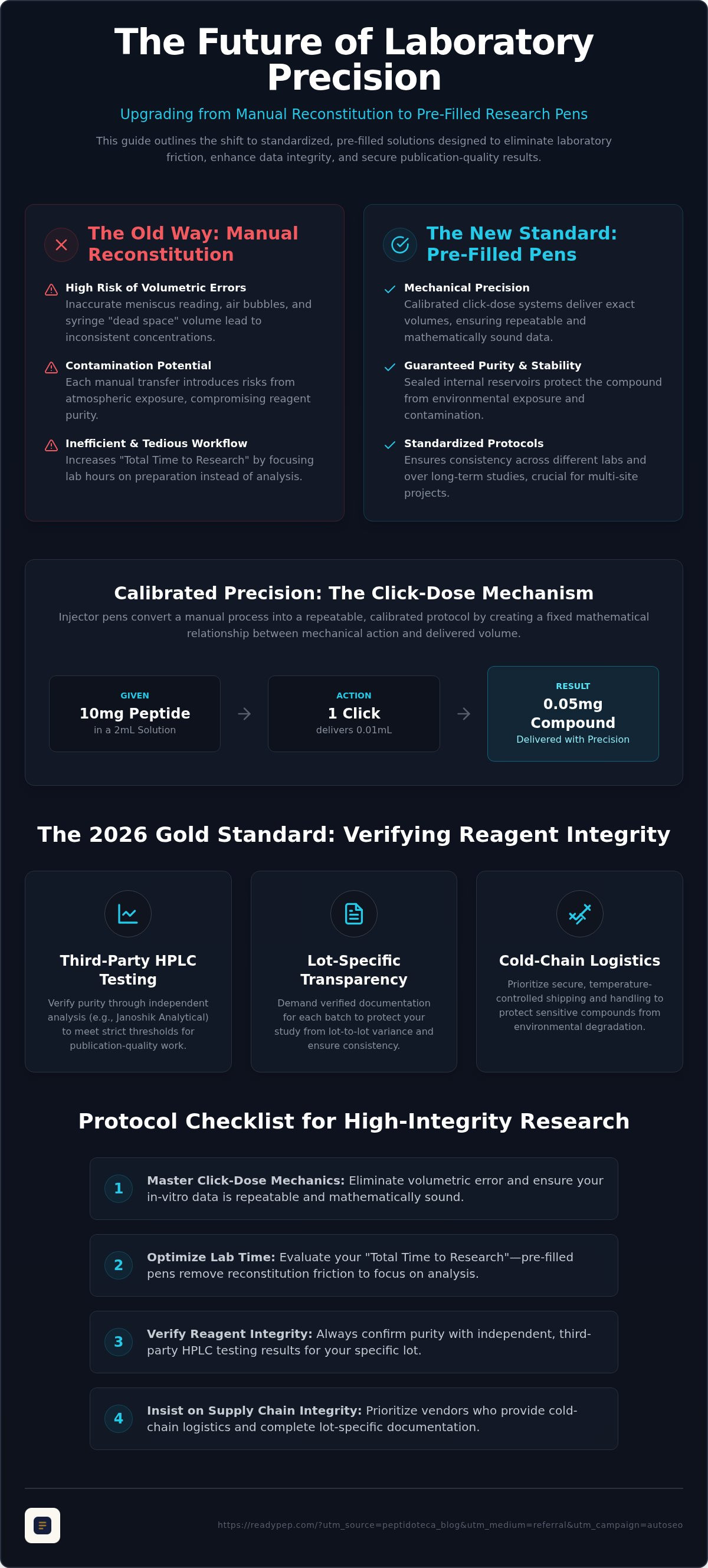
Manual pipetting is a primary source of experimental variance. Even a minor error in reading the meniscus can significantly alter the concentration of a research compound. Air bubbles present another challenge. They occupy volume within a syringe without contributing any active reagent, leading to inconsistent dosing in cellular assays. Every manual transfer from a vial to a delivery device is a point of failure. It introduces the risk of atmospheric contamination and requires a strictly controlled sterile environment that isn't always perfectly maintained. Pre-filled systems bypass these hurdles. By arriving pre-loaded with verified concentrations, they remove the human variables that often compromise metabolic studies and longitudinal research. It's about removing the guesswork from the bench.
Standardizing In-Vitro Protocols
Scientific repeatability relies on the elimination of variables. In multi-site research projects, ensuring that every laboratory uses the exact same concentration and delivery method is a logistical burden. Pre-filled pens solve this by providing a standardized hardware-reagent interface. The "click-dose" system creates a fixed mathematical relationship between the mechanical action and the delivered volume. This ensures that a "click" in one lab is identical to a "click" in another. It's essential for longitudinal cellular assays where consistency over months is the only way to secure valid results. Research integrity is the absolute preservation of reagent purity and volumetric accuracy from the point of manufacture to the final in-vitro application. ReadyPep supports this standard by offering a transparent inventory of research peptide pens for sale, designed to fit directly into high-precision protocols without the need for secondary handling.
Mechanical Precision: How Click-Dose Systems Eliminate Volumetric Error
The internal architecture of a professional injector pen is engineered to solve the physical limitations of the traditional syringe. Standard syringes don't account for "dead space" volume. This is the residual reagent trapped in the needle hub and syringe tip after the plunger is fully depressed. In high-precision in-vitro studies, this lost volume represents a significant percentage of the total dose, leading to skewed data. Click-dose systems utilize a mechanical lead screw to drive a plunger forward in fixed, audible increments. This design ensures that every micro-liter of the reservoir is accounted for. When researchers evaluate research peptide pens for sale, they're often looking for this specific mechanical reliability. It transforms a manual process into a repeatable, calibrated protocol.
Calibrated Increments for Precise Assays
Most professional injectors operate on a 0.01ml increment standard. This granularity allows for high-resolution dosing across various concentrations. Calculating the mass per click is straightforward. If a pen contains 10mg of a peptide in a 2ml solution, each 0.01ml click delivers exactly 0.05mg of the compound. This mathematical certainty is vital for dose-response curves in cellular assays. The internal spring mechanism maintains consistent pressure during delivery. It ensures the reagent is dispensed at a uniform rate, which is critical for subcutaneous-style in-vitro delivery models where flow dynamics can affect cellular uptake. You hear the click. You feel the resistance. You know the exact mass delivered.
Durability vs. Disposable Utility
While reusable metal pens offer longevity, pre-filled disposable housings provide superior protection against environmental factors. Pre-sealed systems are closed loops. They minimize the reagent's exposure to atmospheric oxygen, which is a primary driver of peptide oxidation and degradation. In sensitive cell culture environments, the use of pre-filled, sterile units significantly reduces the risk of cross-contamination compared to reusable hardware that requires constant sterilization. The increasing demand for research peptide pens for sale reflects a shift toward these standardized delivery systems. The integrated design maintains the integrity of the compound from the first click to the last. This level of mechanical precision in pre-filled formats is why modern laboratories are retiring the vial-and-syringe model. It's not just about convenience. It's about protecting the data.
Pre-filled vs. Reusable Peptide Pens: A Comparative Analysis
Choosing between reusable hardware and pre-filled systems is a decision between buying a tool or an integrated solution. Reusable pens are "hardware only" devices. They require the researcher to source lyophilized powder, perform the reconstitution, and manually load a cartridge. This introduces multiple points of failure. Pre-filled pens combine the reagent and the delivery mechanism into a single, sterile unit. When evaluating research peptide pens for sale, the decision often comes down to the trade-off between perceived hardware savings and actual experimental reliability. The integrated approach ensures that the concentration, pH, and mechanical calibration are synchronized from the moment of manufacture.
The most critical metric for modern laboratory management is Total Time to Research (TTR). Traditional methods are high-latency. Reconstitution alone can consume 15 to 20 minutes per batch when accounting for sterile setup and stabilization. Pre-filled formats eliminate this preparation phase. While reusable kits may seem cost-effective on paper, they often lead to higher reagent waste. Residual fluid left in vials or lost during manual transfer represents a direct financial loss. Pre-sealed cartridges utilize every micro-liter of the reservoir, ensuring that the cost-per-assay remains predictable and optimized.
Workflow Efficiency in the Modern Lab
Manual labor is the most expensive variable in any study. Reconstitution requires high-focus pipetting and careful agitation to prevent peptide shearing. For high-throughput screening environments, these manual steps create a significant bottleneck. Improving lab workflow with pre-filled pens allows researchers to move directly from storage to application. This efficiency is why ready-to-use formats are becoming the baseline for 2026 laboratory standards. By removing the "reconstitution friction," labs can increase their daily assay volume without increasing their headcount.
Risk Mitigation and Contamination Control
Contamination control is a game of reducing touchpoints. Manual loading involves at least five distinct contact moments where environmental microbes or atmospheric oxygen can enter the reservoir. Pre-filled units from Metatide Healthcare are factory-sealed in ISO-certified environments. This eliminates the "vial-to-pen" transfer risk entirely. In sensitive studies, such as fibroblast proliferation assays, even trace contaminants can trigger unintended cellular responses. Secure, pre-filled delivery is the only way to guarantee the sterility required for high-stakes in-vitro work. You can find these high-integrity research peptide pens for sale at ReadyPep, where every unit is shipped with lot-specific documentation to verify these standards.
Verifying Purity: The Role of Third-Party HPLC Testing
Data integrity is only as strong as the reagent verification process. High-Performance Liquid Chromatography (HPLC) is the analytical benchmark for peptide research. It works by separating chemical components based on their interaction with a stationary phase. This allows researchers to identify and quantify impurities with high resolution. Without lot-specific HPLC data, a purity claim is just a marketing label. When sourcing research peptide pens for sale, the presence of a Certificate of Analysis (COA) is the minimum requirement for laboratory acceptance. It provides an empirical map of the compound's chemical fingerprint. It's the only way to know exactly what's in the reservoir.
Independent verification is the only way to eliminate manufacturer bias. Janoshik Analytical has emerged as the industry standard for third-party peptide testing. Their reports provide an objective audit of purity, concentration, and pH levels. Reading a COA requires focus on the purity peak. A clean chromatogram with a single, sharp peak indicates a high-fidelity compound. Anything less introduces unknown variables into your in-vitro assays. It's the difference between a successful study and a retracted paper. Transparency isn't just a feature; it's a requirement for modern science.
Analytical Standards for Research Integrity
A purity threshold of 99% or higher is the baseline for credible scientific publication. Contaminants at even 1% can interfere with cellular signaling or cause unintended toxicity in metabolic studies. Proper peptide pen quality control involves more than just identifying the primary sequence. It includes rigorous pH testing. Since pre-filled pens use aqueous solutions, maintaining a stable pH is vital for peptide longevity. If the pH drifts, the peptide's secondary structure may collapse. This renders your research reagent useless before the first click. Verification ensures that the chemical environment remains optimal for the duration of your study.
Documenting Lot Numbers for Publication
The "reproducibility crisis" in modern science is often traced back to unverified reagents. Peer-reviewed journals increasingly require researchers to cite specific lot numbers and provide third-party validation data. It's a matter of accountability. ReadyPep addresses this by providing lot-specific documentation for every unit in their inventory. This transparency allows you to link your experimental results directly to a verified chemical profile. When you choose research peptide pens for sale from a provider that prioritizes data over hype, you secure the foundation of your study. You can review verified purity reports for all current inventory before making a selection for your laboratory.
ReadyPep: Streamlining In-Vitro Studies with Pre-filled Protocols
ReadyPep acts as the primary global distributor for Metatide Healthcare. We don't just sell reagents; we provide a standardized delivery system for complex in-vitro studies. Our inventory focuses on high-concentration, pre-filled formats that eliminate reconstitution errors. When labs source research peptide pens for sale, they need more than a product. They need a reliable supply chain. We maintain a strict compliance framework. All materials are intended solely for laboratory research. They're not for human use. They're not for veterinary use. This clarity ensures seamless international transit and protects the integrity of your institutional protocols.
Specialized Research Inventories
We curate our catalog to match the specific needs of modern metabolic and cellular assays. For researchers investigating incretin mimetics and energy expenditure, we offer Retatrutide 40mg in a calibrated 0.01ml increment pen. Studies focused on cellular regeneration and synergy frequently utilize the Repair Protocol, which combines BPC-157 and TB-500 in a single reservoir. Additionally, our NAD+ 1000mg units provide the high-purity levels required for sensitive senescence and mitochondrial research. These aren't generic vials. They're protocol-specific tools.
Global Cold-Chain Logistics
Aqueous peptides are inherently unstable if exposed to thermal fluctuations. The secondary structure of a peptide can denature rapidly outside a narrow temperature range. ReadyPep mitigates this risk through a comprehensive cold-chain logistics network. We ship directly from the UK. Every order includes specialized packaging designed to maintain a consistent 2-8°C environment throughout transit. We monitor temperature data to ensure your reagents arrive in peak analytical condition. Most providers offer standard shipping. We offer stability. This commitment to logistics is why we're the trusted source for research peptide pens for sale globally. You don't have to worry about degradation. You don't have to worry about lost potency. Explore the full inventory of pre-filled research pens at ReadyPep and secure the materials your study requires.
Standardizing Laboratory Precision for 2026
The transition from manual reconstitution to pre-filled delivery is a fundamental upgrade for in-vitro research integrity. By adopting click-dose technology, labs eliminate the volumetric errors and contamination risks inherent in traditional syringe methods. High-purity reagents require more than just a label; they demand empirical proof. ReadyPep ensures this through lot-specific Janoshik Analytical verification and rigorous Metatide Healthcare manufacturing standards.
When browsing research peptide pens for sale, the focus must remain on the intersection of mechanical accuracy and chemical stability. Maintaining the secondary structure of aqueous peptides is non-negotiable. This is why we include complimentary worldwide cold-chain shipping to protect your materials from the point of manufacture to your laboratory bench. You shouldn't have to choose between efficiency and accuracy. With the right tools, you can achieve both.
Secure high-purity, pre-filled research pens for your next study at ReadyPep and experience the standard of precision your data deserves.
Frequently Asked Questions
Are these research peptide pens for sale intended for human use?
No, these products are intended solely for in-vitro laboratory research and are not for human or veterinary consumption. When evaluating research peptide pens for sale, it's critical to maintain compliance with institutional safety protocols. All items distributed by ReadyPep are classified as chemical reagents. They're designed for benchwork applications where precision and purity are the primary requirements. Any use outside of a controlled laboratory environment is strictly prohibited.
How do pre-filled pens improve experimental repeatability in the lab?
Experimental repeatability is improved by removing the human error associated with manual reconstitution. Traditional pipetting and syringe measurements often lead to volumetric variance. Pre-filled pens utilize a mechanical lead screw that delivers reagent in fixed, audible increments. This ensures that every assay receives an identical volume of the compound. By standardizing the delivery interface, researchers can synchronize results across multiple study sites without the friction of secondary handling or manual calibration.
What is the shelf life of a pre-filled research peptide pen?
The shelf life depends on the specific compound and storage conditions. Most aqueous peptides remain stable for several months when maintained at a consistent temperature of 2-8°C. Exposure to thermal fluctuations or UV light can accelerate degradation. ReadyPep utilizes specialized packaging to protect the secondary structure of the peptide during transit. For optimal longevity, pens should be stored in a laboratory-grade refrigerator immediately upon arrival to preserve the chemical integrity of the reagent.
How can I verify the purity of a specific peptide lot from ReadyPep?
Purity verification is handled through independent third-party testing. Every lot distributed by ReadyPep is analyzed by Janoshik Analytical using High-Performance Liquid Chromatography (HPLC) and mass spectrometry. You can access these lot-specific reports directly on our website. These documents confirm the chemical fingerprint, purity percentage, and pH levels of the reservoir. This transparency allows you to cite verified analytical data in your peer-reviewed publications, ensuring your study meets the highest evidentiary standards.
Does ReadyPep ship research chemicals internationally with cold-chain protocols?
Yes, ReadyPep provides complimentary worldwide cold-chain shipping for all orders. We ship directly from our facility in the UK using temperature-controlled logistics. Our packaging is engineered to maintain the required 2-8°C range throughout the transit process. This prevents the denaturing of sensitive peptide structures. We monitor these logistics closely to ensure that your research peptide pens for sale arrive in peak analytical condition, regardless of the laboratory's global location.
What is the difference between a 20mg and 40mg Retatrutide research pen?
The primary difference is the total mass of the active compound within the reservoir. A 40mg Retatrutide pen contains double the peptide concentration of the 20mg version within the same volume of aqueous solution. This allows for higher-resolution dosing in metabolic studies that require larger mass increments. Both versions utilize the same 0.01ml click-dose mechanism. Researchers should select the concentration that best aligns with their specific in-vitro protocol to minimize the number of clicks required per assay.
Do I need a separate injector kit to use these pre-filled pens?
No separate injector kit is required. These are fully integrated, ready-to-use units that combine the reagent reservoir with the mechanical delivery hardware. Unlike reusable pens that require manual cartridge loading, our pre-filled pens are factory-sealed by Metatide Healthcare. This "all-in-one" design reduces the number of laboratory touchpoints. It eliminates the risk of environmental contamination during assembly. You can move directly from the shipping container to your benchwork assays without any additional hardware or preparation.
Can these pens be used for in-vivo animal testing?
No, these pens are not intended for in-vivo animal testing or any veterinary application. Our products are specifically formulated as reagents for in-vitro laboratory studies, such as cell culture assays and chemical analysis. The stability and concentration levels are optimized for benchwork environments. Using these materials for in-vivo purposes violates our terms of service and standard research compliance frameworks. Always adhere to the "Research Use Only" designation to ensure the safety and integrity of your institutional studies.
Disclaimer
Educational content only. Not medical advice.


