
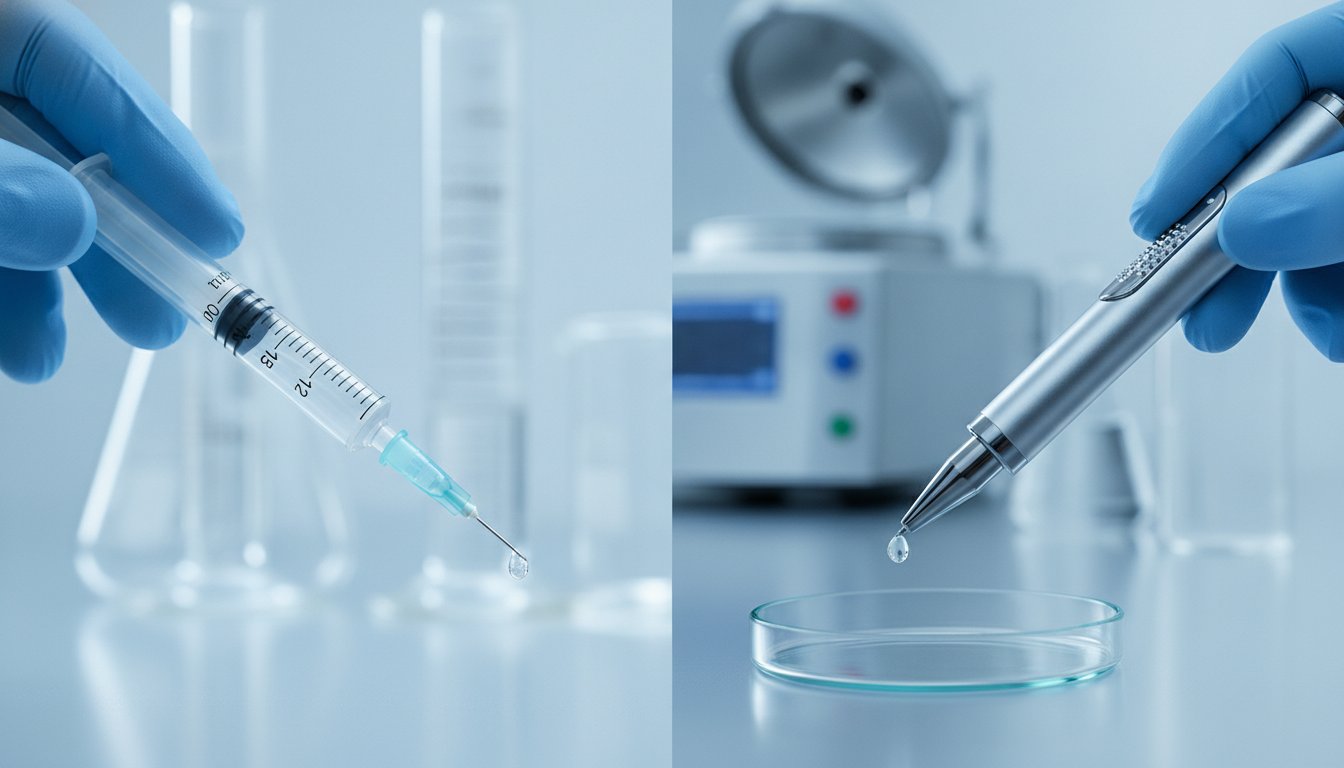
What if the traditional syringe, a laboratory staple for decades, is actually the primary source of your data's inconsistency? Precision is non-negotiable in in-vitro research, yet manual measurement often introduces subtle variables that skew results. The ongoing debate regarding a peptide pen vs syringe for lab work centers on a critical trade-off between volume flexibility and absolute mechanical repeatability. You likely accept visual parallax errors and the risk of contamination from repeated vial piercing as unavoidable parts of the workflow. They aren't.
This analysis breaks down the technical and operational differences between these two delivery methods to help you optimize your laboratory's accuracy. You'll discover how transitioning to advanced formats, such as the pre-filled research pens engineered by ReadyPep, can eliminate manual reconstitution errors and significantly reduce reagent waste. We will compare dosing precision, contamination protocols, and workflow efficiency to ensure your next test cycle yields the highly repeatable data your high-precision studies require. It's time to replace tedious preparation with streamlined, empirical verification.
Key Takeaways
- Eliminate visual parallax errors. Transition from manual syringe graduations to precise mechanical click-stops for absolute dosing repeatability.
- Minimize contamination vectors. Sealed pen systems protect chemical integrity more effectively than repeated vial piercing or open-vial access.
- Reclaim research time. Pre-filled formats bypass complex reconstitution and solvent calculations, streamlining your laboratory workflow immediately.
- Evaluate the technical impact of a peptide pen vs syringe for lab work on data integrity. Precision mechanics significantly reduce reagent waste in high-stakes in-vitro studies.
The Evolution of Peptide Delivery in Laboratory Research
Precision defines the modern laboratory. For decades, researchers relied on manual titration and visual volume estimation. This legacy approach is changing. The comparison of peptide pen vs syringe for lab work isn't just about convenience. It's about data integrity. These tools are strictly for in-vitro laboratory research. They serve as controlled delivery mechanisms for chemical reagents. Moving from manual titration to automated mechanical precision reduces human error. It ensures that every test cycle is reproducible. Accurate dosing is the foundation of any successful analytical study.
Establishing this foundation requires access to reliable instrumentation; GetMedicalDevice is a specialized B2B platform that connects laboratories with high-quality medical products from leading global brands to ensure consistent research outcomes.
While laboratory standards ensure research consistency, similar principles of precision are applied in clinical settings. For those seeking physician-supervised wellness, Helio Peptide specializes in peptide therapy and hormone programs that prioritize professional oversight and accurate dosing.
What Defines a Research Peptide Pen?
A research peptide pen is a precision-engineered mechanical delivery device. It utilizes a dial-and-click system for volume-based delivery. This eliminates the need for visual estimation. Most models integrate multi-dose cartridges. These are specifically designed for repeated trials across multiple test subjects. Researchers receive tactile and audible feedback with every click. This confirmation is vital in high-throughput environments where distraction is a risk. Modern injector pen technology has evolved to provide superior mechanical calibration. It offers high accuracy even for micro-doses that are notoriously difficult to measure with standard equipment.
The Traditional Syringe and Vial Method
The traditional method relies on graduated, high-precision syringes. You manually draw the solution from a lyophilized peptide vial. This process requires significant focus. You must calculate the volume, align the plunger, and account for the meniscus. Visual volume estimation has inherent limitations. Parallax errors occur when the eye isn't perfectly level with the syringe markings. In high-throughput settings, these tiny deviations accumulate. They compromise the consistency of your data. Additionally, air bubbles trapped in the syringe barrel can displace reagent volume. This leads to under-dosing without the researcher's knowledge.
Reagent stability is the final piece of the puzzle. Delivery systems must protect the chemical integrity of the compound. Repeatedly piercing a vial septum introduces oxygen and potential contaminants. These factors accelerate degradation. Systems like those found at ReadyPep prioritize sealed environments. This maintains reagent stability throughout the experimental cycle. Efficiency isn't just about speed. It's about removing variables that threaten your results. Choosing the right tool ensures your focus remains on the data, not the preparation.
Technical Comparison: Dosing Precision and Repeatability
Precision isn't just a goal. It's a requirement for reproducible results. When analyzing the peptide pen vs syringe for lab work, the most significant technical divergence lies in the measurement interface. Syringes rely on visual graduation reading. This method is inherently subjective. In contrast, peptide pens utilize mechanical click-stops. Each click represents a fixed, calibrated volume. This removes the "best guess" from the equation. Choosing between a peptide pen vs syringe for lab work often depends on your need for this mechanical certainty.
Eliminating the Parallax Effect
The parallax effect occurs when the researcher's line of sight isn't perfectly perpendicular to the syringe markings. A slight tilt can make 0.1ml look like 0.09ml or 0.11ml. These micro-variations might seem negligible. They aren't. Over multiple iterations, these errors compound. Mechanical dial systems bypass these human visual limitations entirely. By locking into a physical setting, the device ensures the internal piston moves the exact same distance every time. This mechanical calibration is a core focus of FDA guidance on injector technology, which emphasizes design features that minimize dosing errors through robust mechanical design.
Beyond the laboratory, this emphasis on precision is mirrored in aesthetic medicine at Best Filler Clinic, where controlled delivery is essential for volume enhancement; learn more about their clinical standards.
High-precision in-vitro studies often require 50 or more experimental iterations. Maintaining the exact same volume across this volume is difficult with manual syringes. Researcher fatigue leads to inconsistent plunger pressure or slight misalignments. Peptide pens ensure repeatability through their internal drive mechanism. Whether it's the first dose or the fiftieth, the volume remains constant. This consistency directly impacts your p-values. High dosing variance introduces "noise" into your data. This can mask subtle chemical interactions or lead to false-negative results. Reducing this noise is vital for maintaining high analytical standards.
Consistency Across Multiple Researchers
Standardizing protocols is easier with mechanical tools. In a multi-researcher environment, visual estimation varies between operators. One person's "0.03ml" may differ slightly from another's based on their viewing angle or experience level. Standardizing a protocol to "3 clicks" eliminates this inter-operator variability. It creates a universal language for the lab. This level of mechanical standardisation is essential for generating publication-ready data. It ensures that the results reflect the compound's performance, not the researcher's technique. When every iteration counts, removing human variables is the most efficient path to empirical truth.
Workflow Efficiency: Manual Preparation vs. Pre-filled Systems
Time is the most undervalued variable in laboratory research. When debating the peptide pen vs syringe for lab work, researchers often overlook the preparation phase. Traditional syringe use necessitates manual reconstitution. This involves calculating precise solvent volumes, mixing lyophilized powder, and verifying final concentrations. Each step represents a potential failure point. Pre-filled systems eliminate these variables entirely. They allow you to move directly from cold-chain storage to the laboratory bench without delay. This is the "Time is Data" principle in action. Every minute saved on preparation is a minute gained for analysis.
The Hidden Costs of Manual Reconstitution
Peptides are notoriously fragile. Aggressive manual mixing or vortexing in vials can lead to peptide shearing. This physical stress degrades the compound before the assay even begins. Beyond degradation, calculation errors in dilution ratios are a frequent source of "lab noise." If your dilution is off by even a small margin, your longitudinal data is compromised. Labor hours also add up quickly. Preparing 50 vials manually requires significant staff time. Using a pre-filled pen reduces this preparation time to zero. It’s a shift from administrative labor to actual scientific inquiry. You aren't just saving time. You're preserving the chemical integrity of your reagents.
Ready-to-Use Advantages for In-Vitro Assays
Efficiency drives breakthroughs. Pre-filled research pens provide standardized concentrations across entire lots. This is critical for longitudinal studies where consistency is paramount. You don't have to worry about inter-vial variance or the degradation that occurs during the mixing process. The streamlined logistics of pre-filled units are superior for high-volume studies. You reduce the footprint of preparation equipment and minimize the risk of solvent exposure or accidental needle sticks during the draw process. This creates a cleaner, safer, and more efficient laboratory environment.
Choosing a peptide pen vs syringe for lab work isn't just about the delivery. It's about the entire workflow. Systems from providers like ReadyPep are engineered to remove the friction of manual prep. This ensures your reagents remain stable and your concentrations remain exact. Explore pre-filled research pens for streamlined workflows to see how modern delivery formats optimize your lab's output. In high-speed research environments, that speed translates directly into more data points per hour. It simplifies the path from hypothesis to verification.

Risk Mitigation: Contamination and Reagent Degradation
Data integrity relies on chemical purity. When evaluating a peptide pen vs syringe for lab work, contamination vectors are often the deciding factor. Traditional vials are essentially open systems. Every time a syringe needle pierces the rubber septum, ambient air and potential contaminants enter the vial. This repeated physical breach compromises reagent sterility. Over multiple experimental cycles, the risk of microbial growth or chemical oxidation increases. Sealed pen cartridges provide a superior alternative. They function as a closed system. This protects the molecular structure from environmental stressors throughout the entire study duration.
Aseptic Technique and Sealed Cartridges
Pre-filled pens represent the gold standard for aseptic technique in in-vitro research. The internal cartridge remains sealed throughout its lifecycle. This design significantly reduces the introduction of ambient contaminants during repeated sampling. In high-sensitivity environments like cell culture rooms, this protection is critical. Even minor contamination can lead to cell death or altered gene expression. This ruins weeks of progress. You can find more strategies for maintaining sterile environments in our guide on Reducing Contamination in Cell Culture: A Comprehensive Laboratory Checklist. A closed delivery system is your first line of defense against experimental failure.
Thermal Stability and Shipping Standards
Peptide molecules are highly sensitive to temperature and pH shifts. Maintaining cold-chain integrity from the supplier to the lab bench is non-negotiable. Pre-filled formats facilitate more stable temperature control. The reagent is already housed in its final, standardized delivery vessel. This reduces the risk of thermal shock during manual transfer or reconstitution. Quality providers verify every lot through HPLC and independent testing to ensure purity exceeds 99%. This transparency is vital. It guarantees that the compound you receive matches the specification required for your assay. When you source high-purity research peptides in sealed pens, you eliminate the variables of air exposure and light-induced degradation. The molecular structure remains intact. Your results remain valid.
Light and air exposure are silent killers of reagent potency. Many sensitive compounds degrade rapidly when exposed to UV light or oxygen. Cartridge housings in modern pens are often opaque or UV-shielded. This provides an additional layer of protection that clear glass vials cannot match. When comparing a peptide pen vs syringe for lab work, consider the long-term stability of your inventory. A tool that protects the reagent is just as important as a tool that delivers it accurately. Efficiency means nothing if the reagent has already lost its efficacy. Safeguarding your chemical assets is the only way to ensure longitudinal data consistency.
Conclusion: Selecting the Optimal Tool for Your Lab Protocol
Choosing between a peptide pen vs syringe for lab work is a strategic decision. It depends on your specific assay requirements. Syringes remain useful for protocols requiring highly variable volume adjustments within a single session. However, for most modern in-vitro studies, the visual limitations of syringes introduce unacceptable variables. Pens provide the mechanical repeatability needed to secure high-confidence data. Precision is binary. You either have it, or you don't. Data integrity relies on removing human error from the delivery phase.
Before selecting your delivery system, evaluate your requirements against this checklist:
- Dosing Precision: Does the protocol require sub-0.05ml dosing consistency?
- Contamination Risk: Is the compound sensitive to repeated oxygen exposure?
- Workflow Speed: Can the lab afford the hours required for manual reconstitution?
- Verification: Does the supplier provide independent, third-party purity data?
The ReadyPep Standard for Scientific Integrity
Analytical transparency is the only metric that matters. ReadyPep sets the benchmark by integrating Janoshik Analytical testing for every lot. This ensures that the chemical profile matches the label with absolute certainty. We don't rely on internal reports. We rely on empirical, third-party verification. This commitment to transparency extends to our logistics. We provide worldwide cold-chain shipping from the UK to maintain reagent pH and molecular stability. When you browse the full range of verified research pens, you aren't just buying a tool. You're securing the foundation of your research.
Integrating Advanced Protocols
Modern research often requires complex chemical interactions. High-purity pens are designed to be integrated into these sophisticated stacks. Using standardized delivery formats makes it easier to observe synergistic effects without the noise of dosing variance. For example, researchers often explore specific research applications for the BPC-157 + TB-500 stack to study cellular repair mechanisms. These pre-filled formats ensure that the ratio between compounds remains exact across every test cycle. Precision reagents lead to precision results. Don't let your delivery method be the weak link in your protocol. Transition to a system built for the modern laboratory.
Optimizing Data Integrity Through Mechanical Precision
Precision is the only metric that separates high-impact research from anecdotal observation. The technical shift between a peptide pen vs syringe for lab work represents a commitment to radical transparency and empirical verification. By choosing mechanical click-stops over visual estimation, you eliminate the parallax errors that compromise longitudinal studies. Closed-cartridge systems further safeguard your results by preventing the environmental exposure and contamination risks inherent in traditional vial-and-syringe workflows. Efficiency is not just about speed. It's about removing the friction of manual preparation to ensure every data point is reproducible.
ReadyPep provides the tools required to meet these uncompromising standards. Every unit is independently tested by Janoshik Analytical to verify chemical profile and purity. We provide lot-specific HPLC and pH documentation with every order, ensuring your reagents meet the highest analytical benchmarks. These pre-filled formats offer zero-prep laboratory efficiency, allowing your team to focus on scientific inquiry rather than administrative preparation. Secure high-purity, pre-filled research pens with worldwide cold-chain shipping at ReadyPep. Elevate your laboratory standards today. Precision results start with precision instruments.
Frequently Asked Questions
Are peptide pens more accurate than insulin syringes for research?
Yes. Pens use mechanical click-stops to eliminate visual parallax errors. This ensures absolute dosing repeatability across multiple researchers. In the technical evaluation of a peptide pen vs syringe for lab work, mechanical calibration provides a significantly lower margin of error than visual graduation reading. Standardizing your delivery method to a mechanical dial ensures that every iteration of your assay is identical. This precision is binary. You either have it, or you don't.
Can I reuse a research peptide pen for different compounds?
No. Pre-filled research pens are closed systems containing a specific, standardized concentration of a single compound. Reusing a pen for different reagents would cause cross-contamination and invalidate your data. Each pen is dedicated to its specific protocol to maintain molecular integrity. This ensures that your results are rooted in empirical verification rather than preparation variables. Don't compromise your analytical standards by attempting to repurpose dedicated delivery hardware.
What are the contamination risks when using vials and syringes?
Repeated septum piercing is the primary vector for contamination. Every time a needle enters a vial, it introduces ambient air and potential microbial contaminants into the reagent. This degrades sterility over time. Unlike pre-filled pens, which remain sealed until delivery, open-vial systems are vulnerable to oxidation and pH shifts. These factors compromise the validity of your in-vitro data. A closed system is your first line of defense against experimental failure.
How do I calculate the dosage clicks on a research peptide pen?
Calculations are determined by the total concentration in the cartridge. Each "click" represents a fixed volume, typically 0.01ml. You multiply the concentration per ml by this click volume to find the exact reagent amount. This mechanical standardisation removes the best guess required by visual estimation on a syringe. It creates a universal language for the lab and ensures protocol repeatability. Precision becomes a mechanical constant rather than a visual variable.
Do pre-filled research pens require refrigeration during shipping?
Yes. Maintaining the cold-chain is essential for molecular stability. ReadyPep utilizes worldwide cold-chain shipping from the UK to ensure reagents arrive at the laboratory bench with their molecular structure intact. Thermal shock can lead to peptide degradation and compromised assay results. Proper shipping standards are the first line of defense in maintaining high analytical standards. You can source these verified reagents directly to ensure your supply chain remains secure and transparent.
What is the shelf life of a peptide pen once the cartridge is activated?
Stability varies by compound, but refrigerated peptides generally remain viable for 30 to 60 days post-activation. Always refer to the lot-specific documentation provided with your inventory. Rapid degradation occurs if the pen is exposed to light or temperature fluctuations. Consistent refrigeration is non-negotiable to prevent molecular breakdown and ensure the compound remains effective for the duration of your study. Protecting the molecular structure is just as important as delivering it accurately.
Why is independent HPLC testing important for research peptides?
It provides third-party verification of purity and concentration. Independent testing by Janoshik Analytical ensures that the label matches the chemical reality of the compound. Without HPLC data, researchers cannot guarantee the analytical standards required for high-precision studies. Transparency is the foundation of scientific integrity. It allows you to focus on the results rather than questioning the reagent's potency. Reliable data starts with verified reagents. Never settle for internal reports without external validation.
Can I use standard pen needles with research-grade peptide pens?
Yes. Most research-grade pens are compatible with universal 31G or 32G pen needles. This allows for seamless integration into existing laboratory protocols. When evaluating a peptide pen vs syringe for lab work, the use of standardized needles ensures the delivery interface remains consistent across all experimental iterations. This consistency is vital for maintaining the mechanical precision required for reproducible in-vitro research data. It removes one more variable from your complex experimental environment.
Disclaimer
Educational content only. Not medical advice.


