
The traditional method of manual peptide reconstitution is a liability for modern research accuracy. Inconsistent dosing and rapid degradation during shipping often compromise the integrity of in-vitro studies before they even begin. By utilizing a BPC-157 TB-500 stack pen, researchers can bypass the friction of manual preparation and focus on the data. This pre-filled format ensures that the dual-peptide synergy remains stable and precisely measured. It's time to move past the era of guesswork and embrace a delivery system designed for clinical precision.
You likely understand that the "Wolverine Stack" offers unique systemic and localized repair mechanisms, but maintaining those properties requires high-purity reagents and verified standards. This guide explores how the BPC-157 and TB-500 dual-peptide stack optimizes laboratory workflows through synergistic action and precision pen delivery. We'll break down the technical specifications of these compounds, the impact of the upcoming July 2026 FDA review, and how to ensure your laboratory reagents meet the highest analytical benchmarks. For researchers who prioritize efficiency, moving to a streamlined, pre-filled system is the most direct path to consistent data.
Key Takeaways
- Understand the synergistic relationship between BPC-157’s angiogenic properties and TB-500’s actin-sequestering capabilities for superior in-vitro outcomes.
- Analyze why the BPC-157 TB-500 stack pen eliminates the variables and degradation risks associated with traditional manual reconstitution.
- Streamline laboratory protocols by utilizing precision "click" delivery systems that ensure reproducible dosing across every trial.
- Protect your data integrity by identifying the specific thermal vulnerabilities of these compounds during transport and storage.
- Verify reagent quality through independent third-party analysis, ensuring your research is backed by empirical purity data.
The Science of Synergy: Understanding the BPC-157 and TB-500 Dual Mechanism
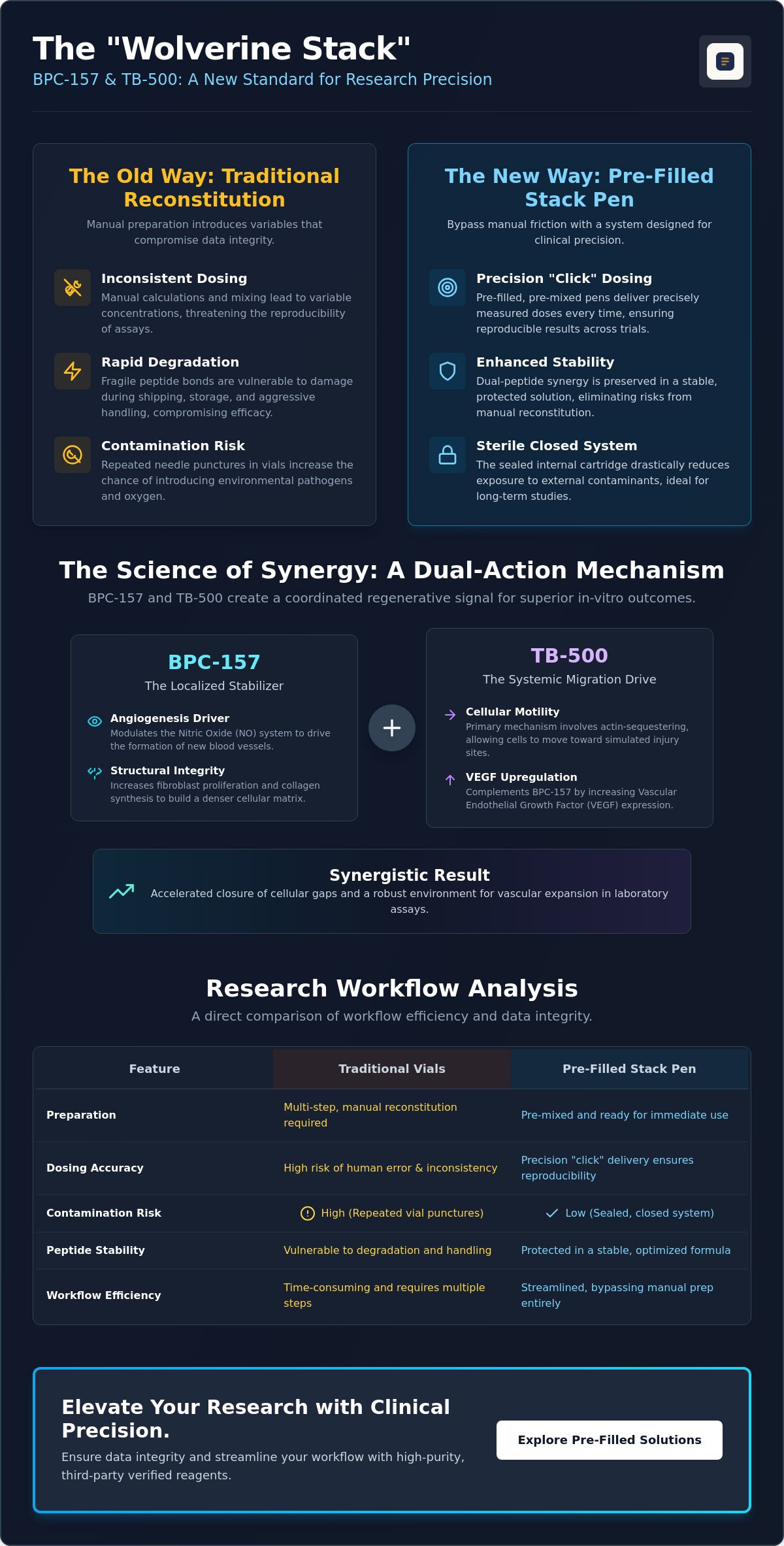
The efficacy of in-vitro regenerative research depends on how precisely the experimental model mimics biological repair. BPC-157 and TB-500 represent two distinct yet overlapping pathways in this process. BPC-157, a gastric pentadecapeptide, is primarily recognized for its angiogenic properties and its ability to modulate the nitric oxide system. In contrast, TB-500 is a synthetic fragment of Thymosin Beta-4, a major actin-sequestering protein that facilitates cellular motility. When these compounds are integrated into a BPC-157 TB-500 stack pen, researchers gain a dual-action instrument capable of targeting multiple phases of cellular regeneration simultaneously.
Stacking these peptides is not merely an additive process; it's a strategic coordination of cellular signals. In laboratory settings, BPC-157 acts as a localized stabilizer, while TB-500 provides the systemic drive for cell migration. This combination is particularly effective for cellular regeneration studies where researchers must observe how different proteins interact to close gaps in a cellular matrix. Using a BPC-157 TB-500 stack pen ensures that these ratios remain constant, providing the baseline stability required for reproducible in-vitro assays.
Angiogenesis and Vascular Endothelial Growth Factor (VEGF)
BPC-157 drives the formation of new blood vessels by modulating the nitric oxide (NO) system. This process is fundamental for delivering nutrients to experimental cellular environments. TB-500 complements this by upregulating the expression of Vascular Endothelial Growth Factor (VEGF) within cell culture models. Together, they create a robust environment for vascular expansion. This synergy is critical for studies focusing on ischemic tissue recovery and nutrient delivery to damaged matrices. For protocols requiring high-purity reagents, the BPC-157 + TB-500 40mg pre-filled format offers a streamlined solution that maintains the integrity of these delicate pathways.
Actin Polymerization and Cellular Migration
TB-500’s primary mechanism involves actin-sequestering, which allows cells to reorganize their cytoskeleton and move toward a simulated injury site. This motility is the first step in tissue repair. BPC-157 then enhances this progress by driving fibroblast proliferation and collagen synthesis.
- TB-500: Facilitates the movement of cells to the gap.
- BPC-157: Increases the density and structural integrity of the new growth.
BPC-157 TB-500 Stack Pen vs. Traditional Vials: A Research Workflow Analysis
The transition from traditional lyophilized vials to a BPC-157 TB-500 stack pen represents a significant shift in laboratory efficiency. Traditional vials require a multi-step reconstitution process. This involves calculating solvent volumes, ensuring sterile transfer, and managing fragile peptide bonds that can denature if handled aggressively. Every manual step introduces a variable. Every variable threatens the reproducibility of your data. Pre-filled pens eliminate these friction points. They arrive pre-mixed in precise concentrations, allowing researchers to bypass the preparation phase entirely. This isn't just about convenience. It's about removing the human factor that often leads to dosing discrepancies.
Contamination risk is a silent killer of research integrity. Traditional vials require repeated needle punctures through a rubber stopper. Each entry increases the chance of introducing environmental pathogens or atmospheric oxygen. Pre-filled pens operate as closed systems. The internal cartridge remains sealed, significantly reducing exposure to external contaminants. This design is particularly beneficial for long-term in-vitro studies where sterility is non-negotiable. In high-throughput settings, the time saved translates directly into more consistent longitudinal observations.
Precision and Accuracy in Micro-Dosing
Manual syringe measurement is prone to parallax error and dead-space loss. A BPC-157 TB-500 stack pen utilizes a mechanical click dial that delivers a fixed volume with mathematical certainty. This system provides a clear advantage in micro-dosing protocols where even a 0.05mL deviation can skew cellular uptake results. By adhering to strict Peptide Pen Quality Control standards, these devices ensure the concentration of both BPC-157 and TB-500 remains uniform from the first dose to the last. This level of accuracy is nearly impossible to maintain across multiple hand-reconstituted vials.
Stability of Aqueous Solutions in Research
A common misconception suggests that peptides in aqueous form degrade faster than their lyophilized counterparts. This is only true in unstable environments. Professional-grade pens utilize pH-balanced bacteriostatic water and stabilizing buffers to maintain peptide integrity. These formulations protect the compounds from thermal fluctuations and oxidation. Lot-specific testing is essential here. It verifies that the aqueous stack remains potent throughout its shelf life. Researchers seeking to reduce laboratory workflow friction often find that pre-filled research pens offer a more stable and reliable alternative to manual mixing. Results depend on stability. Stability depends on precision.
Optimising In-Vitro Protocols with the BPC-157 TB-500 Combination
Integrating a BPC-157 TB-500 stack pen into in-vitro protocols requires a shift from manual volumetric measurement to mechanical precision. Establishing a baseline for cellular uptake begins with defining the exact molar concentration required for your specific cell line. Because the pen provides a standardized, pre-mixed ratio, researchers can eliminate the variable of mixing error. This allows for a cleaner comparison between experimental groups. Reproducibility becomes a function of the device's mechanical accuracy rather than the researcher's steady hand. It's about creating a controlled environment where the data reflects the peptide's action, not the preparation's flaws.
Monitoring stability during an active experiment is equally vital. Unlike open vials, the pen's internal cartridge protects the solution from oxidation. However, researchers must still log environmental factors like ambient temperature and light exposure during the assay. Data logging requirements should include the specific lot number and the third-party purity certificate for every unit used. This level of transparency ensures that if a result deviates, you can trace the reagent's history with absolute certainty. High-quality research demands high-quality documentation.
Preparing the Research Environment
Aseptic technique remains non-negotiable. Even with a closed system, the septum interface must be sanitized with 70% isopropyl alcohol before and after every session. Calculating the required "clicks" is a straightforward mathematical process. If one click equals a fixed volume, and your pen contains a BPC-157 + TB-500 40mg concentration, you can dial in precise molarity with zero waste. Store the pen between 2°C and 8°C. This maintains the efficacy of the bacteriostatic water and prevents microbial proliferation during multi-week studies.
Documenting Synergistic Effects
To isolate synergy, your study design should include four distinct groups: a control, BPC-only, TB-only, and the combined stack. Monitor fibroblast migration and actin filament organization using high-resolution microscopy. Observations of cellular "gap closure" provide the most compelling evidence of the dual-peptide mechanism. Documenting these findings requires rigorous data logging. Every session should record the pen's lot number and the associated Certificate of Analysis. Following established Research Peptide Quality Standards ensures that your data is verifiable and ready for peer review. Integrity in research starts with the quality of the starting material. When you choose a BPC-157 TB-500 stack pen, you're choosing a system designed for this level of empirical scrutiny.
Cold-Chain Logistics: Protecting Peptide Integrity from Lab to Bench
Peptide research is only as reliable as the stability of the reagents. While previous sections focused on the mechanical precision of the BPC-157 TB-500 stack pen, those advantages are void if the proteins denature during transit. BPC-157 and TB-500 are highly sensitive to thermal fluctuations. When a cold chain is "broken," the primary structure of the peptide can unfurl, rendering the compound biologically inactive. This leads to failed in-vitro experiments and wasted laboratory resources. Protecting these molecules requires more than just a box. It requires a sophisticated logistics network designed to maintain a consistent temperature range from the point of manufacture to the researcher’s bench.
ReadyPep manages this through a rigorous UK-based distribution system. By shipping worldwide from the UK, we ensure that transit times are minimized and that every BPC-157 TB-500 stack pen remains within the required 2°C to 8°C window. We utilize advanced insulated packaging combined with phase-change materials (PCMs). Unlike traditional ice packs, PCMs are engineered to absorb or release thermal energy at specific temperatures. This provides a more stable internal environment for high-value research chemicals, even during international transit. Precision in the lab starts with precision in the mailroom.
Thermal Stability and Peptide Half-Life
What happens when TB-500 is exposed to room temperature for extended periods? The molecular bonds begin to weaken. In aqueous solutions, this degradation often manifests as cloudiness or precipitation. These are visible indicators that the protein has lost its tertiary structure. Researchers must insist on temperature-monitored transit to ensure their data isn't compromised by environmental heat. A denatured peptide won't yield reproducible results. It will only yield noise. Verifying the physical state of the solution upon arrival is a non-negotiable step in any sterile lab workflow.
UK-Based Distribution and Global Compliance
Operating from the UK provides a strategic advantage for global researchers. Our logistics team is well-versed in customs clearance for research chemicals, ensuring that sensitive shipments aren't delayed at international borders. Every shipment includes lot-specific documentation to verify the reagent's history upon arrival at the laboratory. This transparency is part of our commitment to research integrity. If you require high-purity reagents that arrive with their molecular integrity intact, you can purchase pre-filled research pens directly from our UK-based facility. Reliability isn't an accident. It's the result of a controlled, verifiable supply chain.
The ReadyPep Standard: Verification, Purity, and Research Integrity
The integrity of in-vitro research relies on the absolute verification of the starting material. At the core of this process is Metatide Healthcare, the manufacturing benchmark for every BPC-157 TB-500 stack pen. We operate with a transparency-first model. This means moving beyond internal quality checks and submitting every lot to independent scrutiny. In an industry often clouded by vague claims, empirical data is the only currency that matters. We provide that data upfront.
Analytical rigor shouldn't be a luxury. It's a requirement. Most researchers focus solely on purity percentages; however, pH levels are equally critical for maintaining cell viability in culture models. If a solution is too acidic or too basic, it introduces a lethal variable to your assay. We verify that every pen maintains a physiological pH range. This ensures that your experimental results are a product of peptide interaction, not chemical stress. Precision is the difference between a breakthrough and a failed trial.
Janoshik Testing: Beyond HPLC Purity
HPLC purity tells you how much of a substance is present, but it doesn't always confirm what that substance is. That's why we utilize Janoshik Analytical for independent third-party verification using mass spectrometry. This process identifies the unique molecular fingerprint of the peptide. It confirms that the 40mg concentration in our Repair Protocol is exactly as stated: a precise 20mg BPC-157 and 20mg TB-500 split. Without this identification, you're essentially researching with a black box. Independent testing is the only defense against under-dosed or mislabeled reagents.
Interpreting a Certificate of Analysis (CoA) is a fundamental skill for any PI or laboratory manager. Each CoA provides a snapshot of the lot’s purity, identity, and stability. You can access these documents directly through our portal to verify the specific batch in your inventory. This level of detail removes the uncertainty that often plagues the procurement of research chemicals. Data doesn't lie. We make sure you have it.
ReadyPep’s Research-First Philosophy
ReadyPep maintains a strict research-first philosophy. Our pre-filled pens are engineered exclusively for in-vitro study and laboratory analysis. We've streamlined the procurement process to meet the demands of both academic and private institutions, providing a direct path to high-purity reagents. If your protocol requires a stabilized, verified, and precisely dosed dual-peptide system, you can find the BPC-157 + TB-500 40mg inventory ready for immediate dispatch. We don't just provide peptides. We provide the certainty your research deserves.
Advancing Research Integrity with Precision Delivery
Precision is the only acceptable standard for in-vitro research. By integrating the BPC-157 TB-500 stack pen into your workflow, you eliminate the variables of manual reconstitution and thermal instability. You've seen how the synergistic dual-mechanism of these compounds drives cellular regeneration studies. Now, you can ensure your reagents match the quality of your hypotheses. Every unit is manufactured by Metatide Healthcare and independently verified by Janoshik Analytical. This isn't just about convenience; it's about securing the integrity of your data through analytical rigor and free worldwide cold-chain shipping.
Reliability is a choice. Don't let inconsistent dosing or broken logistics compromise your laboratory findings. You can secure your high-purity BPC-157 + TB-500 40mg stack pen today and experience the ReadyPep standard of transparency. Your research deserves reagents that are as precise as your protocols. Take the next step toward reproducible excellence.
Frequently Asked Questions
Is the BPC-157 TB-500 stack pen suitable for human use?
No, the BPC-157 TB-500 stack pen is strictly intended for in-vitro laboratory research. It isn't approved for human or veterinary therapeutic use. For those interested in established animal wellness and premium nutrition, platforms such as Petguru provide specialized dietary options. These research peptides are sold as chemical reagents for use in controlled experimental environments only.
How long does a pre-filled BPC-157 TB-500 pen remain stable after opening?
Stability typically lasts for 30 days once the cartridge is punctured, provided it's stored between 2°C and 8°C. The bacteriostatic water and stabilizing buffers help maintain peptide integrity during this period. Researchers should always inspect the solution for cloudiness or precipitation before starting an assay to ensure the proteins haven't denatured.
What is the concentration of BPC-157 and TB-500 in the 40mg stack pen?
The 40mg stack pen contains a precise 1:1 ratio, consisting of 20mg BPC-157 and 20mg TB-500. This standardized concentration ensures that researchers can maintain consistent molarity across multiple experimental groups. Every batch is verified through independent mass spectrometry to confirm these exact levels before distribution.
How do I calculate the dosage for an in-vitro experiment using the pen clicks?
Calculation depends on the fixed volume delivered per mechanical click and the total mg/mL concentration of the solution. For a BPC-157 TB-500 stack pen containing 40mg in 4mL, each 0.1mL click delivers 1mg of the total peptide blend. Researchers should verify their specific lot's volume-per-click to ensure precise molar concentrations in their cellular assays.
Does ReadyPep provide independent lab test results for every batch?
Yes, every batch undergoes rigorous third-party verification by Janoshik Analytical. We provide a lot-specific Certificate of Analysis (CoA) that confirms both purity and correct peptide identification. This commitment to transparency ensures that your laboratory reagents meet high analytical standards and produce reproducible data.
What happens if my peptide pen arrives at room temperature?
Brief exposure to ambient temperatures during transit is usually managed by our insulated packaging and phase-change materials. If the solution remains clear upon arrival, the molecular structure is likely intact. However, if you observe cloudiness or particulates, it suggests the peptides have denatured; in such cases, the reagent shouldn't be used for precision research.
Can I use the BPC-157 TB-500 stack for in-vivo animal studies?
No, our products are not for in-vivo animal testing or any form of clinical trial. ReadyPep focuses exclusively on the procurement of high-purity reagents for in-vitro study and laboratory analysis. Our pre-filled pens are engineered for the specific requirements of cellular models and biochemical research.
Why is TB-500 often combined with BPC-157 in research models?
These compounds are combined because they address complementary cellular pathways. BPC-157 is primarily studied for its angiogenic and collagen-modulating effects, while TB-500 is focused on cellular migration through actin-sequestering. Stacking them allows researchers to observe a more comprehensive regenerative response in cellular gap-closure assays.
Disclaimer
Educational content only. Not medical advice.


