
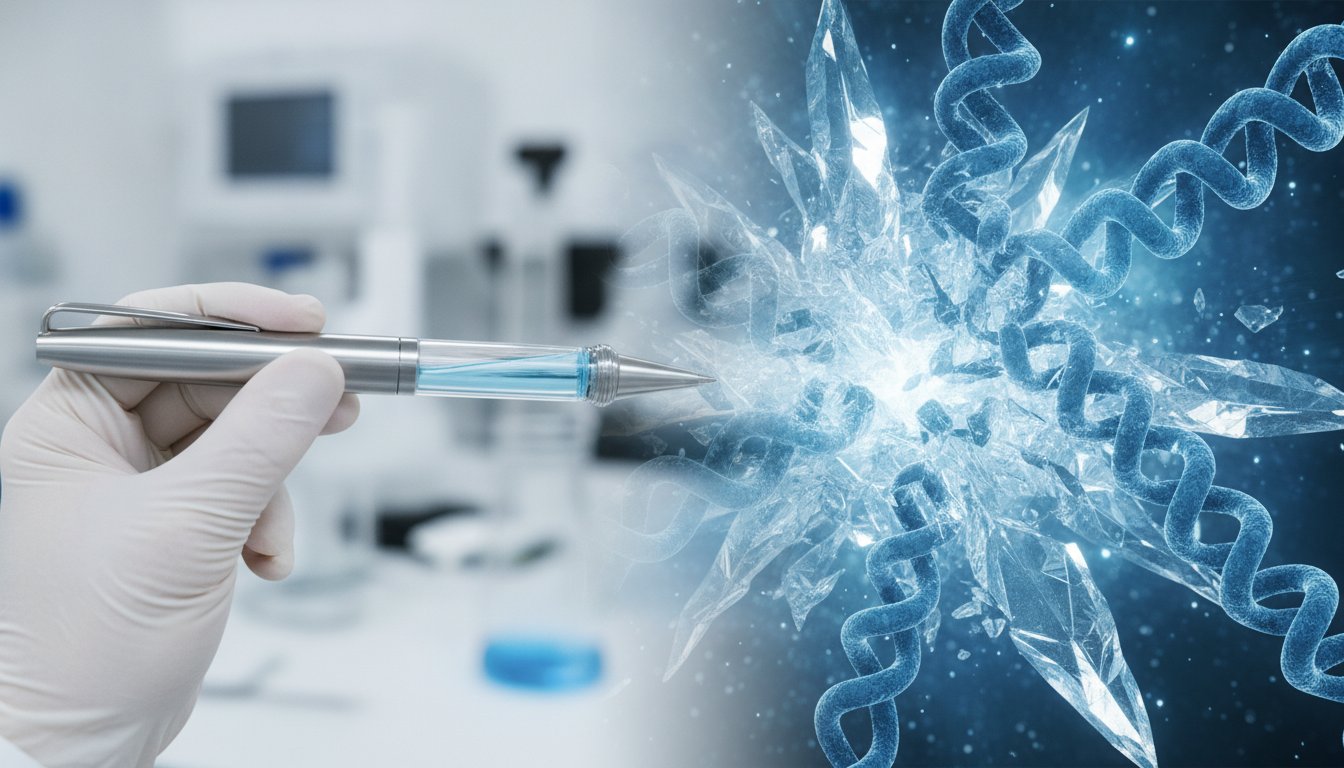
Every thermal cycle is a calculated gamble with your research budget. When you pull a bulk vial from -20°C, you aren't just thawing a reagent; you're potentially triggering molecular aggregation that renders your work useless. Preventing freeze-thaw damage to peptides is not merely a storage preference. It's a fundamental requirement for data integrity. You've likely experienced the frustration of inconsistent results or the financial loss of a degraded sample. It's an avoidable friction in the lab. We understand that precision is non-negotiable. This guide provides the technical protocols to eliminate thermal degradation risks entirely. You'll master the strategies needed to maintain 100% bioactivity from the first use to the last. We'll examine why the shift from traditional bulk aliquoting to modern, ready-to-use formats like pre-filled research pens is the most effective way to ensure reproducible data and a streamlined workflow. Stop settling for compromised purity and start prioritizing empirical verification.
Key Takeaways
- Identify the exact physical mechanisms behind ice crystal formation and peptide structural collapse during phase transitions.
- Implement precise aliquoting protocols using low-protein binding materials to protect your research budget and reagent integrity.
- Utilize flash-freezing methods to maintain solvent-solute homogeneity and prevent irreversible molecular aggregation.
- Discover why modern pre-filled formats are the most reliable method for preventing freeze-thaw damage to peptides while streamlining lab workflows.
- Optimize your cold-chain management to ensure reproducible data and 100% reagent purity across every experimental cycle.
The Molecular Impact of Freeze-Thaw Cycles on Peptides
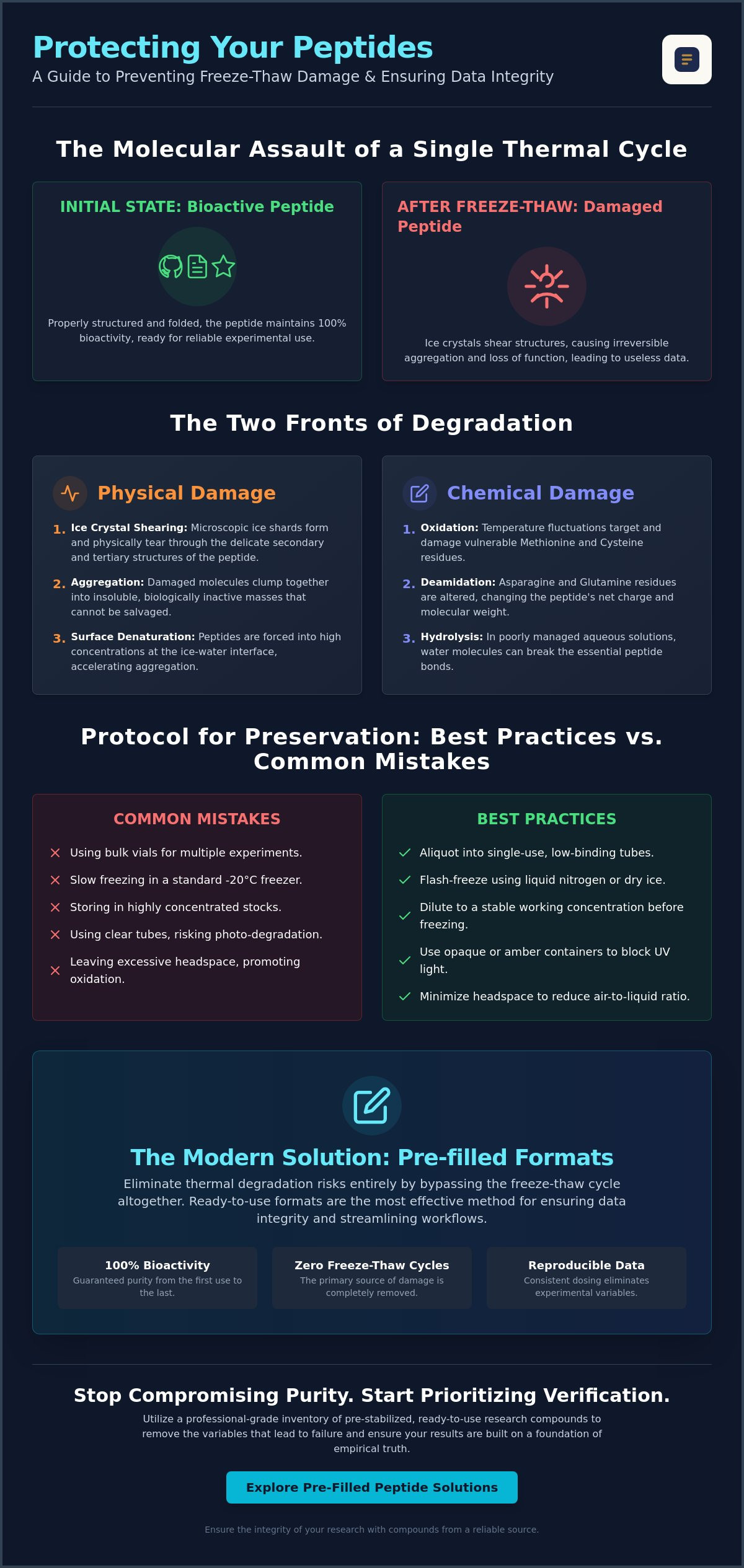
Freeze-thaw damage isn't just a cooling issue; it's a structural assault on your reagents. Every phase transition between liquid and solid states forces a peptide to reorganize at a molecular level. This repeated stress causes both physical and chemical degradation that is often irreversible. During the freezing process, ice crystals act as microscopic blades. They shear through the delicate secondary and tertiary structures that define a peptide’s function. If these structures collapse, the peptide loses its ability to bind to target receptors, rendering your experimental data useless.
When these molecules lose their native conformation, they don't remain isolated. They aggregate. This clumping results in insoluble masses that cannot be salvaged by simple vortexing. Aggregation makes the compounds biologically inactive and can even trigger unintended immune responses in specific assays. If you manage aqueous solutions poorly, you also invite hydrolysis. This is where water molecules actively break the peptide bonds you're trying to preserve. Mastery of Cryopreservation principles is the first step in preventing freeze-thaw damage to peptides and ensuring long-term stability.
Surface Denaturation and Ice-Water Interfaces
Peptides are often "excluded" from growing ice crystals during the freezing process. This phenomenon concentrates the solutes at the narrow interface between the ice and the remaining liquid water. In these zones, the local concentration of the peptide skyrockets, which directly facilitates molecular clumping. Mechanical stress from water expansion pulls at molecular bonds with significant force. While shorter sequences under 50 amino acids are generally more resilient than large, complex proteins, they remain highly vulnerable to this interface-driven aggregation. Controlled freezing is the only way to mitigate this specific risk.
Chemical Shifts: Oxidation and Deamidation
The damage isn't strictly physical. It's chemical. Methionine and cysteine residues are high-risk targets for oxidation whenever thermal cycling occurs. These temperature fluctuations also act as a catalyst for deamidation in asparagine and glutamine residues. Such shifts alter the peptide's net charge and overall molecular weight. Maintaining lot integrity requires rigorous peptide pen quality control to ensure that every dose remains as pure as the day it was synthesized. Consistency is the only metric that matters in a high-stakes laboratory environment. Without it, your research lacks a foundation of empirical truth.
To bypass these risks entirely, many researchers are moving toward pre-stabilized formats. Utilizing a professional-grade peptide pen inventory allows for consistent dosing without the repeated thermal shocks associated with bulk vial handling. It’s about removing the variables that lead to failure.
Factors Influencing Peptide Stability During Storage
Peptide stability is not a fixed property. It's a dynamic state influenced by the reagent’s immediate environment. Concentration levels play a decisive role in this equation. While it might seem efficient to store highly concentrated stocks, this often backfires. High molecular density increases the collision frequency between peptide chains. This directly accelerates aggregation during the freezing process. Dilution to a specific working concentration can be a strategic move in preventing freeze-thaw damage to peptides, provided the solvent is appropriately buffered.
The "hydrophobicity factor" significantly dictates precipitation rates. Peptides with non-polar side chains are inherently less soluble. These compounds often crash out of solution as temperatures drop. Beyond molecular chemistry, the storage container's physical environment plays a role. Excessive headspace creates a high air-to-liquid ratio. This increases the risk of oxidation and surface-induced denaturation. UV exposure further compromises integrity by catalyzing side-chain breakdown. Using opaque or amber containers is a simple but effective defense against photo-degradation.
Sequence-Specific Vulnerabilities
Not all sequences respond to storage stress in the same way. Amino acids like Asparagine (Asp), Glycine (Gly), and Serine (Ser) are particularly susceptible to moisture-induced degradation. For example, compounds like BPC-157 and GHK-Cu exhibit different stability profiles based on their specific amino acid arrangements and metal-binding properties. Understanding these nuances is vital for long-term storage planning. You can find detailed data on how these variables affect longevity in our peptide stability after opening pen reference guide.
The Role of Peptide Purity and pH
Starting purity is the baseline for all stability. Residual Trifluoroacetic acid (TFA) is a common byproduct of synthesis that can lower solution pH. This acidity often triggers hydrolysis. Most peptides find their stability "sweet spot" between pH 4.0 and 6.0. Any deviation from this range usually results in rapid molecular collapse. Verifying these levels through independent lot testing ensures your reagents aren't sabotaging your data from day one. High-purity reagents contain fewer impurities to catalyze degradation. If you value empirical accuracy, choosing a verified high-purity peptide inventory is the only logical choice for your laboratory.
Step-by-Step Guide to Preventing Freeze-Thaw Degradation
Transitioning from theory to practice requires a rigid set of laboratory protocols. Preventing freeze-thaw damage to peptides isn't a suggestion; it's a requirement for any researcher who values empirical accuracy. Your handling process should aim to eliminate variables that lead to molecular collapse. This starts with Protocol 1: precise aliquot sizing. You must calculate your aliquot volumes based on the requirements of a single experiment. If your assay requires 500mcg, don't freeze a 5mg stock. Each time you expose a bulk vial to room temperature, you're degrading the entire lot.
Protocol 2 involves selecting the correct container material. Standard laboratory plastics often have high surface energy that leads to peptide adsorption. You should exclusively use low-protein binding polypropylene microcentrifuge tubes. This ensures that your compound stays in the solution rather than sticking to the walls of the vial. Protocol 3 demands a strict logging system. You must track lot numbers and the total number of thermal cycles for every sample. Verifying these details against independent lab testing data ensures that your starting material meets the necessary purity standards. Finally, Protocol 4 is the "one-way" rule. Once a sample is thawed, it never returns to the freezer. Refreezing is the primary cause of irreversible aggregation.
The Aliquoting Process for Bulk Lyophilized Peptides
Reconstitution must occur in a sterile environment, ideally under a laminar flow hood. Use a calibrated micropipette to add your solvent slowly down the side of the vial. Don't shake the container; instead, use a gentle swirling motion to achieve a homogenous solution. To minimize dead volume, use high-recovery tubes designed for small-volume transfers. Always use aseptic techniques to prevent microbial growth, which can occur rapidly in aqueous peptide solutions even at refrigerated temperatures.
Optimizing the Storage Environment
Your freezer choice is as important as your handling technique. Standard "frost-free" freezers are the enemy of peptide stability. These units use internal heating cycles to prevent ice buildup, causing the temperature to fluctuate by several degrees multiple times a day. This cycling is a direct catalyst for preventing freeze-thaw damage to peptides from being successful. Use dedicated, manual-defrost research freezers equipped with calibrated temperature alarms. While -20°C is acceptable for short-term use, ultra-low temperature storage at -80°C is the gold standard for long-term archives. For those who want to bypass the complexity of manual aliquoting entirely, utilizing pre-filled research peptide pens offers a streamlined alternative that ensures consistent stability without the lab-side friction.
Advanced Methods: Flash-Freezing vs. Controlled Thawing
Rapid cooling is the most effective physical barrier against molecular collapse. Flash-freezing works by accelerating the phase transition so quickly that water molecules cannot organize into large, destructive ice crystals. This process prevents solute-solvent separation. In slower freezing, peptides are excluded from the ice lattice and forced into hyper-concentrated pockets. This local density is a primary driver of aggregation. While liquid nitrogen is the traditional tool, a dry ice and ethanol bath is a highly effective lab-side alternative. This slurry reaches approximately -78°C, which is more than sufficient for preventing freeze-thaw damage to peptides in most research settings.
Thawing requires the opposite approach. You should move samples from -80°C to 4°C (on ice) to allow for a controlled, gradual return to the liquid state. Sudden shifts to room temperature can induce thermal shock, leading to immediate precipitation. Once thawed, avoid the temptation to use a vortex mixer. High-frequency vibrations create intense shear forces that can physically tear delicate molecular structures apart. If you want to ensure your reagents survive these transitions without the risk of human error, choosing pre-formulated peptide pens is the most efficient way to maintain stability across every experimental cycle.
Buffer Selection to Prevent pH Fluctuations
Your choice of buffer is a silent factor in stability. Phosphate-buffered saline (PBS) is notoriously problematic during freezing. Sodium phosphate crystallizes at a different rate than potassium phosphate, causing a sudden, localized pH drop. This acidity triggers hydrolysis and aggregation. Switching to HEPES or acetate buffers provides a more consistent pH profile in the solid state. In some cases, adding cryoprotectants like 5% glycerol or DMSO can further shield the peptide, though you must verify that these additives don't interfere with your specific assay requirements.
The Danger of Mechanical Stress
Peptides are sensitive to the air-liquid interface. Vigorous shaking introduces air bubbles into the solution, which act as catalysts for denaturation. These bubbles create surface tension that pulls at the peptide’s backbone. Instead of shaking, use gentle inversion or a light "flicking" of the tube to ensure homogeneity after thawing. Mechanical denaturation is the loss of structure due to physical shear forces. Treating your samples with clinical precision at this stage is the difference between reproducible data and a failed experiment.
Streamlining Research with Pre-filled Pens and Cold-Chain Integrity
Manual reconstitution is a significant source of laboratory error. Every time a researcher thaws a bulk vial, reconstitutes lyophilized powder, and performs manual aliquoting, they introduce variables that compromise data. Pre-filled research pens represent a shift toward modern efficiency. These systems eliminate the need for complex lab-side preparation, removing the friction of manual handling. By utilizing professional-grade, multi-dose aqueous formulations, researchers can maintain high-level stability without the constant threat of molecular collapse. This streamlined approach is the most effective strategy for preventing freeze-thaw damage to peptides, as it allows for consistent dosing directly from a stabilized format.
Cold-chain integrity is the foundation of this efficiency. Reagents must be maintained at precise temperatures from the manufacturer's lab directly to your facility. Metatide Healthcare utilizes precision engineering to ensure that every pen maintains its structural integrity during transit. This reduces the variability often seen in in-vitro studies where reagents have been exposed to thermal fluctuations. When you remove the need for repeated freezing and thawing, you ensure that the peptide’s secondary and tertiary structures remain intact. Precision isn't just a goal; it's a requirement for reproducible results.
Eliminating the Freeze-Thaw Dilemma
Stable refrigerated storage at 2-8°C is now achievable with advanced pre-mixed protocols. This temperature range bypasses the destructive phase transitions associated with freezing. For high-frequency assays, the Repair Protocol (BPC-157 + TB-500) provides a stabilized solution that remains ready for immediate use. Similarly, metabolic research benefits from the Lean Protocol (Retatrutide), which maintains its potency without the need for traditional aliquoting. These formats ensure that preventing freeze-thaw damage to peptides is handled at the formulation level, not the lab bench.
The ReadyPep Advantage: Verified Purity and Delivery
Transparency is our standard. Every batch undergoes rigorous verification by Janoshik Analytical to confirm pH levels and chemical purity before it leaves the facility. This empirical verification ensures that you aren't starting your research with degraded material. We prioritize international research compliance by providing free cold-chain shipping, ensuring that the reagents arrive in peak condition. Don't let outdated storage methods sabotage your data. Explore the full range of pre-filled research pens to optimize your laboratory workflow and secure the integrity of your next study.
Advancing Laboratory Standards for Peptide Integrity
Maintaining peptide stability is a technical necessity. You've seen how ice crystal formation and thermal cycling compromise molecular structure. Preventing freeze-thaw damage to peptides requires more than just careful aliquoting; it demands a fundamental shift in how reagents are handled. By moving beyond manual reconstitution, you eliminate the primary catalysts for aggregation and degradation. Precision is the only path to reproducible data.
ReadyPep bridges the gap between complex cryopreservation theory and practical lab efficiency. We combine Metatide Healthcare’s precision manufacturing with rigorous independent Janoshik purity testing to remove the variables that lead to experimental failure. Our global cold-chain logistics ensure your research begins with 100% integrity. Don't let avoidable molecular collapse sabotage your next study. Secure your research integrity with pre-filled, cold-chain shipped peptide pens from ReadyPep. High standards are the foundation of breakthrough science. Elevate your laboratory accuracy today.
Frequently Asked Questions
Can I refreeze a peptide once it has been thawed?
No. You should never refreeze a peptide once it has returned to a liquid state. The second phase transition back to a solid state forces the molecule through another cycle of mechanical stress and solute exclusion. This significantly increases the risk of irreversible aggregation. Use the sample immediately or discard the remainder to maintain experimental consistency.
How many freeze-thaw cycles can a peptide typically survive?
Ideally, a peptide should undergo zero freeze-thaw cycles after reconstitution. While some highly stable sequences might retain partial activity after one or two cycles, the loss of bioactivity is cumulative and unpredictable. Preventing freeze-thaw damage to peptides requires a strict single-use aliquot protocol. Relying on "survivability" introduces unnecessary variables that compromise your data integrity.
Is it better to store peptides in a fridge or a freezer?
Storage choice depends on the peptide's physical state and intended use duration. Lyophilized powders require long-term storage at -20°C or -80°C to prevent moisture-induced degradation. Reconstituted aqueous solutions are best kept in a stable 2-8°C refrigerator for short-term use. This avoids the destructive ice crystal formation inherent in freezing cycles, provided the formulation is professionally stabilized.
What are the signs that a peptide has degraded from freeze-thaw damage?
Visible cloudiness or the presence of insoluble particulates is a definitive sign of molecular aggregation. However, chemical degradation like oxidation or deamidation often leaves the solution appearing clear. The most common "sign" is a sudden, unexplained loss of biological activity or inconsistent results across identical assays. Verification via HPLC or mass spectrometry is the only empirical way to confirm purity.
Does flash-freezing really make a difference for short peptides?
Yes. Even short amino acid sequences are vulnerable to the high local concentrations created during slow freezing. Flash-freezing in a dry ice and ethanol bath prevents the formation of large, jagged ice crystals. This rapid transition ensures the peptide remains homogenously distributed within the solid matrix, protecting its structural conformation from mechanical shear forces.
What is the best buffer for storing peptides in the freezer?
HEPES and acetate buffers are superior choices for frozen storage. Unlike phosphate buffers, which undergo selective crystallization and cause sharp local pH drops, these alternatives maintain a stable environment in the solid state. Choosing the correct buffer is a critical technical step in preventing freeze-thaw damage to peptides and avoiding acid-catalyzed hydrolysis during storage.
How do pre-filled pens handle temperature fluctuations during shipping?
Pre-filled pens utilize medical-grade cold-chain logistics to eliminate temperature variability. They are shipped in insulated containers with specialized cooling agents designed to maintain a consistent 2-8°C range. This rigorous control prevents the thermal shocks associated with standard parcel delivery. It ensures the reagent arrives with the same molecular integrity verified during the initial manufacturing and testing phases.
Can I use a standard kitchen freezer for research peptides?
No. Standard kitchen freezers utilize "frost-free" technology that relies on internal heating cycles to prevent ice buildup. These cycles cause the internal temperature to fluctuate by several degrees multiple times a day. This constant thermal cycling is destructive to sensitive biomolecules. Research requires a dedicated, manual-defrost freezer that maintains a constant, unyielding temperature profile.
Disclaimer
Educational content only. Not medical advice.


