
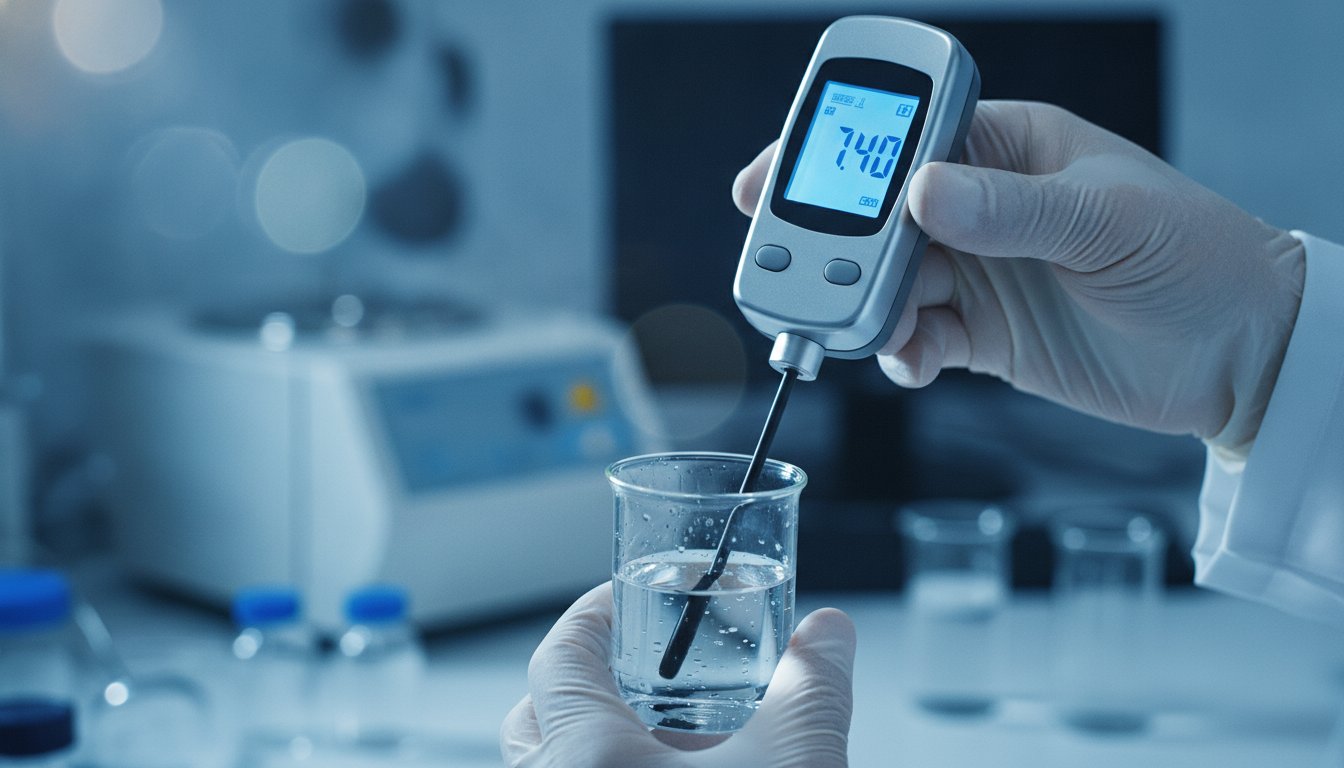
A 99% purity rating is effectively useless if the solution's acidity triggers immediate molecular breakdown. Many researchers focus on the sequence while ignoring the chemical environment that keeps it functional. Understanding what is peptide pH testing is the critical step in ensuring your reagents don't degrade before your experiment begins. You've likely dealt with the frustration of inconsistent results. Peptides that won't stay in solution despite following protocol are a common setback. It's a pain point that stalls progress and wastes expensive resources.
This article explains why pH verification is vital for peptide stability and how it dictates the success of your in-vitro laboratory work. We'll explore the science of pH-driven longevity and how it impacts the isoelectric point. We'll show you how to interpret precise pH data on a Janoshik report. Finally, we'll discuss sourcing pre-verified research chemicals to eliminate analytical uncertainty. Precise data. Verified standards. No guesswork. Discover how to maintain integrity by controlling the variables that matter most in a shifting regulatory landscape.
Key Takeaways
- Learn exactly what is peptide pH testing and why this metric is a non-negotiable requirement for any credible Certificate of Analysis.
- Understand how hydrogen ion concentration directly influences molecular stability to prevent immediate peptide precipitation and loss of potency.
- Discover the critical relationship between the isoelectric point and solubility to avoid common experimental errors in aqueous solutions.
- Identify the professional verification methods used by independent labs to ensure your reagents meet rigorous analytical standards.
- See how pre-filled research pens eliminate the technical risks and inconsistencies associated with manual lab-side reconstitution.
Defining Peptide pH Testing in Analytical Chemistry
Precision research demands more than a simple purity percentage. While many focus on HPLC data, the chemical environment of the molecule is just as critical. So, what is peptide pH testing? In the context of analytical chemistry, it's the measurement of the hydrogen ion concentration within a peptide solution. This metric determines the acidity or alkalinity of the reagent. It isn't just a number on a page. It's a fundamental indicator of how the peptide will behave once it hits your lab bench. If the pH is off, the peptide backbone can degrade rapidly; this renders your experiment void before it even starts. Precision matters.
Analytical pH Testing vs. C-Peptide Medical Tests
There's a common point of confusion in the research community. Search results often conflate analytical pH verification with the C-peptide medical diagnostic. These are entirely different animals. A C-peptide test measures insulin production in a biological subject and is a clinical tool for metabolic health; for individuals requiring such clinical assessments, providers like Ready Health offer a range of professional healthcare services. In contrast, analytical pH testing focuses on the chemical stability of synthetic compounds. We aren't looking at biological markers. We're looking at the structural integrity of the peptide itself. Conflating these two leads to bad data and mismatched expectations. Researchers must distinguish between testing a peptide in a patient and testing the pH of a chemical reagent to ensure its longevity.
The Role of pH in the Certificate of Analysis (COA)
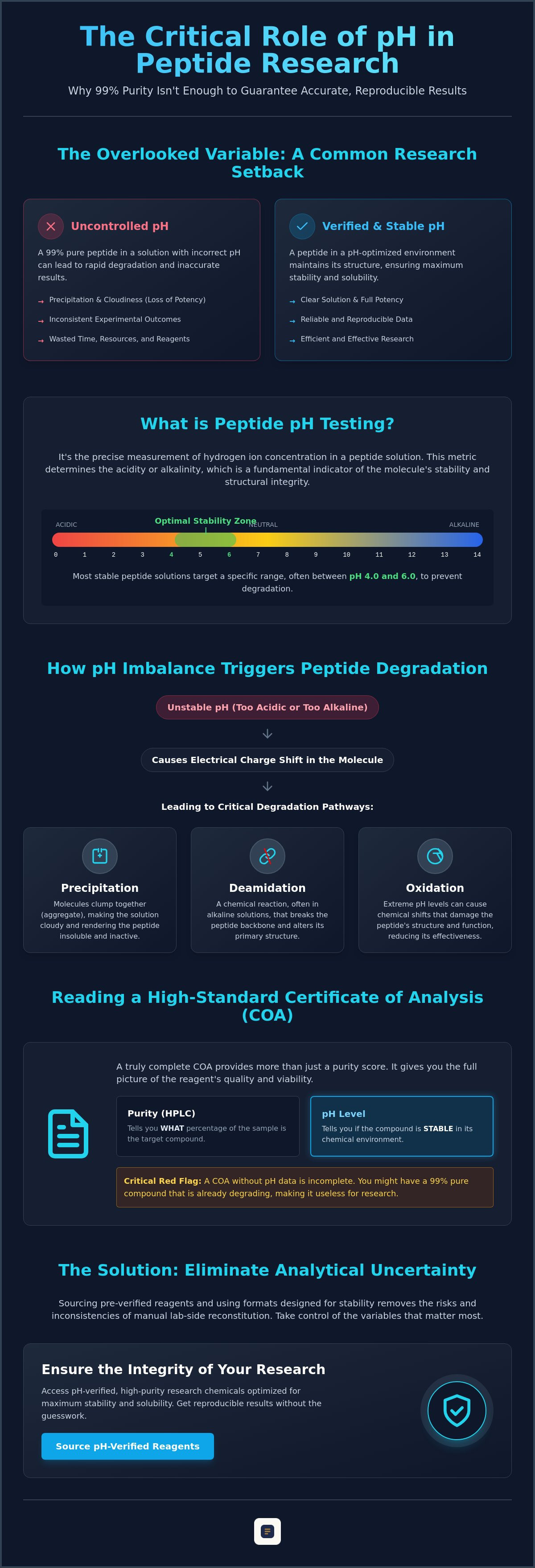
A high-standard Certificate of Analysis (COA) must include pH data to be considered complete. HPLC results tell you the purity, but the pH tells you the stability. Most stable peptide solutions target a specific range, often between 4.0 and 6.0. This range is calculated based on the specific Isoelectric Points (pI) of the molecules involved. If a COA shows a pH that is significantly higher or lower than the industry standard for that compound, it's a red flag. Extreme pH levels can cause deamidation or oxidation. These chemical shifts alter the peptide's primary structure. Without this data, you're flying blind. You might have a 99% pure compound that is chemically unstable due to its environment. Understanding what is peptide pH testing helps you identify these stability risks early. High-integrity providers prioritize these metrics to ensure that researchers aren't fighting their own reagents. You can find fully verified, pH-stable compounds in our research inventory.
Why pH Levels Dictate Peptide Stability and Solubility
Peptides are chemically temperamental. They respond dynamically to the hydrogen ion concentration of their solvent. When the pH deviates from the optimal range, the peptide's electrical charge shifts. This shift can cause the molecule to unfold or clump together. Maintaining the peptide in its monomeric state is the only way to ensure it remains active for your research. If you've ever seen a solution turn cloudy after reconstitution, you've witnessed pH-driven precipitation. This isn't just a visual change. It's a loss of potency that renders your sample useless.
Understanding what is peptide pH testing involves recognizing that pH isn't a baseline; it's a structural necessity. Without this verification, you risk using a reagent that has already begun to break down. Precise testing ensures the solution remains within a range that supports the peptide's intended conformation. It prevents the rapid degradation that occurs when a molecule is forced into a hostile chemical environment.
The Impact of pH on Peptide Solubility
Solubility is a delicate balance. Extreme pH values often lead to irreversible aggregation. This is especially true when using common solvents like bacteriostatic water. While the water itself is regulated, the addition of a lyophilized peptide can swing the pH into a danger zone. Researchers must verify these levels before starting cell culture assays. If the pH is too high or too low, the peptide will fail to dissolve completely. This results in inaccurate dosing and skewed data. For those who require precision, using pre-verified research chemicals ensures that these environmental variables are already optimized for stability.
Degradation Pathways Triggered by pH Imbalance
Chemical degradation is often invisible to the naked eye. Deamidation is a primary concern. In alkaline environments, asparagine residues can undergo a chemical transformation that breaks the peptide backbone. High-pH environments also increase the risk of oxidation for sequences containing methionine or cysteine. These reactions happen fast. A few hours at the wrong pH can significantly reduce the concentration of the active compound. pH-induced degradation compromises in-vitro data integrity by introducing uncharacterized impurities that interfere with your results. Optimal pH isn't a suggestion; it's a requirement for reproducible science.
The Critical Relationship Between pH and Isoelectric Points (pI)
Every peptide has an isoelectric point (pI). This is the specific pH value where the molecule carries no net electrical charge. At this exact point, the electrostatic repulsion between peptide molecules vanishes. The result is almost always immediate aggregation. Peptides are generally least soluble at their pI. This makes understanding what is peptide pH testing vital for any researcher aiming for a clear, stable solution. You must ensure your solvent's pH sits comfortably away from the pI to maintain solubility. Formulators must adjust the solution pH to create a net charge, which keeps the molecules suspended and active. Without this adjustment, your expensive reagents become a cloudy, inactive mess at the bottom of the vial.
Predicting Peptide Behaviour Based on pI
Calculating the pI for complex sequences like Retatrutide 40mg or Tesamorelin 20mg is a prerequisite for successful research. Each sequence has a unique profile of acidic and basic side chains. If your laboratory testing reveals a pH too close to these calculated values, your experiment is effectively compromised. Professional pH testing confirms the solution is sufficiently distant from the pI to allow for proper solubility. This distance also influences cellular uptake in laboratory models. A peptide with a specific net charge interacts more predictably with aqueous environments and cell membranes than a neutral, aggregated one. Precision in your initial setup saves weeks of troubleshooting later.
Buffer Selection and pH Maintenance
Choosing the right buffer is the only way to maintain pH stability during long-term studies. Without a stable buffer, you face the danger of "pH drift." This is a slow, silent shift in acidity that occurs as stored aqueous solutions interact with their container or the atmosphere. It's a common cause of failed reproducibility in longitudinal research. Referencing research peptide quality standards provides broader context on how to mitigate these risks through proper storage and handling. High-integrity reagents, such as those found in our Repair Protocol, are formulated to resist these shifts. This ensures your data remains consistent from the first hour to the final assay. Understanding what is peptide pH testing allows you to spot these drifts before they skew your results. Don't let a minor shift in hydrogen ion concentration invalidate months of work.
How Laboratories Conduct Professional Peptide pH Verification
Professional validation requires more than basic litmus strips. To answer what is peptide pH testing in a clinical sense, one must look at the instrumentation. Independent facilities use calibrated micro-electrodes designed specifically for low-volume samples. These sensors provide accuracy within 0.01 pH units. This level of precision is necessary because even a minor deviation can signal potential degradation. Testing is always performed on the final reconstituted solution. Measuring the dry powder is insufficient; the chemical interaction between the lyophilized peptide and the diluent determines the final stability environment. Every lot must undergo this verification to ensure manufacturing consistency across batches.
Third-party laboratories, such as Janoshik Analytical, play a pivotal role in this ecosystem. They provide the unbiased data that researchers need to trust their reagents. By outsourcing this verification, providers demonstrate a commitment to radical transparency. You don't have to take a manufacturer's word for it. Instead, you rely on empirical evidence from an independent expert. This level of scrutiny is what separates high-grade research chemicals from standard marketplace offerings.
The Step-by-Step pH Verification Process
- Step 1: Calibration. Technicians calibrate the micro-electrodes using standard, NIST-traceable buffer solutions. This ensures the baseline is perfectly accurate.
- Step 2: Sample Preparation. The peptide is reconstituted in a controlled environment. This prevents atmospheric CO2 from dissolving into the liquid and artificially lowering the pH.
- Step 3: Measurement. The hydrogen ion concentration is measured at a specific temperature, typically 25°C. Temperature fluctuations can significantly alter pH readings.
- Step 4: Documentation. The final result is logged against the theoretical stability range of the specific peptide sequence.
Interpreting pH Data on a Third-Party Report
Reading an analytical report doesn't have to be complex. On a Janoshik report, the pH value is typically listed alongside purity and mass concentration. Compare this reported value to the manufacturer’s specifications. If the report shows a pH of 5.2 for a compound like BPC-157 + TB-500 40mg, it confirms the solution is optimized for longevity. Lot-specific pH documentation is vital for publication integrity because it provides a verifiable chemical audit trail for your experimental reagents. For researchers who demand this level of verified precision, our pre-filled research pens come with the assurance of rigorous, third-party analytical testing.
Sourcing pH-Verified Reagents for Reproducible In-Vitro Research
The transition from lyophilized powder to a stable aqueous solution is where most research projects falter. Manual reconstitution introduces a cascade of variables that can compromise your data. Local water quality, incorrect diluent volumes, and atmospheric exposure all contribute to pH fluctuations. These shifts are often enough to push a peptide toward its isoelectric point. When you ask what is peptide pH testing, you aren't just looking for a definition; you're looking for a way to eliminate these experimental errors. Pre-filled research pens solve this by removing the human element from the stabilization process. By utilizing reagents that are already optimized and verified, you ensure that your starting material is chemically consistent every time.
The Benefits of Pre-filled Research Pens
Pre-filled formats offer a significant advantage in maintaining analytical integrity. They drastically reduce contamination risks associated with multiple vial punctures and open-air mixing. Because the solution is prepared in a sterile, controlled environment, pH stability is locked in from the start. This ensures that sensitive compounds like BPC-157 + TB-500 40mg remain in their active, monomeric state throughout the study. You no longer have to worry about immediate precipitation or potency loss. Using pre-filled peptide pens also streamlines laboratory workflows. It allows researchers to focus on data acquisition rather than the complexities of chemical stabilization. Consistency across multiple experiments becomes the standard, not the exception.
Ensuring Research Integrity with Verified Lots
Integrity in modern research requires full documentation. Sourcing from distributors who provide comprehensive analytical reports is the only way to verify the chemical environment of your reagents. ReadyPep maintains rigorous standards by providing third-party pH and purity verification for every batch. This commitment to transparency ensures that your lab work is backed by empirical data. We understand what is peptide pH testing means for your results. It means stability. It means reproducibility. By partnering with Metatide Healthcare, we ensure that every lot meets the highest benchmarks for chemical precision. Don't leave your research outcomes to chance. Explore pH-verified research pens at ReadyPep and secure the analytical foundation your work deserves.
Advancing Analytical Precision in Your Research
Analytical integrity isn't a luxury; it's the baseline for reproducible science. You now understand how pH dictates molecular stability and why the isoelectric point determines whether a peptide remains active or precipitates. Grasping what is peptide pH testing allows you to move beyond the risks of manual reconstitution. It's about removing variables that lead to experimental failure. High standards require empirical proof. Precision isn't optional when your data is on the line.
ReadyPep provides the transparency your work demands. Every batch undergoes independent testing by Janoshik Analytical for both purity and pH levels. These pre-filled pens, manufactured by Metatide Healthcare, ensure that your reagents are stable from the first assay to the last. We protect this integrity with free cold-chain shipping worldwide from our UK hub. This isn't just about sourcing; it's about securing your data against chemical instability and ensuring your laboratory environment remains controlled.
Don't let avoidable pH shifts invalidate your findings. Secure your research integrity with pH-verified peptide pens at ReadyPep. Precision is the only path to reliable results. Your next breakthrough depends on the stability of your reagents.
Frequently Asked Questions
What is the ideal pH for most research peptides?
The ideal pH for most research peptides typically falls between 4.0 and 6.0. This range minimizes the risk of chemical degradation like deamidation or oxidation. However, the exact value depends on the specific amino acid sequence and the molecule's isoelectric point. Professional formulators target a pH that maximizes net electrical charge. This ensures the peptide remains monomeric and active throughout the duration of your in-vitro study.
Can I test the pH of my peptide solution at home or in a basic lab?
Accurate pH testing cannot be performed with standard litmus paper or basic consumer equipment. Precise measurement requires calibrated micro-electrodes capable of handling low-volume samples without interference. Litmus strips provide a broad estimate but lack the 0.01 resolution needed for analytical chemistry. Understanding what is peptide pH testing means recognizing that professional verification is the only way to confirm reagent stability before starting an experiment.
Does the pH of a peptide affect its shelf life?
Yes, the pH of a peptide solution directly dictates its shelf life and structural longevity. A solution sitting outside its optimal range will undergo accelerated chemical breakdown. Even a minor shift can trigger irreversible aggregation or sequence modification. This is why high-integrity providers utilize stabilized buffers. These buffers resist pH drift, ensuring the peptide remains viable and potent during storage or transport to your laboratory.
What happens if the pH of my peptide solution is too high?
If the pH of your peptide solution is too high, the molecule enters an alkaline environment that triggers rapid deamidation. This process breaks the peptide backbone and alters the primary structure. High pH also increases the risk of oxidation for sensitive sequences. You'll often see visible precipitation or cloudiness as the molecules aggregate. This degradation renders the sample useless for precise research and compromises the reproducibility of your data.
Why do some peptides require an acidic pH for solubility?
Many peptides require an acidic pH to maintain solubility by ensuring the solution stays far from the molecule's isoelectric point. At this point, the peptide has no net charge and is most likely to precipitate. Lowering the pH adds positive charges to the amino acid side chains. This creates electrostatic repulsion between the molecules. It keeps them suspended in the solvent and prevents the formation of inactive, insoluble clumps.
How does ReadyPep ensure the pH of their pre-filled pens is accurate?
ReadyPep ensures accuracy by subjecting every lot to independent validation by Janoshik Analytical. These third-party reports verify that the pH sits within the manufacturer’s specified stability range. Our pre-filled research pens are manufactured by Metatide Healthcare under strict quality controls. This eliminates the variability found in manual lab-side mixing. You receive a reagent that is already optimized for stability, allowing you to focus on your results.
Is peptide pH testing the same as the C-peptide blood test?
No, peptide pH testing is a chemical verification process and is entirely unrelated to the C-peptide medical diagnostic test. A C-peptide test measures insulin production in a clinical setting to assess metabolic health. In contrast, pH testing measures the acidity of a synthetic chemical solution. Understanding what is peptide pH testing is essential for researchers sourcing in-vitro reagents. It ensures you are looking at the stability of the compound, not a biological marker.
Disclaimer
Educational content only. Not medical advice.


