
Is your research integrity silently eroding every time a pen seal is broken? You understand that even the most precise assay is worthless if the reagent has degraded. Inconsistent results aren't just frustrating. They're expensive. Maintaining peptide stability after opening pen is the difference between a breakthrough and a retracted paper. It's time to stop guessing. It's time for empirical verification.
We've reached a turning point in laboratory standards. With the May 2026 USP updates now in effect, the margin for error regarding reagent purity has vanished. You will master the scientific parameters of aqueous peptide longevity to ensure reproducible results in your laboratory assays. This guide provides the necessary SOPs for storage and identifies the chemical markers of degradation. We'll examine how reconstituted peptides maintain integrity for 30 to 60 days when kept at 2 to 8 degrees Celsius. Ensure your data remains publication-quality through rigorous reagent management.
Key Takeaways
- Define in-use stability as the critical window where a reagent maintains >95% purity post-activation.
- Establish a 30-day baseline for peptide stability after opening pen to prevent undetected degradation and assay drift.
- Mitigate deamidation and oxidation by minimizing oxygen exposure and maintaining a strict 2°C to 8°C environment.
- Protect sensitive sequences from photo-degradation by utilizing UV-shielded storage protocols throughout the research cycle.
- Ensure research integrity by utilizing standardized pre-filled pens verified through professional cold-chain logistics.
Understanding Aqueous Peptide Stability in Pre-filled Pens
In-use stability is a rigorous scientific metric. It defines the specific duration where a reagent maintains greater than 95% purity after its initial activation. This is a critical distinction for researchers. While shelf-life refers to the unopened, vacuum-sealed state, functional stability begins the second the pen seal is compromised. The transition from a sterile, lyophilized or vacuum-sealed environment to an activated aqueous state introduces immediate chemical variables. These pre-filled pens are engineered specifically for in-vitro laboratory research. Understanding peptide stability after opening pen is essential for maintaining the integrity of your experimental models.
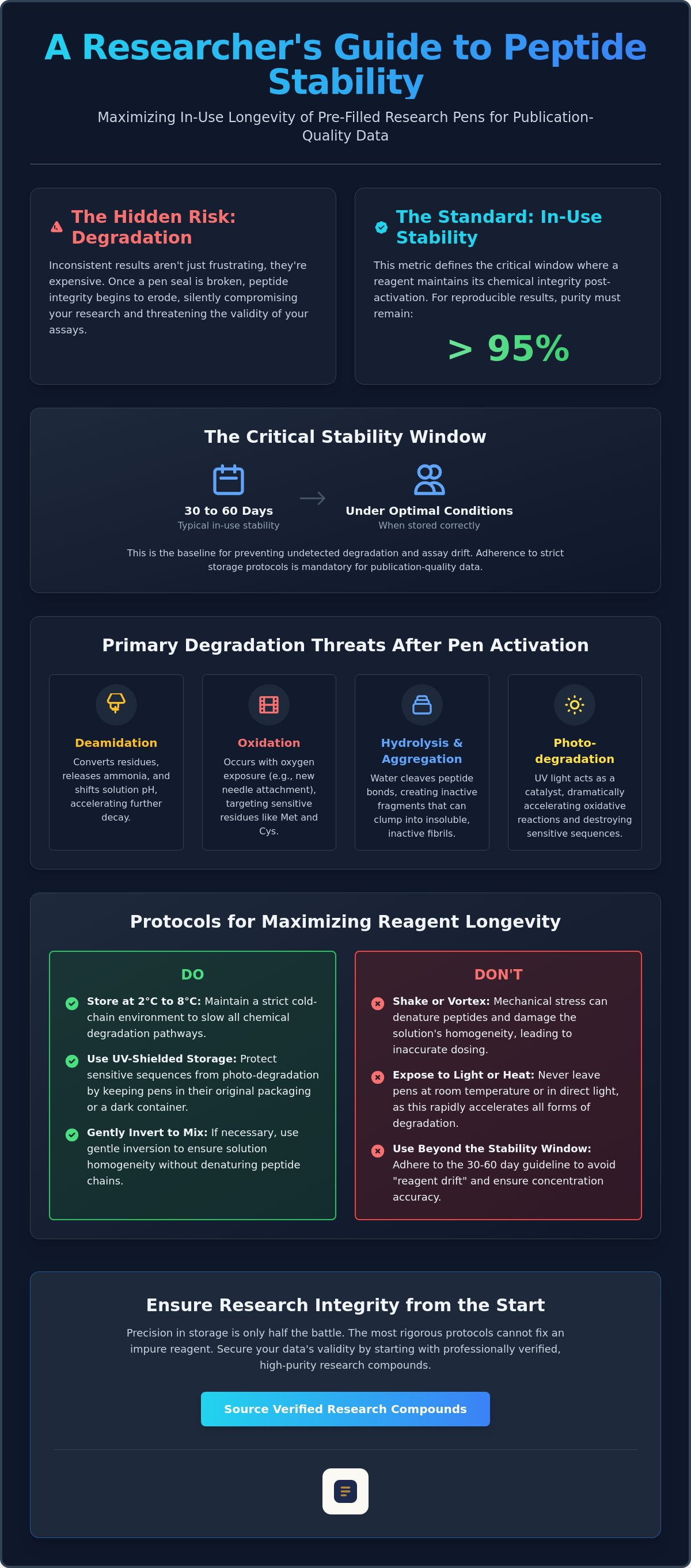
Once activated, the peptide is no longer in a suspended, dormant state. It is active in solution. This shift necessitates strict adherence to storage protocols. Most aqueous peptides maintain their intended chemical structure for 30 to 60 days if handled with precision. Deviating from these windows introduces "reagent drift," where the actual concentration of the active compound no longer matches the calculated dose. This can lead to false negatives or inconsistent signal transduction in your assays. Consistency isn't just a goal; it's a requirement for publication-quality data.
The Aqueous Environment Challenge
Peptides are significantly more reactive in liquid form than in their lyophilized states. Water acts as a solvent that facilitates pathways like hydrolysis and deamidation. While bacteriostatic water or specialized buffers are used to preserve pen integrity, they cannot stop time. The role of these additives is to inhibit microbial growth and maintain a stable pH, but the peptide sequence itself remains susceptible to its environment. High-standard peptide drug stability research shows that liquid formulations are sensitive to thermal and mechanical stress. Repeated mechanical activation of the pen can impact the solution's homogeneity. You shouldn't shake or vortex these pens; gentle inversion is the only recommended method to ensure the solution remains uniform without denaturing the peptide chains.
In-Vitro Research Implications
Inconsistent reagent potency is a primary cause of failed reproducibility in metabolic and cellular assays. Slight degradation can skew cellular response data, leading to inaccurate conclusions. For longitudinal studies, consistent potency is mandatory. If you are working with multifaceted research frameworks, such as the Mind Protocol, the interaction between different compounds must be controlled. If one element in the stack degrades faster than the others, the entire experimental result is compromised. Monitoring peptide stability after opening pen allows you to establish clear SOPs that protect your data from these undetected variables. Radical transparency in your reagent handling protocols leads to more robust scientific outcomes.
Chemical Mechanisms of Degradation After Pen Activation
Activation triggers a countdown of chemical decay. Once the seal is punctured, the peptide solution faces immediate environmental stressors. Deamidation is often the primary culprit. This process converts asparagine or glutamine residues into aspartic or glutamic acid. It releases ammonia and shifts the solution's pH, which can further accelerate degradation. Adhering to EMA peptide manufacturing guidelines ensures that researchers recognize these degradation pathways early. Maintaining peptide stability after opening pen is a matter of proactive chemical management; it's not a passive process.
Oxidation occurs every time a new needle is attached. Small amounts of oxygen enter the reservoir, targeting sensitive residues like methionine and cysteine. This is why light exposure in a pen format is particularly dangerous; UV rays act as a catalyst for these oxidative reactions. Simultaneously, hydrolysis works to cleave the peptide bonds in the presence of water. Over time, this results in shorter, inactive fragments. If left unchecked, these degraded chains may lead to aggregation. This formation of insoluble fibrils renders the peptide biologically inactive and can clog the pen's delivery mechanism. Precision in storage is only half the battle; starting with verified research compounds is the other half.
Sequence-Specific Susceptibility
Not all peptides degrade at the same rate. Longer, more complex sequences like Retatrutide 40mg require more stringent monitoring due to their higher number of potential "hot spots." These are specific amino acid motifs particularly prone to deamidation or cleavage. Peptides with disulfide bridges generally offer more structural rigidity than linear chains, but they remain vulnerable to reductive stress. Identifying these hot spots in your sequence allows you to predict degradation before it skews your cellular assays.
The Role of pH and Temperature
Temperature is the most significant external variable in your lab. The peptide stability after opening pen is compromised exponentially when thermal thresholds are breached. A shift in the pen's pH often signals the onset of deamidation. While a standard refrigerator is necessary, the "fridge door" is the worst location for storage. Constant opening and closing cause rapid thermal cycling that stresses the molecular bonds. Store your research pens in the center of the unit, away from the door and cooling elements, to maintain a consistent 2°C to 8°C environment. Consistent temperature equals consistent data.
Comparative Stability Timelines for Common Research Peptides
Generalizations are dangerous in a laboratory setting. While some informal research communities suggest a blanket 56-day rule, empirical data contradicts this. Most aqueous solutions establish a baseline stability of 28 to 30 days post-activation. Beyond this window, the risk of reagent drift increases significantly. Maintaining peptide stability after opening pen requires a precise understanding of the compound's molecular threshold. We define the stability window as the specific duration before HPLC-detectable impurities exceed 5% of the total peptide mass. Once this 5% limit is breached, the reproducibility of your in-vitro assays is compromised.
Consider the specific requirements of mitochondrial research. Analyzing the stability of MOTS-c 40mg in metabolic assays reveals a sequence highly sensitive to thermal fluctuations. Its 16-amino acid chain requires strict cold-chain adherence to prevent deamidation. Contrast this with high-concentration reagents like NAD+ or GHK-Cu. While these compounds are often used in higher milligram dosages, their chemical structures dictate different decay curves. Higher concentration doesn't always equal higher stability. It often increases the risk of aggregation if the buffer's pH shifts even slightly.
Short-Chain vs. Long-Chain Stability
Chain length is a primary predictor of longevity. Short-chain sequences often exhibit more resilience against mechanical stress. For instance, stability profiles for BPC-157 + TB-500 stacks post-reconstitution show a robust profile, yet they still face the 30-day aqueous limit. Conversely, GHK-Cu 100mg exhibits superior stability compared to many linear peptides. Its copper-complexed structure provides a level of molecular rigidity that resists rapid hydrolysis. When managing complex research stacks, such as the components within the Repair Protocol, you must track the activation date of each pen individually. Don't assume all components in a stack degrade at a uniform rate.
Monitoring Visual Cues of Degradation
Visual inspection is your first line of defense, though it isn't foolproof. Cloudiness or the presence of small "floaties" is a definitive sign of irreversible aggregation. This indicates the peptides have denatured and formed insoluble clusters. Discoloration, specifically yellowing, serves as a clear marker of advanced oxidation. This is common when pens are exposed to UV light or repeated oxygen ingress. However, a clear solution doesn't always guarantee 99% purity. Peptide stability after opening pen can fail at a molecular level long before visual changes occur. Rely on rigorous dating and temperature logs rather than sight alone. If the 30-day window has passed, the reagent's integrity is no longer guaranteed for high-precision assays.
Protocols for Maximising Reagent Longevity in the Lab
Precision requires protocol. To preserve peptide stability after opening pen, you must eliminate environmental variables. Maintain a strict 2°C to 8°C environment. Avoid thermal cycling at all costs. Every time the temperature fluctuates, you risk molecular stress. Protect the pen from UV light. Photo-degradation of sensitive amino acids happens fast. Keep the pen in its original opaque packaging or a dedicated dark storage container. This isn't just about storage; it's about shielding your data from invisible interference.
Handling matters. Use aseptic techniques during every needle change. Microbial introduction is a silent killer of reagent integrity. Even trace amounts of bacteria can accelerate the breakdown of peptide chains. Implement a "First-In, First-Out" (FIFO) inventory management system for your lot-tracked pens. This methodical approach ensures you aren't using older stock while newer arrivals sit idle. It removes friction from your laboratory workflow and guarantees you're always working with the freshest possible compounds.
Cold Chain Continuity
Room-temperature exposure is a common oversight. During active lab sessions, even twenty minutes on a benchtop can initiate degradation pathways. Don't leave pens out while preparing your samples. Use chilled blocks for pens during long-duration in-vitro experiments. This keeps the solution within the required 2°C to 8°C range while you work. Maintaining this continuity is vital for longitudinal studies. For deeper logistics and storage standards, review our guide on Peptide Pen Quality Control to ensure your lab meets modern standards.
Documentation and Lot Tracking
Data integrity begins with a marker. Record the "Date of First Activation" directly on the pen casing. Don't rely on memory or digital logs alone. Cross-reference this date with your Janoshik Analytical reports to confirm starting purity levels. Documenting reagent age isn't just good practice. It's critical for peer-reviewed publication integrity. Reviewers expect transparency. They want to know your reagents were potent and handled correctly. If you require high-standard reagents with verified analytical data, acquire lab-tested research pens to ensure your next assay yields reproducible results.
Ensuring Research Integrity with Verified Pre-filled Pens
Research integrity relies on the quality of the starting material. Metatide Healthcare manufactures standardized research pens to eliminate the guesswork inherent in fragmented supply chains. ReadyPep maintains this integrity through mandatory cold-chain shipping worldwide. This logistical precision ensures that the peptide stability after opening pen begins from a baseline of verified purity rather than compromised transit. Lot-specific documentation is mandatory for every research experiment to ensure that your results are traceable and verifiable. The Reserve Protocol serves as a benchmark for high-purity sourcing in the in-vitro field, providing the consistency required for high-stakes laboratory assays.
The 2026 USP updates have shifted the landscape of reagent quality. Compliance with these modern analytical standards is no longer optional for serious researchers. By utilizing pre-filled pens that adhere to these updated purity requirements, you insulate your study from the risks of sub-standard chemical inputs. Standardized manufacturing processes ensure that every pen in a lot performs identically. This uniformity is the foundation of reproducibility. When your reagents are a known constant, your experimental variables become the sole focus of your analysis.
Independent Analytical Verification
Starting with a high-purity reagent is essential. Every ReadyPep lot undergoes independent Janoshik Analytical testing to verify both purity and pH levels. Starting with 99%+ purity isn't just a quality marker; it's a functional necessity. High initial purity extends the functional peptide stability after opening pen by delaying the point where HPLC-detectable impurities reach the critical 5% threshold. Interpreting HPLC data allows you to predict long-term reagent behavior with statistical confidence. You shouldn't rely on manufacturer promises when third-party validation is available for every batch.
The ReadyPep Advantage for In-Vitro Science
Manual reconstitution is a significant variable you don't need in your lab. It introduces potential for error in both concentration and sterility. ReadyPep pens eliminate this friction by providing standardized dosing and concentration. This improves assay reproducibility across different lab sessions and different researchers. It moves your workflow from "preparation-heavy" to "action-oriented" without sacrificing precision. You focus on the science, while we handle the complex chemistry of stabilization and delivery. Secure verified research pens for your next study here.
Advancing In-Vitro Precision Through Reagent Integrity
Research integrity isn't a static achievement. It's a continuous process of verification and strict adherence to environmental controls. You now have the framework to manage peptide stability after opening pen with clinical precision. By respecting the 30-day aqueous window and eliminating thermal cycling, you protect your assays from reagent drift. Every data point in your study depends on the molecular integrity of your compounds. Sub-standard reagents don't just waste time. They compromise the validity of your entire longitudinal study.
Don't leave your results to chance. ReadyPep provides the empirical foundation your laboratory requires. Every pen is independently tested by Janoshik Analytical for purity and pH. We ensure stability through free cold-chain shipping worldwide and provide comprehensive documentation for every lot. This level of transparency removes the friction from your procurement process and aligns your lab with the latest 2026 USP standards. Optimise your research with lot-verified peptide pens from ReadyPep. Elevate your standards and secure the reproducibility your work deserves.
Frequently Asked Questions
How long does a peptide pen stay stable in the fridge after the first use?
A research peptide pen typically maintains its integrity for 30 to 60 days when stored at 2°C to 8°C in a refrigerator. This window represents the functional period before degradation markers exceed the 5% threshold. You should keep the pen in the center of the unit to avoid the thermal cycling common in fridge doors. Consistent refrigeration is the most effective method for preserving peptide stability after opening pen.
Can I freeze a pre-filled peptide pen to extend its post-opening life?
No, you shouldn't freeze a pre-filled peptide pen once it's in an aqueous state. The freezing process can cause the solution to expand, which potentially damages the mechanical components of the pen or the internal glass cartridge. Formation of ice crystals can also denature the peptide chains, rendering them biologically inactive for your assays. Stick to the validated 2°C to 8°C range for all activated pens.
What are the first signs that a research peptide has begun to degrade?
Visual cues include cloudiness, the appearance of insoluble particulates, or a distinct yellowing of the solution. These signs indicate advanced aggregation or oxidation. However, molecular degradation often occurs before any visible changes are detectable. Relying on activation dates and temperature logs is more reliable than visual inspection alone. If the solution isn't crystal clear, the reagent's purity is likely compromised.
Does the concentration of the peptide affect its stability?
Higher concentrations, such as 40mg variants, can increase the risk of molecular aggregation compared to 20mg versions. As the density of peptide molecules in the solution increases, the likelihood of them forming insoluble fibrils rises, especially if the pH shifts even slightly. While both concentrations follow similar timelines, a 40mg pen requires more vigilant monitoring of storage conditions to prevent the loss of potency.
Is it safe to use a research pen if it was left at room temperature overnight?
Leaving a research pen at room temperature overnight significantly accelerates degradation pathways like hydrolysis and deamidation. While the pen may still function, the exact purity level is no longer verified. Using such a reagent in high-precision in-vitro studies risks introducing undetected variables that can skew your results. For publication-quality data, it's safer to utilize a fresh, cold-chain-verified reagent.
How does light exposure specifically affect aqueous peptide stability?
UV light acts as a potent catalyst for the oxidation of sensitive amino acids like methionine and cysteine. Photo-degradation can occur rapidly, breaking molecular bonds and altering the peptide’s chemical profile. This is why professional research pens utilize opaque or UV-shielded casings. Always store your pens in a dark environment to ensure peptide stability after opening pen remains within acceptable parameters for your experiments.
Why is pH testing important for determining the stability of an opened pen?
pH testing is a critical diagnostic tool because shifts in acidity often signal the onset of deamidation. When asparagine or glutamine residues convert to acids, they release ammonia and change the solution's pH. Monitoring these levels provides an early warning of degradation before visual signs appear. Starting with a pen that has a verified baseline pH allows for more accurate longitudinal monitoring of reagent drift.
Do different peptides have different expiration windows?
Different compounds exhibit unique stability profiles based on their molecular structure. Short-chain peptides like BPC-157 are generally more resilient than complex metabolic reagents like NAD+ or MOTS-c. While the 30-day window is a safe standard for most aqueous solutions, sequence-specific factors can extend or shorten this period. Always cross-reference your specific compound with its lot-certified HPLC data to determine its functional life in the lab.
Disclaimer
Educational content only. Not medical advice.


