

In 2022, a high-profile multi-lab study on the MAPK signaling pathway collapsed entirely. The culprit wasn't a flawed hypothesis or poor technique. It was a simple failure to document batch numbers. Three participating labs introduced new peptide lots without records, forcing the entire consortium to repeat the work from scratch. You already know that in-vitro research is only as reliable as your reagents. A single unverified lot can turn months of meticulous work into a retraction risk. It's frustrating when physical samples don't align with digital Certificates of Analysis (COAs), leaving you to guess at the actual purity of your compound.
This guide provides a definitive framework for tracking peptide lot numbers for research integrity. You'll master the protocols needed to ensure every experiment is reproducible and every data point is audit-proof. We'll examine the technical link between lot numbers and analytical purity, explore 2026 DSCSA compliance standards, and show you how to build a documentation system that eliminates batch-to-batch uncertainty. It's time to move beyond anecdotal data and embrace the biological fingerprint of your experiment. Precision starts with a verifiable paper trail.
Key Takeaways
- Define peptide lot numbers as unique production identifiers to eliminate the hidden variability that compromises in-vitro data.
- Master the technical verification process by matching physical labels to batch-specific data on Certificates of Analysis for tracking peptide lot numbers for research integrity.
- Reduce human error and contamination risks by utilizing pre-filled research pens instead of traditional bulk vial reconstitution and aliquoting.
- Establish an audit-ready documentation system by logging manufacturer details, receipt dates, and storage conditions immediately upon delivery.
- Maintain compound purity through rigorous cold-chain logistics, ensuring the chemical integrity of your specific lot from the manufacturer to the laboratory.
The Role of Lot Identification in Scientific Reproducibility
A peptide lot number isn't just an arbitrary sequence of numbers and letters on a label. It's a unique identifier for a single, specific production run. Think of it as the chemical resume of your reagent. This identifier creates a direct line of sight from the raw materials used in synthesis to the final assay in your laboratory. Without it, you're essentially conducting blind research. The Role of Lot Identification in Scientific Reproducibility is the foundation of credible science; it ensures that your data isn't a one-time fluke but a verifiable reality.
Many researchers succumb to the risk of "batch-jumping." This occurs when a laboratory assumes that two separate orders of the same compound are identical because the catalog number is the same. It's a dangerous assumption. Lot-to-lot variability is a quiet killer of experimental consistency. Even when purchasing high-purity compounds like BPC-157 + TB-500, the impurity profile can shift between production cycles. Tracking peptide lot numbers for research integrity allows you to account for these subtle shifts before they skew your results. If you don't record the specific batch, you lose the ability to reproduce your own successes.
The Biological Fingerprint of Your Reagents
Peptide synthesis is an incredibly sensitive process. Minor fluctuations in reactor temperature, atmospheric pressure, or solvent purity can alter the final product. These manufacturing variables directly impact peptide folding and the presence of truncated sequences. A lot number serves as a biological fingerprint. It's the only mechanism that links your physical sample to its specific analytical data, such as HPLC and Mass Spectrometry results. Implementing a rigorous system for tracking peptide lot numbers for research integrity ensures that your documentation is as precise as your science. If you don't maintain an immutable record of these identifiers for every in-vitro experiment, you can't claim full control over your variables.
Consequences of Tracking Failures in Research
The cost of poor documentation is often measured in retracted papers and terminated funding. When results can't be replicated, the first question an auditor or peer reviewer asks concerns reagent verification. Tracking failures make troubleshooting impossible. If an experiment produces an anomaly, you need to know if the issue lies in your protocol or the specific batch of the compound. Third-party verification is a gold standard, but it's only valuable if the lab testing data is explicitly tied to the lot in use. Precision isn't just about the equipment you use; it's about the integrity of the materials you feed into it. Transparency in sourcing is the only way to protect your laboratory's reputation.
Linking Lot Numbers to Certificates of Analysis (COA)
The Certificate of Analysis (COA) is the bridge between a physical reagent and your experimental data. It's not enough to simply have a PDF on file. You must cross-reference the lot number printed on the COA with the physical identifier on your research pen. Discrepancies here are a major red flag. Tracking peptide lot numbers for research integrity requires this manual verification to ensure the analytical data you're citing belongs to the specific sample in your hand. If the numbers don't align, your research is built on an unverified foundation.
A legitimate 2026 COA must provide batch-specific data rather than generic "typical" results. It should be dated within the last 6 to 12 months to account for degradation or storage variables. Watch for red flags like missing laboratory signatures or generic lot identifiers that lack a sequence number. These often indicate poor supply chain control. If a vendor cannot provide a serialized link between the vial and a verified test, the integrity of your in-vitro study is at risk from the start.
Analytical Verification Standards for 2026
Purity thresholds are critical for sensitive cellular assays. The difference between 98% and 99% purity can be the difference between a clear signal and confusing background noise. HPLC is the gold standard for peptide purity verification in 2026. While HPLC measures the concentration of the target molecule, Mass Spectrometry (MS) confirms its identity by verifying the molecular weight. You should also look for pH testing data in aqueous solutions to ensure in-vitro stability and consistent biological activity across your samples.
Third-Party Testing vs. In-House Claims
In-house testing represents a clear conflict of interest. Independent laboratories like Janoshik Analytical provide a necessary "separation of concerns" that protects your data from manufacturer bias. You should be able to verify any COA directly with the testing lab using the unique lot identifier. This radical transparency is why ReadyPep’s lab testing page provides direct access to third-party verification for every batch. Verifying these records is now a standard part of modern laboratory auditing. If you want to ensure your supply chain meets these rigorous standards, you can examine our verified research inventory to see these protocols in action.
Pre-filled Pens vs. Bulk Vials: Maintaining Lot Integrity
Traditional bulk vials introduce a significant "human error" factor that often goes unrecorded. Lyophilized powders require manual reconstitution; a process that demands precise calculations and meticulous sterile technique. Every manual step creates a potential disconnect between the physical reagent and the documented lot. If a researcher aliquots multiple batches of the same compound simultaneously, the risk of a lot mix-up increases. Tracking peptide lot numbers for research integrity becomes nearly impossible once a sample is transferred into an unlabeled or poorly marked microcentrifuge tube.
Pre-filled research pens eliminate these variables. These systems arrive factory-sealed and pre-reconstituted, ensuring that the reagent remains linked to its original lot data until the moment of application. By removing the need for manual pipetting, these delivery systems maintain a closed loop of integrity. You aren't just buying a compound; you're securing a serialized delivery method that protects your analytical verification. This is especially critical in 2026, where package-level tracing is the new baseline for laboratory standards.
Reducing Manual Handling and Contamination
Manual handling is the primary source of cross-contamination in busy laboratories. When working with multiple peptide lots, the risk of transferring trace amounts between vials is high. Pre-filled systems act as a safeguard; they maintain the purity of the original lot-specific data by minimizing environmental exposure. This streamlined approach is a key component of improving lab workflow with pre-filled pens. It ensures that the chemical profile you verified via HPLC is exactly what enters your assay. Maintaining this sterile barrier is the only way to ensure that external contaminants don't compromise your lot-specific results.
Precision and Dosing Accuracy
Factory-measured doses provide a level of consistency that manual reconstitution cannot match. Products like Retatrutide 40mg arrive with a guaranteed concentration, reducing the variable data points that often plague in-vitro studies. This level of precision is vital for establishing statistical significance in dose-response curves. The "click" mechanism of research pens ensures consistent volume delivery by utilizing a mechanical stop that removes user-dependent volume fluctuations. Tracking peptide lot numbers for research integrity is simplified when the hardware itself enforces accuracy. Precision is no longer a variable you manage; it's a built-in feature of the delivery system. High-throughput labs benefit from this automation by removing the "pipette fatigue" that leads to subtle dosing errors over time.
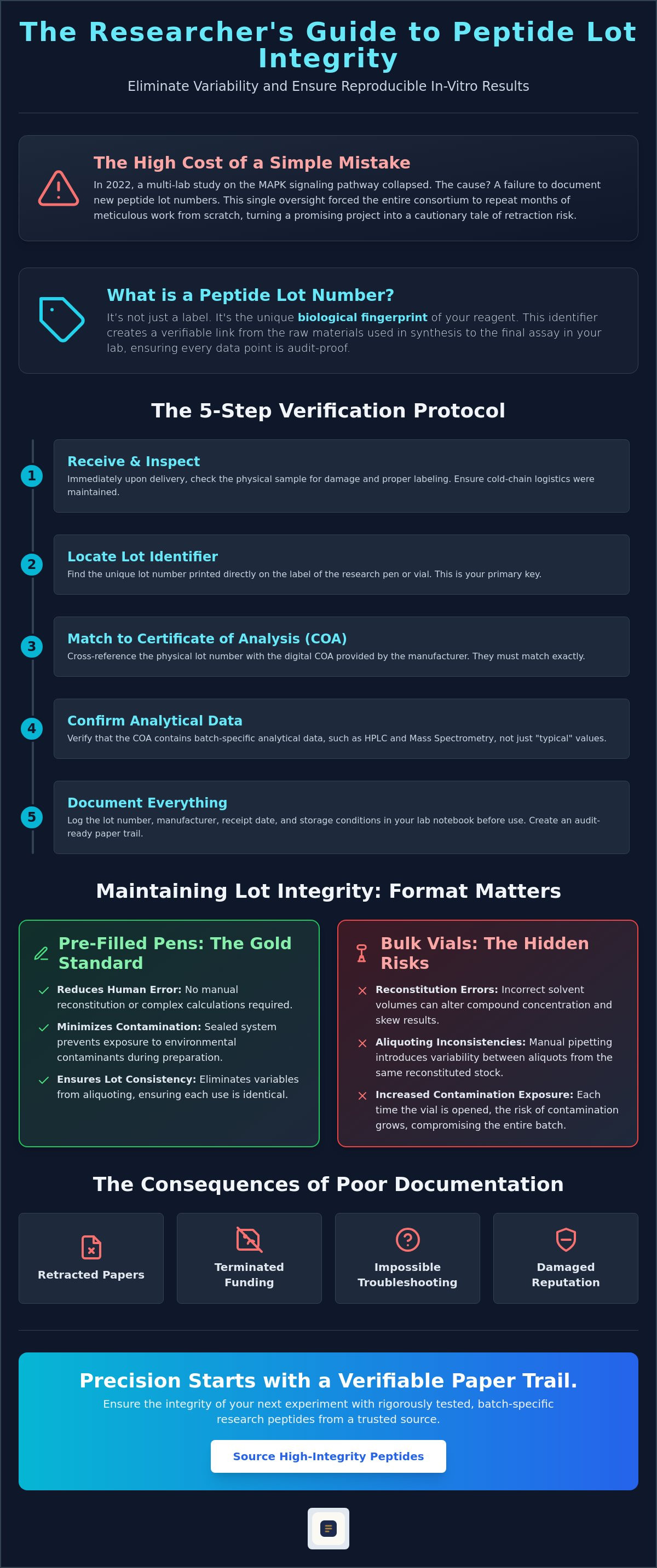
Best Practices for Documenting Lot Numbers for Publication
Scientific rigor begins at the loading dock. Tracking peptide lot numbers for research integrity is a proactive discipline. It transforms a simple chemical delivery into a verified, traceable data point for your future publication. Documentation gaps are often impossible to fill months after the fact. Follow these essential steps for every new reagent intake:
- Step 1: Record the manufacturer and the specific distributor the moment your shipment arrives.
- Step 2: Log the lot number and the exact date of receipt immediately.
- Step 3: Archive a digital copy of the lot-specific COA alongside your experimental raw data.
- Step 4: Monitor and log storage temperatures to verify cold-chain stability.
- Step 5: Reference the specific lot number in the "Materials and Methods" section of your final research paper.
Digital archiving is now a mandatory standard. Save a copy of the lot-specific COA with your raw experimental data. Don't rely on a vendor to host these records indefinitely. You should also monitor storage temperatures consistently. If your cold-chain is compromised, the lot stability is no longer guaranteed. This environmental log is just as critical as the chemical identity of the compound itself.
Preparing for Peer Review and Audits
Modern journals are raising the bar for reagent traceability. It's becoming common for reviewers to request batch-specific documentation during the peer-review process. If you encounter "lot depletion" mid-study, you need a transition strategy. Conduct a side-by-side validation assay between the old lot and the new batch to ensure biological consistency. This documentation prevents accusations of data manipulation. A verified lot number acts as a shield during rigorous institutional audits. It proves your results aren't artifacts of a specific production fluke.
Digital Record Keeping and SOPs
Paper notebooks are a liability in a high-throughput environment. They're prone to transcription errors and loss. Transition to digital lab managers to automate your lot tracking. Establish strict Standard Operating Procedures (SOPs) for reagent intake and verification. Every technician must know how to cross-reference a physical label with a digital record. If your laboratory relies on international sourcing, refer to this customs clearance guide to properly document the chain of custody. Maintaining this level of detail ensures your "Materials and Methods" section is unassailable. You can access our audit-ready research inventory to secure compounds that meet these strict documentation requirements.
Ensuring Integrity from Manufacturer to Laboratory
A lot number is only as valid as the logistics that delivered the compound. If a peptide undergoes severe temperature excursions during transit, its chemical profile changes. The original analytical verification becomes a historical record rather than a current reality. Tracking peptide lot numbers for research integrity must include a verified chain of custody from the point of manufacture to your laboratory freezer. Without this, you're working with potentially degraded reagents that no longer match their documentation. Logistics is the final, critical link in the chain of scientific truth.
Closing the loop on integrity requires a transparent distributor. You need a partner that treats logistics with the same clinical precision as the synthesis process itself. Sourcing from a provider that ignores cold-chain standards is a risk to your entire research portfolio. Integrity isn't just about the numbers on a Certificate of Analysis. It's about the physical stability of the compound inside the research pen. When the supply chain is opaque, your data becomes vulnerable to variables you can't see or control.
Cold-Chain Verification and Lot Stability
Temperature excursions are the invisible enemy of lot stability. Even a brief period outside the required storage range can trigger peptide aggregation or hydrolysis. This is why verifying cold chain integrity is a non-negotiable step for modern researchers. You should use your lot numbers to track stability data over time. If you maintain a consistent log of arrival temperatures, you can validate that the lot still aligns with its original COA. Stability isn't an assumption. It's a documented fact that protects your in-vitro results from environmental interference.
The ReadyPep Commitment to Transparency
We prioritize radical transparency at every stage of the supply chain. Our inventory relies on Metatide Healthcare’s manufacturing standards and Janoshik’s third-party verification to ensure every batch meets the highest purity thresholds. You can easily access lot-specific documentation for compounds like BPC-157 + TB-500 40mg through our centralized testing database. We provide the empirical proof you need to defend your results during peer review or institutional audits. Tracking peptide lot numbers for research integrity shouldn't be a administrative hurdle; it should be a standard feature of your procurement process. Secure high-purity, lot-tracked research pens for your next study here.
Future-Proofing Your Laboratory Standards
Precision in the laboratory is a calculated choice. You've seen how batch-specific documentation and pre-filled delivery systems eliminate the variables that lead to research retractions. By strictly tracking peptide lot numbers for research integrity, you protect your data from the hidden variability of manual handling and opaque supply chains. Every experiment deserves a verifiable paper trail that starts with rigorous manufacturing and ends with validated cold-chain delivery.
Maintaining these standards shouldn't be a burden. ReadyPep simplifies this process by combining Metatide Healthcare manufacturing precision with independent lot testing by Janoshik Analytical. Our worldwide cold-chain shipping integrity ensures that your compound matches its analytical profile the moment it arrives. It's time to elevate your protocols and ensure your findings are unassailable. Your commitment to precision starts with sourcing you can trust.
Browse Lot-Verified Research Peptide Pens and secure the reagents your next study requires. You've built the hypothesis; let us provide the proof.
Frequently Asked Questions
Why is a lot number more important than a general product name in research?
A lot number identifies a specific production cycle; a product name does not. Manufacturing variables like temperature or solvent purity can shift between runs. This identifier is the only way to link your physical sample to its unique HPLC and Mass Spectrometry data. Without this link, you cannot verify the exact impurity profile of your reagent. Precision requires batch-specific accountability rather than generic labels.
Can I use the same COA for different orders of the same peptide?
No, you must secure a new COA for every unique lot number received. Even if you order the same compound twice, the distributor may fulfill the second order from a different production run. Purity levels can fluctuate between 98% and 99% across batches. Using an outdated or mismatched COA invalidates your analytical verification. Always cross-reference the physical label with the digital record upon receipt.
What should I do if the lot number on my pen doesn’t match the COA?
Quarantine the sample immediately and contact your distributor for the correct documentation. A mismatch indicates a breakdown in the chain of custody or a labeling error. Tracking peptide lot numbers for research integrity relies on a perfect 1:1 match between the physical pen and the lab report. Proceeding with an unverified lot risks introducing unknown variables into your in-vitro assays. Never assume a mismatch is a minor clerical oversight.
How long is a peptide lot number valid for research purposes?
A lot number remains valid as long as the compound maintains its verified stability. Most COAs are considered current for 6 to 12 months from the date of testing. However, physical validity depends on your adherence to cold-chain storage protocols. If a lot is stored improperly, its analytical data is no longer accurate. Record your receipt date and storage conditions to validate long-term lot integrity in your logs.
How do I cite a specific peptide lot number in my research paper?
Include the lot number in the "Materials and Methods" section of your manuscript. A standard citation format includes the compound name, the specific lot identifier, and the source. For example: "Peptide X (Lot #12345, ReadyPep, USA) was utilized at a purity of 99.2% as verified by HPLC." This level of detail allows other researchers to replicate your work with the same chemical precision and confirms your data's transparency.
Do lot numbers track the purity of the peptide or just the manufacturing date?
Lot numbers track the entire batch record, including purity, identity, and manufacturing date. While the date tells you when it was synthesized, the lot number links directly to the HPLC chromatogram and Mass Spectrometry results. It's a comprehensive identifier for the chemical's resume. This documentation ensures that the specific impurity profile is known and recorded before you begin your sensitive cellular assays.
What is the difference between a batch number and a lot number?
In most laboratory settings, "batch" and "lot" are used interchangeably to describe a single production run. Technically, a batch is the total amount produced in one cycle, while a lot is a specific portion of that batch identified for distribution. For research purposes, both terms serve the same function: linking the physical product to its unique analytical and manufacturing history. Consistency in your internal lab logs is what matters most.
Does cold-chain shipping affect the lot number documentation?
Yes, cold-chain logs are a critical part of lot-specific documentation. Shipping records prove that the lot remained within stability parameters during transit. If a temperature excursion occurs, the original HPLC data on the COA may no longer reflect the sample's actual purity. Tracking peptide lot numbers for research integrity requires verifying that the logistics chain didn't compromise the compound's chemical structure before it reached your laboratory freezer.
Disclaimer
Educational content only. Not medical advice.


