

How much of your research budget is currently sitting at the bottom of a vial as an insoluble, white precipitate? It's a common frustration in the lab. You invest in high-purity compounds only to watch them degrade or crash out of solution during the delicate mixing phase. Many labs accept peptide reconstitution problems as a necessary evil, but this volatility is actually a manageable variable. With the June 1, 2026, EMA guidelines raising the bar for synthetic peptide standards, achieving 99% purity is no longer just a goal; it's a requirement for rigorous data integrity.
This guide identifies the root causes of peptide precipitation and degradation. You'll learn how to bypass these errors entirely to ensure 100% solubility and maximum purity in every study. We'll examine the impact of pH shifts, the risks of manual handling, and the streamlined workflow offered by modern, factory-calibrated formats. Eliminating the friction of manual preparation is now possible through pre-filled research peptide pens, which provide a sterile, closed-system solution to reconstitution anxiety and human dosing errors.
Key Takeaways
- Identify the chemical triggers behind solubility failure, specifically focusing on amino acid hydrophobicity and isoelectric point (pI) mismatches.
- Master a systematic recovery protocol for precipitated samples using incremental pH adjustments and micro-probe verification.
- Evaluate how manual pipetting errors and atmospheric exposure compound peptide reconstitution problems, compromising research reproducibility.
- Learn how factory-calibrated, pre-filled pens eliminate the need for manual mixing while ensuring verified pH and concentration levels.
- Transition to a zero-reconstitution workflow to minimize contamination risks and achieve 100% solubility for consistent in-vitro results.
Common Peptide Reconstitution Problems: Why Lyophilized Powders Fail
Lyophilization is designed to preserve chemical integrity, yet the transition back to an aqueous state is fraught with risk. Manual handling introduces variables that often lead to total sample loss. Peptide reconstitution problems typically manifest as physical changes in the vial that signal a loss of stability or solubility. Recognizing these signs early can save expensive reagents and prevent flawed data collection.
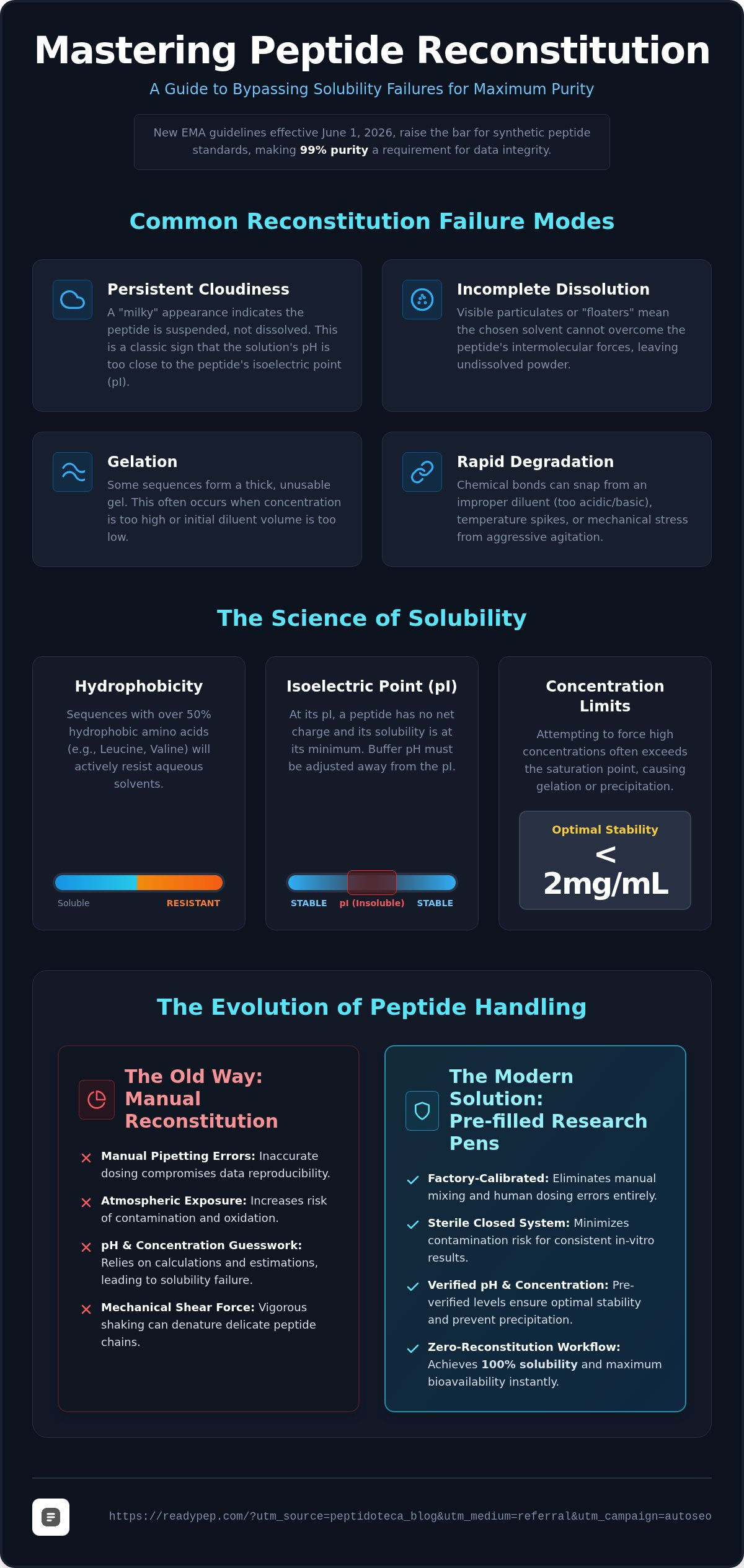
Four primary failure modes dominate the lab setting:
- Persistent Cloudiness: A "milky" appearance suggests the peptide is suspended rather than dissolved. This usually occurs when the solution pH is too close to the peptide's isoelectric point.
- Incomplete Dissolution: Visible particulates or "floaters" indicate that the solvent cannot overcome the intermolecular forces of the peptide cake.
- Gelation: Some sequences form a thick, unusable gel. This entanglement of peptide chains often happens when the initial diluent volume is too low or the concentration is too high.
- Rapid Degradation: Chemical bonds can snap during mixing if the diluent is too acidic, too basic, or if the temperature spikes due to aggressive agitation.
Identifying Precipitation vs. Contamination
Distinguishing between a failed solution and a contaminated one is critical for laboratory safety. Precipitation is usually immediate. It presents as flocculation, where small, snowflake-like clumps settle at the bottom. Contamination, however, is a biological process. It creates a uniform, hazy turbidity that typically develops over 24 to 48 hours. To verify the expected appearance of your reagent, always consult your lot-specific documentation. ReadyPep provides independent testing results from Janoshik Analytical. These reports confirm the purity and pH of the compound before it ever reaches your bench, removing the guesswork from your visual inspections.
The 'Stuck' Vial: When Agitation Isn't Enough
Vigorous shaking is the most common mistake in peptide handling. It's a natural impulse to shake a vial when powder remains visible, but this creates mechanical shear force. This physical stress can denature delicate peptide chains, rendering the research useless. Shaking also introduces air bubbles. This foaming increases the surface area exposed to oxygen, which accelerates oxidation and degradation. Safe alternatives focus on patience. Use a gentle swirling motion. Invert the vial slowly. Let the diluent trickle down the glass wall rather than dropping it directly onto the lyophilized cake. If the peptide remains "stuck," the issue is likely chemical, not mechanical.
The Science of Solubility: Factors Affecting Peptide Stability
The amino acid sequence is the ultimate blueprint for solubility. Hydrophobicity, determined by the presence of residues like leucine, isoleucine, or valine, dictates how a peptide interacts with its environment. If a sequence contains more than 50% hydrophobic amino acids, it will actively resist aqueous solvents. This resistance is the primary driver of peptide reconstitution problems in the laboratory. Researchers must evaluate the ratio of charged to uncharged residues before selecting a diluent to avoid immediate precipitation.
The Isoelectric Point (pI) is equally critical. This is the specific pH at which a peptide carries no net electrical charge. At its pI, a peptide's solubility is at its lowest because there is no electrostatic repulsion to prevent molecules from aggregating. To maintain a stable solution, the pH should be at least one unit above or below the pI. Basic peptides, which have a high pI, require slightly acidic conditions to remain in solution. Conversely, acidic peptides with a low pI behave better in slightly basic environments. Understanding these net charge considerations prevents the common mistake of using a universal buffer for every compound.
Concentration limits also play a role in stability. Every aqueous solution has a saturation point. Attempting to force a high concentration, such as 10mg/mL, for a complex sequence often results in gelation or the formation of visible particulates. For most research applications, maintaining a concentration below 2mg/mL ensures better long-term stability and reduces the risk of intermolecular entanglement.
PH and Its Impact on Aqueous Stability
Precise titration is often necessary to achieve a clear solution. If a peptide remains insoluble in water, adding 1% acetic acid for basic peptides or 1% ammonium hydroxide for acidic ones can induce the necessary charge. However, "pH shock" is a significant risk. Rapidly adding concentrated titrants can cause localized degradation of the peptide chain. It is safer to add these agents dropwise while gently swirling the vial. Recognizing pH testing importance is vital for ensuring that your reagents meet the ISO/IEC 17025:2017 standards required for modern research integrity.
Solvent Selection for Hydrophobic Peptides
Bacteriostatic water is a lab staple, but it is frequently insufficient for hydrophobic sequences. In these cases, primary solvents like DMSO or DMF are required to break the initial intermolecular bonds. Once the peptide is fully dissolved in a minimal volume of these solvents, it can be diluted with an aqueous buffer. The challenge lies in balancing solvent toxicity with the needs of your in-vitro assays. Excessive DMSO concentrations can interfere with cell viability and skew data. To bypass these complex peptide reconstitution problems, many researchers now utilize pre-filled research peptide pens that arrive pre-mixed with factory-calibrated pH levels for immediate use.
Troubleshooting Guide: How to Recover a Precipitated Peptide
Precipitation doesn't always mandate immediate disposal of your sample. While some industry guides suggest discarding failed batches, specific recovery protocols can salvage high-value reagents if handled with clinical precision. The first step is diagnostic. Use a micro-probe to check the current pH of the solution. As established in the previous section, solubility remains at its nadir when the pH sits near the peptide’s isoelectric point. If you find a mismatch, adjust the pH incrementally toward the required polarity. Use 1% acetic acid for basic sequences or 1% ammonium hydroxide for acidic ones. Add these agents dropwise, as rapid titration can cause localized degradation.
If chemical adjustments prove insufficient, introduce sonication as a last resort for physical breakup. This process uses ultrasonic waves to disrupt molecular aggregates that have become "locked" in a semi-solid state. Once the solution appears visually clear, filter it through a 0.22-micron polyethersulfone (PES) membrane. This step is non-negotiable; it removes micro-particulates that are invisible to the naked eye but can skew in-vitro results. If the recovery process required aggressive pH swings or thermal exposure, re-verify the purity via HPLC to ensure the peptide remains intact. Managing these peptide reconstitution problems requires a balance of patience and analytical verification.
Sonication Protocols for Research Peptides
Frequency control is vital during sonication. High-frequency waves generate significant heat, which can denature delicate peptide chains. Set your equipment to a pulse setting rather than a continuous wave to mitigate thermal energy buildup. Always place the vial in an ice bath to maintain cold-chain integrity during the process. Limit sonication to 30-second intervals followed by a cooling period. Over-processing is a common trap; it leads to molecular fragmentation, which creates "ghost" peaks in subsequent analytical data.
Centrifugation as a Diagnostic Tool
Centrifugation acts as a powerful diagnostic tool when transparency is elusive. Spin the cloudy solution at 10,000 x g for five minutes. This process pellets any undissolved material at the bottom of the vial, allowing you to aspirate the clear supernatant. By measuring the concentration of the supernatant, you can calculate the exact mass loss after pellet removal. Documenting these recovered batches is essential for research transparency and reproducibility. To bypass these complex peptide reconstitution problems and the need for emergency recovery, many laboratories are transitioning to pre-filled research peptide pens that arrive pre-mixed and verified for 100% solubility.
Risks of Manual Reconstitution on Research Reproducibility
The "Human Factor" remains the most volatile variable in laboratory research. Manual pipetting introduces subtle volume inconsistencies that compound over time. A 2% variance in diluent volume might seem negligible. However, it fundamentally alters the final concentration, directly impacting the dose-response curve of your in-vitro assays. These peptide reconstitution problems are often invisible until the data fails to replicate in subsequent trials. Precision is not just a goal; it is the foundation of research integrity.
Contamination is a silent threat. Every time a vial is opened, atmospheric exposure introduces entry points for microbes and micro-particulates. Beyond biological risks, manual mixing often involves inconsistent "stir times." This variability affects peptide monomerization. It leads to a mixture of monomers and aggregates that interact differently with biological targets. Aggressive mixing also creates air bubbles. These bubbles increase the surface area for oxidation, leading to rapid degradation of sensitive residues like methionine or cysteine. This process can happen in seconds, yet it can skew weeks of data collection.
Impact on Publication Integrity
The scientific community is facing a reproducibility crisis. Reagent preparation is now under the microscope. Peer reviewers increasingly demand higher transparency regarding preparation protocols. If your lab-to-lab preparation varies, your data becomes non-replicable. Rigorous documentation, including tracking lot numbers, is now a baseline requirement for high-impact journals. Without standardized preparation, even a 99% pure compound can yield flawed results due to preparation-induced artifacts. Consistency is the only way to ensure your findings stand up to external scrutiny.
Time and Resource Drain in the Lab
Manual preparation represents a significant "hidden cost" in laboratory management. A researcher may spend hours calculating molarity, titrating pH, and performing sterile transfers. The financial impact of a failed 40mg peptide batch is substantial. It includes wasted labor, expensive reagents, and discarded consumables. Streamlining your workflow allows you to focus on data collection, not prep. To eliminate these high-risk mechanics and ensure absolute consistency, you can buy pre-filled research peptide pens that arrive factory-verified and ready for immediate in-vitro use.
Eliminating Errors with Pre-filled Research Peptide Pens
The traditional paradigm of research requires the user to act as a chemist, a pharmacist, and a lab technician simultaneously. This multi-role requirement is exactly where peptide reconstitution problems take root. Pre-filled research peptide pens disrupt this inefficient cycle by providing a zero-reconstitution workflow. These pens arrive pre-mixed. This allows researchers to bypass the high-risk mechanics of manual titration and solvent selection entirely. By removing the human element from the mixing phase, you ensure that every microliter of reagent is identical to the last.
Factory calibration is the cornerstone of this precision. Each pen is prepared in a controlled environment where pH and concentration levels are set to exact specifications for immediate in-vitro use. This eliminates the "pH shock" and concentration variances that plague manual preparation. The closed-system design of the pen serves as a primary barrier against environmental stressors. There's no opening of vials, no atmospheric exposure, and no risk of airborne contamination. Click-dose precision replaces the inherent variability of manual pipetting under a laminar flow hood. Every click delivers a calibrated volume. This ensures that your dosing remains consistent across every plate and every replicate.
Verified Purity and pH Standards
Transparency is non-negotiable in modern laboratory settings. Every batch of ReadyPep pens undergoes rigorous lot verification via Janoshik Analytical testing. This third-party validation ensures that the peptide purity meets the new 99% industry standard and that the pH is optimized for stability. Maintaining this integrity requires more than just precise mixing; it requires professional cold-chain logistics. Our free worldwide cold-chain shipping preserves the molecular structure from the manufacturing facility to your incubator. You can explore the full ReadyPep Lab Testing process to view the empirical data behind every pen.
Optimizing Your In-Vitro Protocol
Efficiency in the lab is measured by the quality of data collected, not the hours spent in preparation. Pre-filled pens integrate seamlessly into existing laboratory workflows, reducing the time spent on administrative prep by hours per week. For specialized research, selecting a targeted protocol ensures the reagent matches the assay requirements. The Repair Protocol is specifically designed for cell culture studies requiring high-stability BPC-157 and TB-500 combinations. This standardized approach is particularly valuable for multi-month longitudinal studies. When you eliminate peptide reconstitution problems, you secure the reproducibility of your data across the entire duration of your project.
Securing Research Integrity through Standardized Preparation
Success in the laboratory depends on the absolute stability of your reagents. We've explored how pH mismatches, isoelectric point conflicts, and mechanical stress lead to persistent peptide reconstitution problems that compromise data reproducibility. Relying on manual titration and vial transfers introduces unnecessary variables that even the most experienced researchers can't always control. Transitioning to a streamlined, closed-system workflow is the most effective way to protect your in-vitro assays from contamination and rapid degradation.
You can eliminate reconstitution errors with pre-filled research pens at ReadyPep. Every batch is independently verified by Janoshik Analytical to ensure it meets the highest purity and pH standards. These pens are pre-filled for maximum precision, removing the "human factor" from your dosing calculations. With free worldwide cold-chain shipping included, your compounds arrive stable and ready for immediate application. Focus on your findings, not the friction of manual preparation. Your research deserves the calm assurance of factory calibration and verified data integrity.
Frequently Asked Questions
Why does my peptide turn into a gel during reconstitution?
Gelation occurs when the peptide concentration is too high or the diluent volume is insufficient to prevent chain entanglement. This physical state is common with hydrophobic sequences that aggregate rapidly when they reach their saturation point. To resolve this, incrementally increase the solvent volume or adjust the pH to move away from the isoelectric point. ReadyPep pens prevent this by arriving pre-mixed at factory-calibrated concentrations.
Can I use heat to help a peptide dissolve faster?
No, you should never apply heat to research peptides during the mixing process. High temperatures disrupt the delicate hydrogen bonds and secondary structures, leading to irreversible denaturation. Peptides are thermally sensitive and require cold-chain integrity to maintain their biochemical activity. If a compound is slow to dissolve, use gentle swirling at room temperature or utilize a pulsed sonication protocol while keeping the vial in an ice bath.
What is the best water to use for peptide reconstitution?
Sterile bacteriostatic water containing 0.9% benzyl alcohol is the laboratory standard for peptides intended for multiple uses. The alcohol acts as a preservative to inhibit microbial growth. For single-use in-vitro assays where alcohol might interfere with cell viability, sterile water for injection (SWFI) is a suitable alternative. Regardless of the choice, the solvent must be free of metal ions and contaminants to prevent catalytic degradation of the peptide chain.
How long is a peptide stable after it has been reconstituted?
Stability varies significantly by sequence, but most reconstituted peptides remain stable for 7 to 14 days when stored at 2°C to 8°C. Some highly sensitive compounds may begin to degrade within 48 hours. To maximize longevity, avoid atmospheric exposure and minimize the time the solution spends at room temperature. ReadyPep pens utilize a closed-system design and professional cold-chain logistics to ensure maximum stability throughout your longitudinal research project.
Is it normal for a peptide solution to be slightly cloudy?
A cloudy appearance is not normal and typically indicates peptide reconstitution problems such as incomplete solubility or microbial contamination. A clear, colorless solution is the baseline requirement for research integrity. If turbidity persists after gentle swirling, the pH likely needs adjustment, or the peptide has crashed out of solution. Cloudy solutions should be analyzed via HPLC or filtered through a 0.22-micron membrane before use in any assay.
Does freezing a reconstituted peptide damage its structure?
Repeated freeze-thaw cycles are highly damaging to peptide structures. While a single freeze can preserve a sample for long-term storage, the formation of ice crystals can cause mechanical shear stress that snaps delicate molecular bonds. If you must freeze a solution, aliquot it into single-use volumes to avoid cycling. However, maintaining a consistent refrigerated state at 2°C to 8°C is generally preferred for peptides currently in use to ensure structural integrity.
How do I know if my peptide has degraded during the mixing process?
Visual cues like persistent cloudiness, gelation, or the presence of particulates are strong indicators of physical degradation or solubility failure. However, chemical degradation, such as oxidation or deamidation, is often invisible to the naked eye. The only definitive way to verify integrity is through HPLC analysis. ReadyPep provides lot-specific documentation from Janoshik Analytical for every pen, ensuring that the compound meets 99% purity standards before your research begins.
Are pre-filled peptide pens more stable than manual mixtures?
Yes, pre-filled pens offer superior stability compared to manual mixtures because they are prepared in factory-controlled environments. These pens eliminate the risks of "pH shock" and pipetting inconsistencies that often trigger peptide reconstitution problems. The closed-system architecture prevents atmospheric oxygen and microbes from entering the solution. This professional calibration, combined with independent lab testing, ensures a level of precision and stability that is difficult to replicate in a standard laboratory setting.
Disclaimer
Educational content only. Not medical advice.


