

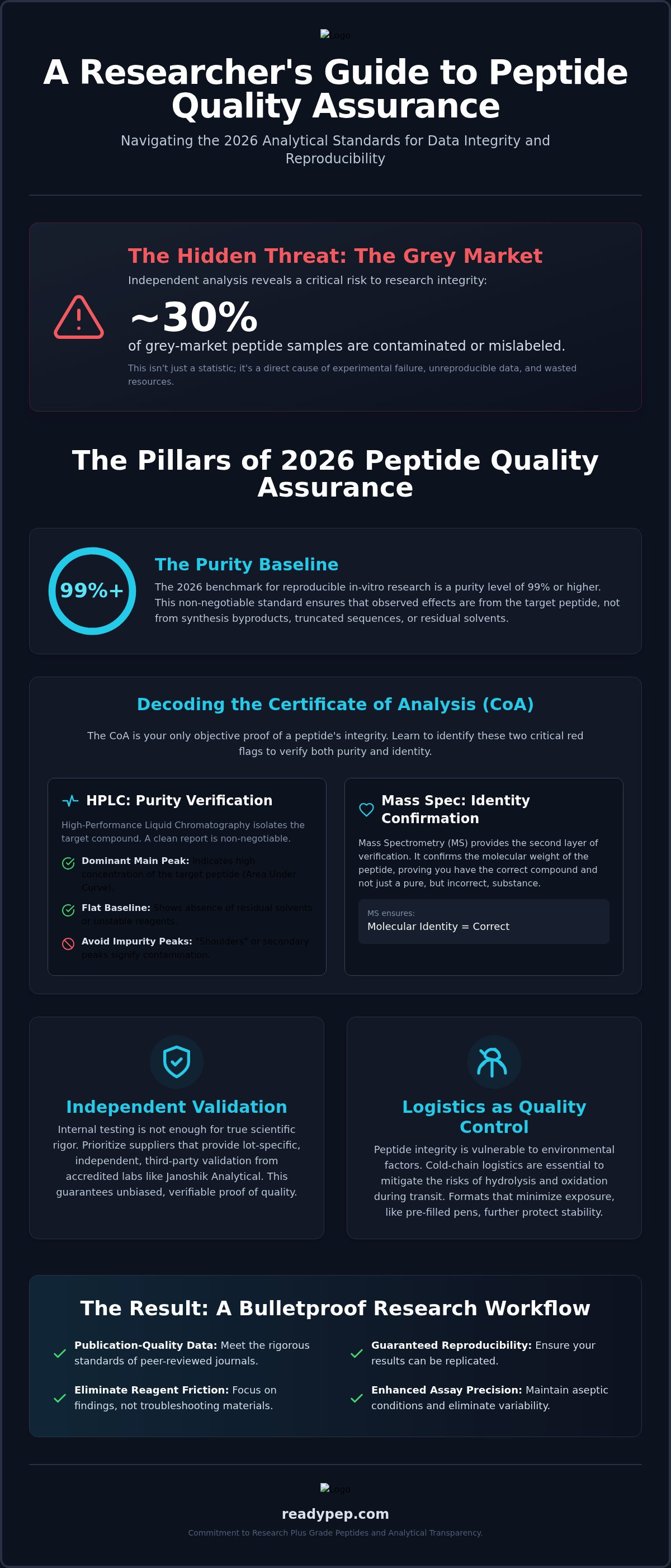
Independent analysis of grey-market peptides recently identified contamination or mislabeling in approximately 30% of samples. For a researcher, that isn't just a statistic; it's a potential disaster for your data integrity. You know that even a slight pH imbalance or a 1% drop in purity can trigger experimental failure, leaving you with months of unreproducible results. It's frustrating to spend more time deciphering cryptic HPLC reports than actually conducting your research. Maintaining rigorous peptide research quality assurance is no longer optional; it's the baseline for scientific credibility.
This guide helps you master modern analytical standards by breaking down the 2026 EMA and FDA requirements for synthetic peptides. You'll learn how to verify molecular identity and purity with clinical precision, ensuring every lot yields publication-quality data. By shifting toward empirical verification and streamlined delivery formats, like the pre-filled research pens used by leading labs, you can eliminate reagent friction and focus on your findings. We'll show you how to build a bulletproof workflow that prioritizes transparency and analytical integrity without compromising your timeline.
Key Takeaways
- Master the 2026 analytical benchmarks, including the 99% purity baseline required for reproducible in-vitro research.
- Learn to identify critical red flags in HPLC chromatograms and Mass Spectrometry reports to confirm precise molecular identity.
- Establish a robust peptide research quality assurance protocol by prioritizing independent, third-party validation from Janoshik Analytical.
- Mitigate the risks of hydrolysis and oxidation through cold-chain logistics and formats that minimize environmental exposure.
- Improve assay precision by utilizing research tools designed to eliminate mechanical variability and maintain aseptic conditions.
The Critical Role of Quality Assurance in In-Vitro Research
In-vitro research demands absolute control over variables. When your primary reagent is a synthetic chain of amino acids, even a minor deviation in the sequence can invalidate weeks of laboratory work. Reagent purity isn't just a line item on a budget; it's the foundation of data reproducibility. Opting for "economical" peptides often results in hidden costs that far outweigh initial savings. You aren't just paying for the compound; you're paying for the certainty that your results are real. Failed assays and the loss of sensitive cell lines represent a massive drain on resources that no budget-friendly supplier can compensate for.
Research quality assurance in the context of peptide integrity is the systematic process of verifying chemical purity, molecular identity, and batch consistency to eliminate experimental variables.
The Impact of Impurities on Experimental Outcomes
Impurities like truncated peptides or deletion sequences act as competitive inhibitors in receptor-binding assays. They skew results by mimicking the target peptide's behavior without providing the expected biological response. Non-peptide contaminants, such as residual solvents from the Commercial Peptide Synthesis process, can be cytotoxic to delicate in-vitro models. These solvents interfere with intracellular signaling pathways, leading to data that reflects chemical stress rather than the peptide's true effect. In immunological studies, peptide artifacts can even trigger false-positive T-cell responses. You can explore the full range of these risks in our detailed breakdown of the Consequences of Impure Peptides in Experiments.
2026 Standards for Analytical Integrity
The 2026 research landscape has moved beyond accepting "crude" or "technical grade" materials. Modern peer-reviewed journals now frequently require lot-specific documentation to validate the reagents used in published studies. This shift toward "Research Plus" grades emphasizes rigorous peptide research quality assurance as a standard operating procedure. Transparency is no longer a marketing claim; it's a requirement. Suppliers must provide empirical proof of purity for every batch through rigorous lab-tested verification. This level of accountability ensures that your work stands up to the highest levels of peer scrutiny and remains reproducible across different laboratory environments.
Decoding the Certificate of Analysis: Purity, pH, and Mass Spec
A Certificate of Analysis (CoA) is the only objective proof of a peptide's integrity. Without it, you're conducting "blind" research. High-Performance Liquid Chromatography serves as the definitive quantitative tool for 2026 peptide research quality assurance, isolating the target molecule from synthesis byproducts with sub-milligram precision. To truly trust your data, you must look beyond the final percentage and verify the raw analytical data provided by the laboratory. Authentic reports aren't just PDF files; they're verifiable records of a specific batch's chemical signature.
Reading the HPLC Chromatogram
The HPLC chromatogram is a visual map of your sample's purity. The primary peak represents your target compound, while smaller "shoulders" or secondary peaks indicate impurities like deletion sequences. You should focus on the "area under the curve" (AUC). This calculation determines the purity percentage by comparing the main peak's area to the total area of all detected peaks. A flat baseline is non-negotiable. Significant baseline noise suggests the presence of residual solvents or unstable reagents that could interfere with your assay. It's also vital to distinguish between purity percentage and peptide content. High purity means the peptide present is the correct one, but the actual peptide content accounts for the total weight, including counter-ions and moisture. For a deeper dive into these metrics, consult our Understanding HPLC for Peptide Analysis reference guide.
Mass Spectrometry (MS) provides the second layer of verification: identity. While HPLC tells you how much of the "main thing" is there, MS proves what that "thing" actually is. By measuring the mass-to-charge ratio, the lab confirms the observed molecular weight against the theoretical weight. If these numbers don't align within a tight margin, the sequence is incorrect, regardless of how pure the HPLC report claims it to be. Always verify the report's authenticity by entering the unique ID or scanning the QR code directly on the testing laboratory's secure portal. This step ensures the CoA hasn't been forged or reused for an older, unrelated batch.
The Importance of pH in Aqueous Solutions
The pH level of a peptide solution is a frequently overlooked metric that directly impacts stability. Peptides are often most stable in slightly acidic to neutral environments. If the pH is too high or too low, the peptide may undergo rapid hydrolysis or deamidation, rendering it biologically inactive. This shift also alters the electrostatic charge of the molecule, which can drastically reduce its receptor binding affinity in cell culture models. You can learn more about why this matters in our article on What is Peptide pH Testing?. To ensure your research begins with a stable foundation, sourcing from providers like ReadyPep ensures every lot undergoes both purity and pH validation by independent analysts before it reaches your lab.
Independent Third-Party Verification: Why Internal Testing Isn't Enough
Trust is a liability in high-stakes research. If a supplier performs their own analytics, they have a vested interest in the outcome. This inherent conflict of interest is the primary reason why "in-house" results are insufficient for peer-reviewed standards. You need an unbiased gatekeeper. Modern peptide research quality assurance relies on a strict separation of powers: one entity manufactures, and a separate, independent laboratory verifies the results. Without this third-party buffer, a Certificate of Analysis is little more than an unverified marketing claim.
The Gold Standard: Janoshik Analytical
Janoshik Analytical has emerged as the definitive authority in the 2026 research landscape. They provide independent validation without a financial stake in the product's sale. Their reports detail both purity and exact concentration, removing the guesswork from in-vitro dosing calculations. A key feature of their service is the public-facing testing log. This transparency allows you to cross-reference your specific lot number against their secure database in real-time. If a supplier hides the lot number or refuses to provide a Janoshik report, they're likely concealing impurities or sequence errors. Authentic peptide research quality assurance requires this level of external scrutiny to ensure your data isn't compromised by reagent variability.
Sourcing Verified Materials Online
Evaluating a new vendor requires a clinical eye for red flags. "Typical analysis" is a common deceptive tactic used by lower-tier suppliers. It means the vendor tested a "good" batch years ago and continues to use that same report for every subsequent lot. This practice is scientifically invalid. Every batch is unique. Modern standards demand lot-specific verification. Every order should arrive with documentation that matches the unique ID on the product itself. When managing institutional procurement, use this verification checklist:
- Does the CoA include a scannable QR code linking directly to the lab's official portal?
- Is the report date within a relevant timeframe for the current stock?
- Does the batch number on the analytical report match the physical packaging?
Logistics as Quality Control: Cold Chain and Stability Metrics
Analytical purity is worthless if the compound degrades during transit. Synthetic peptides are inherently fragile molecules. Their tertiary structure is highly susceptible to environmental stress. Temperature control isn't just a shipping preference; it's a vital peptide research quality assurance metric. Without it, your high-purity reagent arrives as a collection of inactive fragments. You can't publish data based on degraded material.
Two primary degradation pathways dominate: hydrolysis and oxidation. Heat acts as a catalyst for these reactions. It breaks the delicate peptide bonds or alters the chemical signature of side chains. Shipping delays in non-refrigerated environments can strip a reagent of its potency in as little as 48 hours. This isn't just about a lost product. It's about the catastrophic skewing of your experimental data through the introduction of unknown variables.
Cold Chain Integrity and Monitoring
Effective distribution requires a continuous thermal barrier. Cold-chain logistics preserve the structural integrity of complex molecules from the manufacturing floor to your laboratory. ReadyPep solves this by providing free worldwide cold-chain shipping on all research pens. This ensures that sensitive compounds like Retatrutide or MOTS-c maintain their precise folding patterns. Upon arrival, you should immediately verify the thermal packaging state to confirm that the chain of custody remained intact.
Storage Protocols for Research Integrity
Maintaining quality doesn't end at delivery. Lyophilized peptides offer high stability, but pre-filled pen formats provide superior aseptic handling for in-vitro applications. You must avoid the "freeze-thaw" cycle. Rapid temperature fluctuations cause mechanical stress on the peptide structure. Store aqueous solutions at 2°C to 8°C for short-term use. For long-term preservation, ensure your lab monitors lot expiration dates religiously. A streamlined workflow is only efficient if the reagents remain stable. By integrating these logistics standards into your peptide research quality assurance protocol, you eliminate the risk of environmental degradation before your assay even begins.
ReadyPep Standards: Integrating QA into the Pre-Filled Pen Format
Analytical integrity must extend to the point of application. Even the purest peptide can be compromised by improper handling at the lab bench. ReadyPep bridges the gap between Metatide Healthcare’s high-precision manufacturing and Janoshik’s rigorous verification. This dual-layer approach represents the peak of peptide research quality assurance, ensuring that the compound you analyzed in the report is exactly what enters your in-vitro model. By integrating third-party validation directly into the physical product format, we eliminate the friction of manual verification.
The Pre-filled Pen Advantage
Traditional vials require manual reconstitution. This step is a significant source of experimental error. It introduces risks of atmospheric contamination and mechanical variability during the mixing process. Pre-filled pens eliminate these hurdles. They arrive factory-calibrated for precision dosing, which is essential for longitudinal studies requiring consistent concentration across multiple assays. You don't have to worry about pipetting errors or aseptic handling failures. ReadyPep provides lot-specific documentation for every pen, allowing you to link your results to a verifiable chemical signature. This streamlined workflow allows you to focus on data collection rather than reagent preparation. It maintains analytical rigor without the typical laboratory overhead.
Securing High-Purity Reagents for 2026 Studies
Modern research requires specialized tools. Whether your study focuses on cognitive signaling or tissue recovery, your reagents must meet the 2026 baseline of 99% purity. ReadyPep offers a full range of verified protocols designed for specific in-vitro applications. You can access high-purity compounds through the Mind Protocol, the Repair Protocol, or the Lean Protocol, all backed by independent analysis. Every lot is verified for both purity and pH stability to ensure your research yields reproducible, publication-quality data.
Logistics remain a core component of our quality standard. We provide free worldwide cold-chain delivery to prevent the degradation pathways discussed earlier. This commitment to transparency and stability makes us the definitive partner for institutions that value precision. Don't let reagent variability jeopardize your findings. Explore the ReadyPep inventory for verified research integrity and secure the analytical foundation your work deserves. Our peptide research quality assurance standards are designed for researchers who demand absolute data certainty.
Advancing Analytical Standards in 2026 Research
The 2026 research landscape demands more than just a promise of purity. It requires a verifiable chain of custody that spans from the manufacturing floor to the laboratory bench. You've seen how decoding a Certificate of Analysis and prioritizing independent third-party verification can eliminate the variables that lead to experimental failure. By integrating these high-level standards into your peptide research quality assurance protocol, you ensure that every assay yields publication-quality data. There is no room for reagent variability in high-stakes in-vitro models.
ReadyPep provides the empirical proof your work deserves. Our pre-filled pens, manufactured by Metatide Healthcare and independently tested by Janoshik Analytical, remove the friction of manual reconstitution and contamination risks. With free worldwide cold-chain shipping, the structural integrity of your reagents remains intact throughout transit. It's time to stop gambling with reagent variability and start building your findings on a foundation of radical transparency. Secure Independent Lot-Tested Peptides for Your Lab and elevate the precision of your next study. Your data integrity starts with the right partner.
Frequently Asked Questions
What is the minimum purity standard for in-vitro peptide research?
The current baseline for publication-quality in-vitro research is a minimum purity of 99% as of 2026. This standard ensures that experimental results aren't skewed by truncated sequences or residual solvents. Any Certificate of Analysis showing values below this threshold risks introducing significant variables into your assay. Maintaining high peptide research quality assurance requires using reagents that meet these benchmarks to guarantee data reproducibility and stand up to rigorous peer review.
How do I verify the Janoshik report for my specific ReadyPep lot?
Every ReadyPep lot includes specific documentation that you can verify directly on the Janoshik Analytical secure portal. You should use the unique ID or scan the QR code found on the product packaging to access the original testing data. This step confirms that the report hasn't been tampered with or reused for a different batch. It provides empirical proof that your specific reagent meets the required identity and purity standards.
Why is pH testing included in my peptide quality assurance report?
pH testing is vital because the acidity or alkalinity of a solution directly affects the peptide's structural stability and receptor binding affinity. A peptide outside its optimal pH range may undergo rapid hydrolysis or deamidation, rendering it biologically inactive for your study. ReadyPep includes pH verification in its peptide research quality assurance protocol to ensure your aqueous solutions maintain the correct electrostatic charge needed for precise in-vitro interactions.
Can peptide degradation occur if the cold chain is broken for 24 hours?
Yes, even a 24-hour break in the cold chain can trigger significant degradation pathways like oxidation. Synthetic peptides are thermally sensitive; exposure to ambient temperatures acts as a catalyst for chemical reactions that break peptide bonds. While some lyophilized forms are more resilient, aqueous solutions in pre-filled pens require continuous refrigeration at 2°C to 8°C. This is why ReadyPep provides free worldwide cold-chain shipping to preserve the structural integrity of every compound.
Are ReadyPep pens suitable for in-vivo animal testing?
No, ReadyPep products are strictly intended for in-vitro laboratory research by qualified personnel. They are not for human or veterinary use; they aren't suitable for in-vivo animal testing. The pre-filled pen format is designed to maintain aseptic conditions and dosage precision specifically for cell culture and other benchtop applications. Using these reagents outside of a controlled in-vitro environment violates the core safety and compliance standards of their intended scientific application.
What is the difference between HPLC purity and peptide content?
HPLC purity measures the ratio of the target peptide against chemical impurities or deletion sequences. In contrast, peptide content represents the actual weight of the peptide in the sample after accounting for counter-ions and residual moisture. A sample can have 99% purity but only 80% peptide content. Understanding this distinction is essential for calculating exact molar concentrations in your experiments to ensure longitudinal data consistency and accurate dosing in your assays.
How often are the peptide lots at ReadyPep re-tested for stability?
ReadyPep provides lot-specific documentation with every order to ensure the most current stability data is available to the researcher. Every batch undergoes independent analysis by Janoshik Analytical before being released for distribution. This process verifies that the reagents haven't degraded since manufacturing. By sourcing from a transparent provider, you receive reagents that have been validated for both purity and pH stability within a timeframe that is relevant to your current research project.
What documentation is required to cite these peptides in a research paper?
To cite these peptides in a peer-reviewed research paper, you should include the lot-specific Certificate of Analysis, including the HPLC chromatogram and Mass Spectrometry data. These documents prove the molecular identity and purity of your reagents. You should also note the manufacturer, Metatide Healthcare, and the independent verification by Janoshik Analytical. This level of transparency is the new industry benchmark for journals requiring rigorous analytical integrity for all published in-vitro data.
Disclaimer
Educational content only. Not medical advice.


