

The most significant threat to your research reproducibility isn't the compound itself; it's the manual variability of the delivery method. Traditional reconstitution protocols and manual syringe draws introduce silent errors. You've likely seen how a slight volumetric deviation or a single contamination event can invalidate weeks of laboratory work. Precision requires more than just high-purity chemicals. It demands calibrated peptide pens for research that remove human error from the equation.
We recognize that manual reconstitution is a persistent point of failure. It creates friction. It introduces uncertainty. This article explores how pre-filled delivery systems eliminate dosing variability and streamline laboratory workflows for more reproducible outcomes. We'll examine the technical advantages of these tools, including verified pH stability and the reduction of experimental noise. You'll discover how to execute protocols with clinical precision while maintaining total chemical integrity. It's time to move beyond the friction of manual preparation and toward a more efficient, transparent research model.
Key Takeaways
- Eliminate volumetric variability. Transition from manual syringes to dial-a-dose mechanisms for more reliable in-vitro modeling.
- Master mechanical precision. Calibrated peptide pens for research use internal gearing to ensure every click delivers an identical, verified dose.
- Mitigate contamination risks. Pre-filled cartridges remove the vial-to-syringe transfer step, preserving aseptic integrity throughout your workflow.
- Verify chemical standards. Utilize independent Janoshik Analytical data to confirm the purity and pH of Metatide Healthcare delivery systems.
- Standardize protocol execution. Integrate precise mechanical dosing into pulsatile delivery simulations and cell culture assays for superior reproducibility.
The Evolution of Precision Dosing in Peptide Research
Calibrated peptide pens for research represent a fundamental shift in laboratory methodology. These instruments are mechanical delivery systems engineered to provide incremental, repeatable dosing with a level of accuracy that manual syringes cannot match. Historically, researchers relied on graduated glass or plastic syringes for in-vitro modeling. This method is inherently prone to human error. The transition to dial-a-dose mechanisms reflects a broader industry move toward technical verification and the removal of friction. Precision is a requirement, not a luxury. Manual methods fail. The gearing does the work.
Modern injector pen technology has become the gold standard for metabolic and neurological studies. These fields demand extreme precision. A single "click" on a calibrated pen translates to a specific, reproducible linear displacement of the plunger. This reduces experimental noise. It ensures that the results you observe are a direct consequence of the compound's biological activity, not delivery variables. By standardizing the delivery of pre-filled research peptide pens, laboratories can finally address the reproducibility crisis that plagues modern bioscience.
Limitations of Traditional Syringe-Based Methods
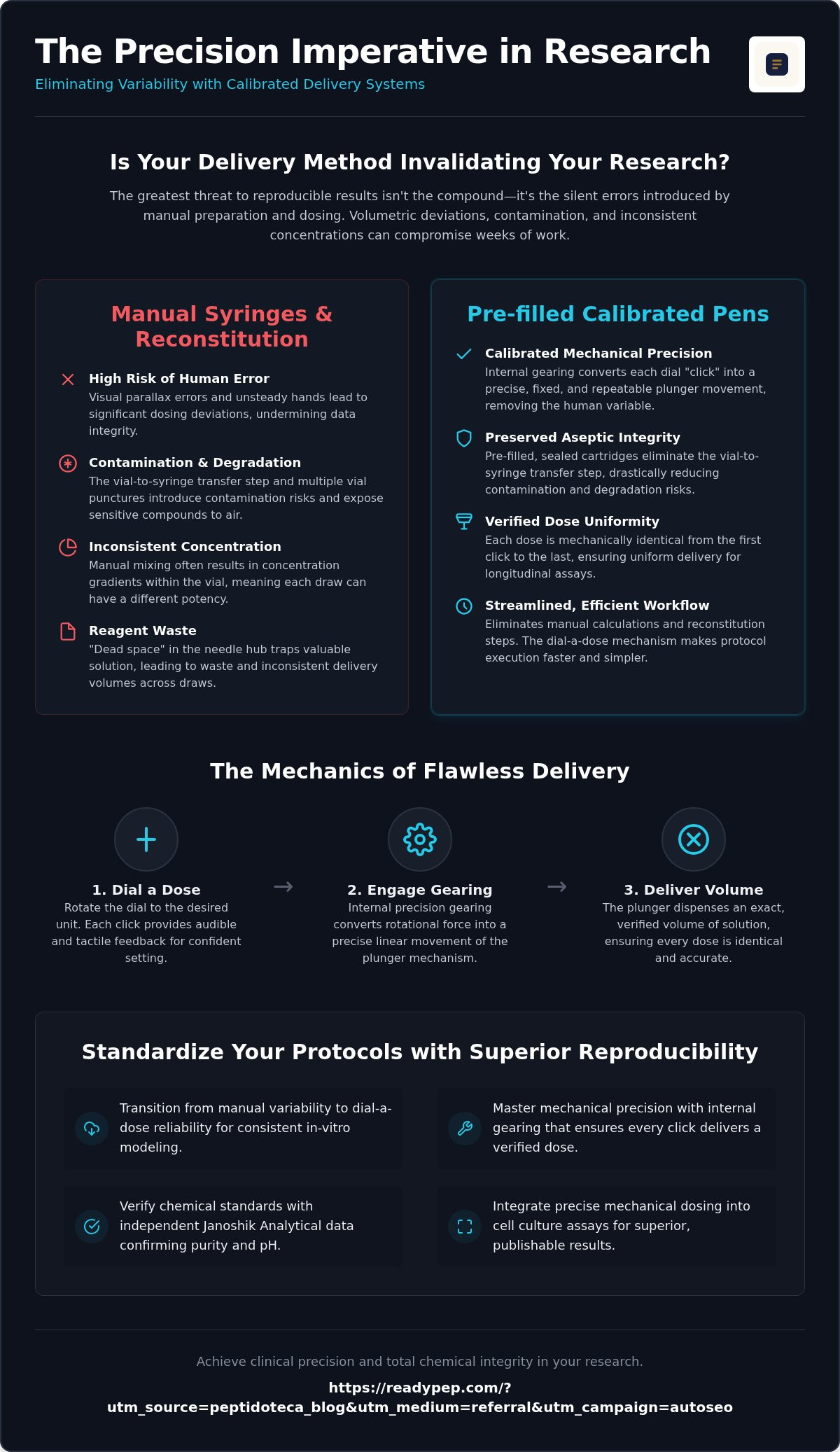
Manual volumetric measurement is technically flawed. Visual parallax errors occur when the researcher's eye level isn't perfectly aligned with the meniscus. This leads to subtle but significant dosing deviations. Standard needles also contain "dead space." This trapped volume leads to reagent waste and inconsistent delivery across multiple draws. The most critical failure point is the reconstitution variable. Manual mixing often results in concentration gradients within a single vial. This compromises the integrity of longitudinal assays. It introduces uncertainty where there should be data.
Key Components of a Research-Grade Calibrated Pen
A high-standard pen is more than a container; it's a precision instrument. The mechanical dial allows for rapid unit-to-milligram conversion. This eliminates the need for mental math during active protocols. The internal plunger mechanism ensures uniform pressure. Flow rate and volume remain constant from the first dose to the last. Cartridge integrity is equally vital. These systems maintain a sterile, anaerobic environment. This protects sensitive compounds from the degradation and contamination risks associated with multiple vial punctures. Efficiency is built into the hardware. It's a streamlined solution for complex science.
Mechanical Calibration: How Dial-a-Dose Systems Ensure Accuracy
The mechanical integrity of calibrated peptide pens for research hinges on precision engineering. It's not about estimation; it's about physics. When you rotate the dial, internal gears convert that rotational force into a precise linear displacement of the plunger. Each "click" represents a fixed movement. This mechanical lock ensures that every dose is identical. Manual aspiration relies on the steady hand of a researcher. Mechanical pens rely on calibrated resistance. This removes the "human variable" from high-throughput laboratory environments. It's about repeatability. You can't achieve this consistency with a standard syringe. The 'click-to-volume' ratio is the primary metric for delivery calibration.
Accuracy isn't just a preference; it's a technical standard. Referencing FDA guidance on drug delivery devices provides a framework for understanding these essential performance outputs. These standards ensure that delivery systems provide a predictable volume of solution. In a research setting, this predictability translates to data integrity. If your delivery volume fluctuates, your assay results are compromised. Calibrated peptide pens for research provide the stability needed for sensitive in-vitro modeling.
The Unit-to-Milligram Conversion Protocol
Standardizing protocols is straightforward with pre-filled systems. For a high-concentration tool like Retatrutide 40mg, the conversion from units to milligrams is fixed by the pen's concentration. Researchers can calculate precise dose increments for MOTS-c 40mg metabolic assays by simply counting clicks. This eliminates the mental fatigue of manual calculations. Documenting click counts in publication-ready methodology sections adds a layer of transparency. It allows other labs to replicate your work exactly. It's a verified trail of evidence.
Ensuring Mechanical Reliability
Reliability is built into the hardware. The dial's resistance is specifically tuned to prevent accidental over-dosing. You won't slip past your intended volume. While reusable systems require constant maintenance and recalibration, pre-filled disposable pens maintain integrity through single-cartridge use. This is a critical factor in improving lab workflow with pre-filled pens. It reduces the technical debt of your laboratory. You focus on the data, not the equipment maintenance. If you want to streamline your next assay, consider the pre-filled delivery options available for modern research.
Pre-filled Pens vs. Manual Reconstitution Workflows
Manual reconstitution is a 10-minute liability. It requires precise volumetric measurement, sterile water addition, and gentle agitation, all of which are prone to human error. When you use calibrated peptide pens for research, this entire preparatory phase is consolidated into a 10-second administration. This isn't just a matter of convenience; it's a matter of concentration stability. Metatide Healthcare pre-filled pens are manufactured in controlled environments that ensure a uniform distribution of the compound. Manual mixing often creates concentration gradients within a vial, leading to inconsistent results across different draws. Pre-filled systems remove this friction entirely.
The economic impact of delivery hardware is often overlooked. Standard insulin syringes have inherent "dead space" in the needle hub and barrel. This trapped volume can lead to significant reagent waste over the course of a long-term study. Pre-filled systems utilize specialized cartridges that minimize this waste, ensuring that every microgram of your research material is utilized in the assay. By switching to pre-filled delivery formats, labs can reduce technical debt and focus resources on data acquisition rather than reagent preparation.
Aseptic Integrity in In-Vitro Assays
Every time a needle punctures a traditional vial, the risk of environmental contamination increases. Pre-filled cartridges are sealed, anaerobic systems that protect sensitive peptides like BPC-157 + TB-500 from oxidative degradation and bacterial ingress. These solutions are professionally balanced for pH and utilize bacteriostatic water to maintain long-term stability. Adhering to technical standards, such as those found in FDA guidance on injector accuracy, ensures that the delivery mechanism doesn't compromise the chemical integrity of the reagent during the administration process.
Workflow Comparison Table
| Feature | Manual Reconstitution | Pre-filled Calibrated Pens |
|---|---|---|
| Preparation Time | 8-12 Minutes | <10 Seconds |
| Contamination Risk | High (Multiple Punctures) | Minimal (Sealed Cartridge) |
| Dosing Precision | Variable (Visual Meniscus) | Fixed (Mechanical Click) |
| Reagent Waste | Significant (Syringe Dead Space) | Negligible |
Justifying the use of ready-to-use reagents is simple when you prioritize reproducibility. For more information on how these standards are maintained, you can review our guide on Peptide Pen Quality Control. It's a transparent look at how we eliminate variables before they reach your laboratory bench.
Integrating Calibrated Pens into Research Protocols
Protocol standardization is the cornerstone of valid in-vitro research. When you integrate calibrated peptide pens for research into your workflow, you're essentially automating the precision of your delivery. This is particularly vital in cell culture and fibroblast proliferation assays where minor volumetric errors can skew metabolic readouts. These pens allow for complex timed-release modeling. You can simulate pulsatile delivery with a level of mechanical accuracy that manual pipetting can't replicate. It's about reducing the noise in your data. It's about removing the friction of manual preparation.
The Mind Protocol and Lean Protocol formats simplify multi-compound research by providing pre-calculated, synergistic concentrations that eliminate the need for manual stack formulation. This allows researchers to manage complex variables without the logistical burden of disparate preparation methods. Every variable you eliminate is a step toward more reproducible science.
Metabolic and Longevity Research Applications
Precision is non-negotiable in senescence studies. Utilizing NAD+ 1000mg requires exact dosing to observe cellular aging markers without interference. Similarly, mitochondrial function assays using MOTS-c pens benefit from the verified concentration of pre-filled systems. Every administration is logged by click count. This creates an audit trail for publication integrity. Tracking lot numbers becomes a seamless part of the methodology. It ensures that your results are tied to independently verified chemical standards, not preparation errors.
Neurological and Signaling Studies
Signaling assays require consistent receptor activation. Administering Selank 10mg in CNS models demands a delivery method that doesn't introduce mechanical artifacts. The same applies to high-concentration GHK-Cu 100mg used in skin cell proliferation research. High concentrations are notoriously difficult to dose manually without waste or clogging. Calibrated pens solve this. They reduce variability in growth hormone secretagogue signaling assays by providing a uniform flow rate every time. You focus on the cellular response, not the syringe resistance. If you're ready to modernize your laboratory standards, you can order pre-filled research pens directly to begin standardizing your delivery protocols today.
Ensuring Integrity: Analytical Verification of Pre-filled Pens
Verification is the final, uncompromising pillar of laboratory integrity. A mechanical delivery system is only as precise as the chemical it contains. For this reason, calibrated peptide pens for research must undergo rigorous analytical verification before they reach the bench. ReadyPep utilizes independent third-party testing from Janoshik Analytical to confirm the identity and purity of every batch. This isn't just an internal quality check; it's a commitment to radical transparency. It ensures that the technical specifications on the label match the reality of the reagent.
Interpreting High-Performance Liquid Chromatography (HPLC) and Mass Spectrometry (MS) data is essential for researchers who demand empirical proof. HPLC chromatograms reveal the purity level by identifying any secondary peaks that indicate impurities. Mass Spectrometry confirms the exact molecular weight, ensuring the peptide in the cartridge is exactly what was ordered. Without this data, you're operating on trust. In professional research, trust is an unacceptable variable. Analytical proof is the only acceptable baseline for high-stakes assays.
Verifying Purity and pH Standards
Purity levels of 99% or higher are the baseline for high-fidelity in-vitro research. Lower purity grades introduce unknown contaminants that can trigger unintended cellular responses, effectively poisoning your data. The pH of the aqueous solution within the pen is equally critical. Peptides are sensitive to their environment; a pH imbalance can lead to rapid degradation or precipitation. ReadyPep provides access to lot-specific Certificates of Analysis (COAs) for every pen in your laboratory inventory. This allows you to verify the exact specifications of your reagents before a single administration occurs. It's about removing uncertainty from the workflow.
Global Sourcing and Cold-Chain Integrity
The logistics of research chemicals require clinical precision. ReadyPep manages UK-based distribution to ensure rapid delivery to global labs while maintaining strict compliance standards. Cold-chain shipping isn't a premium add-on; it's a necessity for maintaining the calibrated accuracy of the reagent. Heat exposure during transit can alter the peptide's structure and concentration. ReadyPep includes free worldwide cold-chain shipping to mitigate this risk. Upon receipt of Metatide Healthcare products, researchers should verify the cold-chain integrity to ensure the compounds haven't deviated from their verified state. You can secure your laboratory's precision reagents at ReadyPep to ensure your next study is built on a foundation of verified data.
Standardizing the Future of Laboratory Delivery
Precision is the only variable that matters in high-fidelity in-vitro assays. Manual methods introduce friction. They create noise. By adopting calibrated peptide pens for research, you eliminate the volumetric inconsistencies of traditional syringes. You secure your data against human error. Every Metatide Healthcare pen provides a verified path from preparation to administration. These systems are independently tested by Janoshik Analytical for purity and pH. This ensures your reagents meet the highest technical standards before they reach your laboratory bench.
It's time to remove the technical debt of manual preparation. You can upgrade your laboratory precision with ReadyPep's verified research pens and benefit from free worldwide cold-chain shipping. Your next breakthrough depends on the absolute integrity of your delivery mechanism. Build your next study on a foundation of mechanical accuracy and empirical proof. We provide the tools; you provide the science. Experience the calm assurance of a streamlined, professional workflow today.
Frequently Asked Questions
Are calibrated peptide pens compatible with standard pen needles?
Yes, calibrated peptide pens for research are designed for compatibility with standard universal pen needles, such as 31G or 32G sizes. This universal fitment allows researchers to utilize widely available laboratory consumables without investing in proprietary attachment hardware. Using standard needles ensures that each administration is performed with a fresh, sterile tip, which is critical for maintaining aseptic integrity during long-term cell culture studies.
How do I calculate the exact dosage per click for a 40mg research pen?
To calculate the exact dosage, divide the total milligram content by the total number of clicks or units the pen provides. For a 40mg high-concentration pen, such as Retatrutide or MOTS-c, you must verify the volume of the cartridge. If the pen is calibrated for 60 units, each click delivers approximately 0.66mg of the compound. Always cross-reference this with the lot-specific documentation to ensure your protocol is mathematically sound.
What is the shelf life of a pre-filled peptide pen once opened?
Once opened, a pre-filled pen typically maintains stability for 28 to 30 days when stored under refrigeration. The bacteriostatic water in the solution prevents microbial growth, but peptide degradation is a function of time and temperature. For longitudinal studies, it's recommended to log the first puncture date to ensure the chemical integrity of the reagent. Always discard any solution that shows visible signs of precipitation or color change.
Why is Janoshik testing important for pre-filled research pens?
Janoshik testing provides independent, third-party verification of the purity and pH levels of calibrated peptide pens for research. This external validation removes the conflict of interest inherent in manufacturer-only testing. It gives researchers empirical proof that the compound's concentration and stability are sufficient for high-fidelity in-vitro modeling. This transparency reduces the risk of experimental artifacts caused by low-purity reagents or incorrect concentration levels.
Can these pens be used for in-vivo animal studies?
These pens are strictly for in-vitro laboratory research and are not intended for in-vivo animal testing. The formulations are optimized for cell culture and biochemical assays rather than biological systems. Using them outside of these parameters violates the terms of service and may yield unreliable data due to the specific pH balancing required for in-vitro environments. Researchers should adhere to all laboratory safety protocols regarding the use of chemical reference materials.
How does cold-chain shipping affect the calibration of the peptide solution?
Cold-chain shipping preserves the molecular structure of the peptide, which is essential for maintaining the calibrated concentration of the solution. If a solution is exposed to extreme heat, the peptide may degrade or precipitate, changing the actual milligrams delivered per click. Free worldwide cold-chain shipping ensures the reagent arrives in its verified state, ready for immediate laboratory use. Maintaining the temperature from the distributor to your lab is non-negotiable for data integrity.
What should I do if the mechanical dial on my research pen feels stuck?
If the mechanical dial feels stuck, don't apply excessive force, as this can damage the internal gearing and compromise delivery accuracy. Check for any obstructions or crystallized residue around the needle mount that might be causing resistance. If the resistance persists, the pen's calibration may be compromised. In such cases, it's safer to use a new pen to maintain the dosing precision required for your research protocol and avoid inconsistent results.
Are ReadyPep pens intended for human or veterinary use?
ReadyPep products are strictly not for human or veterinary use. They are distributed as chemical reference materials for in-vitro laboratory research only. All Metatide Healthcare pre-filled pens are labeled accordingly to ensure compliance with international research standards. Any application involving living subjects is outside the scope of the product's intended purpose and verified safety profile. It's the researcher's responsibility to ensure these compounds are handled within a controlled laboratory environment.
Disclaimer
Educational content only. Not medical advice.


