

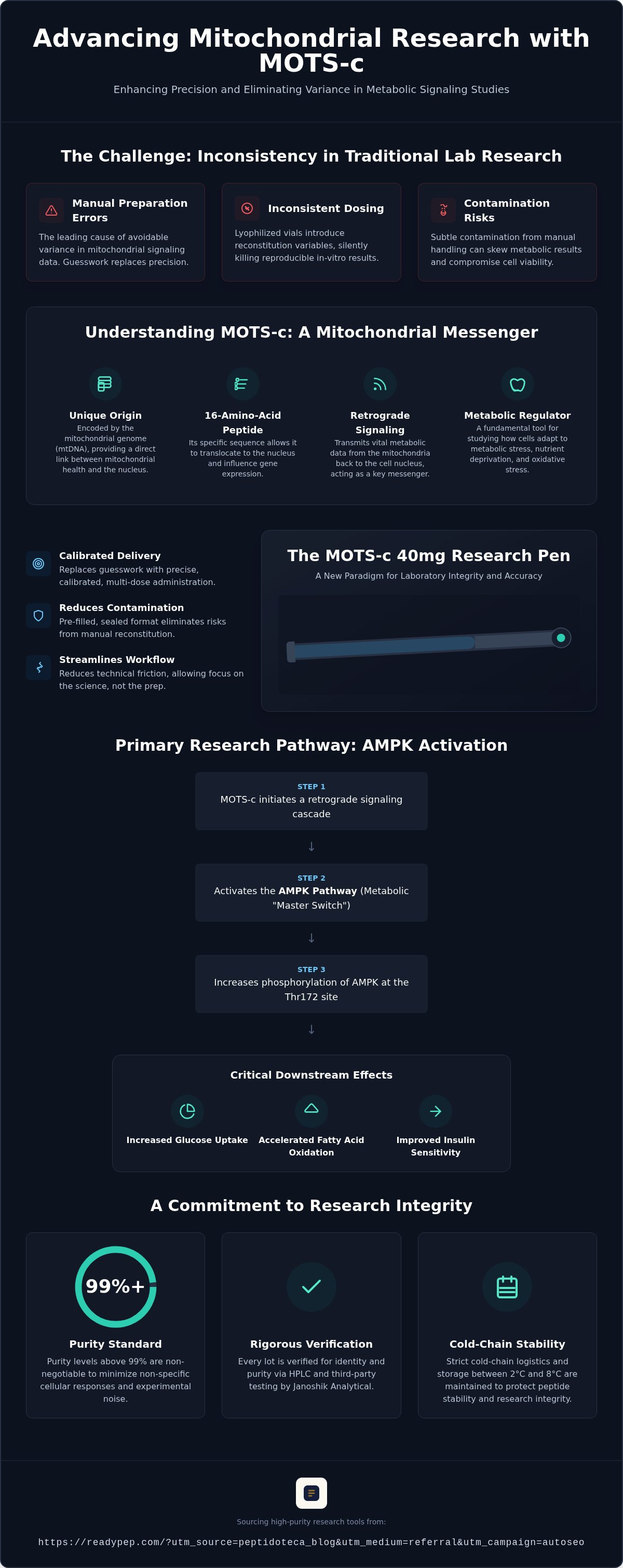
Manual reagent preparation is the leading cause of avoidable variance in mitochondrial signaling data. Traditional lyophilized vials introduce manual variables, from reconstitution errors to subtle contamination risks that skew metabolic results. The MOTS-c 40mg research pen changes this paradigm by replacing guesswork with calibrated, multi-dose delivery. It isn't just a convenience. It's a commitment to laboratory integrity. Many researchers accept these variables as an unavoidable cost of mitochondrial studies, but modern standards demand higher precision.
You likely recognize that inconsistent dosing is the silent killer of reproducible results in in-vitro studies. This article demonstrates how pre-filled formats enhance research accuracy while streamlining your laboratory workflow. We'll examine the technical advantages of the MOTS-c 40mg research pen, including its HPLC-verified purity standards and the impact of reliable cold-chain logistics on peptide stability. We will also explore how standardized delivery systems reduce technical friction, allowing you to focus on the science of AMPK activation. Discover how to upgrade your methodology for the 2026 research landscape.
Key Takeaways
- Understand the role of MOTS-c as a unique 16-amino-acid peptide encoded by the mitochondrial genome that facilitates retrograde signaling to the cell nucleus.
- Analyze the primary mechanism of action involving AMPK activation and its downstream effects on glucose uptake and fatty acid oxidation in cellular models.
- Eliminate reconstitution errors and contamination risks by utilizing the MOTS-c 40mg research pen for standardized, multi-dose delivery.
- Protect research integrity by maintaining strict cold-chain storage between 2°C and 8°C and verifying lot-specific purity via Janoshik Analytical.
- Streamline laboratory workflows with high-precision tools manufactured by Metatide Healthcare to ensure consistency in mitochondrial signaling assays.
Understanding MOTS-c: A Mitochondrial-Derived Peptide (MDP) for Metabolic Research
MOTS-c represents a shift in how we view the mitochondrial genome. It's a 16-amino-acid peptide specifically encoded within the mitochondrial DNA (mtDNA) rather than the nuclear genome. This molecule, officially known as MOTS-c (mitochondrial open reading frame of the 12S rRNA-c), functions as a retrograde signaling agent. It transmits vital data from the mitochondria to the nucleus. Researchers utilize the MOTS-c 40mg research pen to investigate how cells adapt to metabolic stress. Its structural stability in aqueous solutions makes it ideal for consistent in-vitro laboratory assays. It doesn't just sit in the cell; it actively dictates how the cell manages energy.
The Unique Origin: Mitochondrial DNA vs. Nuclear DNA
The discovery of short open reading frames (sORFs) within mtDNA challenged the long-held belief that the mitochondrial genome only encoded 13 proteins. MOTS-c is the result of this unconventional genetic architecture. This unique origin provides a direct link between mitochondrial health and nuclear gene expression. In evolutionary biology research, this peptide acts as a conserved metabolic regulator. The specific 16-amino-acid sequence is critical. It allows the peptide to translocate to the nucleus and bind to specific DNA sequences. This process influences cellular responses to nutrient deprivation and oxidative stress. It's a fundamental tool for studying metabolic flexibility.
Research Grade Purity: Why 99%+ Matters
High-purity reagents are non-negotiable for reproducible signaling studies. Even trace impurities can trigger non-specific cellular responses. This creates experimental noise that obscures the actual effects of the peptide. Using a MOTS-c 40mg research pen ensures that the concentration is precise and the chemical profile is verified. Impure peptides often contain synthesis byproducts that compromise cell culture viability.
- High-Performance Liquid Chromatography (HPLC) identifies peptide fragments that could interfere with binding assays.
- Purity levels above 99% minimize cell culture toxicity and unintended inflammatory responses.
- Consistent pH levels prevent changes in media conditions that might skew metabolic data.
ReadyPep maintains this standard through rigorous third-party verification. Every lot undergoes testing by Janoshik Analytical to confirm its identity and purity. This transparency removes the uncertainty often associated with unverified reagents. You get the data you need without the risk of contamination or batch-to-batch variance. It's about providing the calm assurance that your baseline is secure.
Primary Research Pathways: AMPK Activation and Metabolic Signaling
MOTS-c functions as a metabolic "master switch" in cellular biology. Its primary mechanism involves the activation of the 5’ adenosine monophosphate-activated protein kinase (AMPK) pathway. This isn't a passive process. When cellular energy is low, MOTS-c initiates a retrograde signaling cascade. It communicates mitochondrial status directly to the nucleus. This pathway is a cornerstone for researchers investigating MOTS-c and metabolic diseases in controlled environments. By using a MOTS-c 40mg research pen, scientists maintain tight control over the concentrations required to trigger these delicate phosphorylation events. Precision is vital when observing the shift from energy storage to energy utilization.
AMPK Pathway and Cellular Energy Regulation
In experimental assays, MOTS-c increases the phosphorylation of AMPK at the Thr172 site. This activation mimics the cellular environment of exercise, leading to increased glucose uptake and accelerated fatty acid oxidation. These downstream effects are critical for studying cellular homeostasis and insulin sensitivity in-vitro. MOTS-c acts as a primary energy sensor that bridges mitochondrial function with nuclear metabolic programming to maintain cellular homeostasis. Researchers prioritize this pathway when studying metabolic disorders, as it provides a clear window into how cells manage nutrient flux without nuclear DNA intervention. The ability to stimulate this pathway predictably depends on the stability of the peptide reagent used.
Investigating Mitochondrial Stress Responses
Under conditions of metabolic stress or mitochondrial dysfunction, MOTS-c translocates from the mitochondria to the nucleus. This isn't just a relocation; it's a functional shift. Once in the nucleus, it regulates the expression of genes involved in antioxidant defenses and stress resistance. Researchers utilize this mechanism to study aging and cellular senescence in various in-vitro models. Because this translocation is a response to stress, the purity of the peptide is paramount. Contaminants can trigger false stress responses, leading to experimental noise. Integrating a standardized delivery system ensures that the signaling assays remain consistent across multi-dose applications. This consistency is what allows for the identification of subtle changes in nuclear gene expression during long-term studies.
The Pre-filled Pen Advantage: Workflow Efficiency in Laboratory Settings
Traditional lyophilized vials represent a legacy workflow that often compromises research throughput. Every manual step, from calculating diluent volumes to the actual reconstitution process, is a potential point of failure. The MOTS-c 40mg research pen replaces these fragmented steps with a unified, high-precision system. By transitioning to ready-to-use reagents, laboratories can significantly reduce the hours spent on preparation. This allows researchers to focus on data acquisition rather than reagent maintenance. This shift is particularly valuable in high-throughput environments where speed and reliability are equally prioritized. Consistency isn't just a goal; it's a requirement for modern mitochondrial research.
Precision Dosing and Reconstitution Safety
Manual reconstitution is fraught with risks. Inconsistent volumes and environmental exposure can degrade peptide bioactivity before the assay even begins. The pre-filled format eliminates the need for manual diluent calculations, which are common sources of human error in complex signaling studies. A closed-system design provides a significant aseptic advantage by reducing the number of times a reagent is exposed to the laboratory atmosphere. This minimizes contamination risks that could otherwise trigger non-specific cellular responses. For a deeper look at these technical advantages, consider Comparing Peptide Pens vs Syringes for Lab Work to see how precision tools impact baseline stability.
Precision is further enhanced by the "click" mechanism. This feature allows for micro-volume delivery with tactile verification. Each click corresponds to a specific dosage, removing the visual ambiguity of traditional syringe markings. In longitudinal studies where consistency over several weeks is required, this mechanical precision ensures that every application is identical to the last. It's a level of control that manual pipetting simply cannot match. You get repeatable results without the stress of manual measurement.
Standardizing Protocols Across Multiple Lab Members
Inter-operator variability is a silent killer of scientific reproducibility. When multiple lab members are involved in a single study, subtle differences in pipetting technique or reconstitution habits can skew results. Standardizing your delivery system is the most effective way to mitigate this risk. The MOTS-c 40mg research pen simplifies the training of lab personnel. It provides a uniform interface that remains consistent regardless of the user's experience level. Additionally, the integrated volume indicator allows for real-time reagent tracking. You always know exactly how much material remains, which prevents unexpected shortages during critical assay windows. This transparency leads to a more predictable and cost-effective research cycle.
Research Integrity Protocols: Handling, Storage, and Verification
Research integrity isn't just about the study design; it's about the verifiable quality of the reagents used. Mitochondrial-derived peptides like MOTS-c are highly sensitive to thermal fluctuations and environmental contaminants. Maintaining a constant 2°C to 8°C environment is a non-negotiable requirement for long-term storage. Even brief excursions outside this range can trigger peptide denaturing, which leads to inactive compounds and skewed metabolic data. The MOTS-c 40mg research pen is designed to protect the compound's integrity, but the logistical chain must match the product's precision. Documenting your reagent sources with granular detail is now a standard expectation for peer-reviewed publications and research reproducibility.
Verifying Purity with Janoshik Analytical Reports
Third-party testing is the gold standard for publication-grade research. Relying on internal manufacturer data isn't enough when your study's credibility is on the line. An HPLC chromatogram for MOTS-c 40mg should show a single, sharp peak with minimal baseline noise, indicating the absence of synthesis byproducts. pH verification is equally critical. Aqueous peptide solutions can degrade rapidly if the acidity isn't precisely balanced, which is why ReadyPep provides lot-specific documentation for every MOTS-c pen. These reports from Janoshik Analytical allow you to confirm the identity, purity, and concentration of your reagent before the first assay begins. You don't have to guess if your baseline is secure; you have the data to prove it.
- Review the specific lot number on your pen against the latest Janoshik database.
- Confirm that the peak area percentage exceeds 99% for high-fidelity signaling studies.
- Verify that the pH level is optimized for stability in aqueous laboratory environments.
Cold Chain Integrity and Global Logistics
Peptide denaturing is a common result of poor logistics, especially during international transit. Standard shipping methods often fail to maintain the strict temperature requirements needed for bioactive peptides. ReadyPep’s worldwide shipping protocol originates from their UK base, utilizing specialized temperature-controlled packaging to mitigate these risks. This global cold-chain ensures that the MOTS-c 40mg research pen arrives at your laboratory with its molecular structure intact. For those establishing new laboratory protocols, consulting a MOTS-c Peptide Buy: A 2026 Researcher’s Guide provides the necessary context for sourcing high-purity pens that meet modern standards. Secure your laboratory’s supply of verified MOTS-c 40mg pens to ensure that your metabolic signaling assays remain consistent and reproducible over time.
Sourcing High-Purity MOTS-c 40mg Pens for Scientific Investigation
Reliability is the primary currency of the laboratory. In mitochondrial research, where signaling pathways are delicate and easily disrupted, the quality of your reagents dictates the validity of your data. Many institutions are moving away from unverified suppliers in favor of transparent, verified sources. By choosing a MOTS-c 40mg research pen, you secure a reagent that's already calibrated for high-fidelity assays. This format eliminates the preparatory friction that often leads to experimental variance. The 40mg concentration is particularly versatile. It supports a wide range of experimental designs, from acute signaling observations to long-term cellular adaptation studies. You don't just buy a chemical; you invest in a standardized delivery system.
Metatide Healthcare: Manufacturing Excellence
Metatide Healthcare maintains synthesis standards that exceed generic industry benchmarks. Their facility focuses on molecular stability and precise peptide sequences. This commitment to quality is why the pre-filled pen format is becoming the standard for research chemical delivery. It's a professionalized approach to reagent management. ReadyPep acts as the authorized worldwide distributor for Metatide products, ensuring that these high standards are maintained from the lab to your facility. This partnership removes the uncertainty of third-party resellers. You get direct access to manufacturing excellence with the assurance of third-party verification for every batch. The August 2026 batch is currently available, featuring the latest refinements in peptide stability and pen mechanics.
Procurement and Institutional Compliance
Procurement for academic and private research institutions is often slowed by logistical friction and compliance hurdles. ReadyPep simplifies this process through a streamlined ordering interface and global cold-chain shipping. Operating from a UK base, they provide rapid deployment to international laboratories without compromising the thermal integrity of the peptides. Every shipment is tracked and managed to ensure it meets the highest analytical standards upon arrival. This level of logistical precision is essential for maintaining the bioactivity of MOTS-c. Integrating these pens into your laboratory’s inventory ensures that all members are working with identical, high-purity materials. It's a simple way to boost the reproducibility of your institutional research.
To maintain the highest standards of data integrity, you can procure high-purity MOTS-c 40mg research pens from ReadyPep today. Each unit is ready for immediate integration into your next mitochondrial signaling assay.
Final Safety Reminder: These products are intended solely for in-vitro laboratory research. Strict adherence to institutional safety protocols is mandatory. They are not for human or veterinary use. All research involving MOTS-c must be conducted within a controlled laboratory environment by qualified professionals.
Standardizing the Future of Mitochondrial Signaling
The transition toward pre-filled delivery systems represents a necessary evolution in laboratory precision. By eliminating the technical variance found in traditional manual reconstitution, the MOTS-c 40mg research pen establishes a reliable baseline for complex metabolic signaling assays. This system ensures that every dose is calibrated and every lot is independently verified by Janoshik Analytical. You no longer need to accept the risks of contamination or dosing inconsistency that plague legacy workflows. With Metatide Healthcare manufacturing and global cold-chain shipping from the UK, your reagents arrive with their molecular integrity fully intact.
Securing high-purity compounds is the first step toward reproducible results. You can now explore the MOTS-c 40mg Research Pen and Analytical Reports to verify the current lot specifications for yourself. Elevate your institutional standards by integrating tools designed for the modern researcher. Your data deserves the clarity that only verified precision can provide.
Frequently Asked Questions
Is the MOTS-c 40mg pen intended for human use?
No, this product is strictly intended for in-vitro laboratory research and is not approved for human or veterinary use. All experimental protocols must be conducted by qualified professionals within a controlled environment to ensure data integrity. ReadyPep adheres to these strict standards to provide reagents for scientific investigation only. Misuse of research chemicals outside of these parameters compromises both safety and the validity of your metabolic signaling results.
How should the MOTS-c 40mg research pen be stored in the laboratory?
The MOTS-c 40mg research pen must be stored at a constant temperature between 2°C and 8°C. Maintaining this refrigerated environment is essential to preserve the structural stability of the 16-amino-acid peptide sequence. Exposure to room temperature for extended periods can lead to peptide denaturing and loss of bioactivity. Always store the pen in a dedicated laboratory refrigerator to prevent thermal fluctuations that could skew signaling data.
What is the purity level of ReadyPep’s MOTS-c 40mg pens?
Every pen features a purity level exceeding 99% as verified by High-Performance Liquid Chromatography (HPLC). This high standard is necessary to minimize experimental noise and prevent non-specific cellular responses in sensitive assays. ReadyPep sources its inventory from Metatide Healthcare to ensure that synthesis byproducts are virtually eliminated. This level of chemical precision allows researchers to attribute cellular changes directly to the MOTS-c signaling pathway without interference from contaminants.
Does the MOTS-c 40mg pen come with independent lab testing?
Yes, every batch is independently verified by Janoshik Analytical. These third-party reports confirm the peptide’s identity, purity, and pH level. Accessing these lot-specific COAs is a non-negotiable step for researchers who require publication-grade documentation. By providing transparent analytical data, ReadyPep removes the uncertainty often associated with unverified reagents. You can review the latest Janoshik reports to ensure complete accountability and verify your specific lot number before beginning your signaling assays.
How accurate is the dosage delivery system in a pre-filled pen?
The pre-filled pen utilizes a calibrated click mechanism designed for high-precision micro-volume delivery. This system eliminates the common errors associated with manual pipetting and syringe measurements. Each tactile click corresponds to a specific, repeatable volume, ensuring that every application is identical across multi-dose studies. This mechanical accuracy is vital for longitudinal mitochondrial signaling research where inter-operator variability must be kept to an absolute minimum.
What is the shelf life of the MOTS-c 40mg pen after opening?
Once opened and maintained under strict cold-chain conditions, the peptide typically remains stable for approximately 30 days. However, actual bioactivity can vary based on the specific laboratory handling protocols and environment. Researchers should always monitor the aqueous solution for any signs of degradation or precipitation. For the most accurate results, it's best to use the reagent within its verified stability window to ensure the signaling cascade remains potent and predictable.
Can ReadyPep ship MOTS-c 40mg pens internationally via cold chain?
ReadyPep provides global cold-chain shipping from its UK base to ensure the thermal integrity of every shipment. Specialized temperature-controlled packaging is used to prevent denaturing during international transit. This logistical precision allows research institutions worldwide to receive the MOTS-c 40mg research pen with its molecular structure intact. You can track your shipment’s progress to ensure it meets your laboratory's strict intake and storage requirements upon arrival.
Why is MOTS-c 40mg preferred over lower concentrations for research?
The 40mg concentration offers superior versatility for diverse experimental designs. It allows for a broader range of dosing protocols, from acute signaling observations to long-term cellular adaptation studies. High-throughput laboratories prefer this concentration because it reduces the frequency of reagent replacement, thereby streamlining the procurement cycle. This format provides the necessary material volume for extensive in-vitro assays while maintaining the precise concentration required for reproducible AMPK activation data.
Disclaimer
Educational content only. Not medical advice.


