

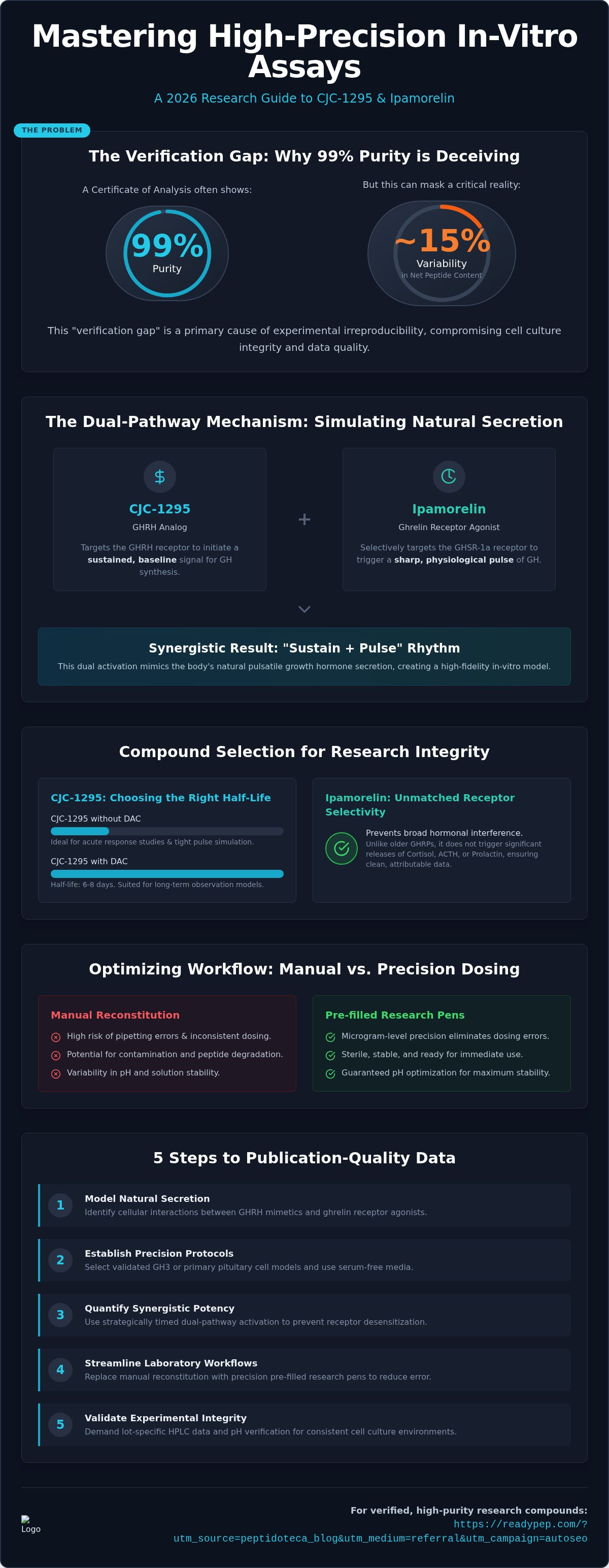
A 99% purity rating on a Certificate of Analysis is often a statistical illusion that masks a 15% variability in net peptide content. For researchers, this "verification gap" is the silent killer of experimental reproducibility. You've likely faced the frustration of material variability in lyophilized peptides or inconsistent dosing during manual reconstitution. These friction points don't just slow you down; they compromise the cell culture integrity required for high-tier publication. Achieving a reliable CJC-1295 Ipamorelin in-vitro assay requires moving beyond generic lab protocols and adopting a standard of clinical precision that accounts for every microgram.
This 2026 research guide promises to help you master the technical requirements for designing high-precision assays using verified compounds. We'll explore the critical pH stability thresholds for growth hormone secretagogues and the 2026 FDA standards for identifying synthetic impurities. You'll learn how to streamline your laboratory workflows by eliminating reconstitution errors and ensuring 99%+ peptide purity. By the end of this article, you'll have a clear framework for producing publication-quality data that stands up to the most rigorous peer review. We're moving past industry norms to focus on empirical verification and streamlined action.
Key Takeaways
- Identify the specific cellular interactions between GHRH mimetics and ghrelin receptor agonists to model natural pulsatile growth hormone secretion.
- Establish high-precision protocols for a CJC-1295 Ipamorelin in-vitro assay by selecting validated GH3 or primary pituitary cell models.
- Quantify synergistic potency and prevent receptor desensitization through strategically timed dual-pathway activation in your experimental design.
- Streamline laboratory workflows and reduce pipetting errors by replacing manual reconstitution with the precision of pre-filled research injector pens.
- Validate experimental integrity with lot-specific HPLC data and pH verification to ensure consistent cell culture environment across all research phases.
CJC-1295 and Ipamorelin: The Dual-Pathway In-Vitro Mechanism
Designing a high-fidelity CJC-1295 Ipamorelin in-vitro assay requires a deep understanding of dual-pathway signaling. These compounds don't compete for the same receptor; they target distinct biological triggers within pituitary somatotrophs. CJC-1295 functions as a synthetic analog of Growth Hormone Releasing Hormone (GHRH). It initiates a sustained baseline signal. Conversely, Ipamorelin acts as a selective agonist of the ghrelin receptor. This combination effectively mimics the natural "sustain plus pulse" rhythm of endogenous growth hormone secretion.
Assay duration dictates the choice between CJC-1295 with and without the Drug Affinity Complex (DAC). The DAC variant possesses a half-life of approximately 6 to 8 days, according to research data from early 2026. This makes it suitable for long-term observation models. For research focused on tight, physiological pulse simulation, scientists prefer CJC-1295 without DAC. This version allows for rapid clearance and precise control over signaling windows, ensuring that the assay reflects acute cellular responses rather than cumulative effects.
GHRH Receptor Activation via CJC-1295
CJC-1295 exhibits high binding affinity for the GHRH receptor in isolated cell lines. Upon binding, it stimulates cAMP-dependent signaling pathways. This intracellular cascade is the primary driver for growth hormone synthesis. In an in-vitro environment, this provides a baseline elevation of GH. It sets the stage for the secondary pulse. Utilizing high-purity CJC-1295 10mg ensures that these signaling pathways aren't compromised by manufacturing byproducts or unexpected salt concentrations.
Selective Ghrelin Receptor Agonism by Ipamorelin
As a pentapeptide, Ipamorelin is recognized for its extreme selectivity for the GHSR-1a receptor. Unlike earlier generations like GHRP-2 or GHRP-6, it doesn't trigger significant releases of ACTH, prolactin, or cortisol in research models. This "clean" profile is vital for assay integrity. It ensures that observed data points result from GH stimulation rather than broad hormonal interference. Using a verified Ipamorelin 10mg research compound prevents non-specific receptor activation that could skew results. This selectivity makes it the preferred ghrelin mimetic for high-precision studies where cellular isolation is critical. Every lot must be verified to ensure the peptide content by weight is consistent with the experimental design requirements.
Designing Precision In-Vitro Assays for Growth Hormone Secretagogues
Precision in a CJC-1295 Ipamorelin in-vitro assay starts with the elimination of environmental noise. You can't rely on generic setups if you aim for reproducible signaling data. Success depends on the rigorous control of cellular models and reagent stability. Many researchers struggle with inconsistent results due to subtle fluctuations in media composition or peptide degradation. Solving these issues requires a transition from traditional manual methods to standardized, high-precision laboratory workflows.
Cell Culture Model Selection and Preparation
Selecting the right cellular model is the first step toward experimental integrity. Immortalized GH3 somatotroph cell lines are the standard for most secretagogue assays. They offer consistent growth patterns and high receptor expression levels. While primary pituitary cells provide a more physiological representation, they introduce significant donor variability. This can skew your comparative data. To maintain receptor sensitivity, utilize serum-free media during the peptide introduction phase. Endogenous growth factors found in fetal bovine serum often mask the specific signaling effects of your research compounds. Standard incubation at 37°C with 5% CO2 is required, but the timing of peptide exposure must be strictly controlled to capture the peak cAMP response.
Reagent Preparation and pH Optimization
Peptide stability in aqueous solution is a critical variable that many labs overlook. Reconstituted peptides are vulnerable to hydrolysis and aggregation if the pH deviates from the optimal range. For Ipamorelin, maintaining a stable environment is essential for receptor binding efficiency. The FDA Pharmacological Review of Ipamorelin highlights the importance of understanding chemical stability when designing these research models. Precise temperature control during the preparation of your CJC-1295 Ipamorelin in-vitro assay prevents premature degradation of the synthetic chains.
Documenting lot-specific data is no longer optional for publication integrity in 2026. High-tier journals now require verification that impurities remain below the 0.10% threshold. Using pre-filled research pens can significantly reduce the risk of contamination during reagent introduction. These systems eliminate the variability inherent in manual pipetting and open-vial reconstitution. Every click provides a verified dose, ensuring that your concentration ranges remain exact across every replicate. This level of precision is the only way to ensure that your data reflects true biological activity rather than technical error.
Analyzing Synergistic Potency: Why Research Models Use Combined Peptides
Researchers often observe that a simple additive response isn't enough to model complex biological systems. In a CJC-1295 Ipamorelin in-vitro assay, the primary objective is true synergistic potency. While individual secretagogues eventually reach a physiological plateau, combining them allows for a more robust signaling profile. This synergy occurs because the two compounds target distinct intracellular mechanisms that converge to amplify the final output of growth hormone. It's a method of bypassing the limitations of single-pathway stimulation.
The GHRH-Ghrelin Cross-Talk in Somatotrophs
Intracellular signaling convergence is the technical foundation of this dual-peptide model. CJC-1295 acts on the GHRH receptor to stimulate the cAMP-dependent pathway, which is critical for GH synthesis. Ipamorelin targets the ghrelin receptor (GHSR-1a), triggering a separate cascade involving phospholipase C and calcium mobilization. When these pathways activate simultaneously, they potentiate GH release beyond the maximum capacity of either individual peptide. This shift in the dose-response curve allows researchers to achieve significant results with lower concentrations. It effectively reduces the risk of receptor desensitization, which often occurs during high-dose mono-therapy experiments. It's a precise way to simulate natural pulsatile rhythms without overwhelming the cellular model.
Minimizing Experimental Noise with High-Purity Reagents
High-purity reagents are non-negotiable for validating these synergistic models. If your compounds contain even 1% impurities, you risk off-target effects that can mask the true signaling data. The consequences of impure peptides are particularly severe in cell culture assays. Trace contaminants can alter cell viability or receptor binding affinity, leading to inconsistent replicates. Using verified CJC-1295 10mg and Ipamorelin 10mg ensures that every data point reflects the intended biological interaction rather than chemical noise.
Third-party verification plays a critical role in this process. Every research lot should undergo independent testing, such as HPLC and Mass Spectrometry, to confirm that purity exceeds 99%. This transparency allows for publication-quality results that other laboratories can reproduce with confidence. When you eliminate the variability inherent in lower-grade materials, you transform your assay from a speculative experiment into a rigorous scientific study. Precise data requires precise materials. There's no room for uncertainty when you're mapping the intricate cross-talk of pituitary somatotrophs.
Optimizing Laboratory Workflow with Pre-filled Research Pens
Traditional laboratory workflows for a CJC-1295 Ipamorelin in-vitro assay often suffer from a "human error tax." Manual reconstitution of lyophilized powder is a high-friction process. It introduces micro-variations in concentration that cascade through serial dilutions. Pre-filled research pens modernize this by integrating the reconstitution step into a closed, sterile system. This shift minimizes exposure to atmospheric contaminants and eliminates the need for open-vial handling. It's about removing the technical friction that leads to inconsistent data.
High-throughput in-vitro screening demands speed without sacrificing accuracy. Manual pipetting is the bottleneck. By utilizing the precise mechanical clicks of an injector pen, researchers can standardize reagent introduction across hundreds of replicates. This level of automation is critical for maintaining the integrity of growth hormone signaling models. It ensures that the only variable in your experiment is the biological response, not the technician's pipetting technique.
Precision Dosing and Reconstitution Efficiency
Calculating molarity becomes significantly more efficient when working with standardized aqueous solutions. Manual preparation errors can lead to significant deviations in final concentrations. In contrast, the internal mechanism of an injector pen provides a fixed volume per click. When comparing peptide pens vs syringes for laboratory work, pens offer superior reproducibility. This precision is vital for multi-well plate assays where reagent waste can quickly inflate project costs. By using a pre-filled system, you ensure that every well receives the exact concentration required for valid statistical analysis. It's a streamlined approach that prioritizes accuracy over manual labor.
Storage Protocols for Reconstituted Research Peptides
Maintaining the integrity of your CJC-1295 Ipamorelin in-vitro assay requires strict adherence to cold-chain storage. Reconstituted peptides are sensitive to thermal degradation. Store your pens at a consistent 2°C to 8°C to ensure long-term stability. Avoid frequent temperature fluctuations. Freeze-thaw cycles are particularly damaging; they cause mechanical stress on the peptide chains, leading to aggregation or loss of biological activity. Modern pen formats are designed to protect the aqueous solution from light and heat during active use.
Once the assay is complete, follow established protocols for the safe disposal of used research peptide pens to maintain biohazard compliance. Transitioning to these advanced delivery systems allows your team to focus on data analysis rather than manual preparation. To ensure your next study uses the highest standard of delivery precision, integrate pre-filled research peptide pens into your laboratory setup. This approach doesn't just save time; it safeguards the empirical validity of your research results.
Ensuring Research Integrity with Verified Purity Standards
Data integrity is the bedrock of scientific publication. In a CJC-1295 Ipamorelin in-vitro assay, the difference between a breakthrough and a retracted paper often lies in the purity of the chemical reference materials. You can't rely on self-reported data from manufacturers. Every research lot requires independent HPLC and Mass Spectrometry verification to ensure the absence of cross-contaminants. These impurities don't just add weight; they introduce biological noise that can distort receptor binding kinetics and downstream signaling pathways. It's about ensuring that every microgram of your reagent is accounted for before the first cell is plated.
Verification extends beyond chemical purity to include precise pH testing. Delicate cell lines, such as primary pituitary somatotrophs, are highly sensitive to the acidity of the surrounding media. If your peptide solution shifts the pH outside the physiological range, you risk cell death or altered gene expression. Navigating the logistical hurdles of customs clearance for research chemicals in 2026 requires a partner who understands these technical requirements. It's about ensuring that the product arriving at your lab matches the specifications on the screen, regardless of international borders.
Interpreting Certificates of Analysis (COA)
A Certificate of Analysis is only as good as the lab that issued it. When reviewing a COA for your CJC-1295 Ipamorelin in-vitro assay, focus on the retention time and the sharpness of the HPLC peaks. A broad peak indicates the presence of closely related peptide fragments that can interfere with your results. Purity should consistently exceed 99%, with all individual impurities identified if they exceed 0.10%. Lot-specific documentation provides the transparency necessary for peer-reviewed validation. It allows you to eliminate the "verification gap" and provide empirical proof of your reagent's quality.
ReadyPep: The Disruptor in Research Peptide Sourcing
ReadyPep operates as a high-standard gatekeeper in the research community. By providing pre-filled pens tested by Janoshik Analytical, they solve the material variability issues that plague traditional peptide sourcing. This independent, third-party validation ensures that every pen meets the rigorous standards required for publication. These pens are the future of improving lab workflow, combining dosage precision with radical transparency. There's no hyperbole here; the data speaks for itself.
Global cold-chain logistics further safeguard the integrity of the compounds during international transit. This ensures that the peptides remain stable from the moment they leave the UK until they reach your incubator. Don't let material variability compromise your research outcomes. Explore verified peptide pens for your next assay and ensure your data stands up to the most intense scrutiny. Precision in sourcing is the first step toward precision in discovery.
Advancing Secretagogue Research with Empirical Precision
Mastering a CJC-1295 Ipamorelin in-vitro assay requires more than just biological knowledge. It demands a commitment to technical accuracy and material transparency. By leveraging the dual-pathway synergy of GHRH mimetics and ghrelin receptor agonists, you can model complex physiological rhythms with unprecedented clarity. Eliminating the "verification gap" through high-purity reagents and streamlined workflows isn't just about efficiency; it's about protecting the integrity of your discovery. When you remove the friction of manual reconstitution and material variability, your data becomes the focal point of the research.
ReadyPep provides the tools to bridge the gap between speculative design and reproducible results. Every research lot undergoes independent testing by Janoshik Analytical to verify purity and pH standards. Our pre-filled format ensures maximum dosing precision, allowing you to focus on analysis rather than preparation. With free worldwide cold-chain shipping, your materials arrive stable and ready for application. It's time to elevate your laboratory standards. Secure high-purity research pens for your next study and lead your field with verified data. Your next breakthrough depends on the precision you choose today.
Frequently Asked Questions
What is the recommended storage temperature for CJC-1295 Ipamorelin research pens?
The recommended storage temperature is between 2°C and 8°C. Cold-chain integrity is non-negotiable for maintaining the structural stability of synthetic peptides. Keeping research pens within this specific range prevents thermal degradation and aggregation of the aqueous solution. Avoid the freezer section to prevent mechanical stress from ice crystal formation. Consistent refrigeration ensures that your CJC-1295 Ipamorelin in-vitro assay remains accurate throughout the duration of your study.
How long are pre-filled peptide pens stable after the first use in an assay?
Pre-filled peptide pens typically remain stable for up to 30 days after the first use when stored under refrigeration. The sterile, closed-loop system of the pen protects the solution from atmospheric contaminants that often plague open-vial formats. While the peptide remains biologically active, the preservative system is designed for a one-month window to ensure maximum reagent integrity. Always document the first use date to maintain strict adherence to your laboratory's quality control protocols.
Can CJC-1295 and Ipamorelin be used together in the same in-vitro experiment?
Yes, CJC-1295 and Ipamorelin are frequently combined in the same experiment to study dual-pathway synergistic effects. This model mimics the natural "sustain plus pulse" release of growth hormone by activating both the GHRH and ghrelin receptor pathways simultaneously. Researchers utilize this combination to bypass signaling plateaus encountered during mono-therapy studies. Using high-purity compounds from ReadyPep ensures that observed results reflect true biological cross-talk rather than off-target interference from manufacturing byproducts.
What cell lines are most effective for growth hormone secretagogue assays?
Immortalized GH3 somatotroph cell lines are the most effective models for growth hormone secretagogue assays due to their consistent receptor expression. Primary pituitary cells provide a closer physiological representation; however, they introduce donor-specific variability that can complicate statistical analysis. For high-throughput screening, GH3 cells offer the stability required for reproducible replicates. Selecting the right model depends on whether your study prioritizes signaling mechanism mapping or the observation of acute, pulsatile cellular responses.
How do I verify the purity of a research peptide lot before beginning a study?
You verify the purity of a research peptide lot by reviewing independent HPLC and Mass Spectrometry data. Every lot available at ReadyPep is tested by Janoshik Analytical to confirm purity levels exceed 99% and to verify the specific pH profile. Don't rely on generic manufacturer claims. Lot-specific documentation is essential for publication integrity. This transparency allows you to account for net peptide content and ensures that your CJC-1295 Ipamorelin in-vitro assay isn't compromised by chemical noise.
Are ReadyPep peptide pens suitable for in-vivo animal testing?
No, ReadyPep peptide pens are strictly intended for in-vitro laboratory research and are not suitable for in-vivo animal testing. Our products are formulated specifically for cell culture applications and chemical analysis. Utilizing these research-grade materials for animal or human studies is a violation of the intended use and safety protocols. Researchers should always adhere to the "Research Use Only" labeling to maintain compliance with institutional review boards and international regulatory standards.
What is the difference between CJC-1295 with DAC and without DAC for research?
The primary difference is the half-life; CJC-1295 with DAC has a half-life of 6 to 8 days, while the non-DAC version lasts only 30 minutes. The DAC (Drug Affinity Complex) variant is designed for long-term observation in extended assays. Conversely, the non-DAC version is preferred for studies focused on acute, pulsatile signaling. Choosing the correct variant is critical for your assay design to ensure the timing of receptor activation matches your experimental objectives.
How does the pH of a peptide solution affect in-vitro cell viability?
The pH of a peptide solution significantly impacts cell viability by altering the microenvironment of the culture media. Physiological pH levels between 7.2 and 7.4 are required for somatotroph health. If the peptide reagent is too acidic or alkaline, it can trigger cellular stress or apoptosis. ReadyPep verifies the pH of every lot to ensure compatibility with delicate cell lines. This precision prevents experimental artifacts and ensures that signaling data results from peptide interaction rather than environmental stress.
Disclaimer
Educational content only. Not medical advice.


