

A single undocumented impurity in a new peptide batch can silently invalidate six months of cell culture data. In the current 2026 research landscape, relying on a manufacturer’s generic Certificate of Analysis is no longer a viable strategy for high-stakes labs. Validating new peptide lots for in-vitro assays requires more than a glance at a PDF; it demands a rigorous, empirical protocol that accounts for purity, identity, and the stability of the compound after transit. You know the frustration of seeing your assay results drift without a clear explanation. It’s often not your methodology that failed, but the reagent itself.
We agree that your time is too valuable to waste on "black box" reagents or inconsistent batches that force you to restart your work. This article provides a master framework for verifying lot-to-lot consistency, moving beyond basic HPLC to ensure your research remains reproducible. We'll preview the essential 2026 analytical standards, explain how to interpret third-party reports from labs like Janoshik, and outline a repeatable validation protocol. You'll gain the confidence to identify degradation before it hits your bench and learn why pre-filled, cold-chain-shipped formats are becoming the new standard for laboratory precision.
Key Takeaways
- Quantify the impact of minor purity deviations on cellular signaling to prevent "hidden variable" errors in your longitudinal data.
- Master the interpretation of HPLC chromatograms and Mass Spectrometry reports to verify molecular weight and sequence identity before beginning an assay.
- Establish a repeatable protocol for validating new peptide lots for in-vitro assays that integrates third-party verification and cold-chain integrity checks.
- Evaluate why independent audits from Janoshik Analytical are essential for maintaining the high standards required for 2026 laboratory publications.
- Leverage pre-filled research pens and lot-specific documentation to eliminate reagent handling risks and ensure consistent results across multiple batches.
The Impact of Lot Variability on In-Vitro Assay Reproducibility
Precision in cellular research is fragile. A seemingly negligible 1% deviation in peptide purity can fundamentally alter cellular signaling responses, leading to skewed data that misrepresents biological reality. When validating new peptide lots for in-vitro assays, researchers must recognize that "98% purity" isn't a static value. That remaining 2% often consists of truncated sequences or residual solvents that interfere with receptor binding kinetics. These hidden variables are the primary cause of assay drift, where results from one month fail to align with the next.
Manufacturer-provided Certificates of Analysis (COAs) often lack the granularity required for high-impact publication. These documents are typically internal snapshots, failing to account for degradation during transit or lot-to-lot inconsistencies. Relying solely on these opaque reports creates a "Hidden Variable" problem. Without independent Verification and validation, you risk building years of longitudinal data on a shifting baseline. Common impurities, such as Trifluoroacetic acid (TFA) residues or residual organic solvents, can induce baseline toxicity in sensitive cell lines, masking the actual effects of the peptide being studied.
Cross-Reactivity and Cellular Interference
Peptide-related impurities don't just sit idle in a solution. They often act as competitive inhibitors or unintended agonists. Truncated sequences, which are common byproducts of solid-phase synthesis, can trigger apoptotic pathways that have nothing to do with your experimental hypothesis. Sequence-specific interference occurs when structurally similar peptide fragments competitively occupy receptor sites, generating false-negative or false-positive signaling noise that masks the true biological effect of the target ligand. This noise makes it impossible to establish a clean dose-response curve.
The Financial and Temporal Cost of Reagent Failure
The ROI of high-purity reagents is best measured by the absence of failure. An unverified lot can lead to months of wasted labor and the eventual retraction of academic papers. In many cases, institutional labs lose significant funding when a multi-year study's baseline is compromised by a sudden shift in reagent quality. Transitioning to more reliable delivery systems can mitigate these risks. For instance, Improving Lab Workflow with Pre-filled Pens offers a method to reduce handling-induced variability, ensuring that the lot you validated remains stable throughout the experiment. Investing in rigorous validation upfront is the only way to protect your publication timeline.
Decoding Analytical Data: HPLC, Mass Spectrometry, and pH Verification
Precision isn't just a number. It's the result of a rigorous analytical process that confirms every atom is exactly where it belongs. When validating new peptide lots for in-vitro assays, you can't rely on a single percentage claim. A "99% pure" label is meaningless without the underlying chromatograms and mass spectra to prove it. You need to decode the purity profile to understand what constitutes that final 1%. Is it harmless water weight, or is it a truncated sequence that will competitively inhibit your target receptor?
While many labs focus solely on purity, pH verification is the silent guardian of aqueous stability. This is especially true for peptides delivered in pre-filled research pens. If the pH deviates from the optimal range, the peptide may aggregate or undergo rapid hydrolysis, rendering your longitudinal data useless before the experiment even concludes. Aligning your internal protocols with FDA validation guidelines ensures that your assay performance remains statistically defensible and resistant to reagent-induced drift.
Analyzing the HPLC Chromatogram for Impurity Detection
The HPLC chromatogram is your primary tool for quantitative assessment. You aren't just looking for a tall peak; you're looking for what's happening at the baseline. "Ghost peaks" or significant baseline noise often indicate the presence of residual solvents or synthesis byproducts. It's vital to distinguish between area-under-the-curve (AUC) and absolute purity, as AUC can sometimes mask small, co-eluting impurities. HPLC identifies sequence deletions by detecting elution time shifts caused by the missing hydrophobic properties of the omitted amino acid residue. For a deeper dive into these metrics, see our guide on Understanding HPLC for Peptide Purity Verification.
Structural Verification via Mass Spectrometry
Mass Spectrometry (MS) provides the "fingerprint" of your peptide. While HPLC tells you how much of the "main thing" you have, MS confirms that the "main thing" is actually your target compound. By matching the experimental mass-to-charge (m/z) ratios with the theoretical molecular weight, you can confirm sequence identity with absolute certainty. This step is crucial for detecting isobaric impurities—contaminants with the same molecular weight but different structures—that HPLC might overlook. Researchers who prioritize this level of data often source from providers who publish lot-specific analytical reports for every reagent, ensuring that structural integrity is never a guessing game.
The Necessity of Independent Third-Party Lot Validation
Trust is a poor substitute for empirical data in a laboratory setting. When you are validating new peptide lots for in-vitro assays, relying solely on in-house manufacturer data introduces a significant conflict of interest. A provider's primary goal is distribution; your primary goal is accuracy. These objectives don't always align. Independent third-party validation serves as the necessary audit to ensure that what was synthesized in the lab is exactly what arrives on your bench. In 2026, the Janoshik Standard has emerged as the benchmark for this verification. Janoshik Analytical provides the level of scrutiny required for high-stakes research, offering transparent, reproducible results that are uninfluenced by the vendor's commercial interests.
Transparency acts as a disruptor in an industry often clouded by vague specifications. You shouldn't have to take a supplier's word for it. Modern verification methods, including secure QR codes and unique lot numbers, allow researchers to authenticate reports directly with the testing facility. This process eliminates the risk of forged or outdated Certificates of Analysis (COAs). It moves the relationship from one of blind trust to one of empirical verification. By verifying the digital signature of a report, you confirm that the data matches the specific lot in your hand. This is the only way to ensure that your reagent's purity hasn't been misrepresented through clerical error or intentional obfuscation.
Bypassing the Opaque Global Supply Chain
The global peptide supply chain is notoriously complex. Many vendors engage in white-labeling or secondary distribution, where a single batch of product is sold under multiple brand names. This layers risk. Third-party audits are the only way to bypass this opacity and eliminate 'cherry-picked' sample bias. A manufacturer might send a high-purity sample for testing while distributing a lower-quality batch to customers. You can see how this works by reviewing validation examples on our testing page.
Lot-Specific Documentation for Publication Integrity
Research journals have significantly tightened their reagent tracking requirements. By 2026, providing a generic COA is often insufficient for publication in top-tier journals. They require lot-specific documentation that links every result back to a verified reagent batch. This level of traceability is the backbone of data reproducibility. Adhering to strict Peptide Pen Quality Control standards ensures that your methods section is as robust as your data. Without this documentation, you risk your work being questioned during peer review.
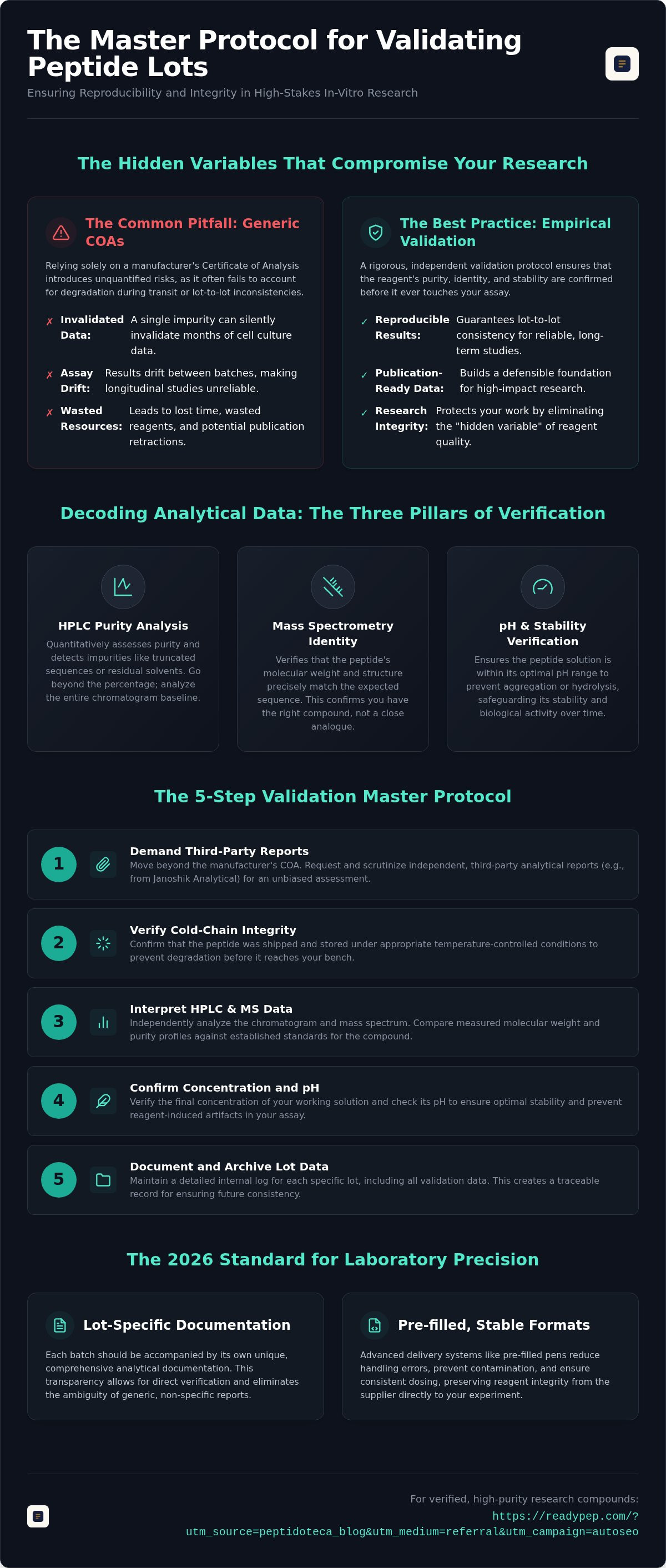
Step-by-Step Protocol for Validating New Reagent Batches
Validating new peptide lots for in-vitro assays is a linear process that begins the moment the shipment arrives. It's a critical checkpoint that prevents unstable reagents from entering your workflow. This protocol ensures that every new batch performs identically to the last, maintaining the integrity of your longitudinal data. Following a standardized sequence of verification steps removes the guesswork from reagent transitions.
- Step 1: Receipt and Cold-Chain Verification. Inspect the package for active temperature indicators. If the thermal sensors show a deviation during transit, the lot's secondary structure may be compromised.
- Step 2: Documentation Review. Cross-reference the lot number printed on the pen barrel with the independent Janoshik analytical reports. Authenticate the digital signature of the report to ensure the data is current and specific to your batch.
- Step 3: The Lot Bridge Assay. Conduct a head-to-head comparison between the expiring lot and the new lot. This empirical test is the only way to confirm functional parity.
- Step 4: Statistical Alignment. Verify that the new lot's signaling responses fall within your laboratory's acceptable variance range, typically less than 5%.
- Step 5: Long-term Storage Protocol. Once validated, transfer the reagents to stabilized storage at -20°C or -80°C. Maintaining a consistent thermal environment post-validation is essential for preventing mid-study degradation.
Precision research requires absolute certainty. You can verify your next lot by sourcing from providers who prioritize analytical transparency and lot-specific verification.
Executing the Lot Bridge Assay
A lot bridge assay involves running the old and new peptide lots in parallel using a standard cell culture model. You must establish clear acceptance criteria before the run. If the new lot shows a deviation of more than 5% in potency or binding affinity, it introduces an unacceptable variable. Identifying red flags early, such as an unexpected increase in baseline cellular toxicity or a shifted dose-response curve, allows you to reject a lot before it invalidates your broader dataset.
Cold-Chain Integrity and Thermal Stability
Thermal excursions are the primary cause of peptide instability. Even brief exposure to ambient temperatures can cause sensitive sequences to unfold or aggregate. Pre-filled research pens offer superior protection for lot integrity compared to traditional lyophilized vials; they reduce the surface area exposed to oxygen and provide a more stable aqueous environment. Ensure your research integrity with ReadyPep’s cold-chain shipped protocols to minimize the risk of transit-induced reagent failure.
ReadyPep Lot Integrity: Ensuring Reagent Consistency in Longitudinal Studies
Longitudinal studies often span years. They require a reagent baseline that remains unwavering from the first day to the final assay. Metatide Healthcare manufacturing is precision-engineered specifically for this level of research consistency. Every lot is independently audited. Janoshik Analytical verifies purity and pH for every batch. This isn't a selective process. It's a mandatory protocol. Validating new peptide lots for in-vitro assays is simplified when the foundational data is provided before the reagent even reaches your lab. Direct distribution from our UK hub ensures a tight chain of custody. Combined with global cold-chain logistics, we eliminate the thermal instability risks common in standard shipping.
The pre-filled pen format also addresses the reagent drift often seen in multi-vial studies. When you draw from a single, stabilized source, you eliminate the concentration fluctuations inherent in repeated freeze-thaw cycles of larger vials. This stability is critical for maintaining a consistent cellular response over months of testing. Our logistics network is built to maintain this integrity from our facility to your bench. Every step is documented. Every lot is verified. This is the new standard for research accountability.
Precision Dosing for In-Vitro Models
Standardized delivery formats are the only way to effectively reduce inter-operator variability. In high-throughput research settings, manual reconstitution is a liability. It introduces pipetting errors and contamination risks. Pre-filled pens solve this problem. They offer a closed system that maintains sterility while providing exact volumetric dosing. This allows researchers to focus on data rather than reagent preparation. For example, using the Repair Protocol or Edge Protocol ensures that your delivery format is as specialized as your research tool. Standardized dosing acts as a constant in your experimental equation.
A Commitment to Radical Transparency
We believe transparency is a prerequisite for scientific progress. Accessing lot-specific data shouldn't be a request; it should be a right. We provide comprehensive analytical reports for every ReadyPep purchase. This commitment supports the global research community by providing verified reagents that stand up to the most rigorous peer review. Validating new peptide lots for in-vitro assays becomes a final confirmation rather than a desperate search for variables. We act as your gatekeeper for quality and data integrity. Secure verified peptide lots for your next assay at ReadyPep.
Securing the Future of Reproducible Research
Reproducibility in the 2026 laboratory environment isn't a matter of chance. It's the result of rigorous, lot-specific verification. By prioritizing empirical data over manufacturer promises, you protect your longitudinal studies from the silent variables of batch inconsistency and thermal degradation. Validating new peptide lots for in-vitro assays ensures that your signaling responses remain consistent, your baselines stay stable, and your publication timelines are never compromised by reagent failure. You've worked too hard to let a single undocumented impurity invalidate months of cellular data.
The standard for modern research demands radical transparency and accountability. This means insisting on independent Janoshik Analytical verification and lot-specific pH and purity documentation for every reagent. When these analytical standards are combined with global cold-chain shipping integrity, the gap between synthesis and application disappears. You can now move forward with the calm assurance that your reagents are as precise as your methodology. Take the final step in safeguarding your data today. Source Verified Peptide Lots for Research Integrity and ensure your next breakthrough is built on a foundation of absolute certainty.
Frequently Asked Questions
What is the standard purity level required for in-vitro peptide assays?
Most in-vitro laboratory research requires a minimum purity of 95% for preliminary screening. However, high-precision signaling assays and longitudinal studies demand 98% or higher to minimize off-target effects. Lower purity grades contain synthesis byproducts like truncated sequences that competitively inhibit receptor binding. Always verify that the purity level matches the sensitivity of your specific cell model to ensure the resulting data is statistically defensible and reproducible across different batches.
How do I read a Janoshik Analytical peptide report for a new lot?
Start by matching the lot number on your reagent with the ID on the report. Locate the HPLC chromatogram and verify that the main peak integration matches the claimed purity percentage. Next, check the Mass Spectrometry data to confirm the experimental mass aligns with the theoretical molecular weight of the peptide sequence. A valid report from Janoshik Analytical will also include a secure QR code for direct digital authentication on their database.
Why does pH testing matter for pre-filled research peptide pens?
pH testing is a critical step in validating new peptide lots for in-vitro assays because it determines the compound's aqueous stability. Peptides in pre-filled pens are already in solution; if the pH drifts outside the optimal range, the peptide may aggregate or undergo rapid hydrolysis. A stable, verified pH ensures that the reagent remains bioactive throughout the duration of your study and prevents unintended baseline toxicity in your cell cultures.
How can I verify if a peptide lot degraded during shipping?
Inspect the active temperature indicators included in your cold-chain shipment for any signs of thermal excursion. If the indicators show exposure to ambient temperatures, the peptide's secondary structure may be compromised. In pre-filled pens, look for changes in solution clarity or the presence of visible precipitates. These physical alterations often indicate that the peptide has unfolded or aggregated during transit, rendering it unsuitable for high-stakes laboratory research.
What is a lot bridge assay, and why is it necessary?
A lot bridge assay is a head-to-head comparison between an existing, validated peptide batch and a newly received lot. This test is necessary to ensure functional parity and prevent assay drift during long-term studies. By running both lots in parallel using the same cell culture model, you can verify that the new reagent produces signaling responses within an acceptable variance range, typically less than 5% deviation from the established baseline.
Can impurities in a 98% pure peptide lot affect cell culture results?
Yes, the remaining 2% of a 98% pure lot consists of impurities that can significantly alter assay noise. These contaminants are often truncated sequences or deletion peptides that structurally mimic the target ligand. They can competitively occupy receptor sites or trigger unintended apoptotic pathways in sensitive cell lines. Even minor purity deviations can skew dose-response curves, making it impossible to isolate the true biological effect of the primary peptide compound.
How should I document peptide lot numbers for scientific publication?
When validating new peptide lots for in-vitro assays, you must record the unique lot number and the third-party verification source in your laboratory notebook. For publication, include these details in the "Materials and Methods" section of your manuscript. Specify the manufacturer, the batch ID, and the date of the independent analytical audit. This level of traceability is now a standard requirement for many top-tier journals to ensure data reproducibility across different institutions.
Why are pre-filled pens preferred over vials for maintaining lot consistency?
Pre-filled pens are preferred because they function as a closed system, significantly reducing the risk of contamination and oxidation. Unlike vials, which require manual reconstitution and repeated pipetting, pens provide standardized volumetric dosing that minimizes inter-operator variability. This format also protects the lot's integrity by limiting exposure to ambient air and light. For researchers prioritizing consistency, sourcing from ReadyPep's verified inventory ensures that reagent handling doesn't become a hidden variable in your research.
Disclaimer
Educational content only. Not medical advice.


