

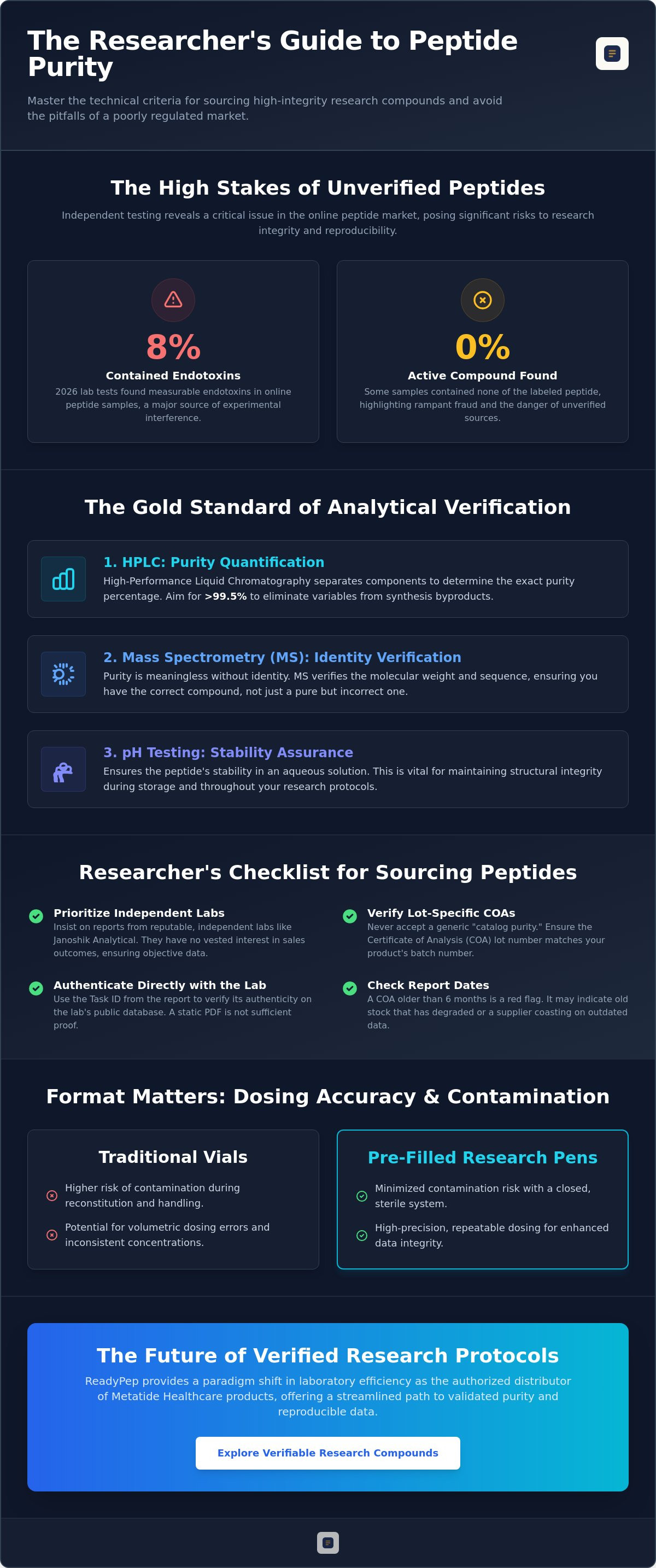
Did you know that 2026 independent lab testing found 8% of online peptide samples contained measurable endotoxins, while some contained none of the labeled compound at all? Finding reliable third-party tested peptides online shouldn't feel like a high-stakes gamble with your research integrity. You already understand that a static, outdated Certificate of Analysis is no longer sufficient for serious in-vitro studies. Fraudulent reports and inconsistent lot quality remain the primary obstacles to reproducible data. It's a precision-killing friction that slows your progress.
This guide prepares you to master the technical criteria for verifying peptide purity. You'll learn why lot-specific, verifiable Janoshik reports are non-negotiable in the current regulatory climate. We'll also explore how to secure high-precision dosing and cold-chain delivery to prevent degradation. By the end of this article, you'll know how to bypass the industry's opacity and source products that meet the highest analytical standards. For researchers who demand this level of empirical verification, exploring ReadyPep's inventory provides a streamlined path to validated purity.
Key Takeaways
- Identify the gold standard for third-party tested peptides online by prioritizing independent labs like Janoshik for empirical verification.
- Master the technical skill of decoding a Certificate of Analysis to cross-reference lot numbers and ensure 2026 purity standards are met.
- Compare the structural integrity of pre-filled research pens against traditional vials to minimize contamination risks and volumetric dosing errors.
- Utilize a professional researcher’s checklist to authenticate every report directly with the laboratory before integrating compounds into your workflow.
- Understand how ReadyPep’s authorized distribution of Metatide Healthcare products provides a paradigm shift in laboratory efficiency and data integrity.
What Defines Legitimate Third-Party Tested Peptides Online?
Legitimate third-party testing isn't a marketing badge. It's a rigorous, external audit of a chemical's molecular profile. For researchers sourcing third-party tested peptides online, this means the vendor has sent a randomized sample from a specific production batch to an independent facility. Laboratories like Janoshik Analytical have become industry benchmarks because they operate without a vested interest in the vendor's sales. They provide raw data, not curated summaries. This independence ensures that the results are objective and free from the bias inherent in manufacturer-provided documentation.
Relying on manufacturer-provided Certificates of Analysis (COAs) is a critical error in high-stakes in-vitro research. Manufacturers often present "catalog purity." This represents a theoretical best-case scenario or a single "golden batch" from years ago. True research integrity requires lot-specific purity. This confirms that the exact vial or pen in your laboratory matches the analytical report. If a supplier cannot provide a report linked to your specific batch number, the data is functionally useless for precision dosing. You need proof of what is in your hands, not what was in the factory last year.
The Gold Standard of Analytical Verification
Analytical chemistry provides the only objective truth in this industry. The primary tool for this is High-performance liquid chromatography (HPLC), which separates components in a mixture to determine the exact purity percentage. However, purity alone doesn't confirm identity. Legitimate testing must include Mass Spectrometry (MS) to verify the sequence and molecular weight of the peptide. Without MS, a 99% pure substance could be the wrong compound entirely. Finally, pH testing ensures aqueous solution stability. This is vital for maintaining peptide structure during your research protocols. For researchers who demand this level of data, exploring verified lab-testing protocols is the first step toward experimental success.
The Risks of Unverified Research Compounds
Inconsistent reagents destroy research. Even a 2% variance in purity can introduce uncontrolled variables in cell culture assays. This leads to skewed results or total experimental failure. The temporal and financial costs are immense. Retracting a study due to contaminated reagents is a professional disaster. Watch for red flags. Suppliers who redact dates on reports or reuse the same COA for multiple years are compromising your work. High-precision sourcing of third-party tested peptides online requires radical transparency. Don't settle for "verified" claims that lack a direct, verifiable link to an independent laboratory's database.
Decoding the Certificate of Analysis (COA)
A Certificate of Analysis (COA) is your primary defense against research failure. When you source third-party tested peptides online, the document shouldn't just exist; it must be current. In 2026, a report older than six months is a red flag. It suggests the vendor is coasting on old data or selling degraded stock. Every Janoshik report contains a unique task ID. Use it. Don't rely on a static PDF that could be altered. Go to the laboratory’s online database and enter the ID. Verify that the lot number on your product matches the official record. If the database entry doesn't exist, the product isn't verified.
Purity levels aren't just vanity metrics. The difference between 98% and 99.5% purity is significant in a controlled environment. A 98% pure sample contains 2% unknown synthesis byproducts. These impurities can interfere with receptor binding or cause cytotoxic effects in cell cultures. High-precision research demands the 99.5% threshold to eliminate these variables. Researchers often find themselves at a legal and ethical crossroads when navigating the 2026 peptide market. Empirical data is the only reliable anchor for compliance and safety. Without it, you're guessing.
Verifying HPLC Chromatograms
HPLC is the primary tool for separating and quantifying peptide components. Look at the chromatogram's main peak. It should be sharp and symmetrical. High baseline noise or secondary peaks indicate residual solvents or truncated sequences. These byproducts are often the result of rushed synthesis or poor purification. If the baseline isn't clean, your data won't be either. Precision requires a clear separation of the target compound from any impurities. Analysis of these peaks tells you exactly what survived the synthesis process.
Mass Spectrometry and Sequence Accuracy
Purity doesn't guarantee identity. Mass Spectrometry (MS) confirms you have the right molecule. Match the "observed mass" on the report to the "theoretical molecular weight" of the peptide. Even a minor discrepancy suggests an incorrect amino acid sequence. This is critical for receptor binding studies where structural accuracy is paramount. A wrong sequence means your research is invalid from the start. Learn more about our lab testing protocols to see how we handle these technical requirements. For those seeking consistency, choosing verifiable research compounds ensures every study starts with a known quantity.
Vials vs. Pre-filled Pens: Accuracy and Contamination
Traditional lyophilized vials are the legacy format of the peptide industry. They demand manual reconstitution, a process that introduces significant human error. Volumetric inaccuracies during mixing can skew concentration by 5% to 10% before the research even begins. For high-precision in-vitro assays, this variance is unacceptable. When you source third-party tested peptides online, the purity on the analytical report only matters if the final concentration in your pipette is accurate. Vials also present multiple-entry risks. Every time a needle pierces the rubber septum, you risk introducing environmental contaminants. Pre-filled research pens solve this. They are closed systems that eliminate the need for external mixing. This streamlined workflow saves time and preserves reagent integrity.
Legal scrutiny in the 2026 market is intensifying. The FDA enforcement on research peptides highlights the necessity for verifiable quality and accurate labeling. Using sealed, pre-filled systems reduces the risk of misbranding or accidental degradation during preparation. These systems represent a shift from "do-it-yourself" chemistry to professional laboratory standards. By removing the reconstitution step, researchers minimize the variables that lead to irreproducible data. This is why many laboratories are moving away from traditional vials in favor of stabilized, pre-measured formats.
Precision Dosing in In-Vitro Models
Precision is the primary advantage of the pen format. Research pens use a click-based delivery system where each "click" translates to a fixed milligram increment. This removes the guesswork from micro-dosing protocols. Manual syringing is prone to "dead space" volume loss, which is difficult to quantify. Pens don't have this issue. For a deeper look at these standards, see our guide on Peptide Pen Quality Control: Ensuring High Purity. This mechanical precision ensures that your dosing remains consistent across every trial.
Stability of Pre-mixed Aqueous Solutions
Stability is often a concern for pre-mixed reagents. Aqueous solutions in pens utilize bacteriostatic preservatives to maintain sterility throughout their use. However, these require strict cold-chain logistics to prevent molecular degradation. While lyophilized powder is stable during standard shipping, it degrades rapidly once reconstituted. Pre-mixed pens from ReadyPep arrive ready for immediate use, ensuring the stabilized liquid maintains its structural integrity. This provides a level of reliability that manual reconstitution simply cannot match. High-quality third-party tested peptides online deserve a delivery system that protects their analytical purity.
Researcher’s Checklist for Sourcing Peptides Online
Sourcing third-party tested peptides online requires an objective framework. Community-vetted lists on social media lack the systematic rigor needed for laboratory standards. You need a verifiable protocol to ensure reagent stability and data validity. A 2026 report found that 8% of online peptide samples contained measurable endotoxins. This statistic underscores the danger of choosing suppliers based on marketing claims rather than empirical proof. Use the following checklist to audit your supply chain before initiating any in-vitro protocols.
- Step 1: Verify the Lot-Specific COA. Demand documentation that matches the batch number on your product. Generic or "catalog" reports don't reflect the purity of the specific unit in your lab.
- Step 2: Authenticate with the Laboratory. Use the task ID on the report to verify results directly on the Janoshik or independent lab database. If the ID doesn't return a match, the report is fraudulent.
- Step 3: Evaluate Shipping Logistics. Confirm if the supplier uses cold-chain or ambient shipping. Aqueous solutions and many lyophilized compounds are thermolabile.
- Step 4: Confirm the Manufacturer. Ensure the supplier is an authorized distributor for established manufacturers like Metatide Healthcare. This provides a clear chain of custody.
- Step 5: Review Documentation for Publication. Ensure the analytical data is comprehensive enough to meet the peer-review standards of major scientific journals.
Evaluating Supplier Transparency
Transparency is a physical business presence and a direct line for technical queries. Does the supplier offer direct contact for complex analytical questions? Peptides must be clearly labeled for in-vitro research only to comply with 2026 standards. If the "About" section is vague or lacks a physical headquarters, the supply chain likely lacks accountability. Reliable providers act as high-standard gatekeepers. They prioritize data over hype.
The Critical Role of Cold-Chain Logistics
Peptide thermolability is a silent research killer. Room temperature transit causes rapid degradation of stabilized liquid formats and can even compromise lyophilized powders over long durations. Research integrity depends on cold-chain logistics. This includes insulated packaging and temperature monitoring during transit. It's the only way to ensure secondary structures remain intact. Explore our range of cold-chain shipped products to see how we maintain these standards. For researchers who demand a secure thermal environment, choosing ReadyPep’s verified supply chain ensures your reagents arrive at peak analytical purity.
ReadyPep: The Future of Verified Research Protocols
ReadyPep operates as the authorized distributor for Metatide Healthcare. We've moved beyond the traditional vendor model to provide a complete analytical ecosystem. Our pre-filled research pens represent a paradigm shift in laboratory efficiency. They eliminate the manual reconstitution errors that compromise so many in-vitro studies. By standardizing the delivery format, we remove the most common source of experimental variance. Protocols like Edge and Lean provide researchers with specialized tools for targeted modeling. We maintain a global reach with worldwide cold-chain shipping originating from the United Kingdom. This ensures that molecular stability is preserved from our facility to your laboratory bench.
The 2026 peptide market is saturated with "research only" labels that lack substance. ReadyPep disrupts this by prioritizing accountability. We don't just promise purity; we prove it with every shipment. Our commitment to radical transparency is a direct response to the inconsistent quality found elsewhere in the industry. We act as a high-standard gatekeeper for the scientific community. When you source third-party tested peptides online through our platform, you're investing in data integrity. It's about removing the friction of uncertainty so you can focus entirely on discovery.
Lot-Specific Documentation for Every Pen
Publication integrity depends on traceable reagents. We ensure every individual pen is linked to a verifiable Janoshik report. This isn't a generic batch check. It's a granular verification process. Every unit has a direct connection to its analytical data. This level of tracking facilitates the rigorous reagent verification required by top-tier scientific journals. For those focused on cellular senescence and metabolic longevity, the Reserve Protocol for longevity studies provides a benchmark in verified purity. We provide the documentation you need for a robust materials and methods section, ensuring your work stands up to the highest level of peer review.
Precision Research Tools
High-intensity assays require specific, high-concentration compounds to maintain protocol consistency. Our Retatrutide 40mg pen provides the exact dosing needed for complex metabolic modeling. It removes the need for multiple smaller doses, which reduces the risk of contamination during repeated entries. For researchers investigating synergistic repair pathways, our BPC-157 + TB-500 40mg stack delivers consistent ratios across every trial. We don't settle for industry norms; we set them through empirical validation. Discover how ReadyPep removes friction from your research workflow by visiting our full product library. It's time to demand more from your supply chain.
Advancing Your Research with Analytical Certainty
The 2026 research landscape demands a departure from the "trust-based" procurement of the past. Success in the lab now depends on a model of radical transparency where every variable is accounted for. You've learned that verifying third-party tested peptides online requires more than a cursory glance at a website. It requires lot-specific Janoshik testing that links directly to the unit on your bench. By prioritizing pre-filled pens over traditional vials, you eliminate the volumetric errors and contamination risks that threaten experimental reproducibility.
Precision is no longer a luxury; it's the standard for publication-grade data. ReadyPep facilitates this transition by providing compounds manufactured by Metatide Healthcare, ensuring a professional chain of custody. Our worldwide cold-chain shipping preserves the structural integrity of every peptide, delivering stabilized solutions ready for immediate in-vitro use. It's time to remove the friction of uncertainty from your workflow.
Secure your research integrity with lot-verified peptide pens at ReadyPep. Elevate your protocols with the analytical certainty your work deserves.
Frequently Asked Questions
How do I know if a peptide third-party test is real?
You verify a report's authenticity by entering the unique Task ID directly into the independent laboratory's online database. Don't rely on static PDF images provided by a vendor, as these can be digitally altered. Legitimate labs like Janoshik Analytical maintain public records specifically to prevent the reuse of old data. If the search doesn't return a match for your specific batch, the documentation isn't valid.
Why is Janoshik Analytical the preferred lab for peptide testing?
Janoshik Analytical is the industry standard because of its specialized focus on the complex analytical requirements of peptides. They utilize high-resolution HPLC and Mass Spectrometry to confirm both purity and sequence identity. Their searchable database provides a level of radical transparency that generic labs don't offer. This independence ensures that researchers receive objective data free from vendor bias.
Do pre-filled peptide pens degrade faster than lyophilized powder?
Pre-filled pens contain stabilized aqueous solutions that maintain integrity when kept within a strict cold-chain environment. While lyophilized powder is stable at ambient temperatures for longer periods, it degrades rapidly once you reconstitute it manually. Pre-mixed formats from ReadyPep utilize bacteriostatic preservatives and refrigerated shipping to ensure the reagent remains viable and ready for immediate laboratory use.
Can I use third-party tested peptides for human use?
No, these compounds are exclusively for in-vitro laboratory research and are never for human or veterinary use. Even when you source third-party tested peptides online with high purity markers, they remain unapproved research chemicals. Using these substances outside of a controlled experimental setting is a violation of safety protocols and can lead to unpredictable biological interactions.
While laboratory reagents are strictly for research, maintaining personal health requires a commitment to purity in the supplements you consume. To understand how to choose all-natural products that support your fitness goals without causing digestive issues, read more about the approach taken by Fantastic Nutrition.
What is the minimum purity required for published research?
High-impact scientific journals typically require a minimum purity threshold of 98% for published data. However, 99% is the preferred standard for precision assays to minimize the impact of unknown synthesis byproducts. These impurities can act as uncontrolled variables, potentially skewing your results. Verifiable analytical reports are a requirement for the "Materials and Methods" section of professional publications.
How does cold-chain shipping affect peptide potency?
Cold-chain shipping is critical for preventing the thermal degradation that compromises peptide potency. Peptides are thermolabile molecules that can lose their secondary structure if exposed to temperatures above 8°C during transit. Temperature-controlled logistics ensure that the molecular profile you receive in your laboratory is identical to the one verified during the initial third-party analytical testing.
What should I do if a lot number doesn’t match the COA?
You should quarantine the compound immediately and request the correct documentation from your supplier. A mismatch between the lot number and the Certificate of Analysis means the purity and sequence identity of that specific batch are unverified. Reliable providers ensure a transparent chain of custody where every unit is directly linked to its corresponding analytical report to prevent experimental error.
Are pre-filled pens more expensive than vials for lab work?
Pre-filled pens offer superior cost-efficiency when you factor in laboratory labor and the reduction of reagent waste. They eliminate the need for manual reconstitution, separate bacteriostatic water, and syringing supplies. By removing the risk of volumetric dosing errors, pens protect the financial investment of your research project and ensure that every micro-dose is delivered with mechanical precision.
Disclaimer
Educational content only. Not medical advice.


