

Choosing a standalone actin-sequestering agent like TB-500 might actually be slowing down your cellular repair assays. Precision research demands more than just isolated compounds; it requires kinetic harmony. You've likely felt the friction of manual reconstitution and the constant worry of reagent variability during critical phases. It’s frustrating when manual dosing protocols introduce contamination risks that compromise your data integrity. We agree that laboratory efficiency shouldn't be sacrificed for chemical complexity. This comparative analysis examines the mechanistic differences and BPC-157 and TB-500 synergistic effects to show how a precision blend optimizes laboratory modeling. You’ll discover how the BPC-157/TB-500 40mg blend addresses complementary repair pathways more effectively than standalone alternatives. We’ll also detail how HPLC and MS verified purity ensures your 2026 research remains beyond reproach. By the end of this guide, you’ll understand how to streamline your workflow while maintaining the highest standards of analytical accuracy.
Key Takeaways
- Differentiate isolated actin-binding from the multi-pathway signaling profiles of blended research reagents.
- Analyze how BPC-157 and TB-500 synergistic effects optimize angiogenesis and cellular migration in in-vitro repair models.
- Replace traditional lyophilized vials with pre-filled pens to eliminate the volumetric risks of manual reconstitution.
- Verify reagent integrity using independent Janoshik Analytical HPLC/MS reports to maintain rigorous laboratory standards.
- Master click-dosing mechanics for precise delivery, ensuring high-standard accountability in precision laboratory modeling.
Comparative Mechanistic Profiles: TB-500 vs. Synergistic Blends
TB-500 is a synthetic 17-amino acid peptide derived from the active region of Thymosin beta-4. It's a low molecular weight molecule designed for high tissue permeability in laboratory models. While TB-500 operates as a focused actin-sequestering agent, the BPC-157 + TB-500 blend functions as a multi-pathway signaling reagent. This distinction is critical for in-vitro research. A standalone peptide offers a narrow window into a single biological process. A blend integrates complementary molecular signals to better simulate the complex environments found in tissue modeling assays.
Precision in research requires selecting the reagent that matches your specific experimental objectives. Whether you're investigating angiogenesis, fibroblast migration, or cell signaling, the kinetic profile of your compound determines the reproducibility of your data. Investigating BPC-157 and TB-500 synergistic effects allows researchers to move beyond isolated observations. It provides a framework for understanding how different signaling molecules cooperate to drive cellular repair and structural remodeling in a controlled environment.
Key Differences in Signaling Pathways
TB-500 functions primarily by regulating the conversion of G-actin to F-actin. This sequestration is the foundation of cellular motility. It allows cells to reorganize their cytoskeleton to move toward a stimulus. BPC-157 utilizes an entirely different pathway. It focuses on the upregulation of growth factor receptors, specifically VEGFR2. This interaction triggers the signaling cascades necessary for new vessel formation. When used together, the blend targets both the internal structural machinery and the external growth signals. This dual-action approach provides a more robust model for regenerative research than either compound could achieve alone.
In-Vitro Assay Suitability
The choice between a standalone reagent and a blend depends on your target cell line. For scratch assays measuring fibroblast migration, TB-500 provides clear data on cytoskeletal dynamics. However, if your research involves endothelial cell tube formation or tenocyte differentiation, the blend's broader signaling profile is often more relevant. The Repair Protocol is designed to facilitate these multi-variable studies. It eliminates the manual variability of combining reagents, allowing for a more streamlined laboratory workflow. Choosing a pre-formulated blend ensures that the ratio of BPC-157 to TB-500 remains consistent across every assay plate.
TB-500 in Isolated Cellular Assays: Understanding Thymosin Beta-4
TB-500 represents the active 17-amino acid sequence of Thymosin Beta-4. Its molecular structure contains specific actin-binding domains that dictate its biological utility in laboratory settings. In vitro, this peptide drives the upregulation of Matrix Metalloproteinases (MMPs). These enzymes are essential for extracellular matrix remodeling. Researchers studying cellular senescence also utilize TB-500 to observe its role in modulating inflammation within aging cell populations. Achieving reproducible data in these sensitive models requires uncompromising lot-specific purity.
Mechanism of Action: Actin Sequestration
The primary function of TB-500 is actin sequestration. It binds to G-actin, or monomeric actin, to prevent its polymerization into F-actin, which is the filamentous form. This process creates a pool of available building blocks for rapid cytoskeletal remodeling. In epithelial cell cultures, this mechanism facilitates accelerated cell migration. This is a foundational observation in wound healing models. High-resolution assays show that without this sequestration, cell motility remains sluggish and disorganized. Such dynamics are critical for understanding how tissues reorganize after physical or chemical disruption.
While these mechanisms provide deep insight into cellular repair, researchers must maintain a strict research-only framework. Regulatory bodies note the BPC-157 Prohibited Substance status for human use, which underscores the importance of keeping these compounds within in-vitro or chemical reference applications. Maintaining this distinction ensures that laboratory findings remain focused on empirical molecular biology rather than non-compliant therapeutic claims.
Limitations of Standalone TB-500 Research
Relying solely on TB-500 creates a narrower investigative focus. While effective for studying actin dynamics, isolated use can lead to signaling pathway saturation. This saturation limits the depth of regenerative data. Concentration management is also more difficult with standalone reagents. Excessive concentrations can lead to off-target effects that skew results. This often necessitates complex titration phases that consume valuable laboratory time.
This is where exploring BPC-157 and TB-500 synergistic effects becomes advantageous. A dual-peptide approach prevents the saturation of a single pathway by distributing the signaling load across multiple growth factor receptors. To ensure these observations are valid, verified reagent integrity is non-negotiable. Utilizing high-purity research materials ensures that your data reflects the compound's performance rather than chemical variability. Consistent, verified purity is the only way to eliminate the noise of reagent inconsistency in precision laboratory modeling.
The BPC-157 + TB-500 Blend: Synergistic Pathways for In-Vitro Repair
Combining specific signaling molecules creates a biochemical environment that a single peptide cannot replicate. The Repair Protocol focuses on the interaction between BPC-157 and TB-500 to simulate complex regenerative environments. In angiogenesis research, BPC-157 acts as a potent modulator of Vascular Endothelial Growth Factor (VEGF). It prepares the environment. It upregulates growth factor receptors. TB-500 then provides the mechanical drive by facilitating actin remodeling. This dual approach ensures that endothelial cells are both signaled to grow and physically capable of migrating to form new vascular structures.
Connective tissue models show enhanced fibroblast proliferation when exposed to both compounds. This isn't just about faster growth. It's about the quality of the extracellular matrix (ECM). Research indicates that BPC-157 and TB-500 synergistic effects lead to more organized collagen deposition. Isolated peptides often yield disorganized cellular patterns. The blend provides the necessary checks and balances for structured tissue modeling. Maintaining this synergy requires high stability in aqueous environments. The BPC-157 + TB-500 40mg pen utilizes advanced manufacturing standards to ensure molecular integrity remains consistent across multiple click-doses.
Complementary Regenerative Mechanisms
BPC-157 functions as a biological stabilizer. It enhances the cellular response to endogenous growth factors. This creates a receptive environment for repair. TB-500 serves as the primary driver of physical translocation. It allows cells to move rapidly across the assay surface. This combination directly impacts collagen synthesis. When BPC-157 stabilizes the signaling environment, the actin-driven movement of TB-500 becomes more efficient. This results in a more accurate representation of in-vivo repair processes within a controlled in-vitro setting.
Optimizing the 40mg Research Ratio
The specific ratio in the 40mg pen isn't arbitrary. It's engineered to achieve balanced signaling across diverse multi-cell culture environments. Improper ratios can lead to pathway dominance. This occurs when one signal overwhelms the other, masking the BPC-157 and TB-500 synergistic effects you’re trying to observe. A pre-mixed reagent eliminates the variables inherent in manual laboratory workflows. You don't have to worry about pipetting errors or concentration shifts. Every click delivers a precise, verified ratio. This streamlined approach allows researchers to focus on data acquisition rather than the logistics of compound preparation.
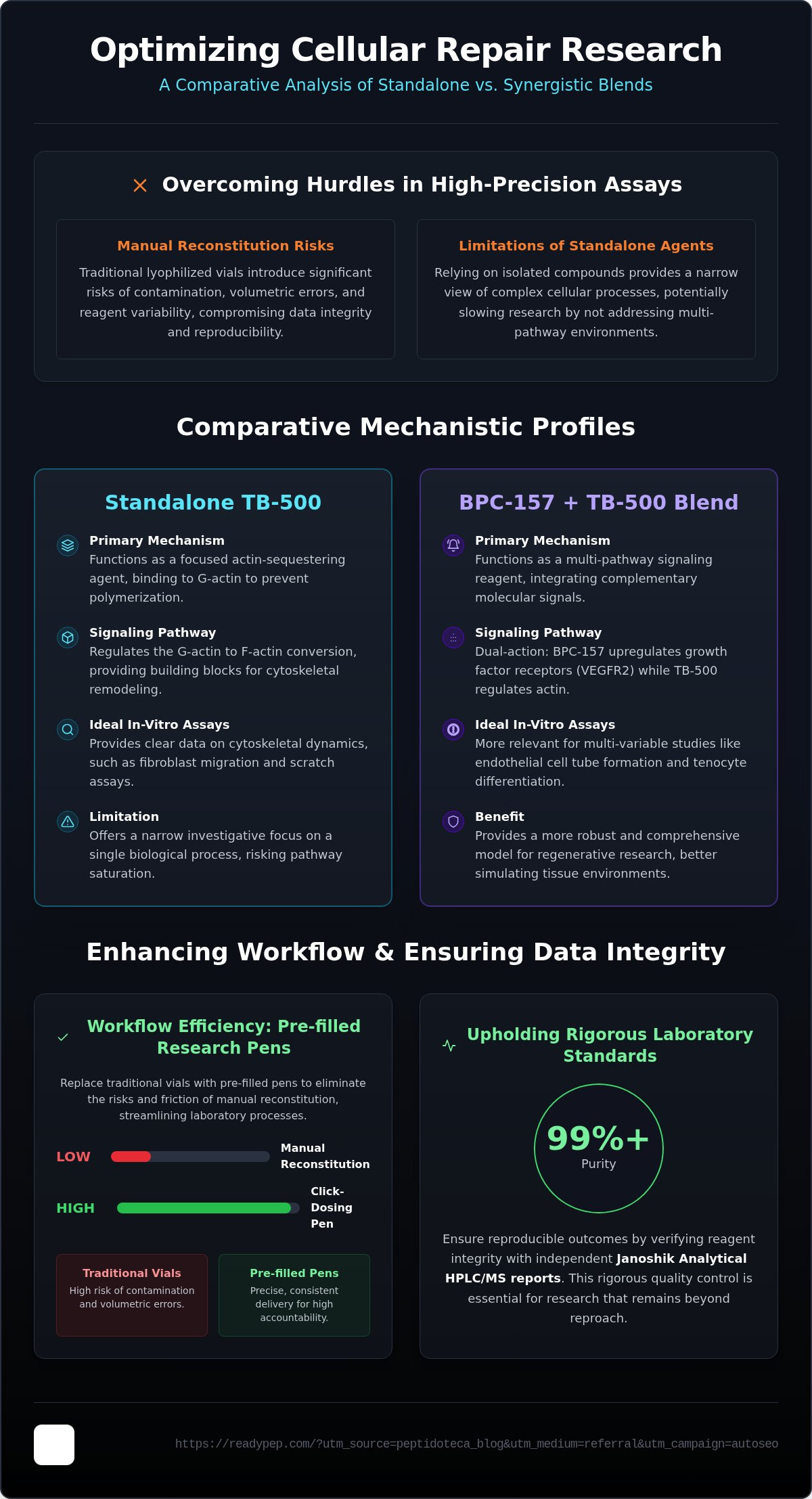
Workflow Efficiency: Dosing Precision in Pre-filled Research Pens
Lyophilized vials are a legacy format. They demand manual reconstitution, which is time-consuming and prone to volumetric error. Modern laboratory modeling has shifted toward pre-filled research pens to ensure clinical-grade accuracy. By removing the need for external titration, you eliminate the most common source of contamination. Manual handling increases the surface area for microbial exposure. Pre-filled pens are manufactured by Metatide Healthcare under strict standards to minimize these variables. It’s a transition from high-friction preparation to streamlined action.
Click-dosing precision is the primary driver of this transition. Manual math and pipetting drift can compromise the integrity of your results. Standardized delivery is especially critical when investigating BPC-157 and TB-500 synergistic effects. If the concentration of one peptide varies even slightly, the observed synergy becomes an artifact of dosing error rather than biological interaction. You need a reliable, fixed-ratio delivery system to isolate the molecular variables that actually matter.
Comparing Pens vs. Traditional Syringes
Traditional syringes often struggle with the micro-volumes required for high-throughput assays. Clumsy handling leads to waste and data noise. Pre-filled pens allow for rapid, incremental dosing that is repeatable across hundreds of plates. Improving lab workflow with pre-filled pens significantly reduces the hours spent on benchtop logistics. This efficiency isn't just about speed; it's about the accountability of your experimental design.
Storage and Stability Protocols
Maintaining peptide bioactivity requires strict adherence to cold-chain integrity. ReadyPep provides free cold-chain worldwide shipping to ensure that compounds arrive without thermal degradation. Once in the lab, these pens should be stored in optimal temperature ranges to prevent denaturation. Aqueous solutions are more sensitive to light and heat than their lyophilized counterparts. It's vital to use dark storage and precise refrigeration to maintain the molecular structure. Monitoring pH levels is also essential for ensuring the BPC-157 and TB-500 synergistic effects remain potent throughout the study. Every batch is tested by Janoshik Analytical, providing the HPLC and MS data necessary for publication-ready research.
For researchers who value precision and data integrity, selecting verified research pens is the most direct path to reproducible outcomes.
Selecting High-Purity Reagents for Reproducible Research Outcomes
Reproducibility is the benchmark of scientific validity. In 2026, the global peptide therapeutics market is projected to reach $59.92 billion according to industry reports; yet, reagent variability remains a persistent challenge for in-vitro laboratories. Relying on unverified sources introduces noise into your data. Independent third-party verification, such as testing by Janoshik Analytical, provides the empirical proof required for high-standard research. You need to know that your BPC-157 and TB-500 synergistic effects are the result of high-purity compounds rather than unknown contaminants or degraded molecules.
Interpreting analytical reports is a critical skill for the modern researcher. Documented lot numbers allow for precise tracking across different assay cycles, ensuring that every plate in your study remains consistent. You should look for two primary verification markers:
- High-Performance Liquid Chromatography (HPLC): This confirms the purity percentage and ensures the absence of related substances that could skew cellular responses.
- Mass Spectrometry (MS): This verifies the molecular weight, proving the identity of the peptide matches the intended sequence.
Avoiding grey market reagents is essential for maintaining radical transparency. Without these standards, your research lacks a foundation of accountability. If your study requires a multi-pathway signaling approach, the Repair Protocol offers a verified, pre-mixed solution that eliminates manual formulation risks. It’s a streamlined choice for laboratories prioritizing precision over price-point compromises.
Research Integrity and Publication Standards
Scientific journals increasingly demand specific reagent sourcing details. You must cite purity levels and manufacturer standards to meet 2026 publication benchmarks. Impurities don't just skew results; they can trigger off-target cellular responses that invalidate an entire assay. Following research peptide quality standards ensures that your findings are robust enough for peer review. Precision is the only way to move from observation to conclusion without the interference of chemical artifacts.
Sourcing from Verified UK Distributors
ReadyPep operates as a transparent expert in the field, distributing Metatide Healthcare products designed specifically for laboratory use. We prioritize radical transparency over industry hyperbole. Our worldwide cold-chain shipping maintains reagent stability from the production line to your benchtop. This commitment to quality ensures that the BPC-157 and TB-500 synergistic effects observed in your models are authentic and reproducible. Don't let logistical friction compromise your scientific integrity. It’s time to secure high-purity research pens for your next study and experience the efficiency of professional-grade tools.
Advancing Precision in Regenerative Research
High-standard laboratory modeling requires more than just high-purity compounds. It demands the removal of preparation friction and the empirical verification of molecular synergy. We've analyzed how isolated actin-binding differs from the multi-pathway signaling of the BPC-157/TB-500 blend. You understand that reproducible data depends on eliminating manual dosing errors and verifying every lot via Janoshik Analytical testing. Utilizing Metatide Healthcare manufacturing standards ensures your research remains compliant and authoritative. Investigating BPC-157 and TB-500 synergistic effects provides a more robust framework for tissue repair studies than standalone reagents. ReadyPep supports these objectives with free cold-chain worldwide shipping to maintain bioactivity from our facility to your benchtop. It's time to move beyond the limitations of legacy lyophilized vials. You can optimize your laboratory workflow with pre-filled research pens at ReadyPep today. Your commitment to precision deserves reagents that match your high standards.
Frequently Asked Questions
Is TB-500 the same as Thymosin Beta-4 in research applications?
TB-500 is a synthetic peptide representing the active 17-amino acid fragment of the full-length 43-amino acid Thymosin Beta-4 protein. In research assays, TB-500 is often preferred due to its lower molecular weight and higher tissue permeability. While they share biological activities like actin sequestration, TB-500 is specifically engineered for laboratory modeling where the full protein structure isn't required to trigger the desired signaling pathways.
Can BPC-157 and TB-500 be studied separately in the same assay?
Researchers can study these compounds independently within the same experimental framework to establish baseline data. However, analyzing BPC-157 and TB-500 synergistic effects usually requires a simultaneous application to observe how multi-pathway signaling alters cellular behavior. Using pre-filled pens with fixed ratios ensures that the concentration of each peptide remains constant across all assay wells; this is nearly impossible to replicate with manual pipetting from separate vials.
What is the stability of the BPC-157 + TB-500 blend in a pre-filled pen?
The BPC-157 + TB-500 40mg blend is highly stable in its aqueous format when maintained under proper cold-chain conditions. ReadyPep utilizes Metatide Healthcare manufacturing standards to ensure the molecular integrity of the compounds. The pre-filled pen format protects the solution from light exposure and oxidation, which are common degradation factors in traditional vials. Each lot undergoes pH verification to ensure the biochemical environment remains optimal for long-term bioactivity.
How do I calculate the exact dosage per click for a 40mg research pen?
Calculating the dosage per click depends on the specific volume and concentration of the 40mg research pen. Each pen is engineered for precision, delivering a standardized micro-volume with every dial turn. You should refer to the specific lot documentation provided with your order for the exact milligram-to-click ratio. This system eliminates the manual calculation errors associated with reconstituting lyophilized powders, allowing for reproducible dosing in high-throughput in-vitro assays.
Why is third-party testing (Janoshik) critical for TB-500 research?
Third-party verification by Janoshik Analytical is the only way to guarantee reagent purity and identity. Grey market peptides often contain manufacturing byproducts or incorrect sequences that skew experimental results. By providing HPLC and Mass Spectrometry reports for every lot, ReadyPep ensures that your data reflects the compound's actual performance. This radical transparency is essential for meeting 2026 publication standards and maintaining the scientific integrity of your laboratory modeling.
What are the storage requirements for pre-filled peptide pens in a lab?
Pre-filled peptide pens must be stored under refrigeration, ideally between 2°C and 8°C. They should be kept in dark storage to prevent UV-induced peptide denaturation. For long-term stability, avoid frequent temperature fluctuations and ensure the pen cap is securely replaced after every use to maintain an aseptic environment. ReadyPep facilitates this by providing free cold-chain worldwide shipping, ensuring your reagents arrive at the correct temperature for immediate laboratory use.
Are these peptides intended for human or veterinary use?
No, these peptides are strictly intended for in-vitro laboratory research and are not for human or veterinary use. ReadyPep supplies these compounds as chemical reference materials for qualified scientific personnel only. Any application outside of a controlled laboratory setting is non-compliant with the product's intended research-only designation. Maintaining this distinction is critical for laboratory safety and regulatory compliance within the scientific community.
How does the BPC-157/TB-500 synergy affect fibroblast proliferation?
The synergy between these compounds significantly enhances the organization and rate of fibroblast proliferation in connective tissue models. BPC-157 stabilizes the signaling environment and upregulates growth factor receptors, while TB-500 drives the physical actin remodeling required for cell migration. This dual-action approach results in more structured collagen synthesis compared to isolated peptide assays. Observing these BPC-157 and TB-500 synergistic effects provides a more accurate representation of complex tissue repair processes.
Disclaimer
Educational content only. Not medical advice.


