

What does the evidence on tesamorelin establish, and what can a research-material label tell you? Clinical findings and laboratory claims can look interchangeable online, but they answer different questions. The tesamorelin peptide is a synthetic growth hormone-releasing hormone analogue. Research-grade material and an approved medicine belong to different contexts.
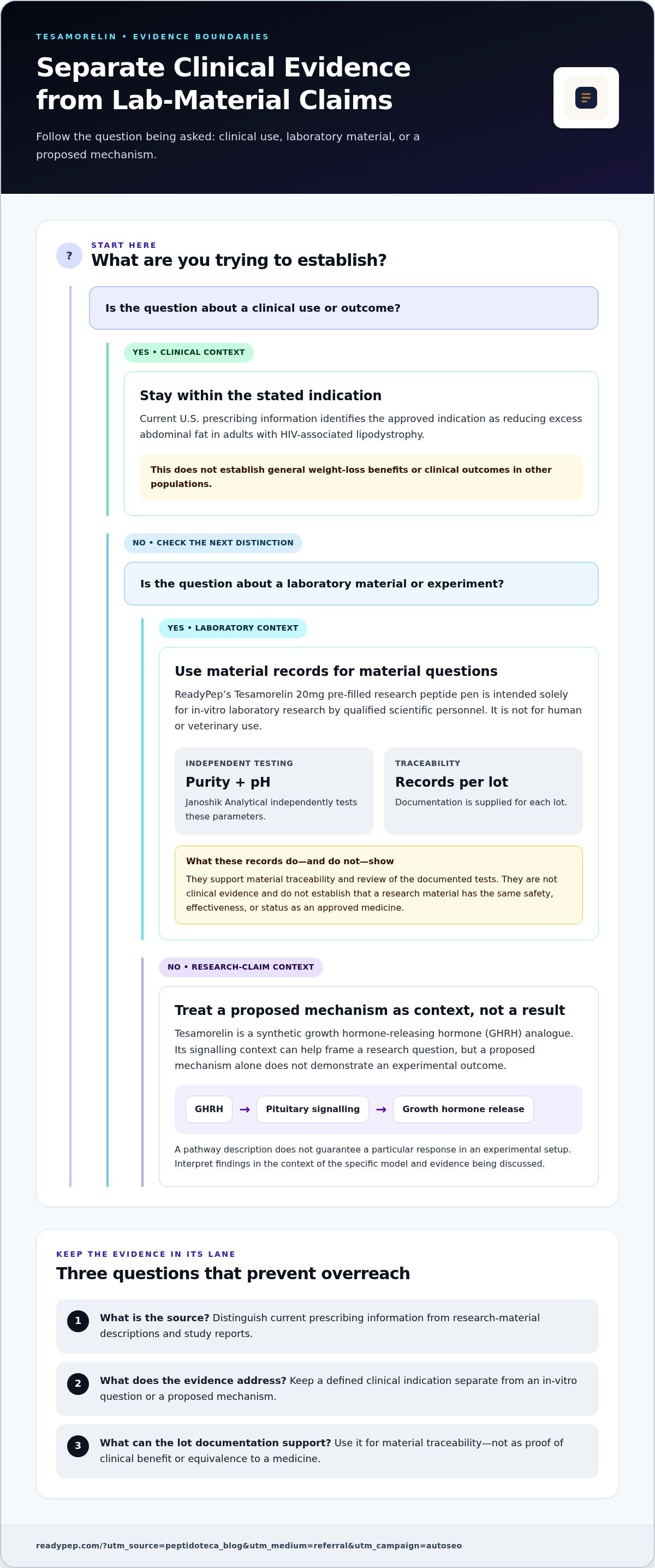
Clinical information concerns specific formulations studied and approved for a limited indication: reducing excess abdominal fat in adults with HIV-associated lipodystrophy. It doesn’t establish general weight-loss benefits or prove that research materials have the same safety, effectiveness, or status. Keeping these distinctions clear matters when interpreting studies or assessing materials for laboratory work.
This article explains tesamorelin’s identity, separates clinical evidence from in-vitro research, and outlines how purity and pH results and lot-level documentation support material traceability. ReadyPep’s Tesamorelin 20mg pre-filled research peptide pen is intended solely for in-vitro laboratory research by qualified scientific personnel, not for human or veterinary use. Janoshik Analytical independently tests its purity and pH, and documentation is supplied per lot. Use these records to evaluate research context and material traceability, not as clinical evidence.
Key Takeaways
- Understand how the tesamorelin peptide is discussed in research, and why a proposed mechanism shouldn’t be mistaken for evidence of an outcome.
- Compare clinical and laboratory contexts by intended purpose, evidence type, and the records that support each.
- Use a consistent procurement and recordkeeping sequence to connect study requirements with the material lot used in an experiment.
- Learn what batch-specific documentation can establish, and where its evidentiary limits remain.
What Is Tesamorelin Peptide? Identity, Clinical Context, and Research Boundaries
Tesamorelin is a synthetic analogue of growth hormone-releasing hormone (GHRH), a signalling molecule involved in regulating growth hormone release. The name identifies a peptide compound, not a particular medicine, research formulation, or proven outcome. A prescription product and a laboratory research material may share the compound name while differing in purpose and evidence.
In the United States, current prescribing information identifies the approved medical indication as reducing excess abdominal fat in adults with HIV-associated lipodystrophy. It is not indicated for general weight-loss management. For a concise background overview, see Tesamorelin’s identity and clinical context. Product-specific medical decisions depend on current official prescribing information, not a general reference or research-material description.
How Is Tesamorelin Related to Growth Hormone-Releasing Hormone?
GHRH is produced in the hypothalamus, a brain region involved in coordinating hormone signalling. It acts on the pituitary gland, which can then release growth hormone. Tesamorelin is designed to engage this signalling pathway as a synthetic GHRH analogue. That mechanism provides biological context; it does not guarantee a particular result in an experimental setup.
For researchers, this distinction helps frame a testable question, such as whether a signalling pathway changes under defined laboratory conditions. A proposed mechanism cannot replace controls, validated measurements, or study-specific evidence. An observation in one model or assay also shouldn’t be presented as proof of clinical benefit or as evidence that another experimental system will respond the same way.
Why Clinical Use and Laboratory Research Must Stay Distinct
Prescription medicines are evaluated and labelled for defined clinical uses. Research materials are described in terms of their suitability for laboratory investigation and the records available to identify and trace them. Clinical evidence for an approved medicine does not establish the identity, quality, safety, effectiveness, or intended use of a separately supplied research material.
This distinction applies to ReadyPep’s Tesamorelin 20mg research peptide pen. It is exclusively for in-vitro laboratory research by qualified scientific personnel. It is not a prescription medicine and is not for human or veterinary use. Neither its format nor its compound name is evidence of suitability for administration.
Keeping these contexts separate makes research interpretation more precise. When reviewing a paper, identify whether its evidence comes from clinical use or a particular laboratory model. When documenting a material for an experiment, rely on the relevant lot records and study documentation rather than applying conclusions from a medical label. The compound’s identity provides context, but it does not erase the difference between clinical evidence and in-vitro investigation.
How Tesamorelin’s Signalling Context Is Discussed in Research
Mechanistic descriptions explain why a compound might be relevant to a research question. They don’t show what happened in a particular experiment. Tesamorelin’s relationship to growth hormone signalling offers biological context, but a pathway diagram or plausible rationale is not an experimental result. To assess a claim, examine evidence from the specific model and conditions being discussed.
What Mechanistic Language Can and Cannot Tell Researchers
In the hypothalamus-pituitary pathway, growth hormone-releasing hormone (GHRH) signals the pituitary to release growth hormone. Tesamorelin, a synthetic GHRH analogue, is discussed in relation to this signalling context. The clinical mechanism described in prescribing information can help orient a research question, but it doesn’t establish that a chosen experimental system will show a particular response.
Mechanism alone cannot establish an experimental outcome. A claim that the tesamorelin peptide “activates a pathway” needs more precision: which pathway component was measured, in what model, and according to which source? Look for the original study, its stated endpoint, and the distinction between measured results and the authors’ interpretation. If a source only proposes a mechanism, describe it as a rationale or hypothesis, not a demonstrated finding.
Reading Evidence Without Overextending Clinical Findings
Clinical-label evidence and laboratory research answer different questions. Current US prescribing information describes tesamorelin’s approved indication as reducing excess abdominal fat in adults with HIV-associated lipodystrophy. That label context does not establish effects in unrelated populations, other clinical conditions, or in-vitro models. A result in one setting cannot be carried into another without direct evidence.
When assessing a research claim, separate what is established from what remains under investigation:
- Clinical label: Identify the precise population and indication covered by current prescribing information. Don’t broaden it into a general claim about weight loss or other groups.
- Study question: Check whether a paper reports an experiment, proposes a hypothesis, or reviews previous findings. These are different levels of evidence.
- Model and endpoint: Note what system was studied and what outcome was measured. Don’t treat a result from one model as a prediction for another.
- Claim and source: Verify statements about mechanisms, populations, or outcomes against the cited paper or authoritative label. If a source doesn’t support the wording, narrow the claim.
This discipline keeps scientific language proportionate to the evidence. An observation in a defined model may support a statement about that observation, but it does not, by itself, establish a clinical benefit. Likewise, a clinical finding should not be presented as proof of an in-vitro result the study did not test.
For qualified scientific personnel planning in-vitro work, ReadyPep’s product and lot information can help with material identification and procurement review. Explore ReadyPep’s research materials with the distinction between pathway rationale and experimental evidence in view.
Tesamorelin Medical Products vs. Research Materials: Compare the Evidence and Purpose
A medicine and a laboratory research material can share the name tesamorelin without sharing the same purpose, evidence base, or documentation. The label “tesamorelin peptide” identifies a compound, but it doesn’t establish that separate products are interchangeable or support the same conclusions. Compare the categories directly:
| Comparison point | Prescription medicine | Research material |
|---|---|---|
| Intended context | Clinical use for the indication stated in current prescribing information. | Laboratory research, with intended use defined by the supplier’s material description. |
| Oversight | Subject to medicine-specific approval and prescribing information in the relevant jurisdiction. | Evaluated through its research-material description and supporting product records, not as an approved medicine. |
| Evidence type | Clinical evidence and product-specific label claims. | Material identity and quality records; experimental findings depend on the specific study. |
| Documentation | Prescribing information and medicine-specific records. | Supplier and batch documentation relevant to the material supplied. |
Which Claims Belong to Prescription-Medicine Information?
For a clinical claim, consult current authoritative prescribing information for the specific medicine and jurisdiction. In the United States, FDA-approved tesamorelin medicine labeling describes a limited indication involving excess abdominal fat in adults with HIV-associated lipodystrophy. That statement belongs to the labelled medicine. It is not advice for laboratory work and does not establish an outcome for a research material.
Indications, warnings, and formulation details can vary or change. Verify them against the current label before publication or clinical interpretation. Don’t transfer a medicine’s precautions or claims to a separate research product as if their documentation and status were identical.
What Should a Research-Material Description Establish?
A useful description should state the material’s research-only purpose and identify the documentation supplied for the relevant lot. If a supplier reports independent testing, interpret it as a statement about the tested material and reported results, not as a guarantee that an experiment will perform as expected. Purity claims are product-specific; one product’s result cannot be assumed to apply to another.
A shared compound name does not establish product equivalence. Distinguish the identity claim from the records supporting the material in hand. Lot-specific documentation can connect a material to laboratory records, while experimental performance still depends on the study and its evidence.
ReadyPep’s Tesamorelin 20mg research peptide pen is supplied solely for in-vitro laboratory research by qualified scientific personnel, not for human or veterinary use. For researchers comparing research-material descriptions with their procurement needs, the Tesamorelin 20mg research pen is ReadyPep’s tesamorelin offering.
How to Evaluate Tesamorelin Research Material and Preserve Lot Traceability
Traceability starts with a clear link between the material selected for a study and the material recorded in its results. Before procurement, define the study’s requirements and the information your laboratory needs to retain. A consistent process helps teams identify the material associated with an experiment during review or when comparing records across studies.
A Practical Procurement Sequence
- Define study requirements. Identify the material and supporting information relevant to the planned in-vitro work.
- Review the available records. Compare product information with your requirements, and separate documented details from assumptions.
- Log the received material. Record its product identifier, lot reference, and receipt date in your laboratory’s materials system.
- Retain the records. Keep procurement documents connected to the related study records so they can be retrieved together.
What to Record for Research Material Traceability
At receipt, link the product identifier and lot reference with the date received. Store the accompanying records where they can be accessed alongside the relevant laboratory documentation. This creates a practical trail from procurement to experimental records and helps distinguish the material associated with one study from materials received at another time.
Keep the original documents accessible and label internal files clearly. For storage and handling, follow the product documentation and established laboratory procedures. Don’t fill gaps with assumed conditions or generic recommendations.
How Independent Testing Supports Documentation
Analytical information can help researchers assess material characteristics within the scope of the reported results. It cannot guarantee experimental performance or predict what a study will find. Interpret each result according to what the record actually reports, and don’t extend it to claims it doesn’t establish.
ReadyPep’s Tesamorelin 20mg research peptide pen is independently tested by Janoshik Analytical for purity and pH, with documentation supplied per lot. Use the lot-specific records in procurement review and connect them to your own study documentation.
Researchers assessing materials for in-vitro work can review ReadyPep’s research peptide materials as part of a traceable procurement process.
ReadyPep Tesamorelin 20mg: A Documented Option for In-Vitro Research
For laboratory procurement, a product description should make its identity and intended context clear. ReadyPep supplies a Tesamorelin 20mg pre-filled research peptide pen manufactured by Metatide Healthcare. The pre-filled pen is a research-material format, not a prescription medicine or therapeutic product. Its stated purpose helps qualified research teams assess whether it fits their laboratory procurement needs.
What the ReadyPep Product Information Establishes
The product is intended exclusively for qualified scientific personnel conducting in-vitro laboratory research. It is not for human or veterinary use. This boundary is central to interpreting the offering: neither the compound name nor its format implies clinical approval or suitability for administration.
Manufacturer information adds context when recording a material for a study. Teams can connect the named product and manufacturer with procurement records, then keep those details alongside internal study documentation. This supports clear identification without implying that manufacturer details predict an experimental result.
ReadyPep offers free cold-chain shipping worldwide from the United Kingdom. This describes the shipping option and origin; it doesn’t establish experimental performance or replace the laboratory’s own procedures for handling received materials.
Where to Review Tesamorelin Product and Testing Details
Researchers can review the Tesamorelin 20mg research pen and its independent laboratory testing details as part of a procurement assessment. Use the product information to identify the offering, and interpret testing information within the scope of what it reports, not as a claim about clinical effects or a guaranteed experimental result.
Choosing research material is one part of a well-documented study. Align the product information with your laboratory’s requirements and recordkeeping process. Review ReadyPep’s Tesamorelin research offering in that context.
Make Your Next Research Decision Traceable
A strong research workflow starts with a clear question: what evidence would address the hypothesis, and what records will make the work interpretable later? Connect that question to material selection and study documentation. The tesamorelin peptide name alone can’t answer it; careful distinctions between a research claim, a measured result, and a documented material can.
For your next procurement decision, align product information with your study requirements and laboratory recordkeeping process. ReadyPep’s Tesamorelin 20mg research offering is intended exclusively for qualified personnel conducting in-vitro laboratory research, not for human or veterinary use. Review its product and lot details in that context, then decide whether they fit your research needs.
Review ReadyPep’s documented Tesamorelin 20mg research offering and take your next step with a clear, evidence-led approach.
Frequently Asked Questions
What is tesamorelin peptide?
Tesamorelin peptide refers to the synthetic compound related to growth hormone-releasing hormone; the phrase alone doesn’t identify a specific formulation or product. For research interpretation, distinguish the compound’s name from the material’s format, intended use, and supporting evidence. Those details show whether a source is discussing a prescription medicine, a laboratory material, or a study hypothesis.
Is tesamorelin FDA-approved?
Yes. The FDA has approved tesamorelin medicines for reducing excess abdominal fat in adults with HIV-associated lipodystrophy, not for general weight-loss management. Approval applies to specific medical products and their labelled indication, not automatically to research materials that share the compound name. For current formulation details, warnings, and indication wording, consult the latest FDA-approved prescribing information rather than relying on a general summary.
How does tesamorelin work?
Tesamorelin acts as an analogue of growth hormone-releasing hormone, signalling the pituitary gland to release the body’s own growth hormone. This differs from directly administering growth hormone. The pathway provides biological context for research, but it doesn’t predict a particular effect in a given model. To interpret a claim, check what the cited study actually measured and in which setting.
What is tesamorelin used for in research?
In laboratory research, tesamorelin may be studied in relation to growth-hormone signalling and questions defined by an individual experiment. There isn’t one universal research purpose or outcome that applies to every study. Read the paper’s stated aims and results separately: a proposed pathway may explain why a question is being investigated, while only data from that study can support its reported observations.
What is the usual tesamorelin dose?
There isn’t a dose to apply to ReadyPep research materials. They’re intended only for in-vitro laboratory research by qualified scientific personnel, not for human or veterinary use. For a prescription medicine, dosing depends on the specific formulation and current prescribing information. Tesamorelin medical formulations may differ in dosage and handling, so don’t use a research-product description as a basis for medical decisions or administration.
What side effects are associated with tesamorelin?
Clinical trials reported injection-site reactions, joint pain, pain in the extremities, muscle pain, and peripheral edema among common adverse events. The FDA prescribing information reports rates of 17%, 16%, 6%, 6%, and 6%, respectively. These figures concern patients receiving medical products in clinical studies; they don’t establish the risks of a research material or predict outcomes in laboratory experiments.
How can researchers assess tesamorelin research material?
Set study-specific acceptance criteria before procurement, then match the received product identifier and lot to its accompanying records. Review what the documentation reports, note any gaps against your criteria, and connect the material record to the samples and results generated in the study. ReadyPep’s Tesamorelin 20mg research pen is for in-vitro research only.
Disclaimer
Educational content only. Not medical advice.


